1973 CL350 Restore - First Timer!

Lost_Cause said:

About The vht self etch primer ...

Does it contain ceramic?

One of the reasons people like the crud cutter metal Etch (which is what I used) is it allows you to use a non etching primer with ceramic in it so that it will dissipate Heat in the high temperatures.

Was the primer designed for engine temperatures?

Sent from my SM-G930V using Tapatalk
 
I linked the exact product I used below. I read a lot of guys use self-etch primer, like Tony (Saturday’s Wrench), so I went for it.

https://www.amazon.com/ask/questions/asin/B003BGYRPO/ref=ask_mdp_dpmw_ql_hza?isAnswered=true

I checked the amazon questions and someone said it is intended for normal auto body temps, not headers or manifolds. But a lot of people with experience with it said they used it on motorcycle engines and it’s held up for years.

VHT also makes this engine enamel primer with ceramic. Should I be using that when I paint the jugs and head?

https://m.autozone.com/paint-and-bo...mer-high-temperature-engine-enamel/464933_0_0

I know you got great results with Krud Kutter! I’m jealous! I used it double-strength, like you did, but it didn’t bubble or react at all. It just sat there on the parts for 10 min and then rinsed off leaving white discoloration behind. I’m not sure what happened...
 
Now THAT's a picture for the single guy! (Chris, you seeing this??) :lol:

(okay, since Mike beat me to the punch and my comment is no longer under the picture in question, the one of the painted engine parts sitting in his living room)
 
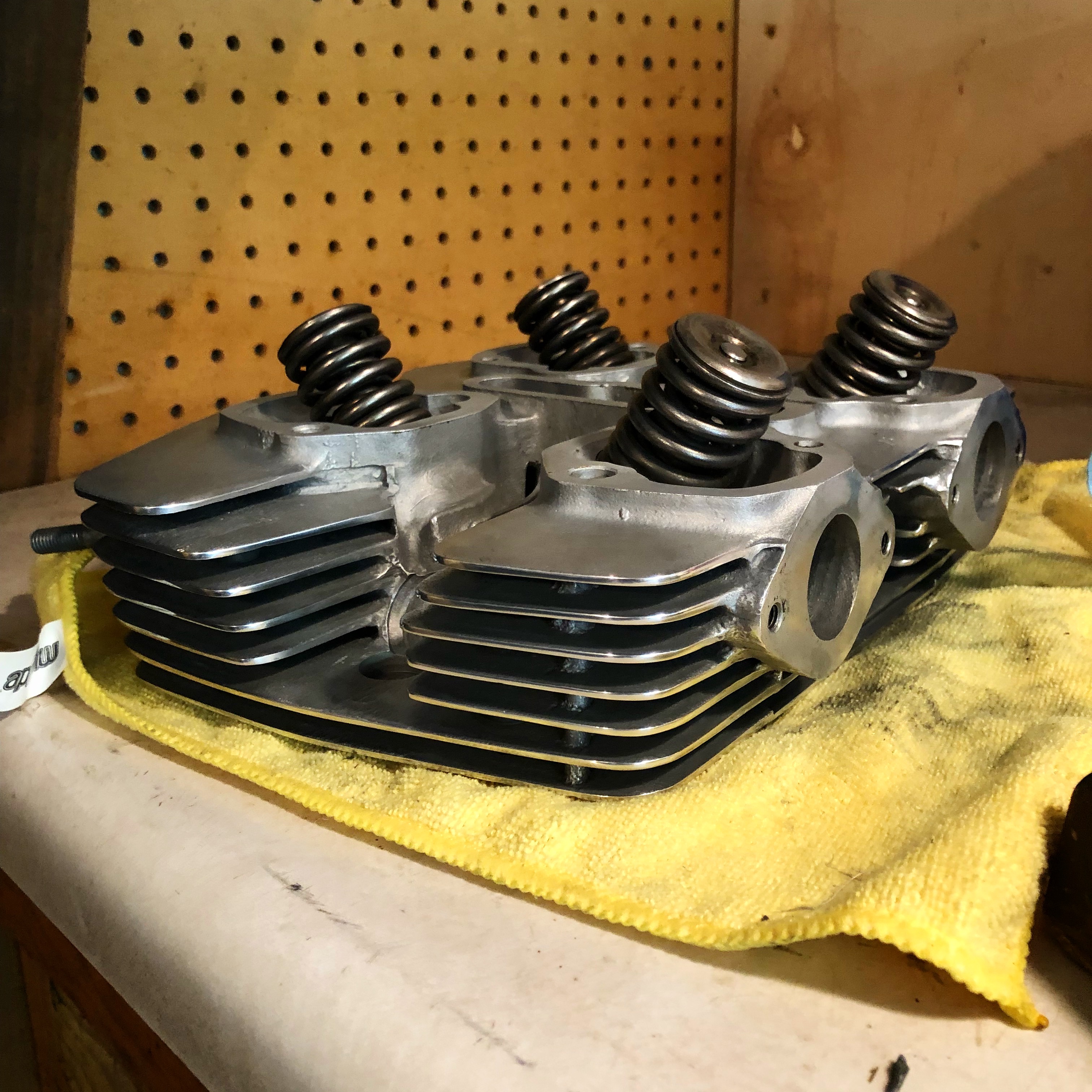
Here is how I polished my cooling fins, but I wrote a much better and more professional version of this process is over on Return of the Cafe Racers.

https://www.returnofthecaferacers.com/building-a-cafe-racer/how-to-polish-aluminum/

So you want to paint your engine matte black but visions a colorless turd in the center of your bike are staying your paint-spraying hand. To add 10 horsepower and leave your kickstart-only friends in the dust, I’ll show you how to give it some detail—in the form of polished cooling fins on the cylinder head.

Polishing your fins is a lot of effort, but combined with new stainless-steel hardware and exhaust flanges, your block will turn heads at every café. I extensively researched how to do this, and here’s the process I followed. That being said, I’m not an expert and suggestions are welcome.

If you look at your grubby old aluminum under a microscope, the surface would look like a jagged mountain range. Light refracts off of the saw-toothed surface, giving off a dull appearance. By repeated abrasion, we can turn these aggressive peaks into nice rolling hills, causing light to reflect directly into the eyes of hipsters everywhere.

You’ll need:
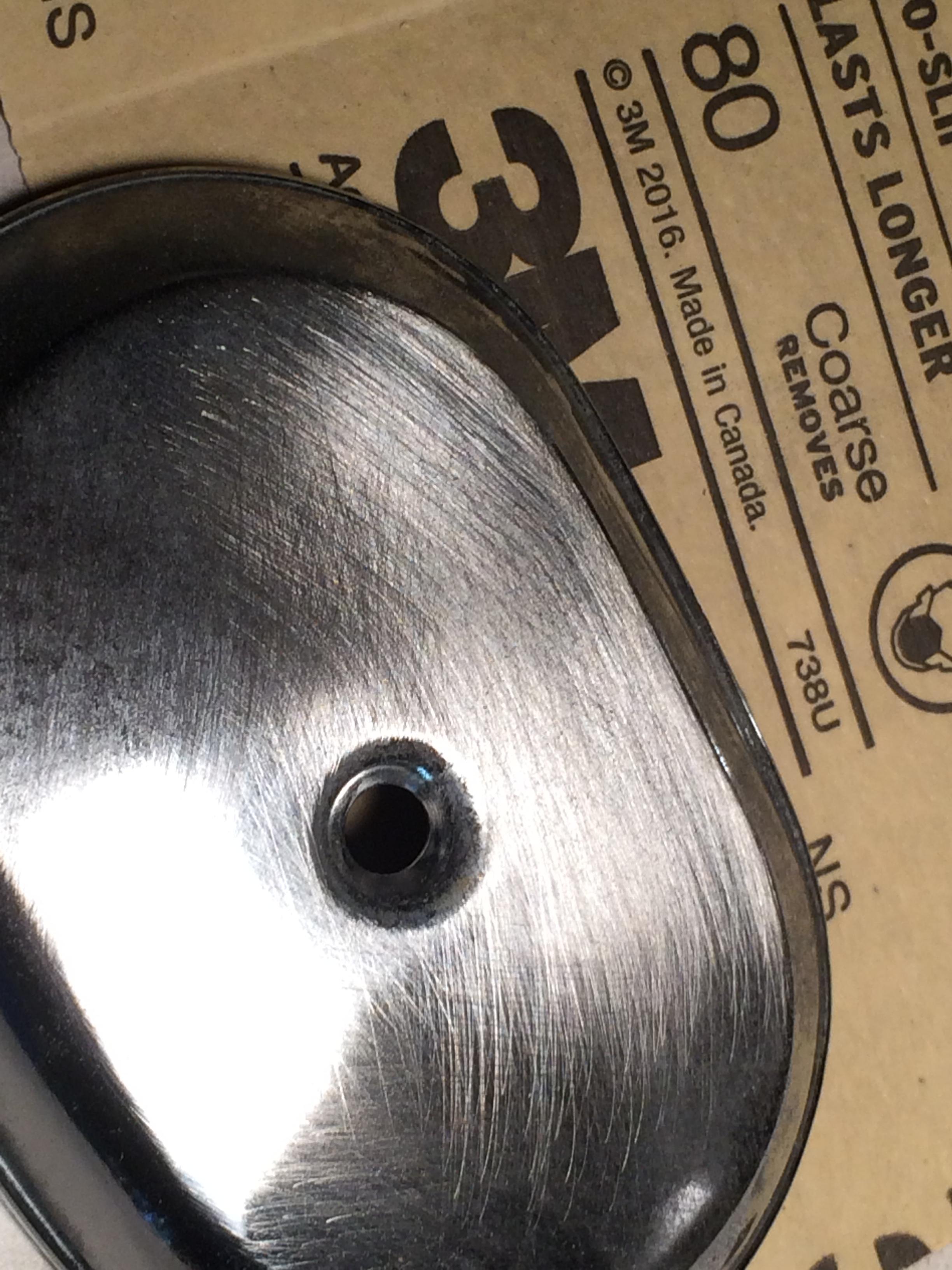
Sandpaper of ascending grits (I used 220, 400, 600, and 800)
1 Bucket of water
Shop towels
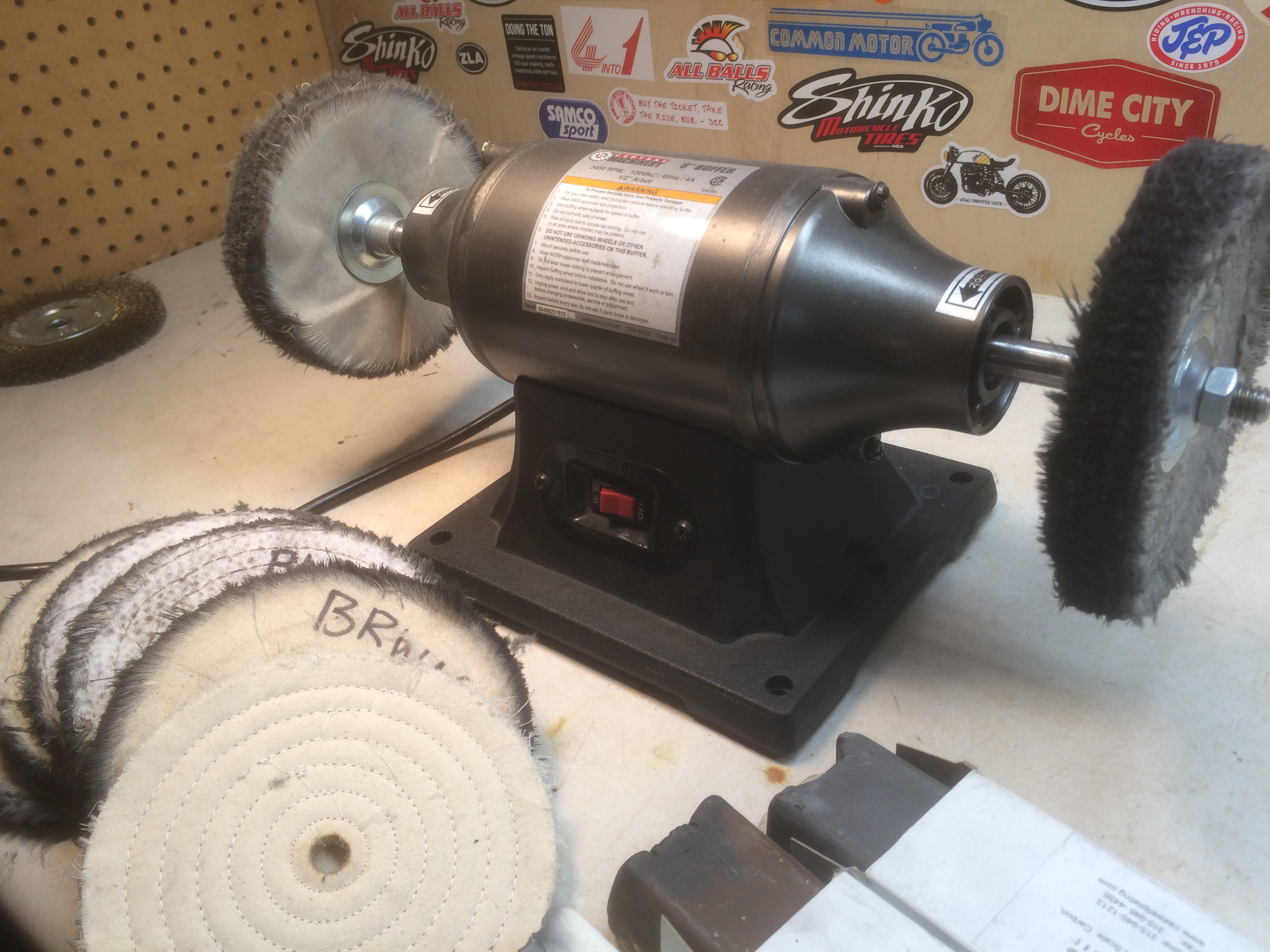
1 Bench grinder/polisher
1 Sisal rope buffing wheel
2 Cotton sewn buffing wheels
2 Loose cotton flannel buffing wheels

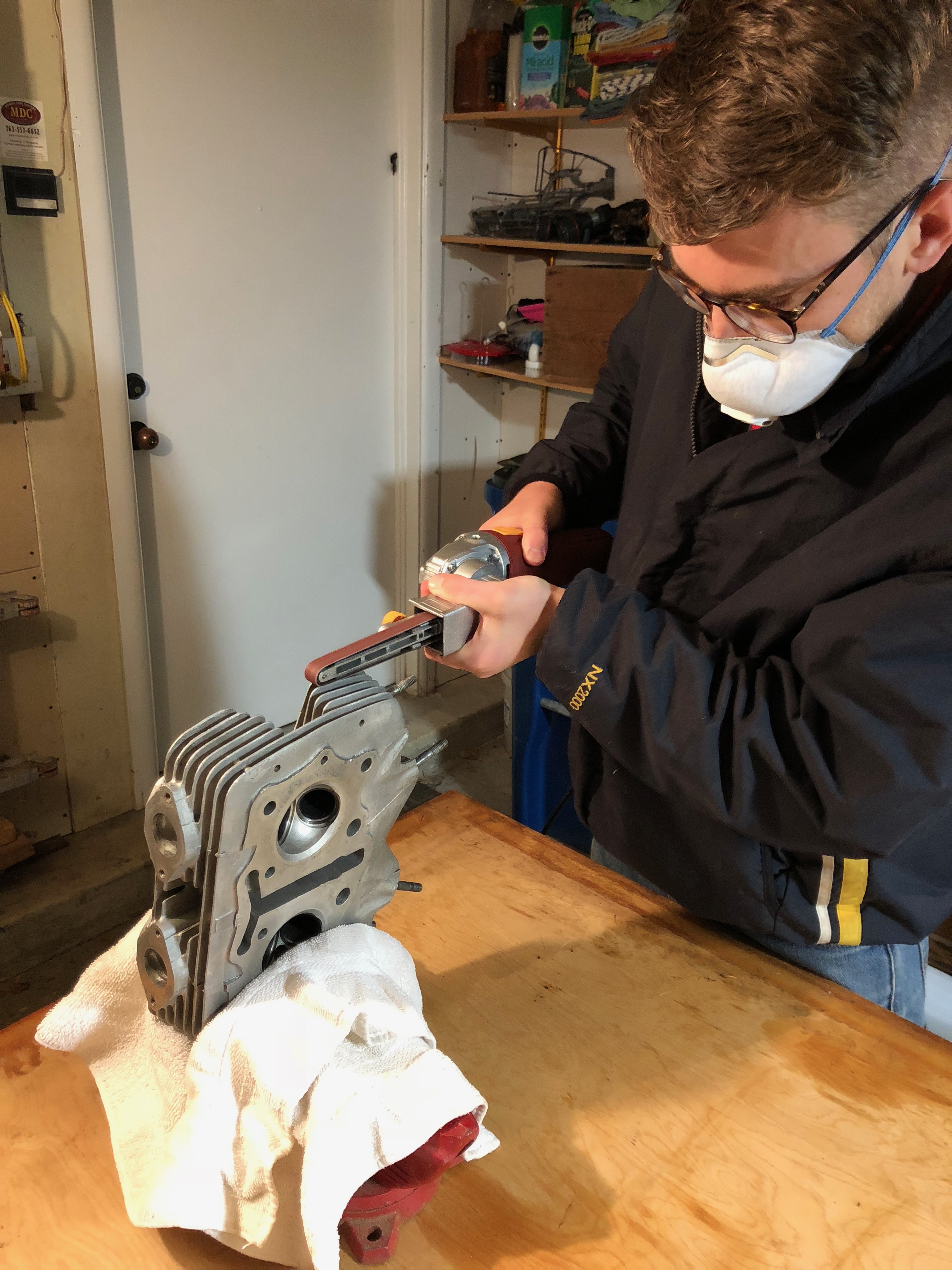
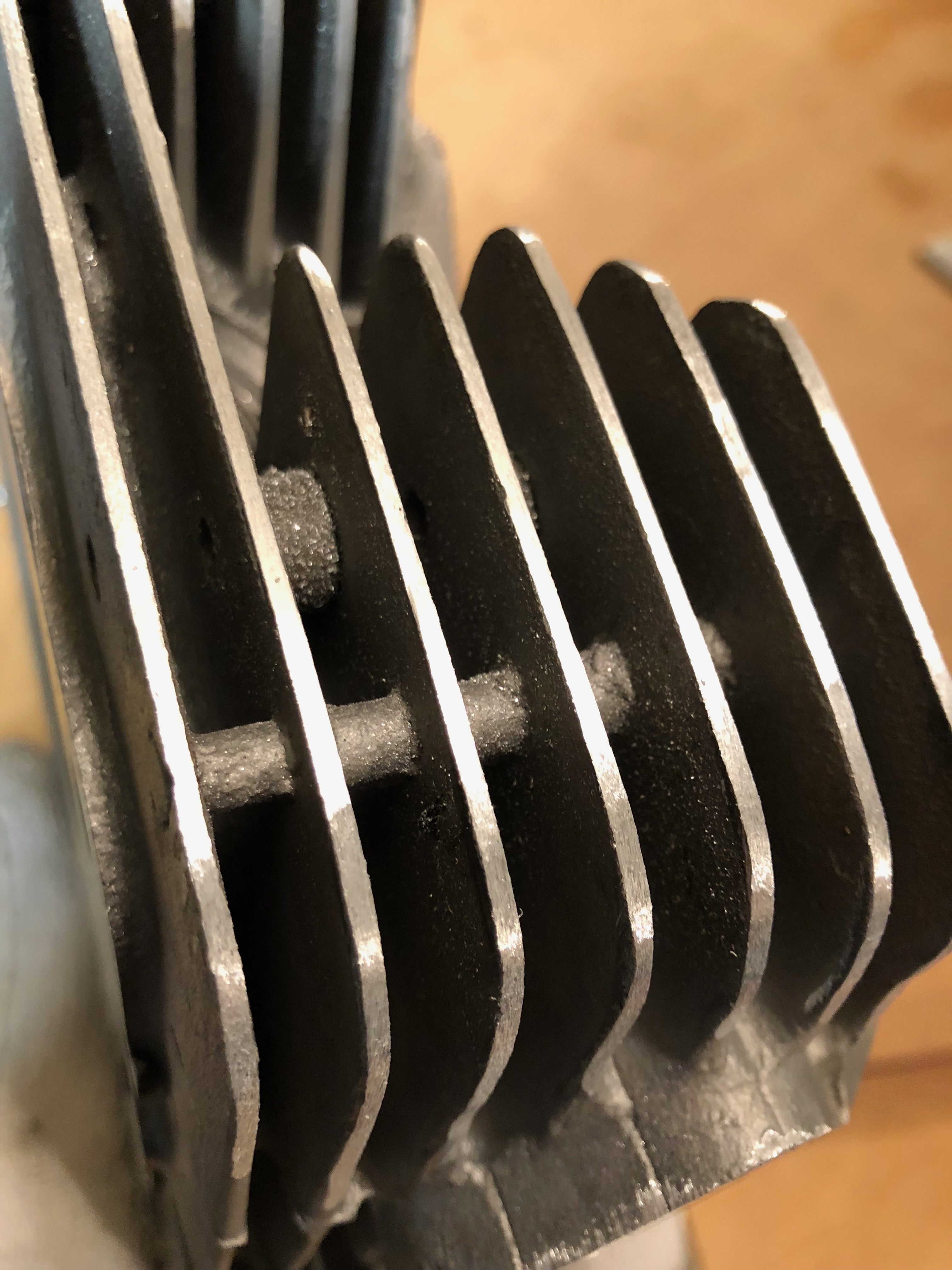
Honda CL350 cooling fins are molded to an ultra-fine edge, so I had to grind the surface profile a lot. I invested in a Harbor Freight power file, clamped the head in a vice (protected by rags), and sanded each fin lengthwise with a 180-grit belt to roughly ¼” thickness. This helped me remove a lot of material in short order. If you have flat edges to start with—or are simply shining a part with a larger surface area—skip to the next step.

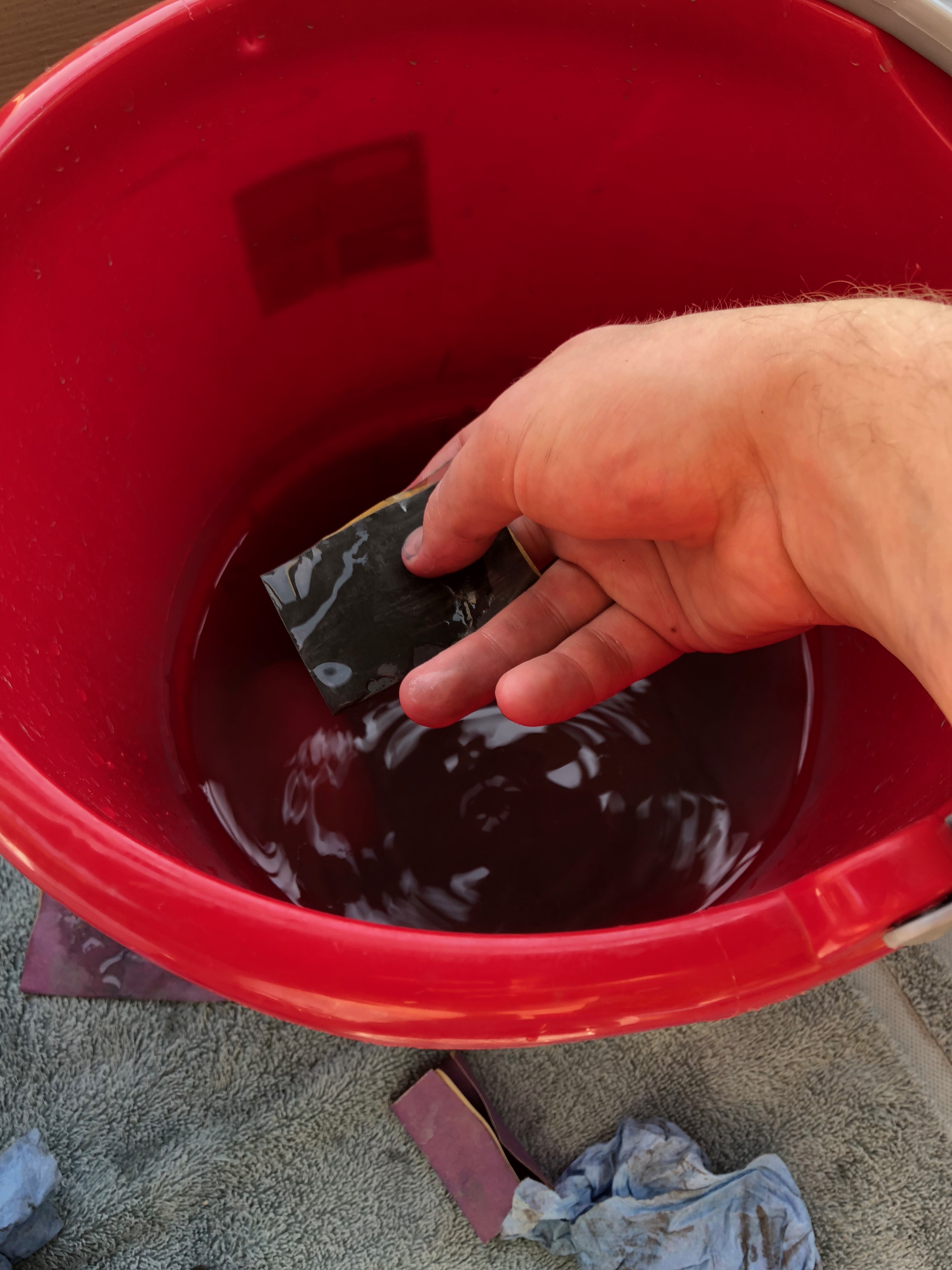
Wet-sand
With a flat surface to work with, it’s time to wet-sand your piece. This is where you remove the majority of the material, and it takes the most time and effort. At times you’ll want to lodge your part in the garage door, but stick with it—there’s nothing more satisfying than looking back with admiration on the hours you spent with every nook and cranny of your bike. Just think of that brilliant shine!

Start with your lowest grit of sandpaper and work up through your highest. I used 220 through 800, but the grit you start with will depend on the original condition of your piece. Cut the paper into manageable squares, dip one in your water bucket, and sand the length of the fins. Wet it often and shift to a new section whenever you notice diminished cutting power. Don’t be shy with this, you’ll will save a lot of time and effort without using too much more paper. Periodically wipe your surface with shop towels to see your progress. When it all looks uniform, you’re ready to move to the next grit.

If you are sanding a piece with more surface area, do your best to sand in one direction, and rotate 90 degrees each time you change grits. This helps eliminate scratch marks as you go. If you’re sanding fins, always sand lengthwise. Once you finish with your final grit, your part should be already be making you squint. Now it’s time to move to the buffing wheel.

Buffing is like wet sanding, but instead of taking frequent breaks to fill up on beer and elbow grease, you’ll have an electric motor to speed things up (and you can still hit the cooler for another cold one). Let’s set up our shop.

Buffer Speed and Wheel Size
To choose the right buffer and wheels, you’ll have to do a bit of math. For best results, your wheel should maintain 3,600 to 7,500 SFPM (surface feet per minute). SFPM refers to the area of buffing wheel that passes over your part every minute.

SFPM = 0.25 x wheel diameter x RPM.

My 0.5-HP buffer and 6-inch diameter wheels put me smack-dab in the acceptable range.

0.25 x 6 inches x 3450 = 1.5 x 3450 = 5175 SFPM.

The maximum thickness of a 6-inch wheel on a 0.5 horsepower motor is 2.5 inches, but I went with 0.5-inch thickness for my more refined purposes.

Wheel Types
You will need three types of wheel for this job, described below.

Sisal Wheel: A hard, fibrous wheel made from twine, cord and rope. Provides polishing and quick cutting action, especially when used with black emery compound.
Spiral Sewn Wheel: The muscle of your buffing operation. The plies of cotton are sewn together, increasing the density of the wheel and the pressure that can be exerted on it. Cuts and polishes.
Loose Cotton Wheel: This wheel cuts and polishes very similar to the spiral sewn wheel above, however it will cave under pressure since the cotton discs are not held together. This is EXTREMELY useful for accessing awkward crevices like cooling fins around the spark plug holes.

Compound Grits
You will also need three bars of compound to incrementally bring the part up to a mirror finish.

Black Emery Bar: This bar has excellent cutting properties and you should start almost every job with it. You’ll save tons of time and materials with this compound rather than continuing wet sanding beyond 800 grit or starting with a gentler bar.
Brown Tripoli Bar: A general-purpose workhorse for buffing soft metals like aluminum, brass, or copper. It will both cut your piece and color your it to a high shine.
White Rouge Bar: This bar has little to no cutting properties and is used almost strictly for coloring. Will produce a brilliant shine.

Begin with your sisal wheel and black compound. This combination will give the most cutting action and is a suitable jumping off place from the 800-grit sandpaper. Make sure you wear gloves, eye protection, a breathing mask, and a badass apron, and that your buffer is properly secured to your bench.

Apply the compound directly to the wheel for 0.5 to 1 second. Less is more. Applying too much will waste compound and actually prolong your buffing duration. Move your part up against the rotation of the wheel for the best cutting action. Buff your part, applying considerable pressure and not stopping in one place for too long. This helps to avoid burning the part.

Reapply compound in small amounts and often. Turn the part often in 90-degree increments and keep working until the metal has become quite smooth and shiny. Between compounds, rub off the residue with a microfiber cloth.

IMPORTANT: Only use the bottom quadrant of the buffing wheel—anywhere else is unsafe and could cause the part to bounce back, causing damage to the part, other equipment, or YOU. Just try to explain to the wife why there’s an oil filter cap sticking out of your head!

Move on to the spiral sewn cotton wheel and brown compound. Buff as before, constantly moving the part against the rotation of the wheel and applying moderate (but less) pressure. But this time, move your part with the direction of the wheel. If you find any black streaks from buffing too long in one area, simply scrub them with a microfiber cloth or buff them out on the wheel.

The final step is the loose cotton wheel and white compound. Your part should be completely smooth by now; we’re just putting on the final sheen. As before, move the part with the wheel. This stage should take the shortest amount of time. When you’re done, rub in Autosol aluminum polish and buff it off with a microfiber cloth. This will protect your finish from oxidation for a while. You will have to reapply over and over again unless you seal the shine with clearcoat or something else.

C8BgzoI.jpg


1Uqdnvx.jpg


ZwqNcp8.jpg


OaH0qkV.jpg


dIkOW0E.jpg
 
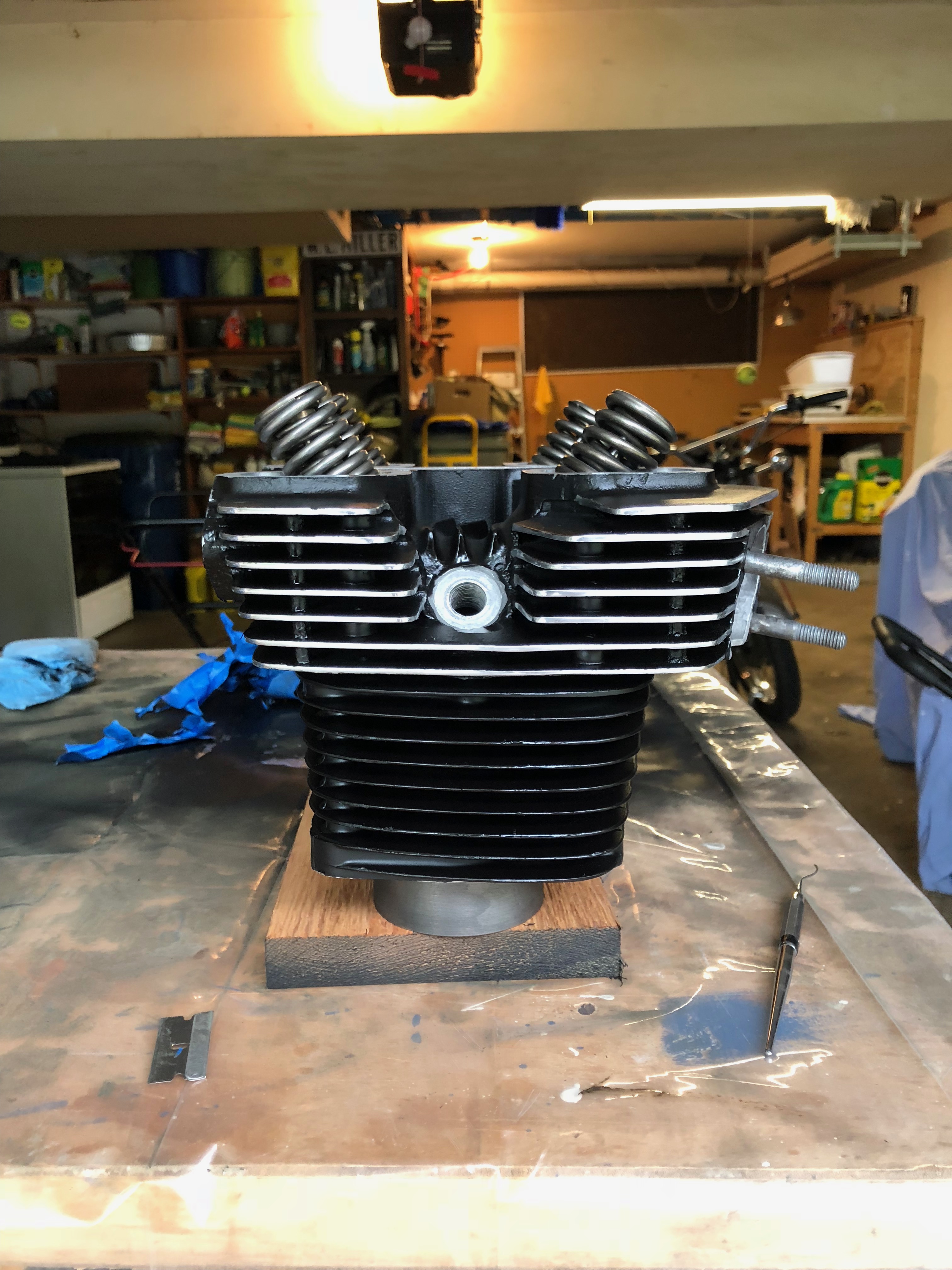
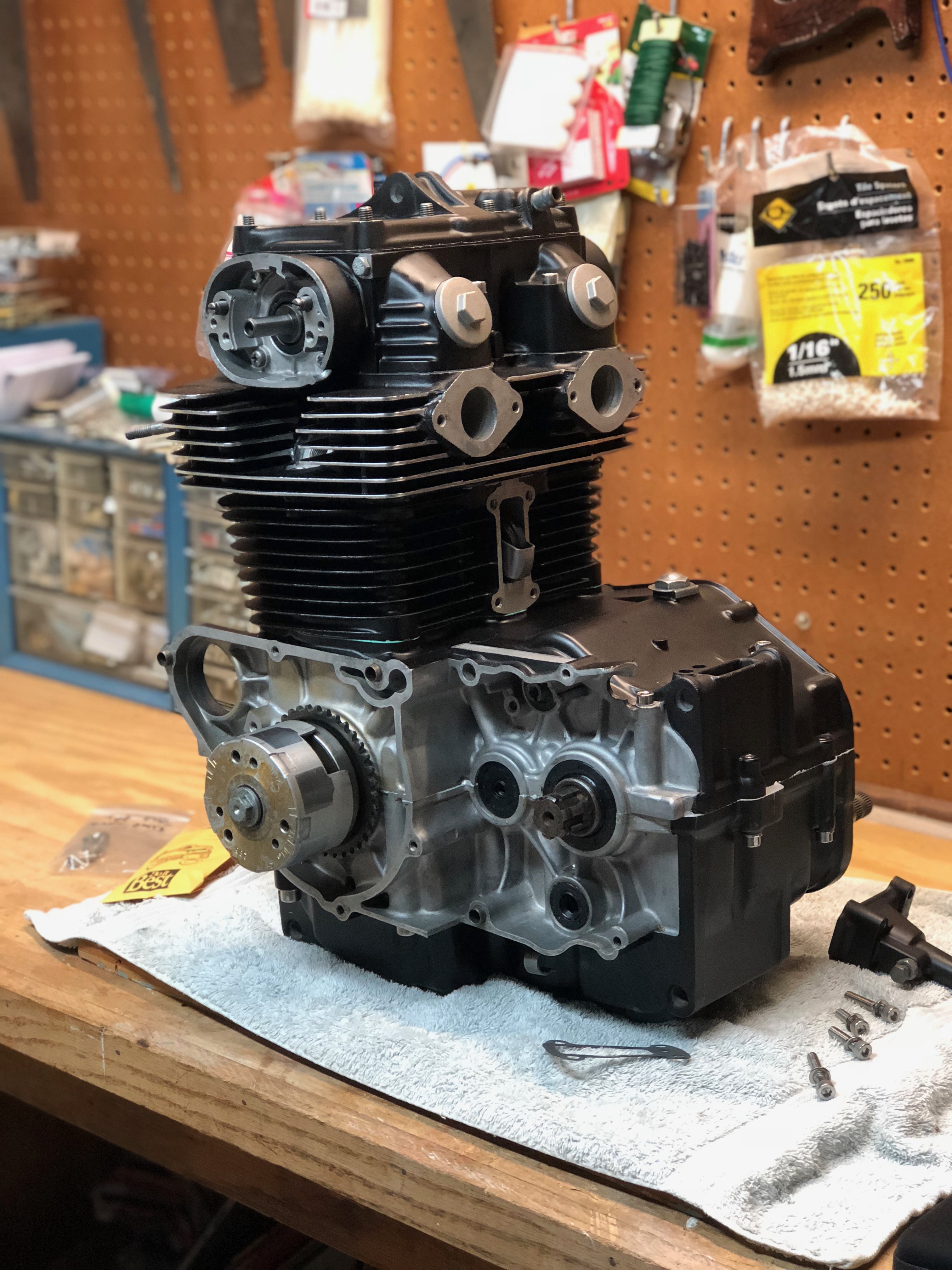
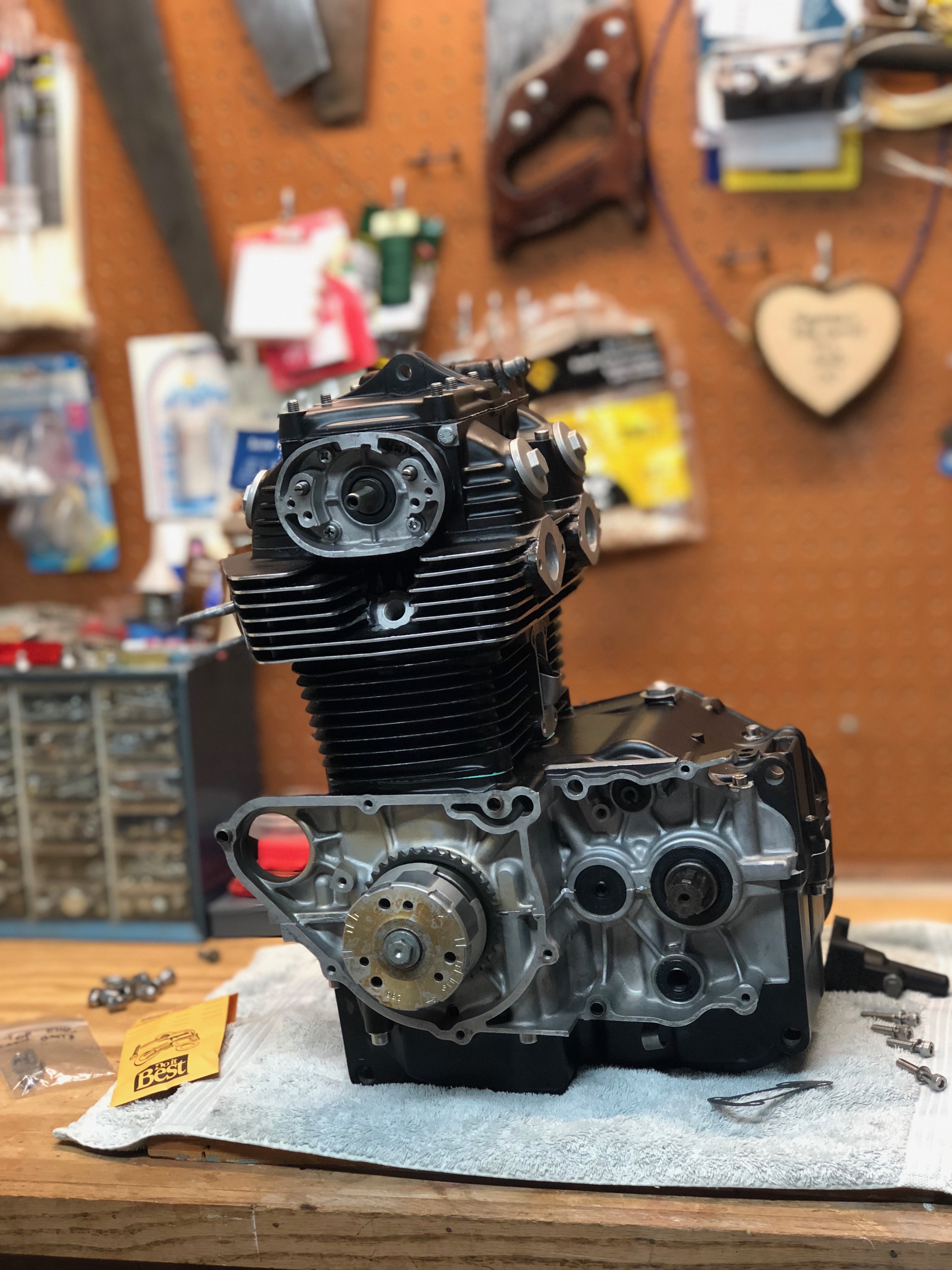
Finished up painting the engine pieces, including the jugs, head, cam case, cam case cover, and the tach and points boxes. This round, I learned from my mistakes and tried things a little bit differently. Things went well...mostly.

First I cleaned everything. The jugs and head had already been soda blasted, and the jugs were returned to me clean from TOOLS, but I cleaned everything again to remove any fingerprints, oils, or other debris. As discussed previously in this thread, I wasn't getting satisfactory results with Simple Green. I followed TOOLS recommendations this time and tried mineral spirits (easy to find at Home Depot) and had good results.

The tach and points boxes had some really stubborn grease and/or blemishes, so I hit them with a drill and an interleaf mounted flap wheel bit, which cleaned everything up and left a nice scuffed surface for optimal paint adhesion.

I scuffed the rest of the parts with 220-grit sandpaper and worked a scotchbrite pad between the cooling fins on the cylinders and cylinder head as well as I could.

I dunked everything in my tub of mineral spirits once more to remove any loose material from sanding and let the parts dry.

I masked the same way as my last post, but had some intricate detail work to do this time on the stator cover and cooling fins. There's no way around this, just gotta take a few hours, have a beer, and get to it. For anyone insane enough to go down the same path, make sure to switch out your razor frequently on the fins. It dulls faster than you think, and a fresh blade might be just what you need to remove that pesky flap of masking tape that keeps folding over the edge.

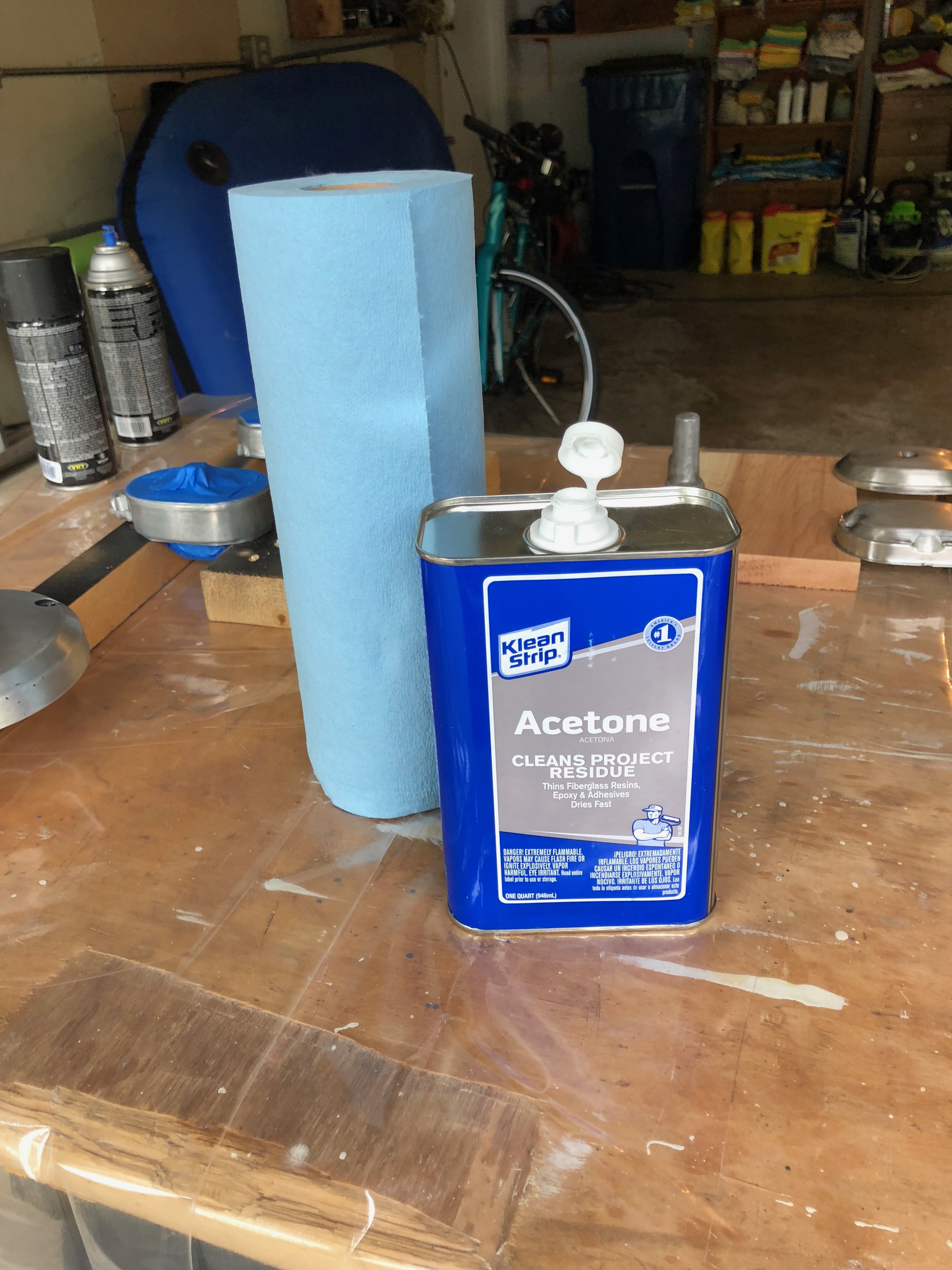
With parts dried and masked, I laid them out on a table lined with plastic sheeting and did a final wipe-down with acetone rags. Acetone dries almost instantly and supposedly doesn't leave behind any residue, making it a good choice for a final clean.

I soaked my primer and paint cans in water I heated up in a 3-gallon kettle, but my water was definitely too hot and the paint pressurized enough that one of the caps shot off the can while I was shaking it up. Not sure if/how bad that is, but I used the paint anyway.

The first time I painted, I thought some debris got underneath my primer as the surface was rough. However that happened again and I realize it was paint clumping on the surface. I was able to sand most of it flat his time, but does anyone know why this happened? Too much humidity? Heated the paint too high? Any suggestions are welcome. Admitting my mistakes on this forum and getting feedback is how I learn and get better!

Unfortunately, humidity rose throughout the course of the project. The paint took a long time to dry to the touch, and removing the masking in some cases left adhesive residue. That's why it's important to check the weather before you start! My masking wasn't perfect on the fins, so I used a rag with a tiny bit of paint stripper to clean them up while the paint was still wet. Everything turned out great after baking in an oven for 1 hour at 200 degrees F to cure.

8fbU3vf.jpg


FVnt8lu.jpg


MpPlN4H.jpg


kp0QBys.jpg


GmbW20s.jpg
 
HerrDeacon said:

Interesting to see how you did the fins. I thought about taping mine off like that but didn't trust myself to be able to do it correctly. I ended up polishing the fins before painting and then carefully remove the paint from the edges. It was a bit tedious and not perfect but worked. I may give your method a try if I ever do it again.
 
The key is to go through a ton of razors. You might not feel it getting duller, but when you switch to a fresh blade you'll definitely feel a difference. If you use the same blade for too long it starts to leave rough edges in your masking tape, and that caused a few minor imperfections for me. I've also read that you can use wheel stripe, but I couldn't find any thin enough for my 350 fins. My fins taper so gradually that I would have had to sand off too much for a thicker edge. I don't want to mess with the factory cooling design too much!

EDIT: I also picked up some flat black hobby paint. I'll test it first for color matching, and if it matches I'll touch up a few of those spots on the fins and around the polished lettering on the stator cover. I'll let you know how that goes (probably this weekend).

To anyone who is better at painting than me...why did my paint leave a slightly rough texture in places? Is it from humidity? Did I heat it up too hot before use?

I'm quite happy with my results and was able to sand down this effect in the primer, but I'd just like to know to improve for future paint jobs. My entire paint process is detailed above.
 
TOOLS1 said:

I do not know why you heated the paint up. I have never done that before. I always use Dupli Color engine paint with ceramic. This stuff goes on smooth, dries in a few minutes, and is really tough. And does not need to be baked on.

TOOLS
 
Don't remember which thread exactly but was told to get it nice and hot - in the 100 degree range - for best application. Might have left it in hot water a bit long though. Not sure if that affected anything.
 
Longdistancerider said:

Most spray paints have an application temp range listed on the can, that's the temps the paint and work piece should be within. If it's not on the can then it'll be in the MSDS sheet that can be found online.

Curious how you kept debris from the sanding and buffing out of the head or was the machine work done afterwards.
 
Could it have been humidity? It's not bad at all, just a little curious that it happened. I had read the hotter the better basically, so that is why I heated them up. It did get a bit humid on the last day of painting tho.

I sanded with a power file prior to the machine work but sanded by hand and buffed afterward. I thoroughly cleaned the head in mineral spirits after buffing was complete to get rid of any debris.
 
Longdistancerider said:

It could have been the humidity, there again that MSDS sheet has the acceptable range info if it's not on the can. I've seen people run dehumidifiers when painting to solve that problem.

Good to know it was all kept clean, it's amazing the amount of damage that can be done by little tiny bits of metal left in an engine. One race shop I was affiliated with re-purposed a paint booth for engine cleaning and assembly. Nice and clean area to work in.
 
Horaay! All the arduous labor of disassembling the engine, cleaning it with all the elbow grease I had in stock, buying replacement parts, soda-blasting, paint-prepping and painting, I am FINALLY ready to put this engine back together. I have a lot of other things swirling around in life so this engine has taken me close to a year. It's crazy to think it's almost back together. My first engine!! I can't wait to start this thing up one day and find out if I made any mistakes
yH5BAEAAAAALAAAAAABAAEAAAIBRAA7


Here goes.

First things first, I bought a new cam chain and we'll be needing that later so I wiped off the preservatives off with a rag and placed it in a plastic bucket of oil to soak. You want oil to penetrate all the seals of the chain.

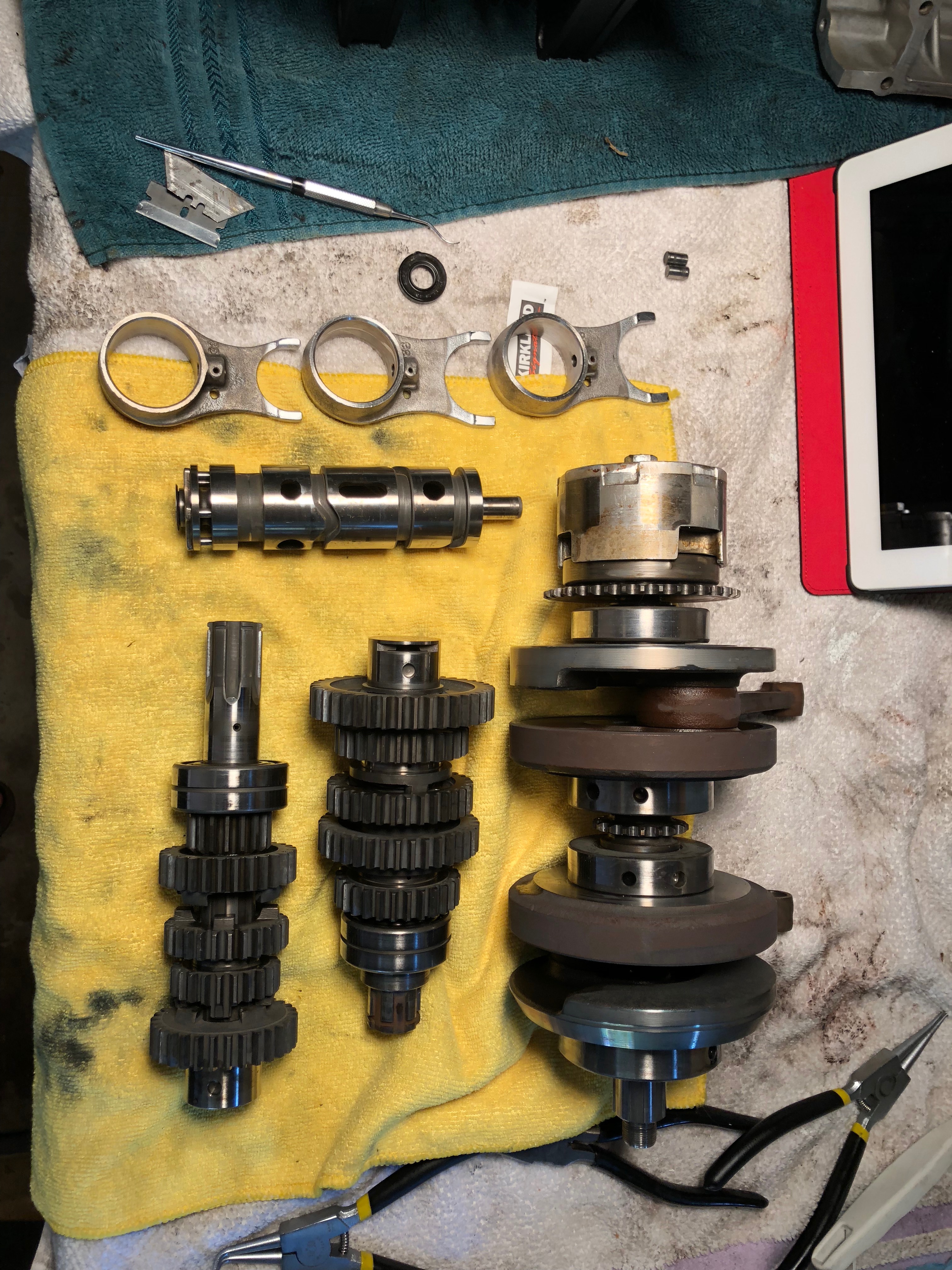
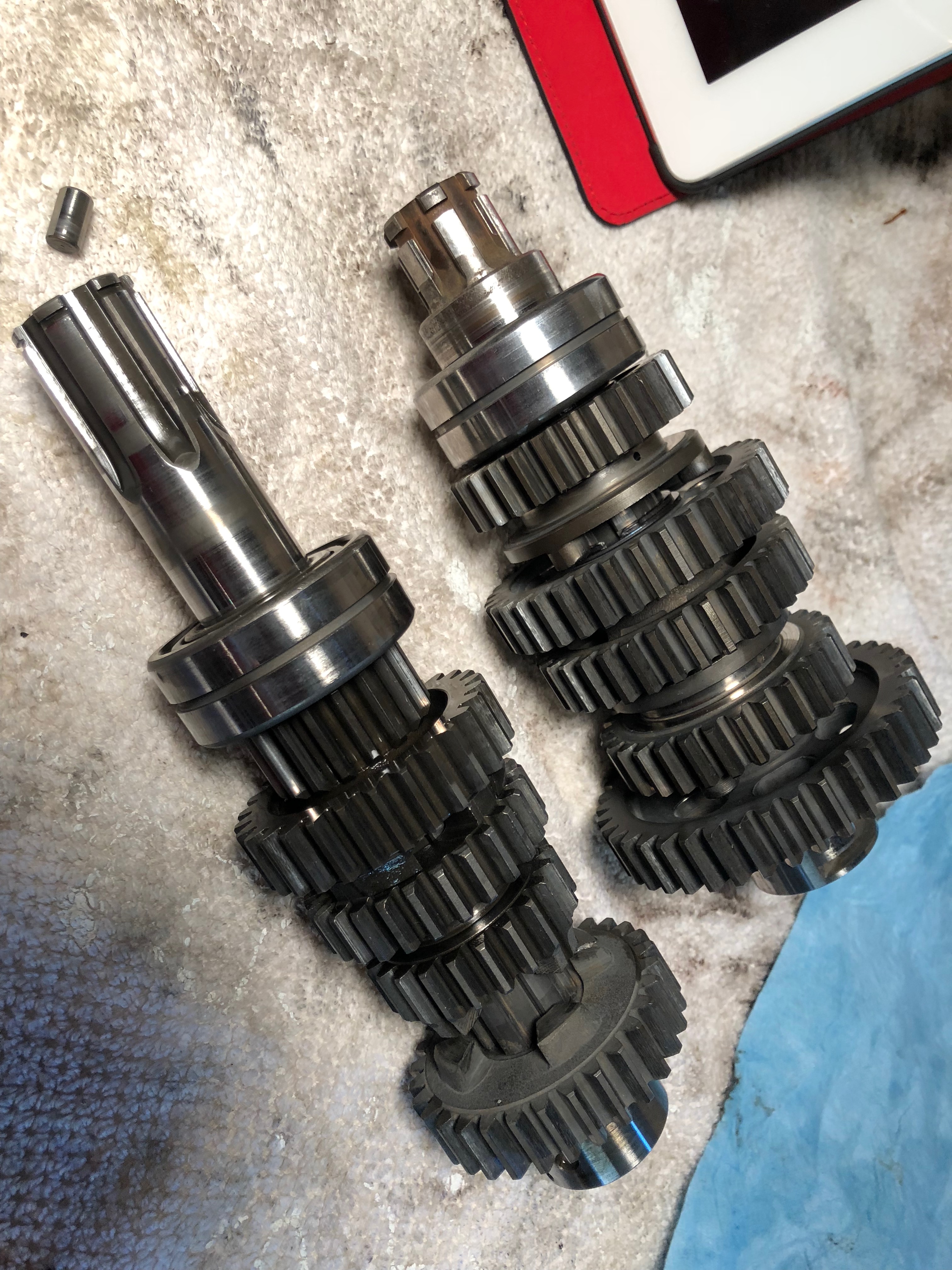
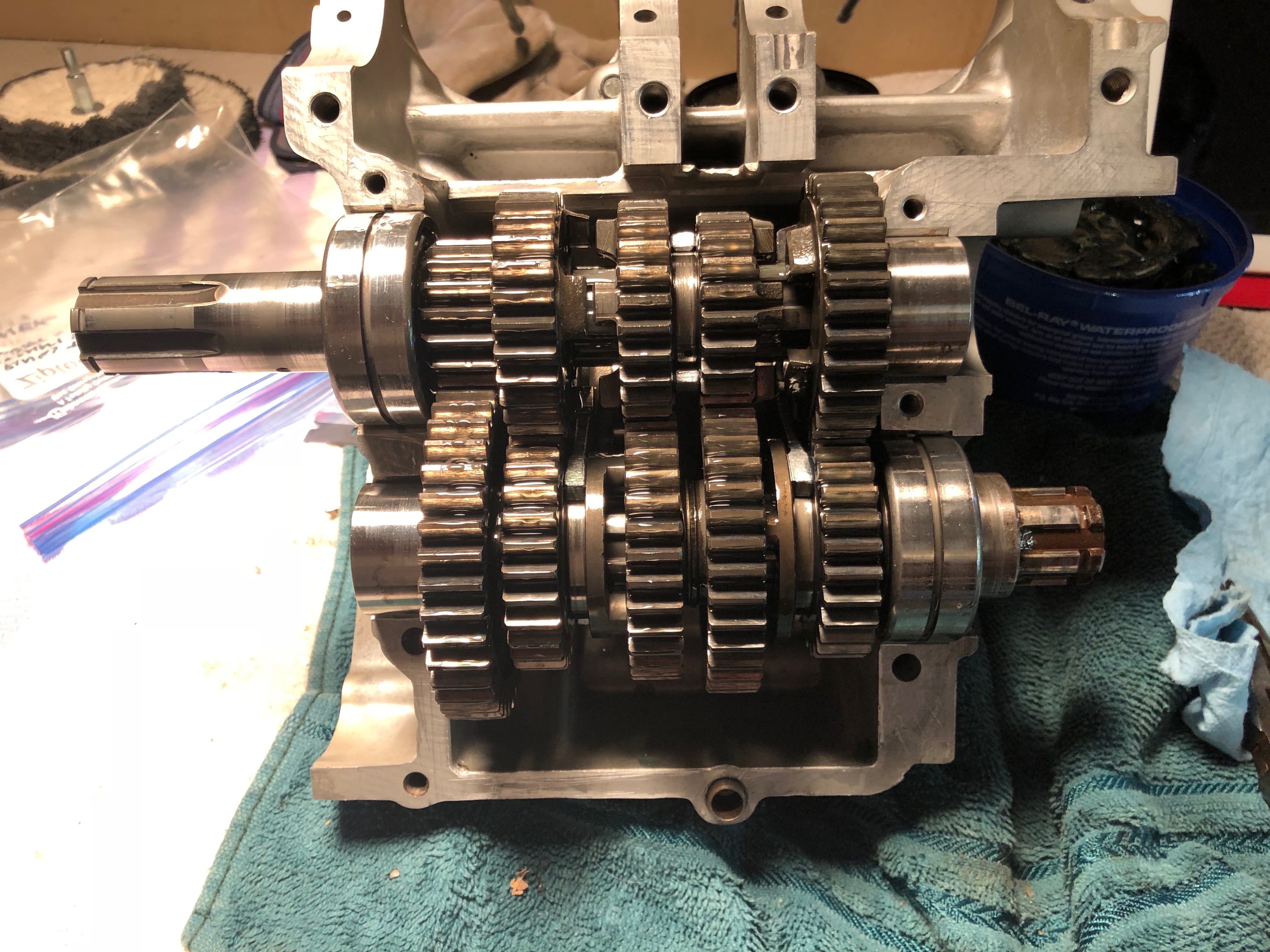
Next I cleaned up my transmission and crankshaft, which had just been sitting oiled up exactly as I removed them from the engine. I dismantled each gear on the main and counter shafts, dunking everything in mineral spirits and scrubbing with a plastic-bristled brush. I cleaned up the shift drum and forks in the mineral spirits as well. I wiped everything down afterwards.

Make sure you go slowly and follow the parts diagrams when putting the transmission shafts back together. Sometimes it's hard to tell which way a gear goes, even on the diagram, and it's easy to make a mistake. It took me a bit of time and head-scratching to make sure I had everything back together properly.

Next I used a razor blade to chamfer the edges of the mating surface on each case half, to de-burr and remove any old sealant stuck on. Afterwards, I wiped it with a cloth that was dampened with mineral spirits to clean the mating surfaces of any debris loosened by the razor.

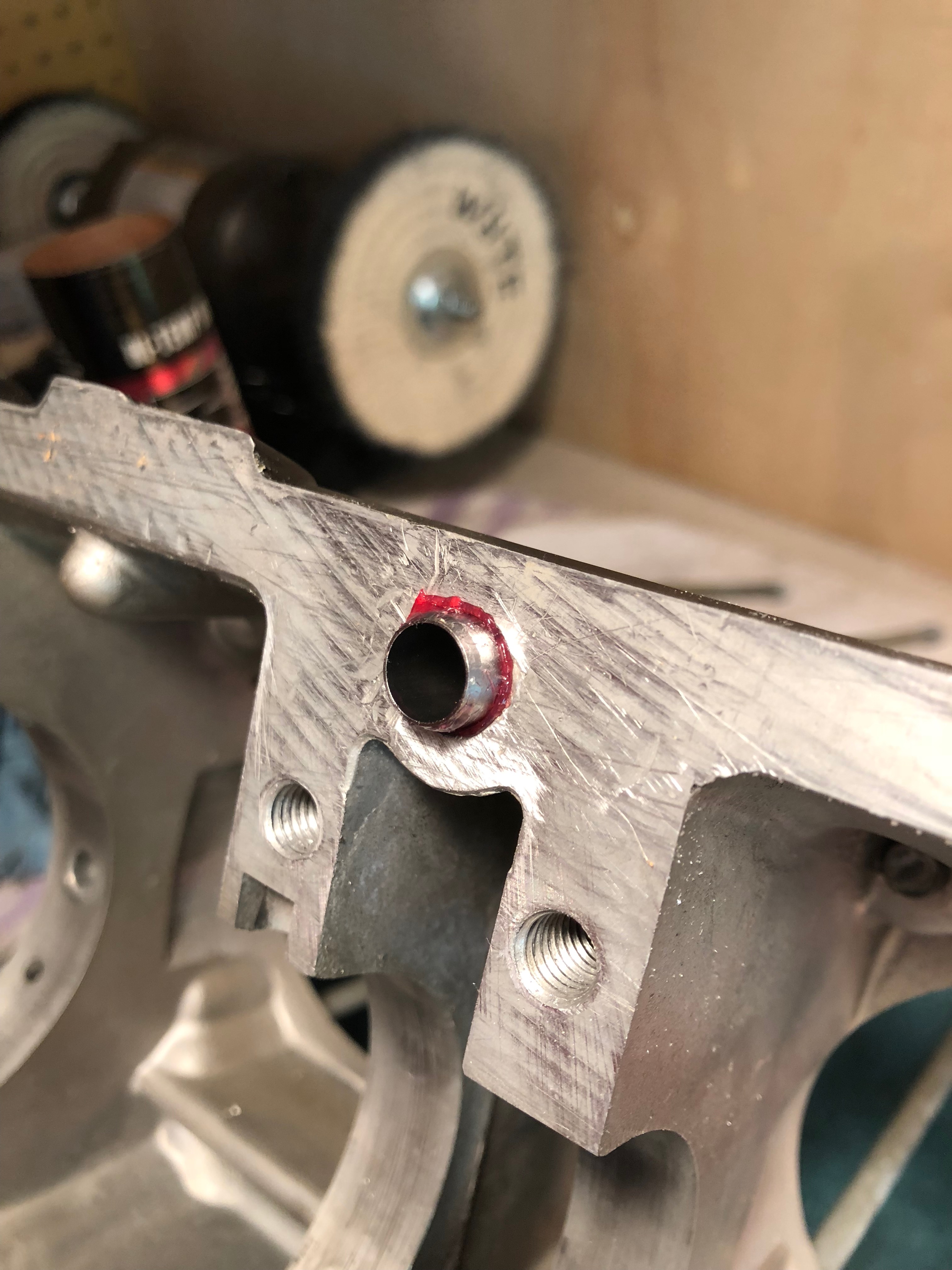
Then I replaced the oil splash guard I previously removed by chiseling off the tac welds that held it in place. I had a machine shop tap new threads into the posts and bought matching bolts at Home Depot. I added a bit of red loc-tite (god forbid I ever have to crack this baby open again). I used an impact driver that goes both ways to twist them down good.

Replaced one of the case dowels (with anti-seize) which was destroyed on removal. Had to have a machine shop tap that as well. Wasn't me, I swear! Ok, it was... :grin:

Replace that rubber oil stopper ball!

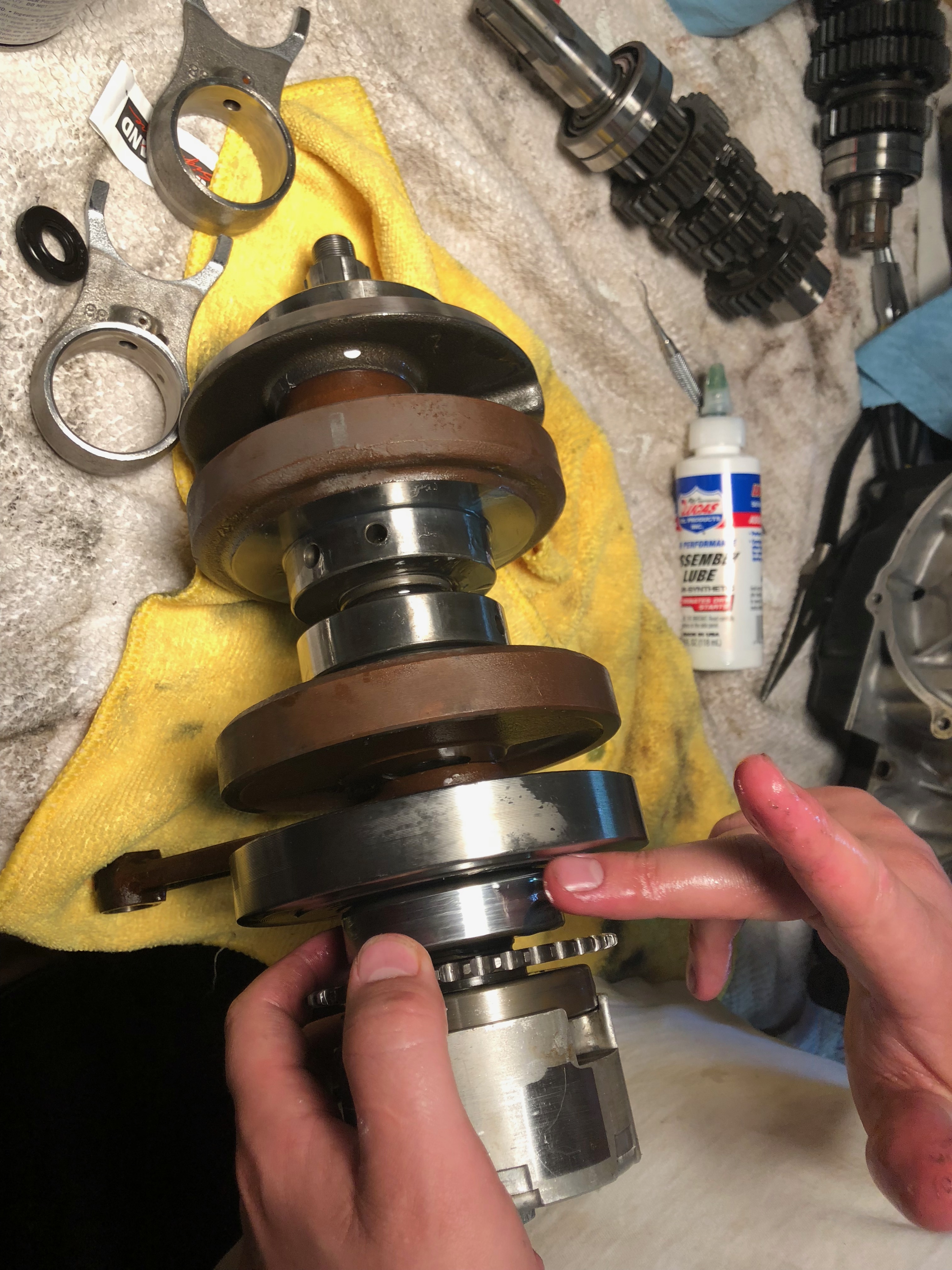
I worked ample amounts of assembly lube into all moving parts of the crankshaft. When I was finished, the bearings on either end spun whisper-quiet and smooth. You really want to work this into all cracks and crevices where there are moving parts because they need lube before oil works its way through all the galleys on startup. It isn't shown below, but I also worked it into the bearings on the inside where the piston rods are. I even coated some on the rods themselves...I'm not sure if those are susceptible to rust and they were dry after using the mineral spirits.

In preparation for installing the shift drum, I ran the neutral detent bolt on a brass wire wheel to polish it up and remove 40 years of aging. I tried to be very gentle with this and not polish right through the zinc coating. I rubbed on some autosol to protect the nice shine. and I straightened out the lock washer with a hammer and the anvil of a vice grip.

...to be continued...

QNRc7FQ.jpg


2q1nLar.jpg


v2glEEc.jpg


E1srJCN.jpg


oqZhQgD.jpg


ktlhMWX.jpg


Btbd3Nv.jpg
 
Let's continue where we left off and build ourselves a bottom end!

In my last post, I cleaned up some parts, prepared the mating surfaces of the crankcases, installed the oil splash tray, greased up the crankshaft, and did some quick and easy restoration on some of the neutral detent parts. now we will continue right where we left off - installing the shift drum, forks, and transmission.

There is an oil seal on the right side of the top crankcase (left side if upside-down) that we need to install. I grabbed the correct seal from my new oil seal kit and greased the lips of the seal with Bel-Ray's Waterproof Grease to keep them soft and long-lasting. It is a tight fit so I used a similar sized socket and hammer to gently pound it in. Make sure the socket is the same size or smaller than the bearing so you don't jack up the crankcase during installation.

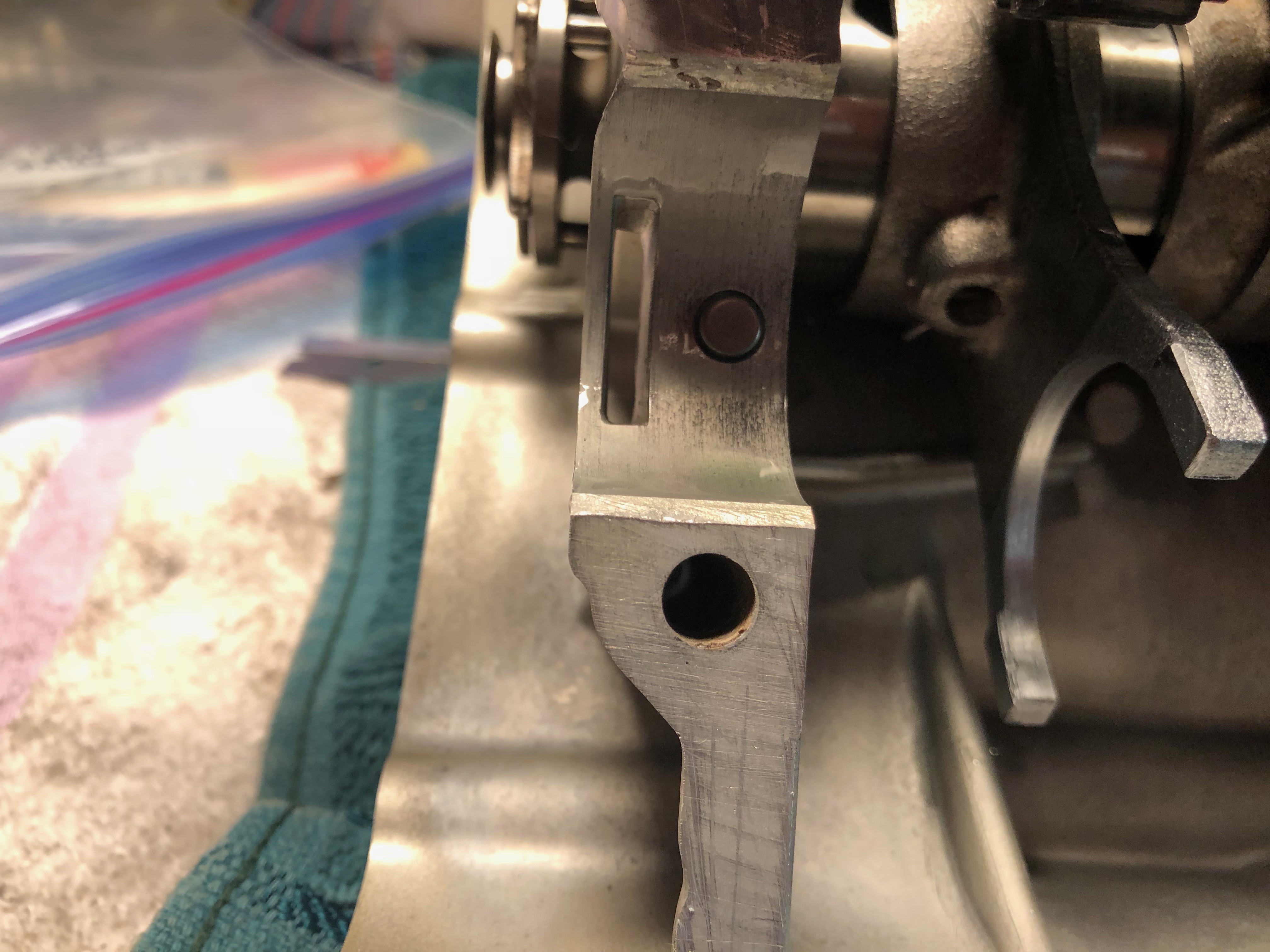
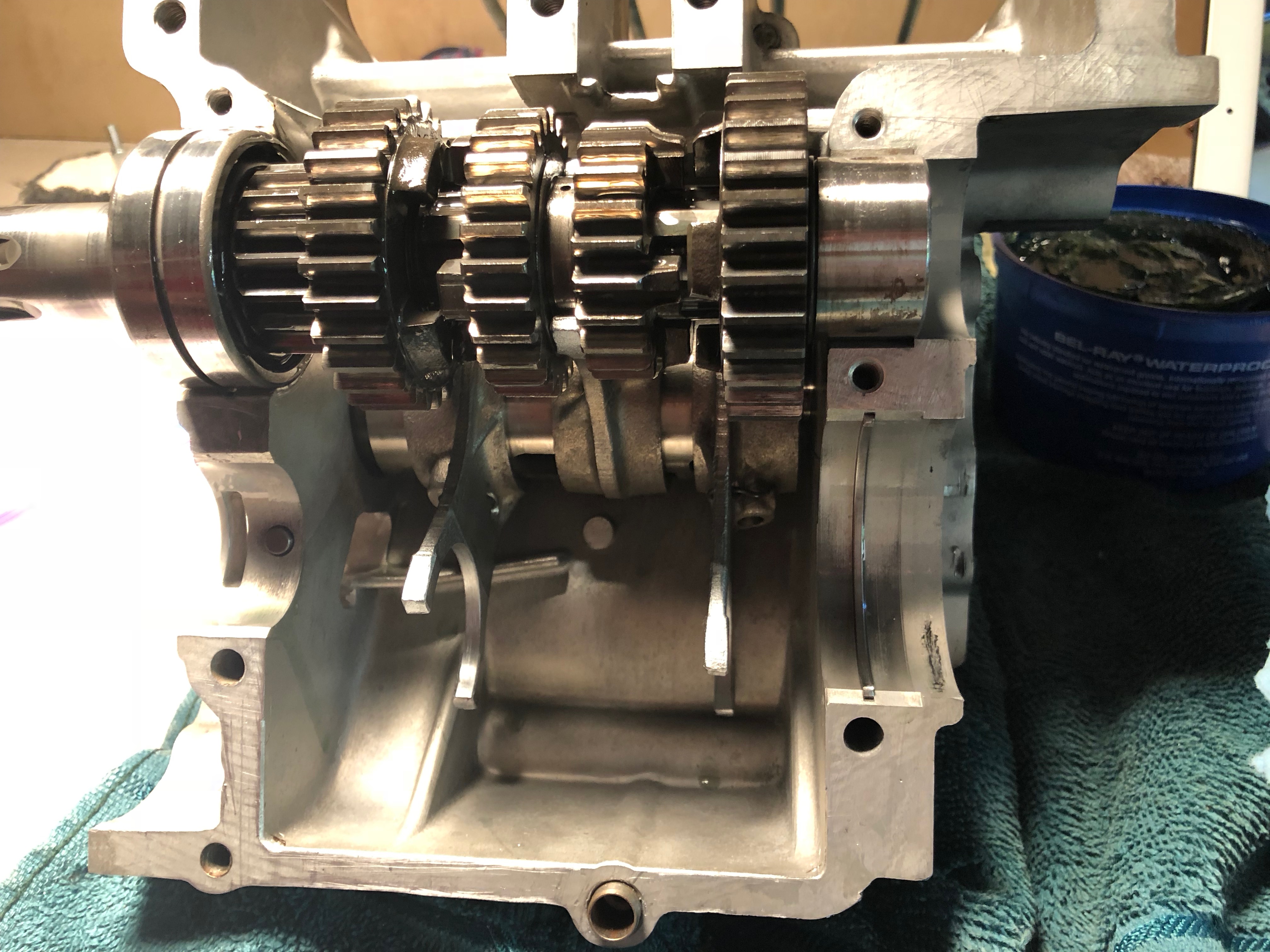
Before sliding the shift drum into the top case, I applied assembly lube to the inner lips of the hole you're about to slide it through. It's opposite the seal I just installed. Now slide the shift drum through that hole in the top case, from left to right (the case is upside down). I slid the shift forks onto the drum as I pushed it through, making sure the short one was in the middle and the pins on the large ones face out.

This is the correct order, but double check your manual if you're following along.

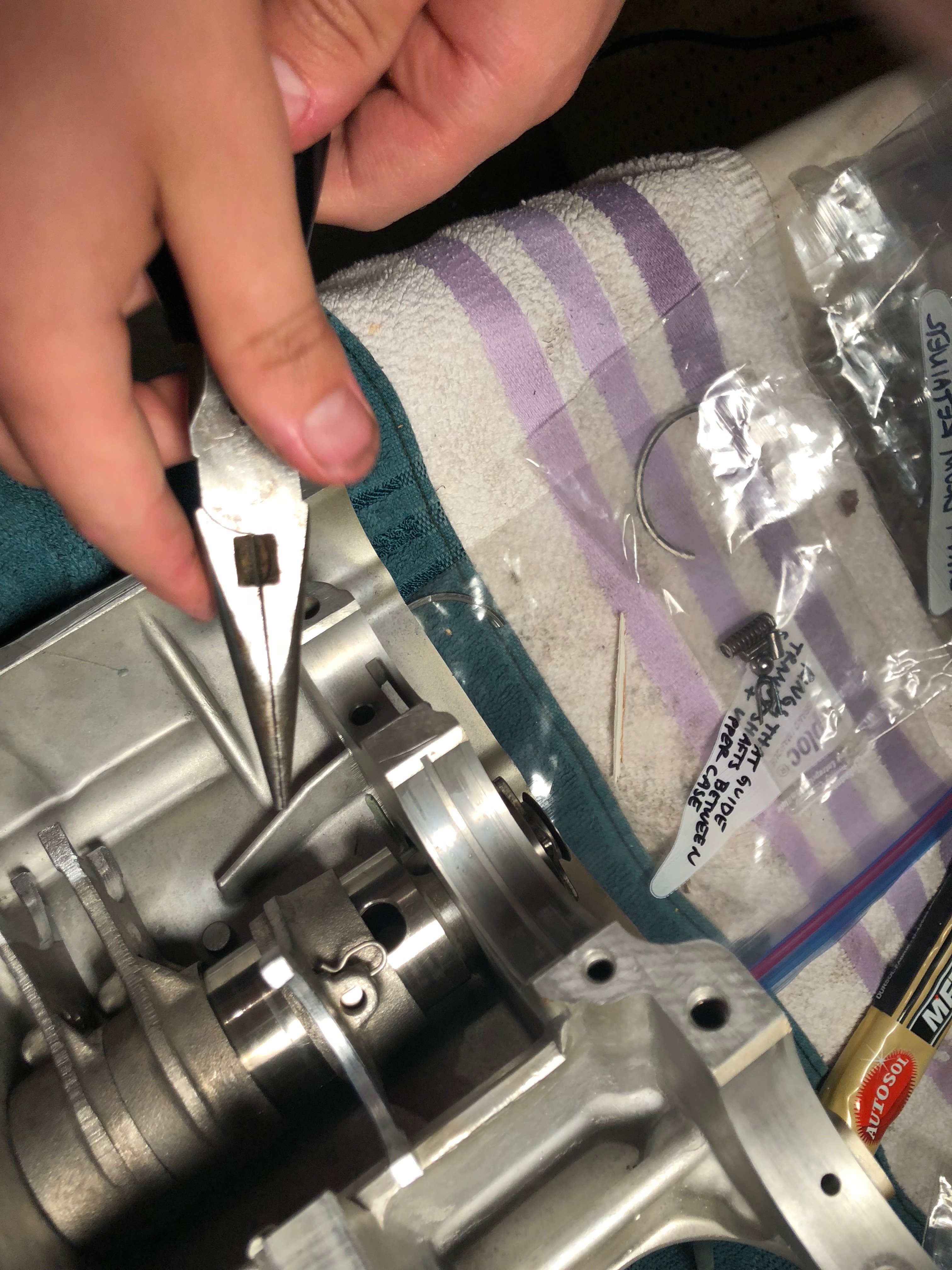
I coat the shift drum in more assembly lube and move the three shift forks up, down, and side to side to spread it around. Then I installed the pins that hold the shift forks in their tracks by dropping them into the holes and pressing them in with a pick. Next I secured them with the cotter pins. This is tricky, and I found the easiest way is to grab the head of the cotter pin and the whole fork with a needle nose and press gently.

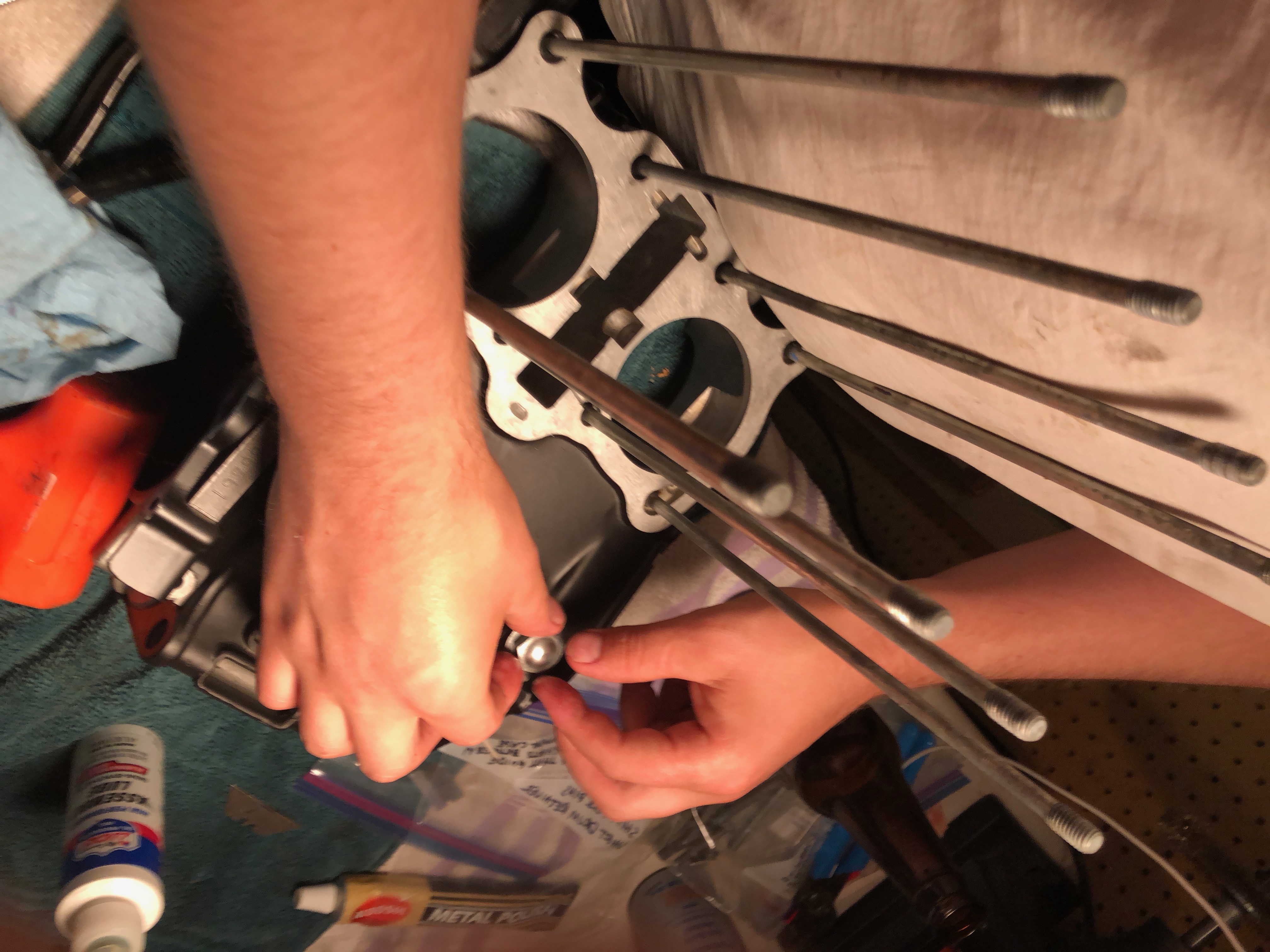
With the neutral detent (that little dimple on the star-cog side of the shift drum) pointing north (toward the top of the case), I flipped the case over and installed the neutral detent ball, spring, lock washer, and bolt in that order.

Then I flipped the case on it's back again and placed all the locating hardware in the depressions where the transmission shafts go. There should be a half-circle shaped rod and a little dowel pin for each shaft.

With those in place, I installed the transmission shafts. But before placing them into the case, I pre-lubed the bearings and gears with PLENTY of assembly lube. Get it all over and in between every gear. You want all moving parts covered to help on startup. Sorry, no pics, greasy hands!

First I dropped the main shaft into place, hooking the smaller (middle) shift fork onto it. I wasn't quite sure where it hooks on, so I looked it up in the manual. Works every time! I rotated the bearing cap until I heard the locating pin drop into place and tugged the shaft left and right to make sure everything was in place.

Same process with the countershaft, but cradling it in the two larger (outer) shift forks this time. I rotated the gears to make sure they move smoothly and I am in neutral.

NOTE: Make sure that the bearing locator pins are actually in the holes in the bearing caps, or BAD THINGS WILL HAPPEN. I do not know what things...but I am told they are bad.

With it all in place, I added another line of assembly lube to the gear train and twisted the shafts to spread it around. Everything looked good, but to prove that the transmission shifted properly into all gears, I tested it out. While rotating the output shaft, I grabbed the star-cog on the shift drum with a vice grips and twisted it, shifting through all the gears. It was REALLY tough to get a purchase on the star cog and I am sure this is not the best way to do it. Lastly, I put it back in neutral, and had a really tough time doing so, haha.

See you next time for installation of the crankshaft and kickstarter, and closing up this bad boy!!!

subHYZf.jpg


WOkaC39.jpg


kT3xH9h.jpg


MRp7OqN.jpg
P4f1AH8.jpg


HFk1Tiq.jpg


dk8rLUb.jpg
 
Hey guys, here's the last post in the bottom end rebuild series! In this post, I install the crankshaft and kickstart mechanism, and close her up!

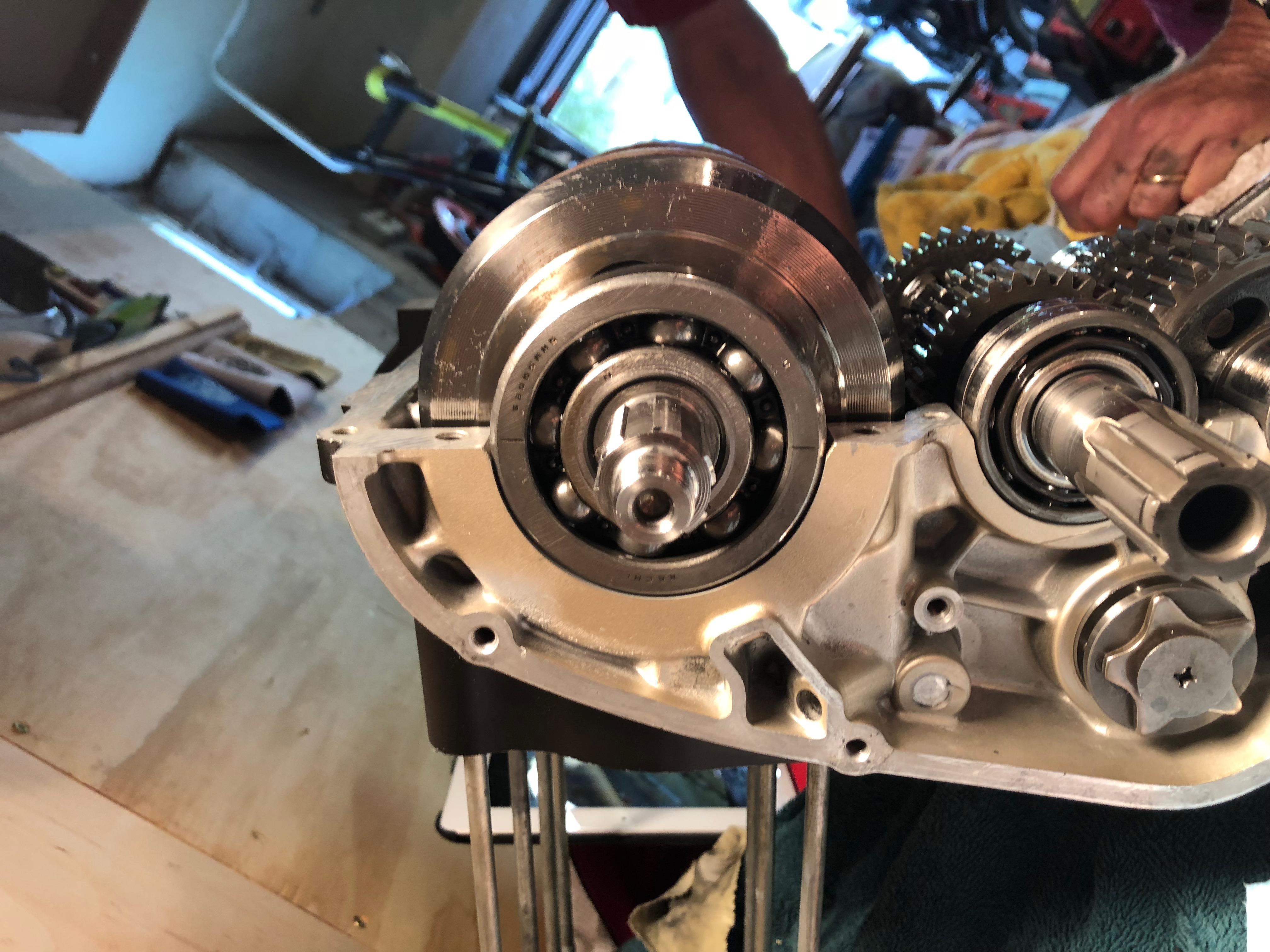
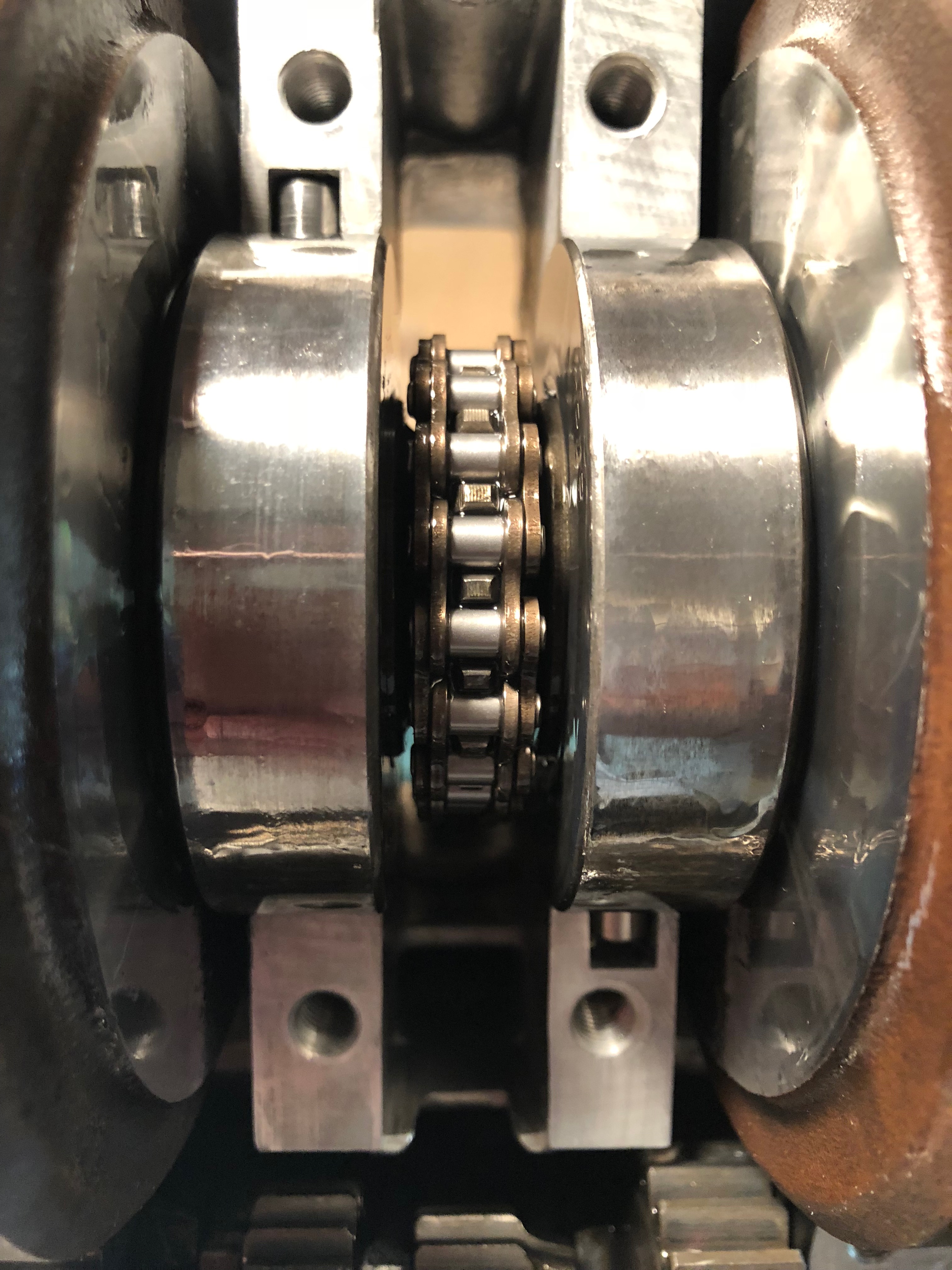
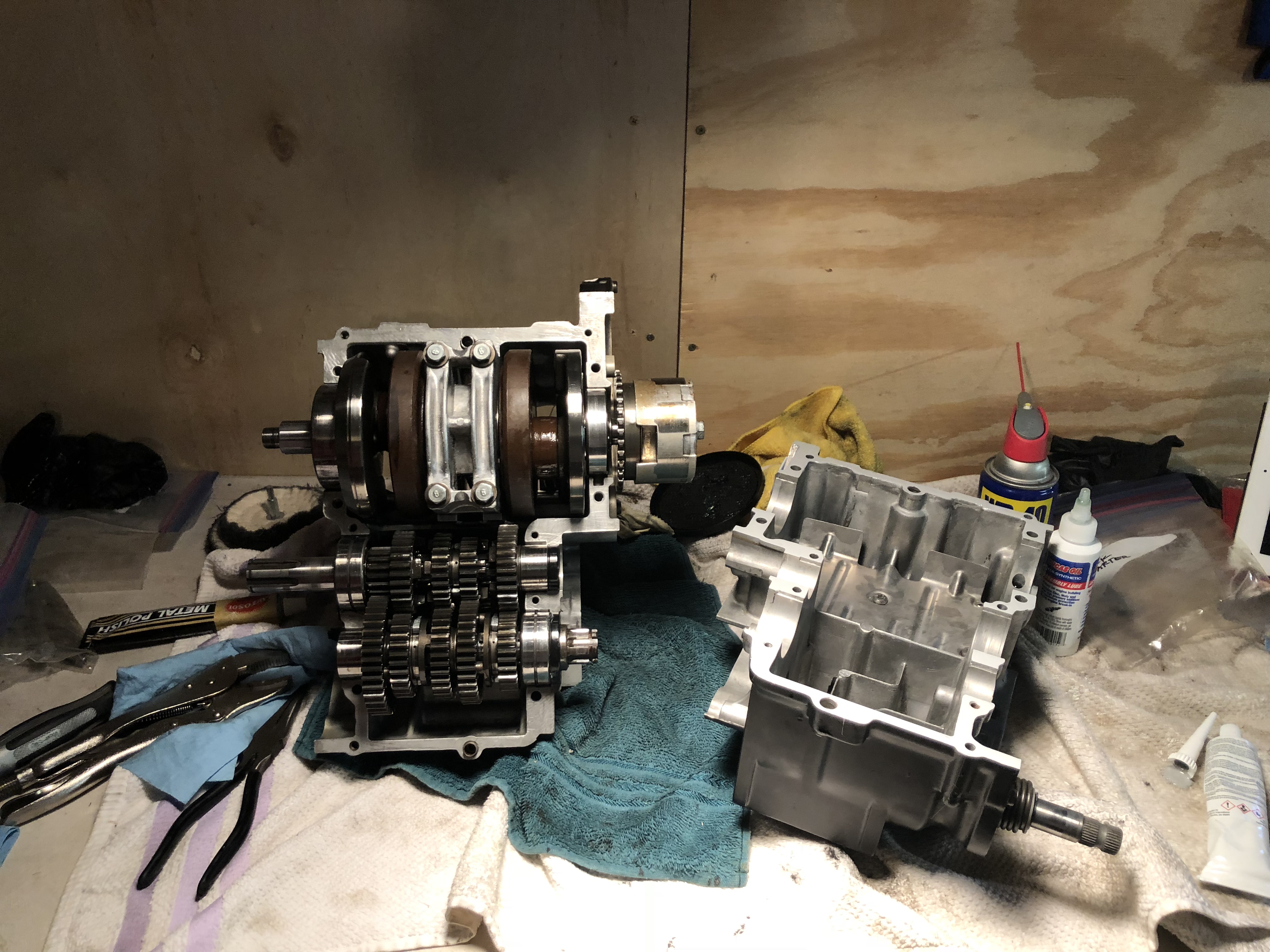
Let's get right to it! I installed the crankshaft in the top half of the case (where the transmission is), making sure I installed it with the alternator to the left and the side that drives the oil pump to the right (since the case is upside-down). Install the two locator pins (if you removed them) into the bearings on either end of the cam chain sprocket. BE CAREFUL here and reference the manual. Two of the holes are for the locator pins, and two more holes are oil galleries. Installing the pins into the wrong hols will end in tears. I twisted the bearings so the pins lay flat in the grooves on the crankcase. There are also locator pins in the bores for the outer bearings. Make sure those are in the case and twist the crankshaft bearings until you hear them click into place. Look at it from the side to make sure the outer bearings are absolutely flush with the case.

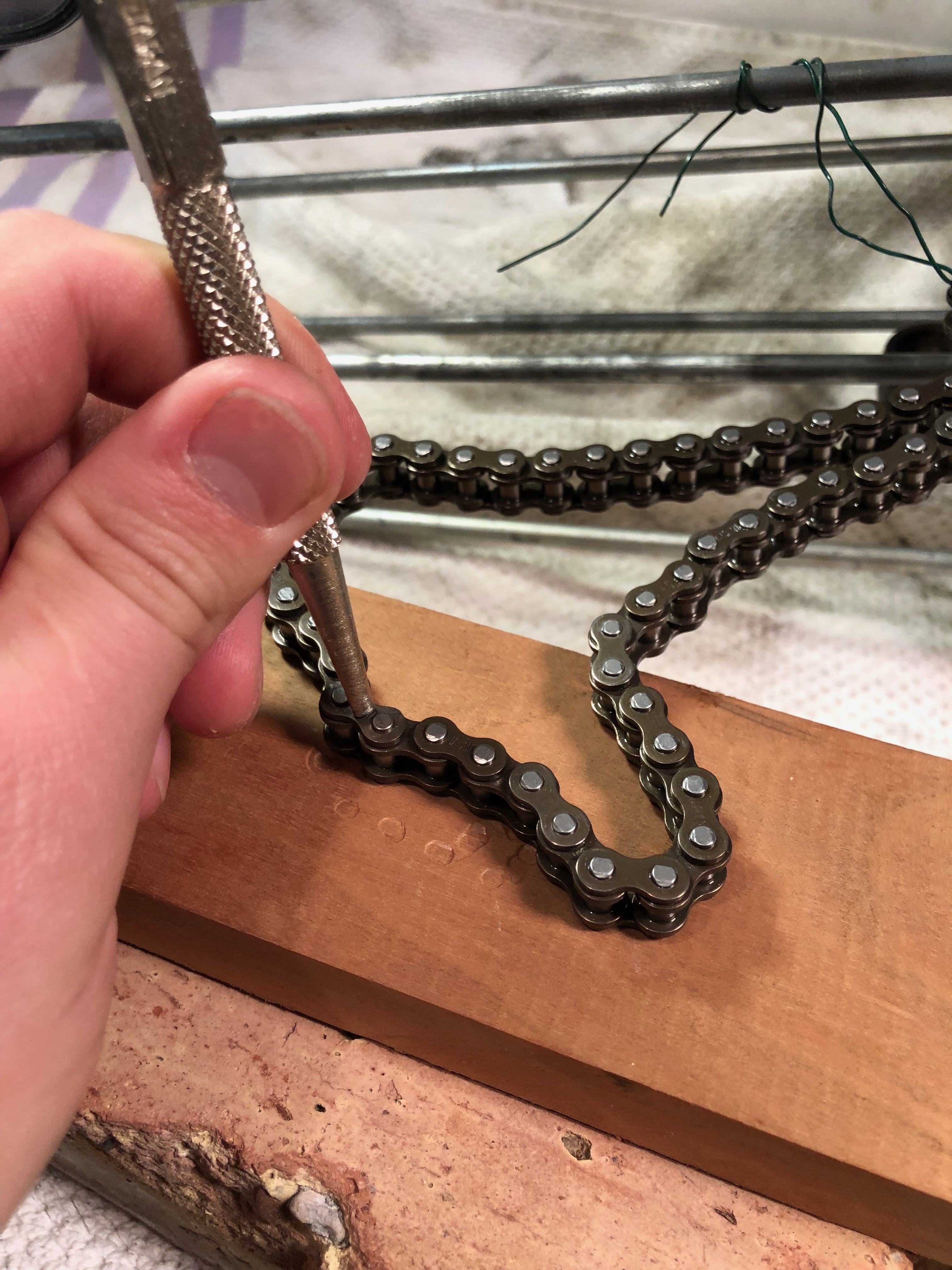
Next, I got that out of the oil bath, wiped off the excess (you really just need the oil to penetrate the links) and strung it on the crankshaft. If you have an endless chain (and you should if you are taking your engine down this far), you would loop the chain over the crankshaft before laying it in the case. My cam chain is NOT an endless cam chain, so I did it now. Furthermore, I didn't have the proper tools to close the press-fit style master link, so it's not connected for now. There's basically no info on the internet about this type of master link, but I'll figure something out later.

This is what I get for buying parts last-minute for a build and not being fully prepared, but my bike is 1.5 hours away from where I live at my dad's house, so I gotta do what I gotta do to make wrench sessions work.

Next I installed the yoke that holds the crankshaft down. Check which way you install it because it will bolt down 2 ways but only one way will allow enough room for the crankcases to seal. Look at the outline of the case surface and match that to the outline of the yoke. The notch faces the front of the motorcycle. I greased the threads of the bolts with Bel-Ray's Waterproof Grease and hand-tightened them in the threads. When hand-tight, I torqued them to 18 ft lb, slightly over factory specs (16-17 ft lb, I think) in the pattern that the manual requires. It's a simple cross pattern: top right - bottom left - top left - bottom right - repeat. I clicked the torque wrench several times on each bolt to make sure it actually reached the torque I set the wrench for.

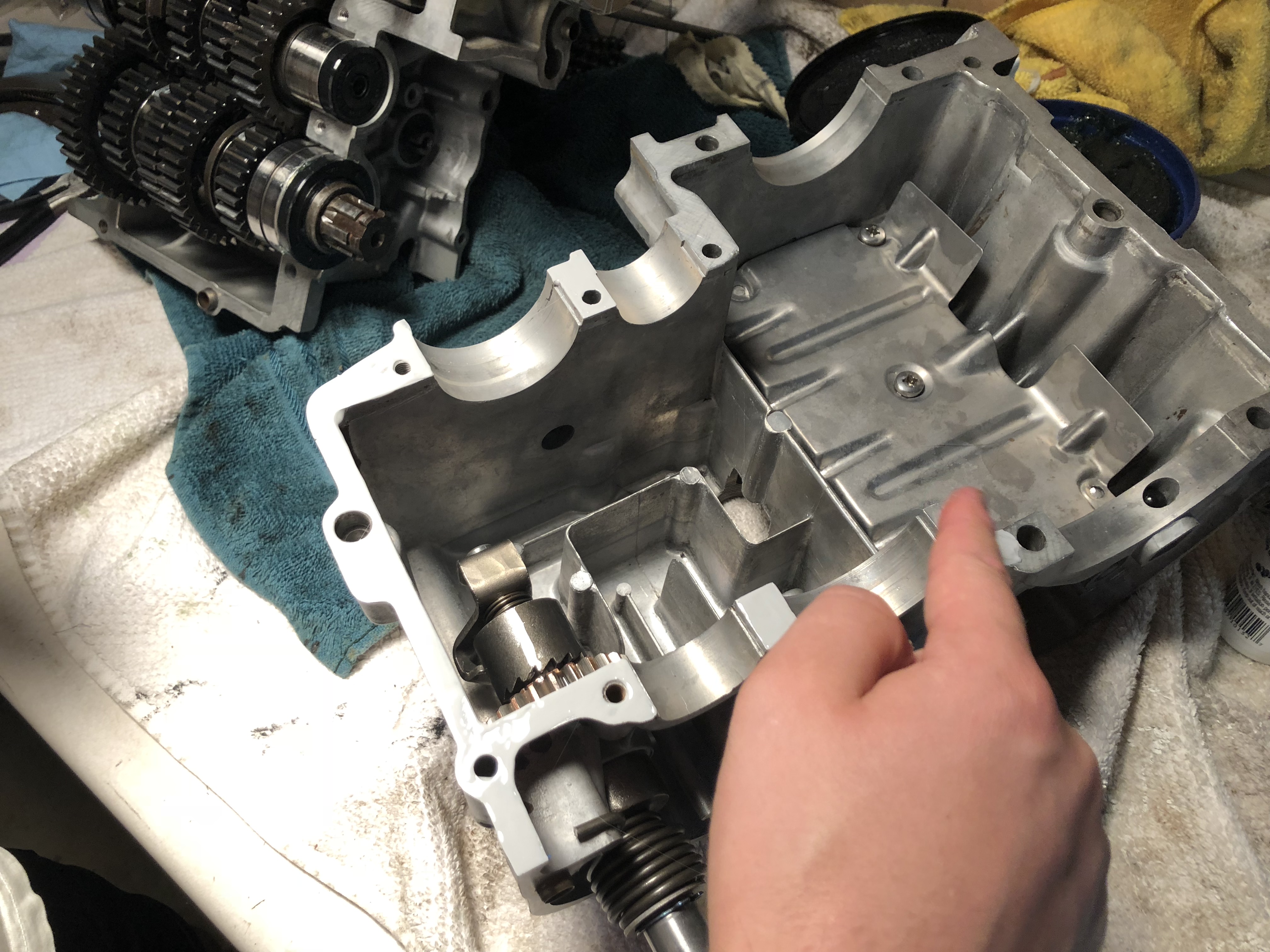
Twist the transmission shafts and crankshaft to double-check that everything still works, and the top case is ready to go! For the bottom case, I started by installing a seal for the kickstart mechanism, greasing the lips as before. Then I used the brass wire wheel to clean some light surface rust off of some of the kickstart mechanism gears. I applied assembly lube to all the moving parts, both on the kickstart spindle and inside the bores of all the gears.

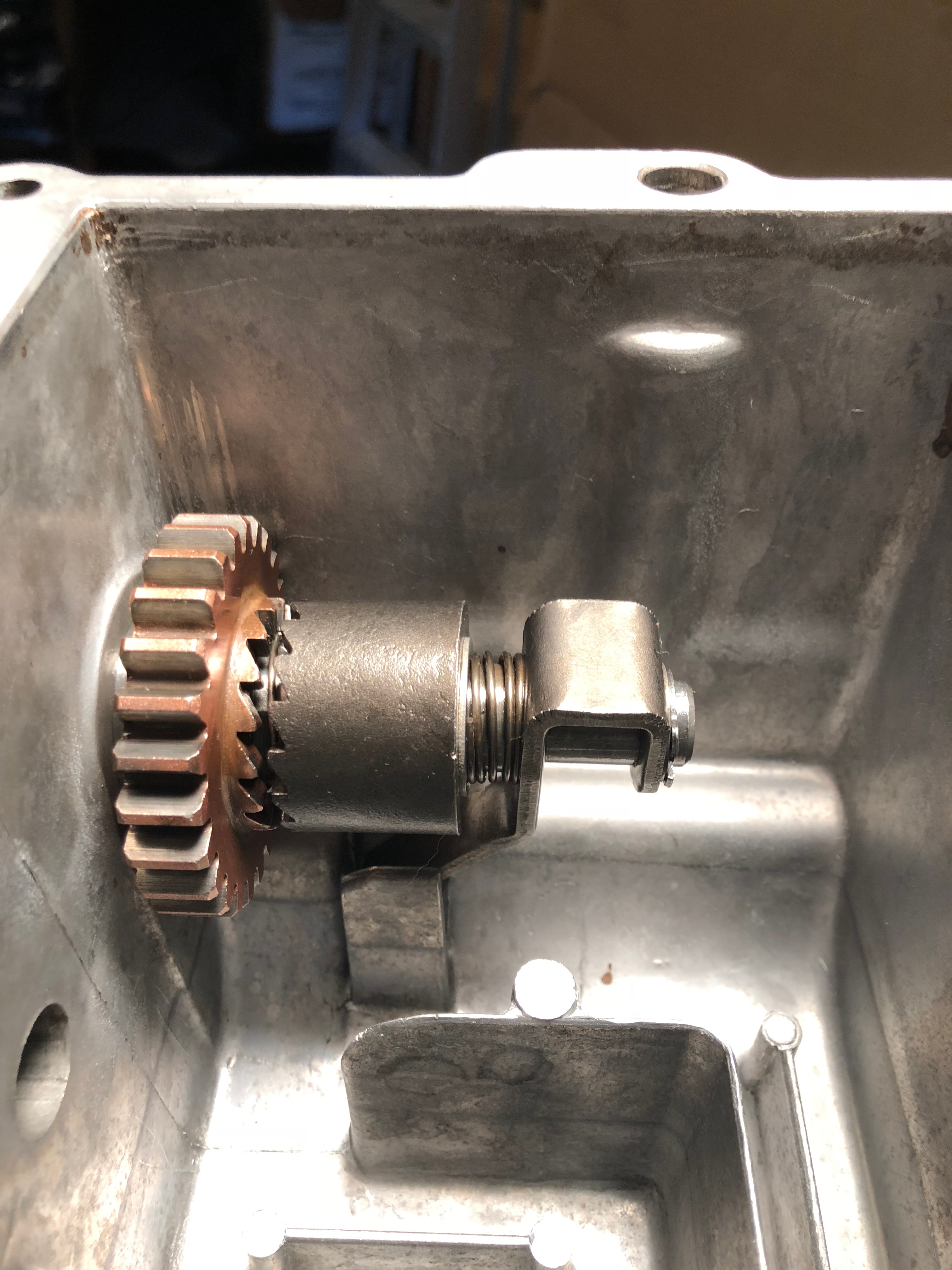
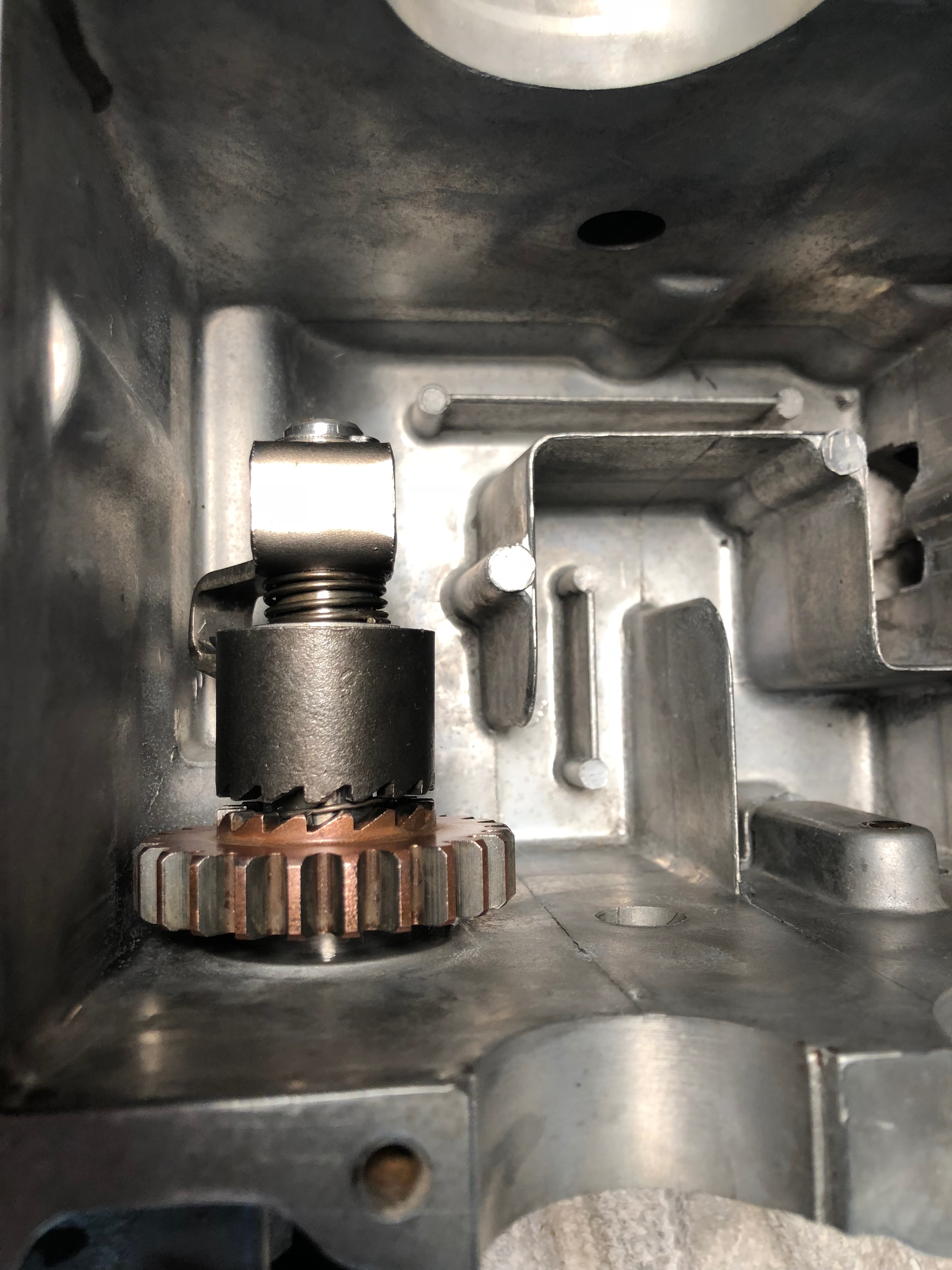
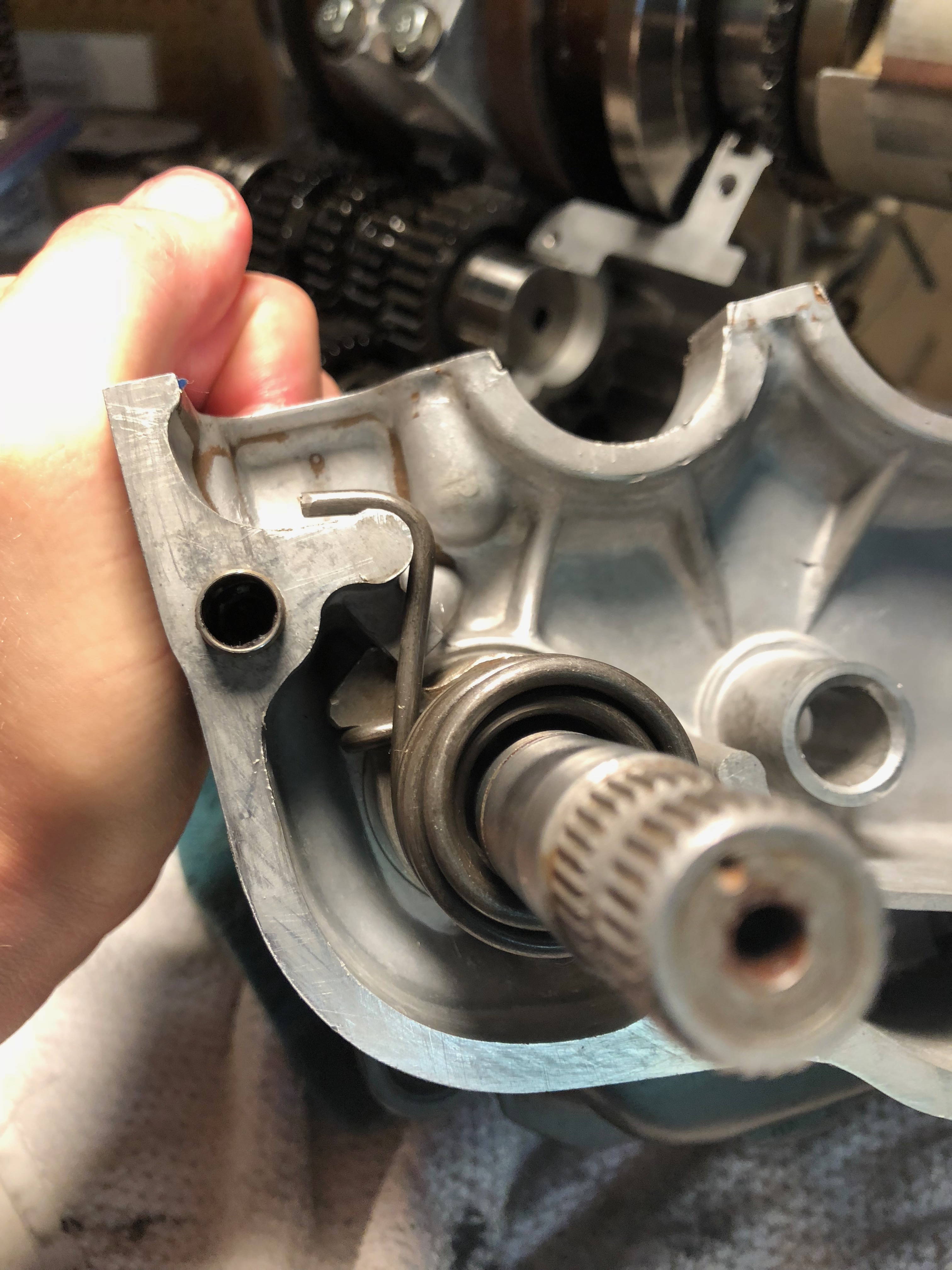
I installed all the parts on the spindle inside the crankcase in the order it shows on a parts fiche. I took my time because it's kind of tricky, even with the photos I took on disassembly. The kickstarter spring that goes outside the case and torques it was also tricky to remember how to install. I rotated the spindle counter-clockwise until the tooth on it was butting up against the case around 10 or 11 o'clock. Then I hooked one end of the spring around that tooth, wound the spring one full rotation ALL THE WAY AROUND the spindle and hooked the other end to the rib on the case "north" of the spindle. If anyone's reading this, please take a look at my pictures below and tell me if everything looks correct.

With everything installed for the kickstarter, I used a damp towel to lightly rub mineral spirits on the crankcase mating surfaces to get everything perfectly clean for a good seal. Also install the transmission countershaft seal, greasing up the lips before hand as before. Then drop a new transmission main shaft seal in front of the recessed bearing. DON'T grease it up since it takes pressure from the case halves to stay put. Grease would increase the chances of it popping out.

I am ready to seal up my first bottom end!!!! I'll detail that in another post because I hit the limit for images in one post.

TdTbbku.jpg


lhHQh6K.jpg


3JYjYYW.jpg


QamiCAQ.jpg


en6spW6.jpg


4cbQ6ic.jpg


NCWlt7V.jpg


IYwpncf.jpg
 
Ancientdad said:

Mike, it looks right, and nice clean work so far - but I haven't been into a 350 bottom end in so long I'm not the best person to be totally sure. However, Yendor pointed out something you should check on the kickstart shaft... the snap-ring has a flat side and a slightly rounded side from how it is stamped/made, and the flat side is the one that should be facing out to get the squarest edge on the outside of the groove to help it better retain the assembly on the shaft. The more rounded side can more easily jump out of the groove.
 
Here we go guys, the grand finale of the bottom end. It took me a year to get this far but all the research and wrenching has been worth the satisfaction I feel. I learned SO much about critical components of the bike. Got to see the crank for myself and have visual representation of the concept of shifting as I actually watched the gears move and followed the power from the crank flywheel to the chain sprocket. It's been an awesome ride, and this community has been CRITICAL in my success. Just a few more bolts and I'll finally get to the top end!

Alright, let's wrench!

I opened my packs of new stainless steel allen-head case bolts and organized them for easy installment. I also opened my manual to the page that shows which ones go where, what the torque pattern is, and what the torque specs are.

I checked everything once more.

  • Kickstart mechanism is in place.
  • Little rubber ball is in place.
  • All seals are in place.
  • Transmission shaft bearings didn't pop off locator pins during seal installation.
  • Transmission and crank still move freely.
  • If anyone has anything to add, comment below!
I went with ThreeBond for my case sealant. I used my finger to apply a sort of thin layer of sealant on the mating surface of the bottom case, avoiding the bores for the transmission and crankshaft.

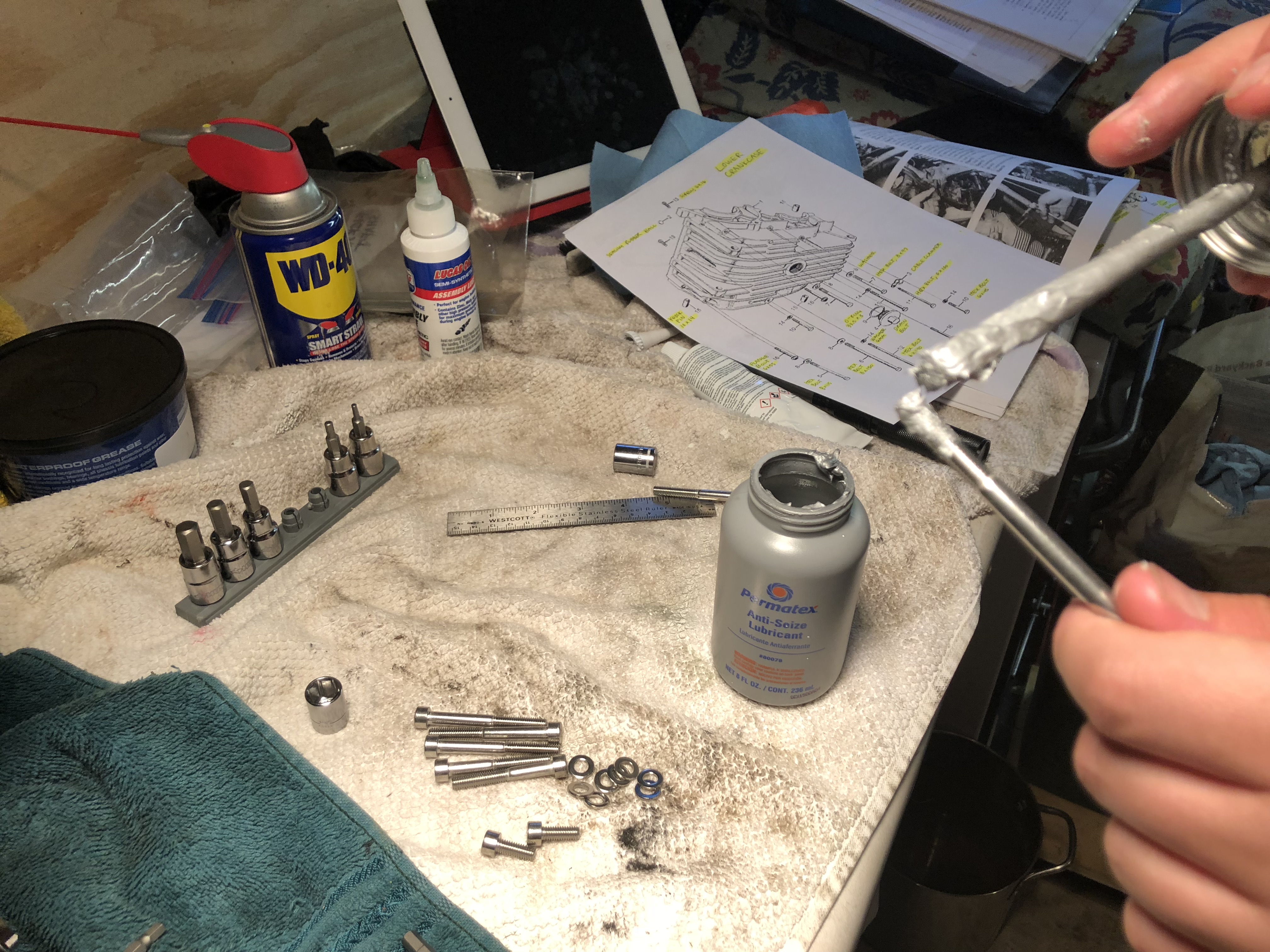
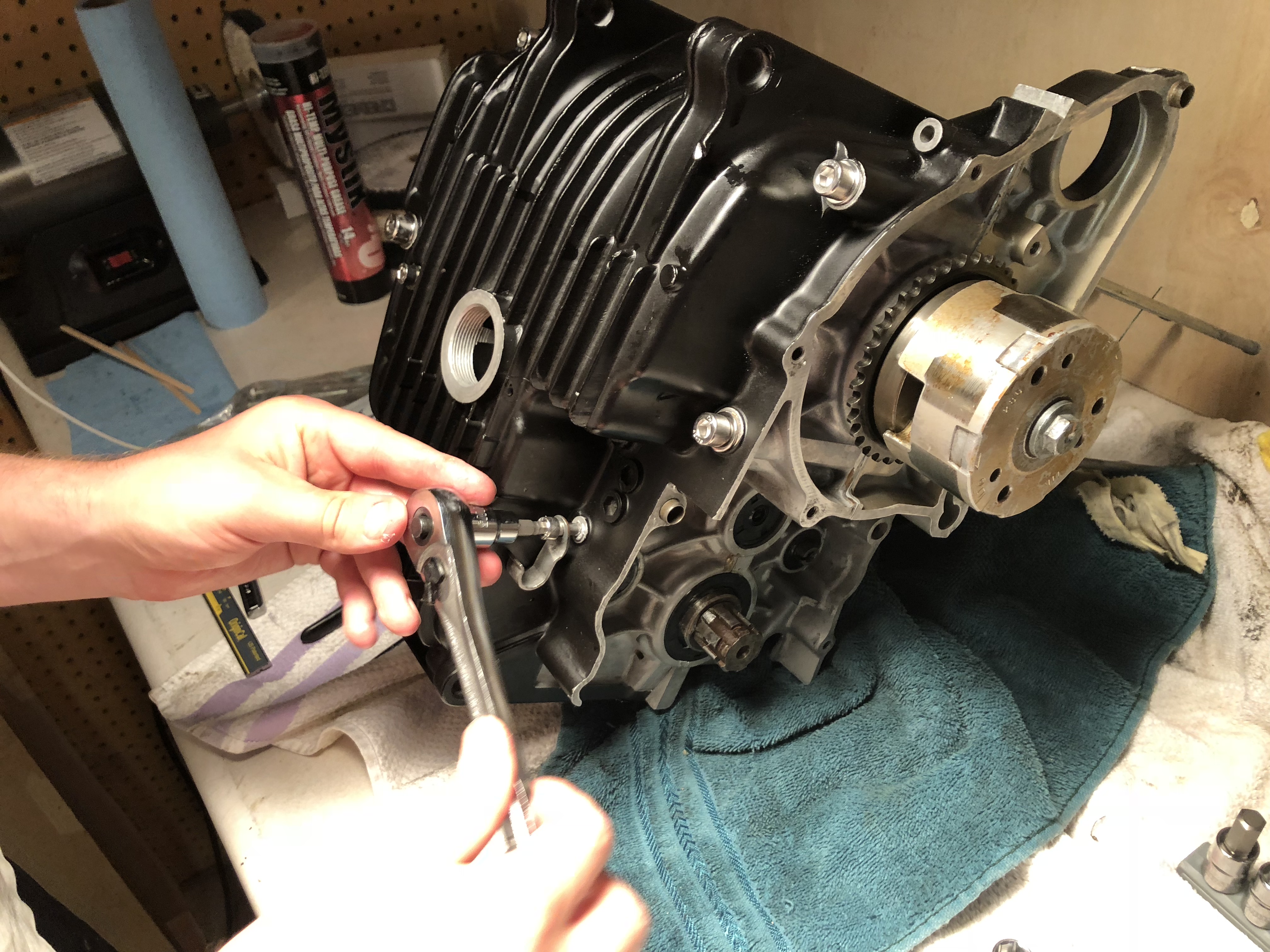
I placed the bottom case on the top case and made sure the seals were still in place. I put anti-seize on the case bolts and dropped them in their threads. First I hand-tightened them all. Then...I found out that I didn't have the right drive adapter for my smaller torque wrench that goes down to the factory spec of 6 ft lb!!! Stores were closed and there was nothing I can do...I guessed at the torque and used a "dumb" socket to torque everything in the sequence from the manual. In the morning, I got the drive adapter and verified torque with my torque wrench. Most bolts had to be backed off a bit, so I think I'll be ok with how my ThreeBond sealed.

Behold my beautiful bottom end!

Ia4oCUZ.jpg


5uMTGWO.jpg


3Jqlk2D.jpg


PxkBGJv.jpg

 
Thanks a lot, Tom! Its all sealed up so there's no way for me to check that. I remember his advice, and in the heat of things, I forgot to check which way I was installing it...It's in the groove, but not sure which side is facing out. Fingers crossed! I will have (and plan to use) the electric start, so hopefully I won't ever need to split cases on this bike again!
 
Hey Gang, it’s been a long time since my last post. Did ya miss me? I apologize to anyone who was following along with this series for the gap in posts, but life gets in the way sometimes. Anyhow, I’m here to finish up my motor rebuild!

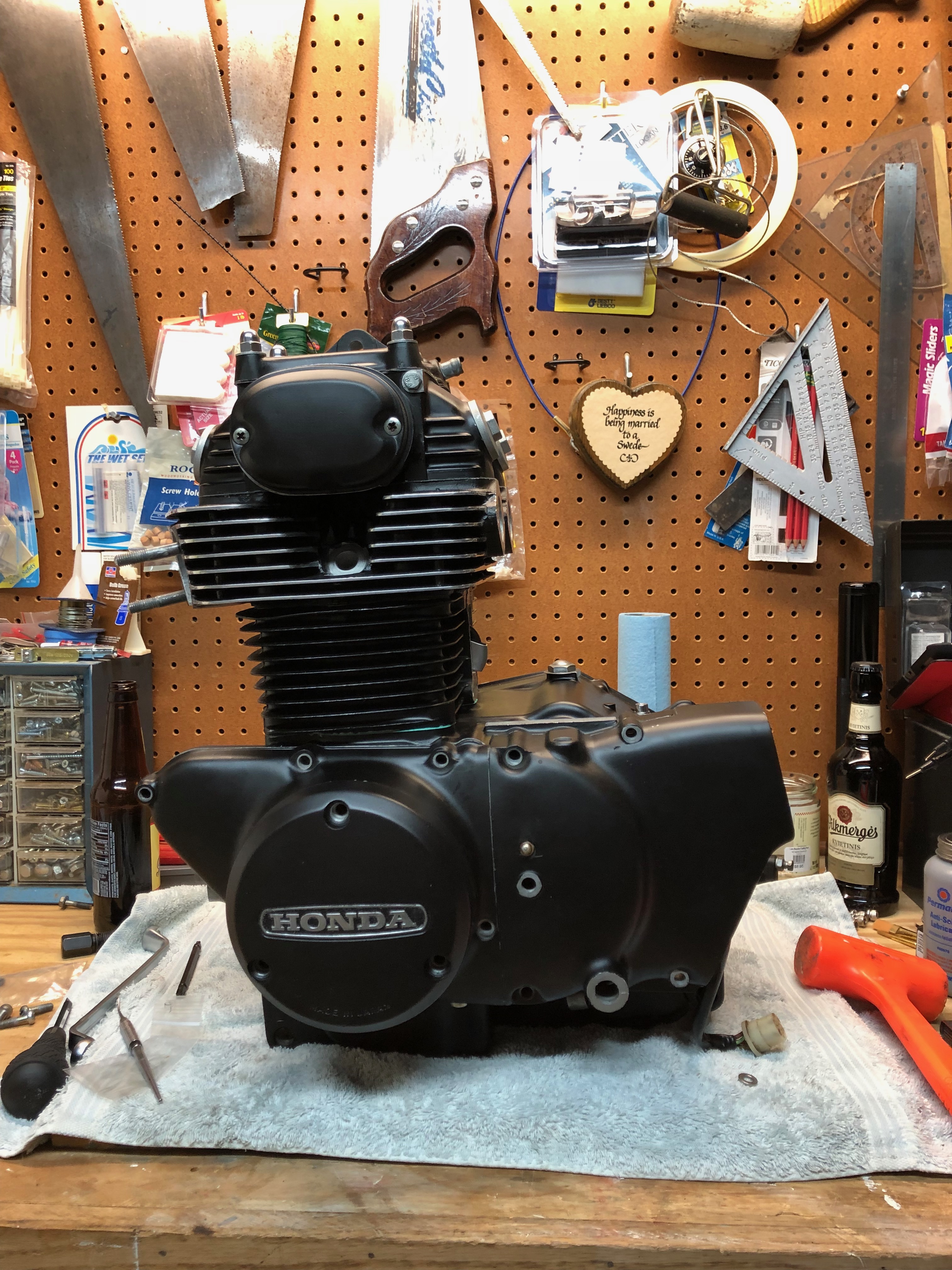
I’m stoked to finally have finished this bad boy up! It took me an entire year from taking it out of the frame to torquing down the final eight acorn nuts, but it was so worth it. I was apprehensive about taking on this task for the first time and as a total noob, but I got help from a lot of great guys on the forum and it feels amazing to be done!

I encourage everyone who’s teetering on the edge of doing this task to dive in, because you’ll learn so much about the way your machine works and appreciate it to a higher degree every time you swing a leg over.

Before I start sounding too corny, here’s the end of my series! REMINDER: I say “series” because this is NOT a How-To. It simply reflects my experience with the hope that it helps someone along the way. You need to also do your research and read the manual for your bike!!!

Here goes:

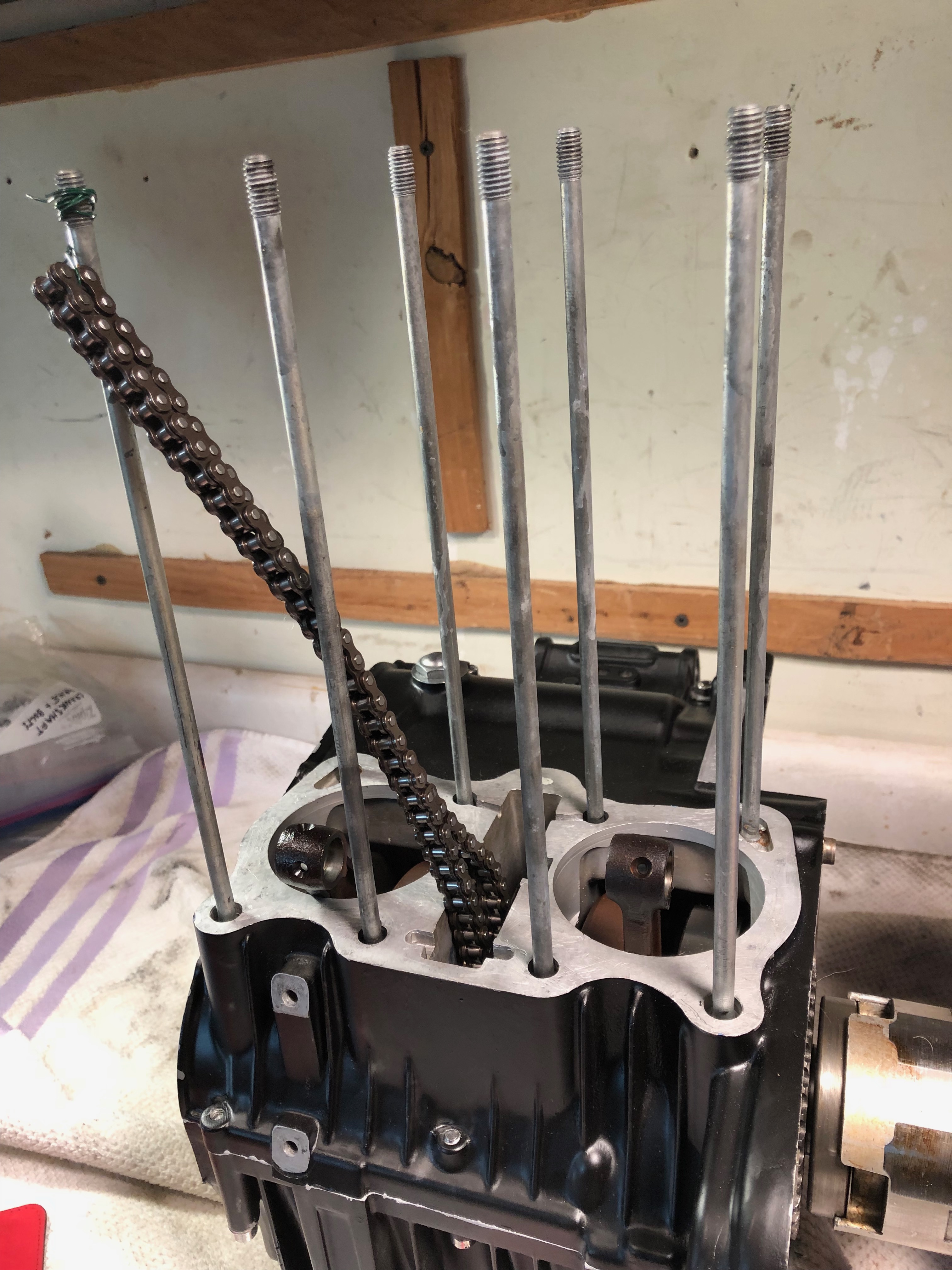
Some of you may recall I got a broken cam chain from those guys in Houston…and then I lost the master link plate. I was able to get through building the bottom end without closing it, but the time has come to do so. Common was kind enough to send out another master link, which just came in, so it’s time to resume progress.

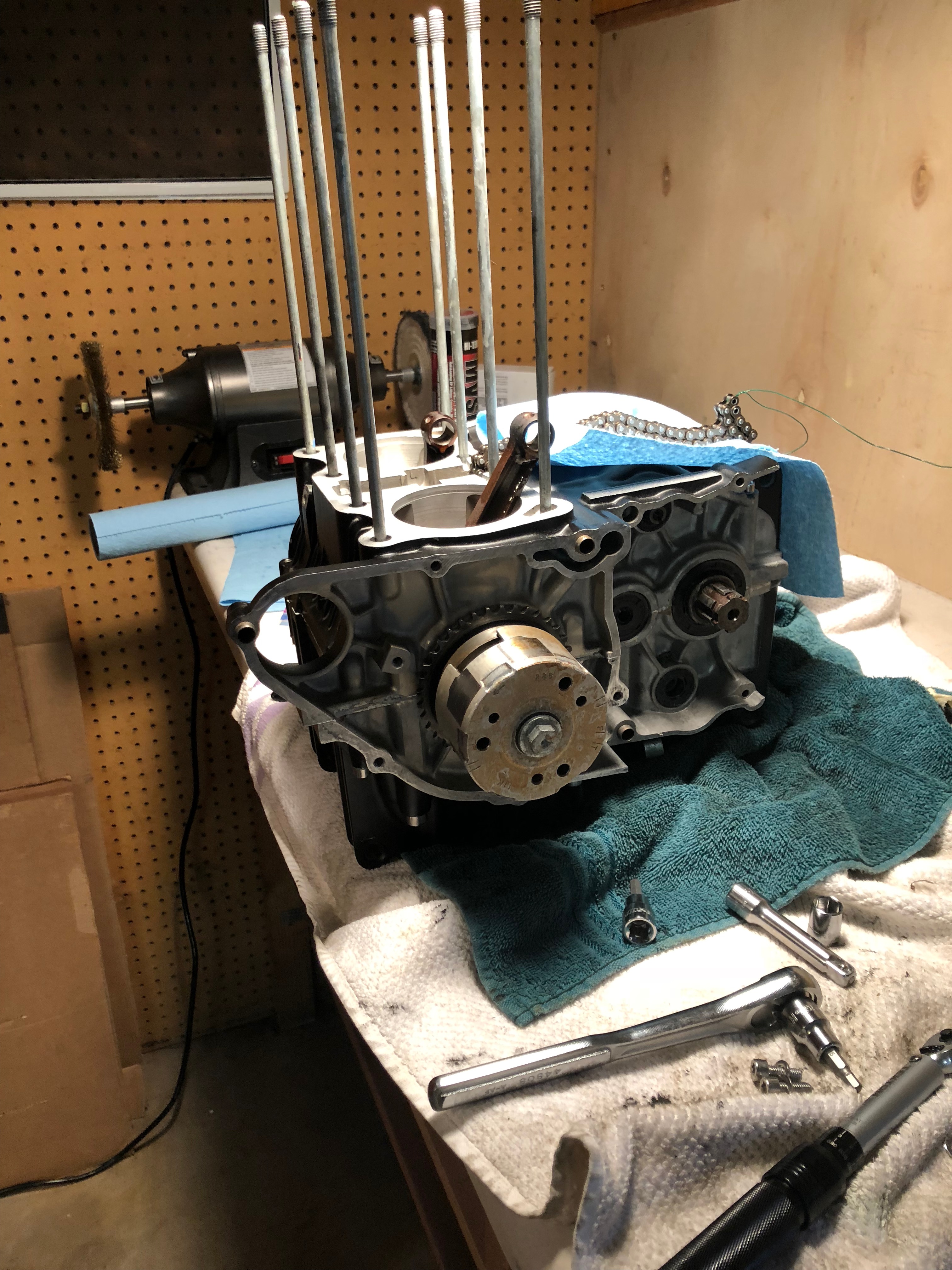
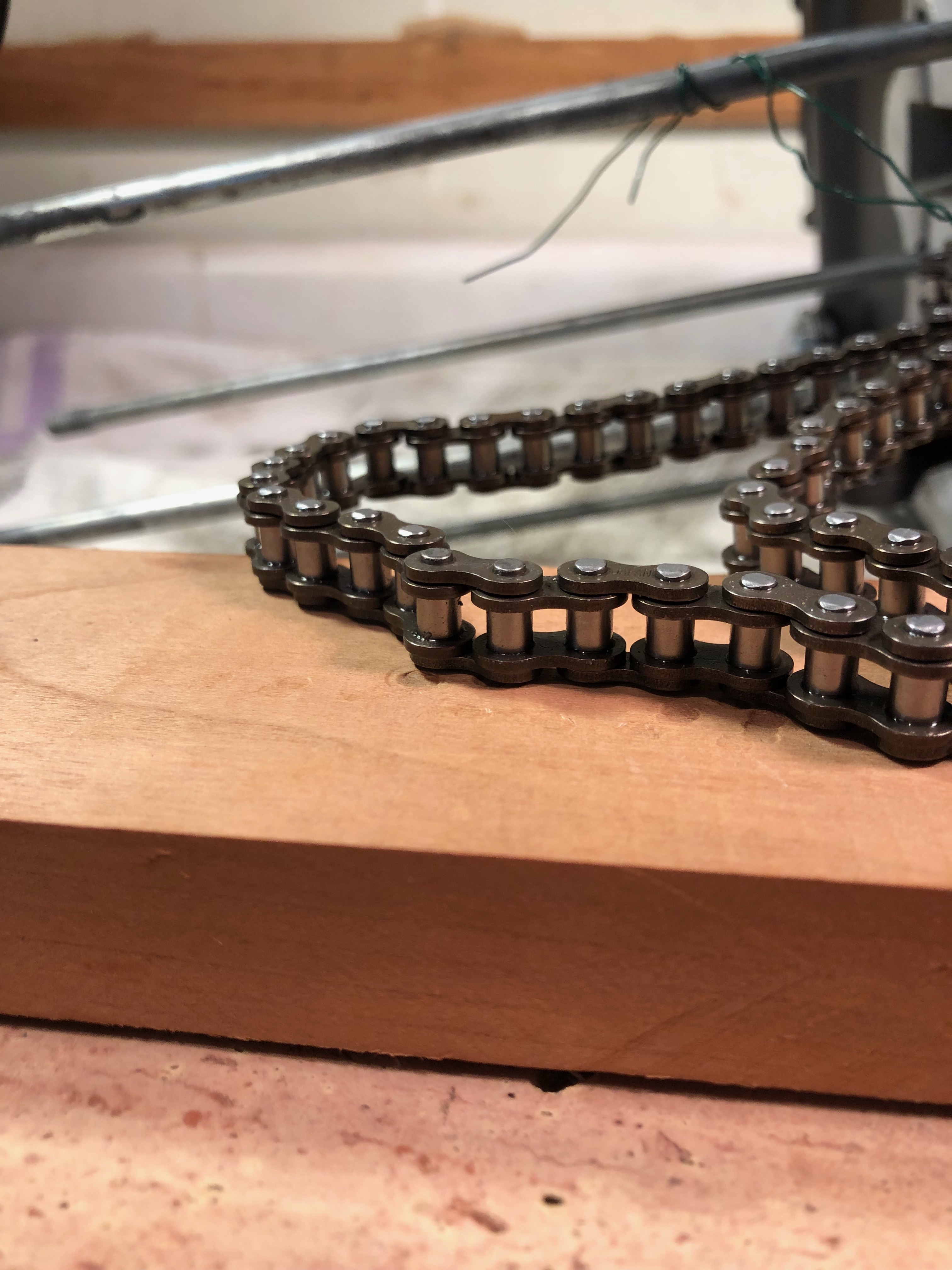
It’s a press-type, not a rivet-type or clip-type master link. There’s not a whole lot of info about these on the net, but essentially the plate onto is pressed onto the pins with a special tool and stays without peening or a cotter pin. It sounds dodgy, but people say it holds up. The mini chain press tool I ordered was too big, so I laid the motor on its side and used a large punch and a mallet to gently persuade the plate over the pins. I secured the closed chain to one of the posts with some wire.

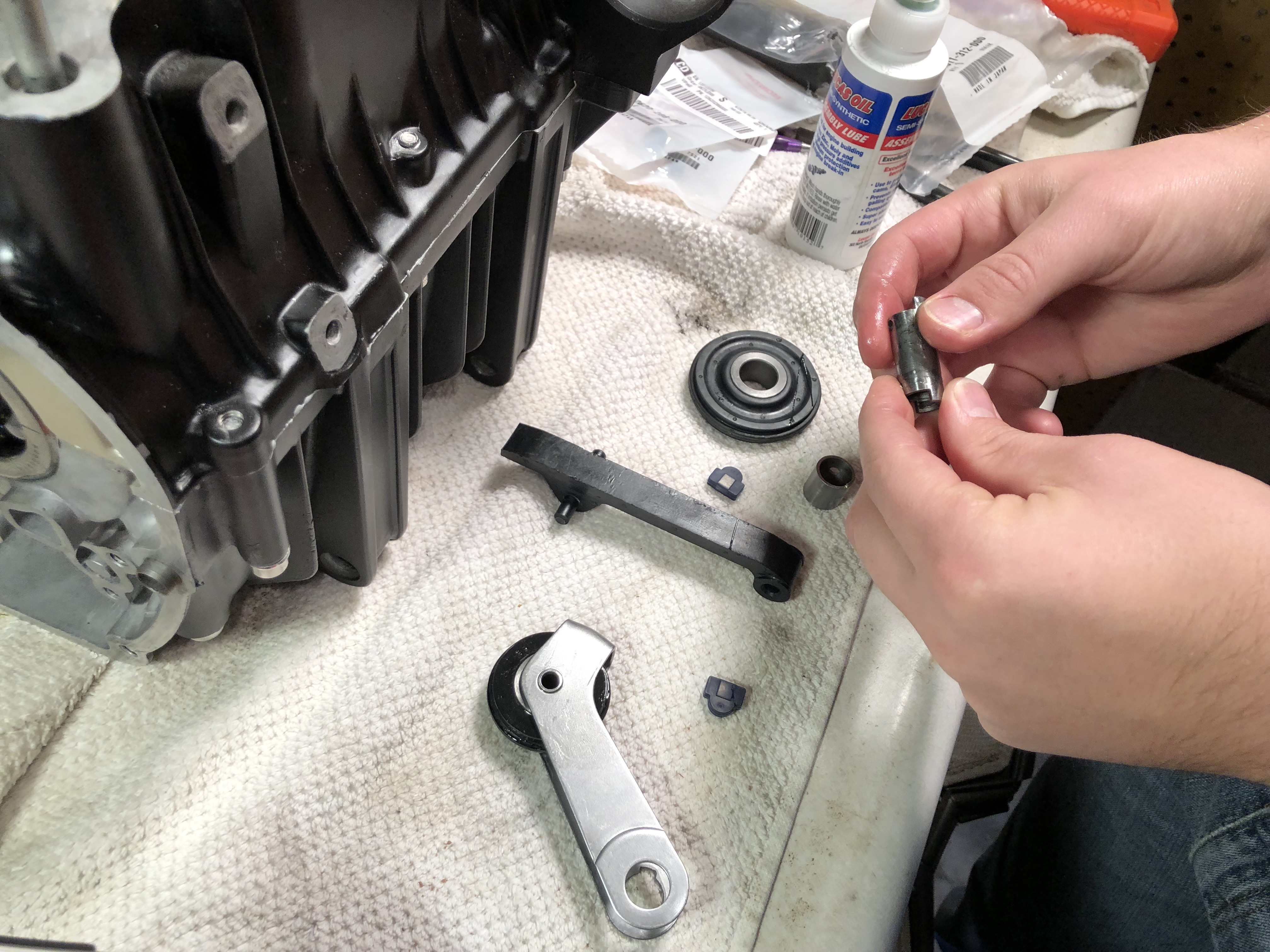
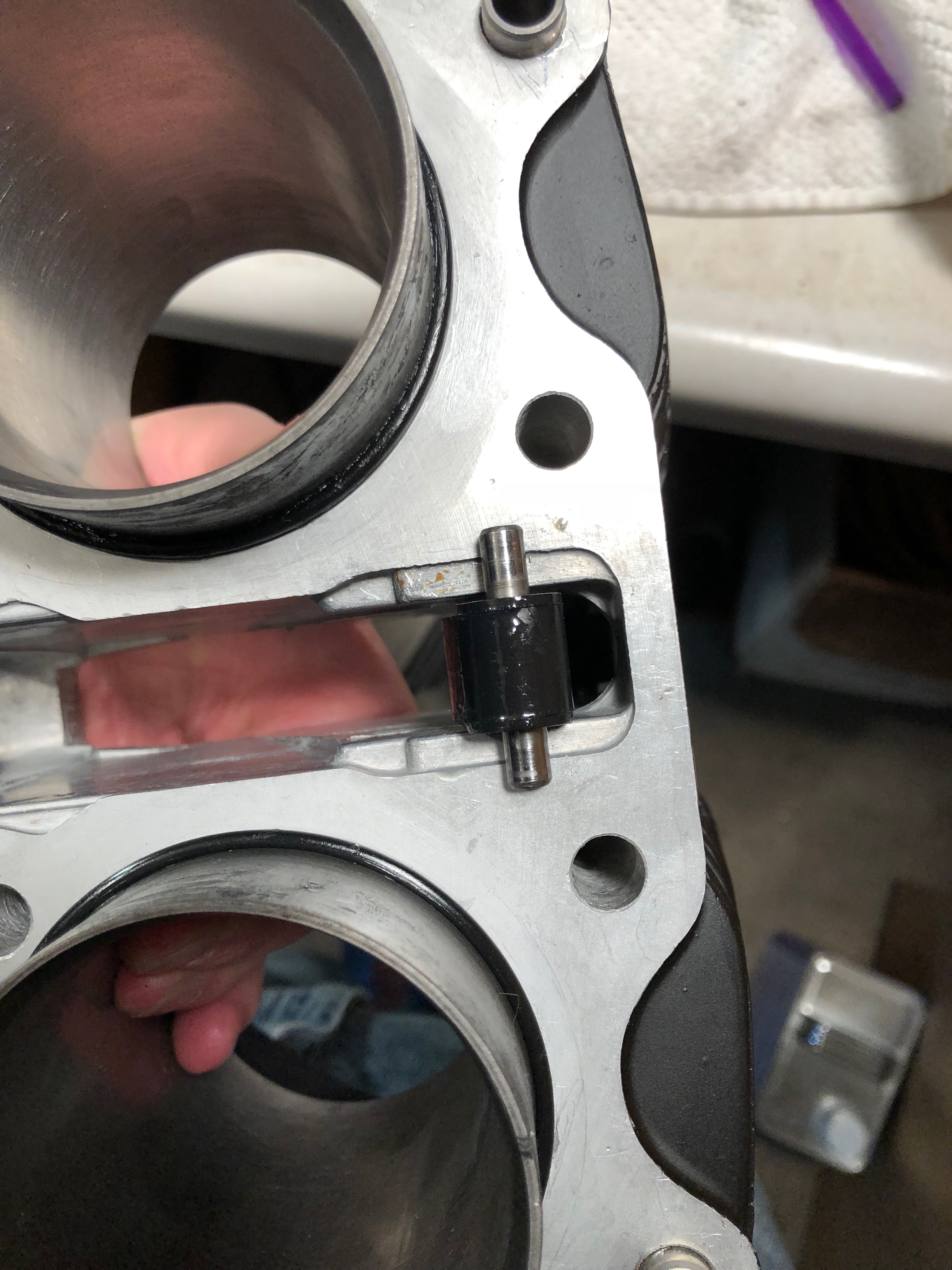
Next I installed the cam chain tensioner. I applied assembly grease to the collar and roller. I threaded the chain through the tensioner and installed the larger rubber roller, locking it in place with the tab on the roller collar. I set the whole assembly in the groove between the cylinders and installed the two tiny rubber pieces into the indents on either side of the roller. BE CAREFUL NOT TO LOSE THESE INTO THE CRANKCASE! I installed a fresh base gasket over the tensioner and secured the chain to one of the long poles.

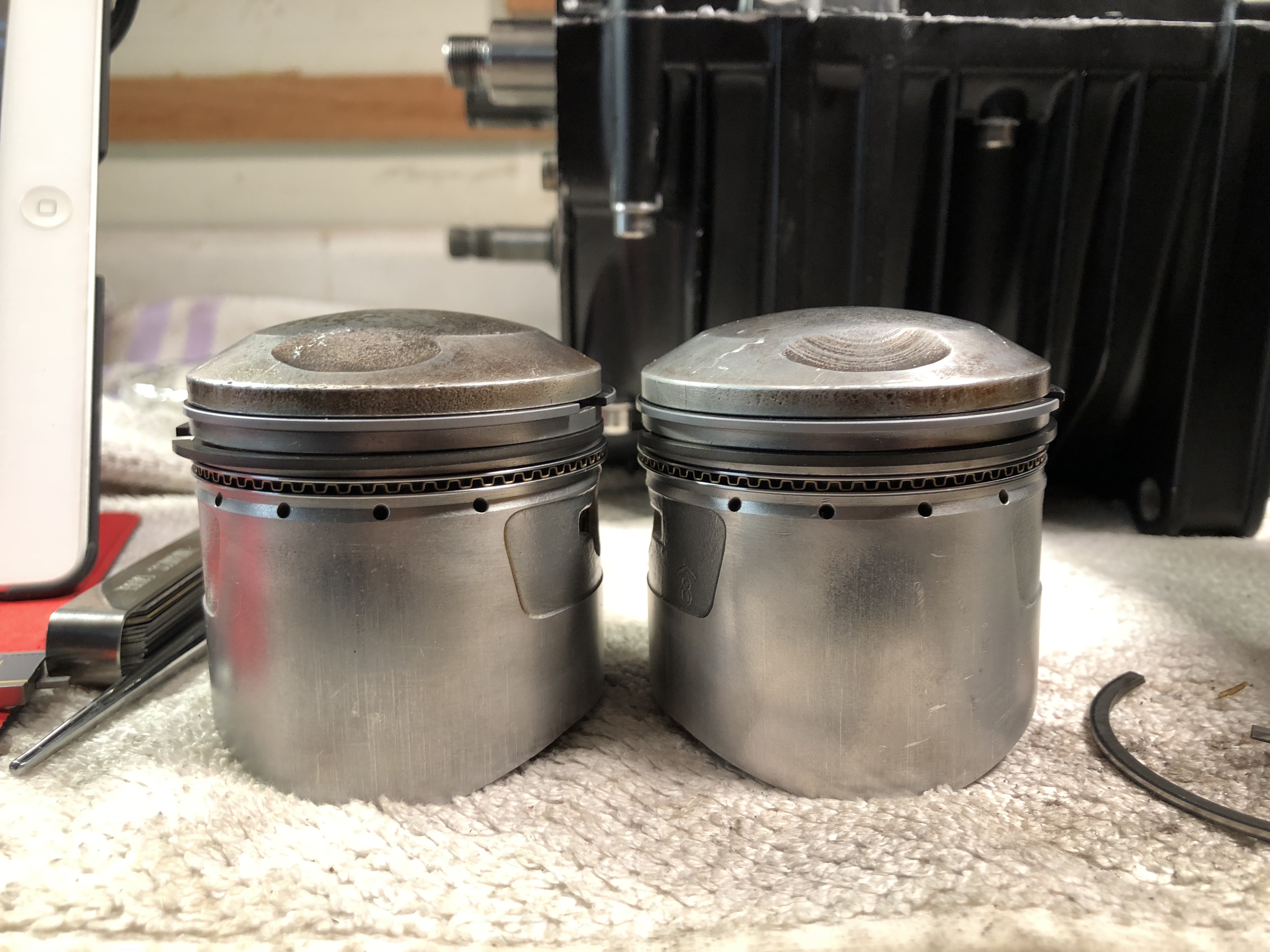
Next I put new rings on the pistons. First I measured ring gap by placing the rings into the cylinder and sliding a feeler gauge through the gap. Then I soaked the pistons in mineral spirits and scraped the grime out of the grooves with the edge of an old broken ring. Now I'm ready to install them! The three-part oil control ring goes in the bottom groove, with the ends of the wavy expander ring touching but not overlapping and the two straight rails sandwiching it. The gaps of the rails and expander should be staggered a few degrees. The steel ring goes in the middle and then finally the chrome ring goes on top. Any engraved letter or number faces up. The ring gaps should be staggered 30 degrees like a peace sign. The manual has exact specifications.

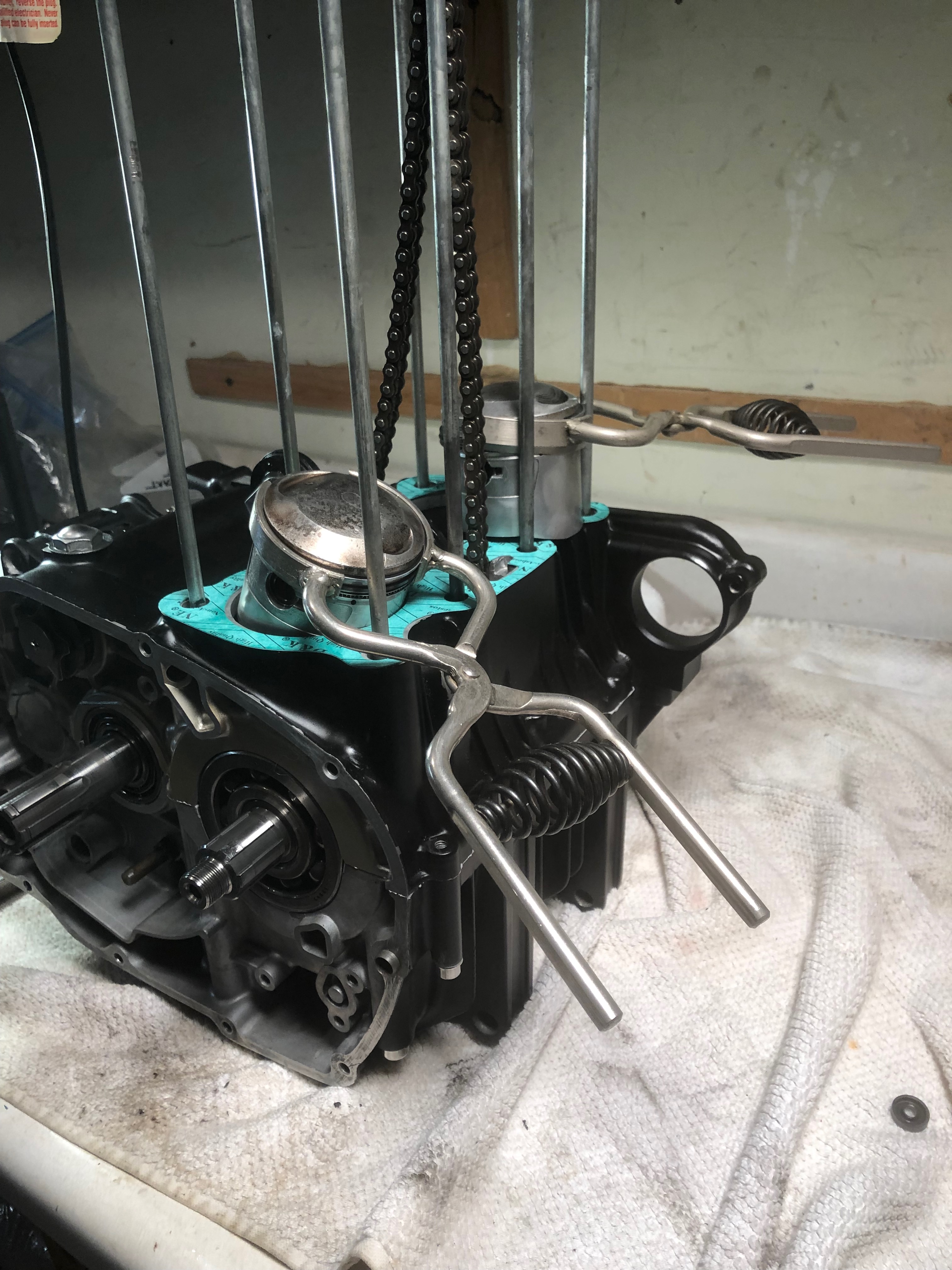
With rings installed, I can prep the crankcase to install the pistons onto the connecting rods. First I install the two knock pins that locate the cylinders (if removed). Next, I drop a fresh base gasket over the spindles.

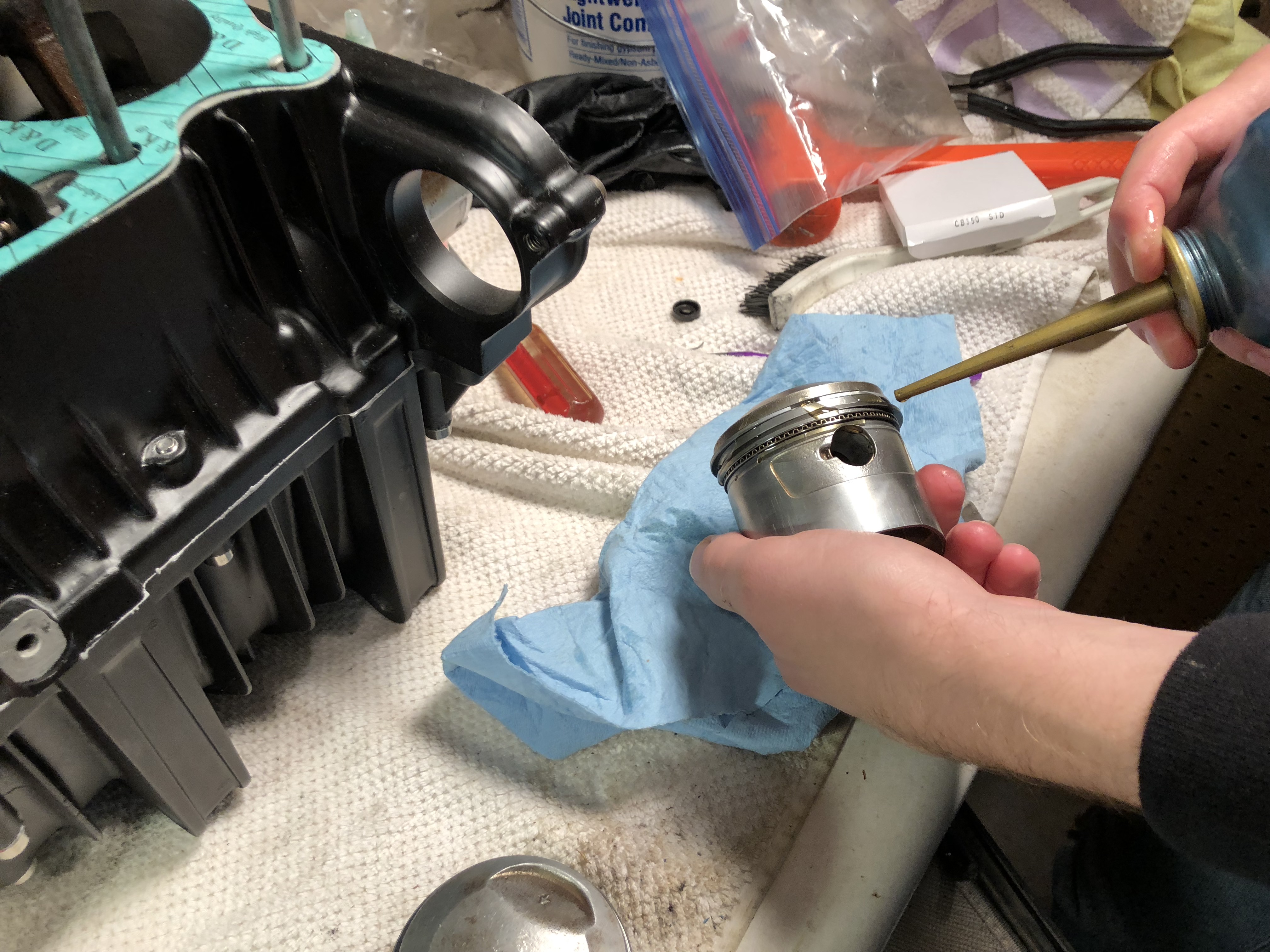
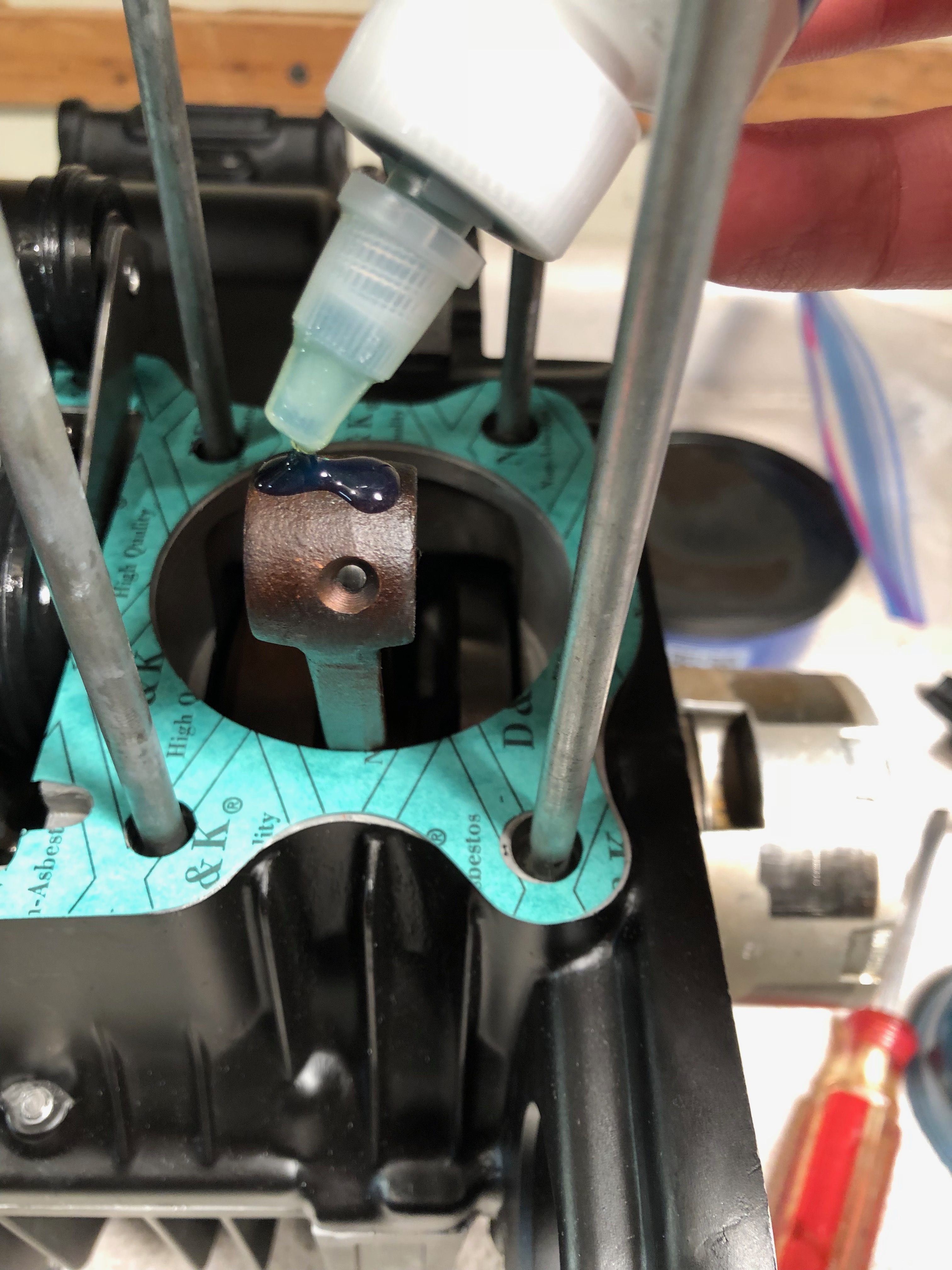
To begin, I install the inner piston ring clip on each piston to save myself a lot of headache trying to reach around the pistons when they're installed. I dab engine oil on the rings to lube them up. I also put assembly lube on the top of the connecting rod and on the piston wrist pins. Then, I install the first piston with the arrow pointing to the front of the bike. I wrap a shop cloth underneath the piston to prevent anything from falling into the bottom end and install the outside piston ring clip. Repeat for piston #2.

DON'T FORGET TO INSTALL THE TWO KNOCK PINS that locate the cylinders if you removed them. Mine are still stuck into the bottom of the cylinders since disassembly. I install fresh O-rings to the base of the cylinders. I lubed the O-rings in grease and tried not to twist them during installation. Fit them firmly into the groove so they don't get squished between the cylinders and crankcase later. I also greased and installed the rubber chain guide that goes between the cylinders. I swirl some motor oil into each cylinder with my finger and wipe away the excess with a clean towel. Now I'm ready to install the cylinders.

I'll stop here and finish up in the next post!

XFmY5dG.jpg


mE4jetL.jpg


Kf0XHGv.jpg


VFplbcM.jpg


WMAcvuP.jpg


ufRYawk.jpg


sScQL7W.jpg


lDzNbNQ.jpg


d2Kzt0t.jpg


RsS3rQV.jpg
 
As I left off in my last post, I'm about to install the cylinders.

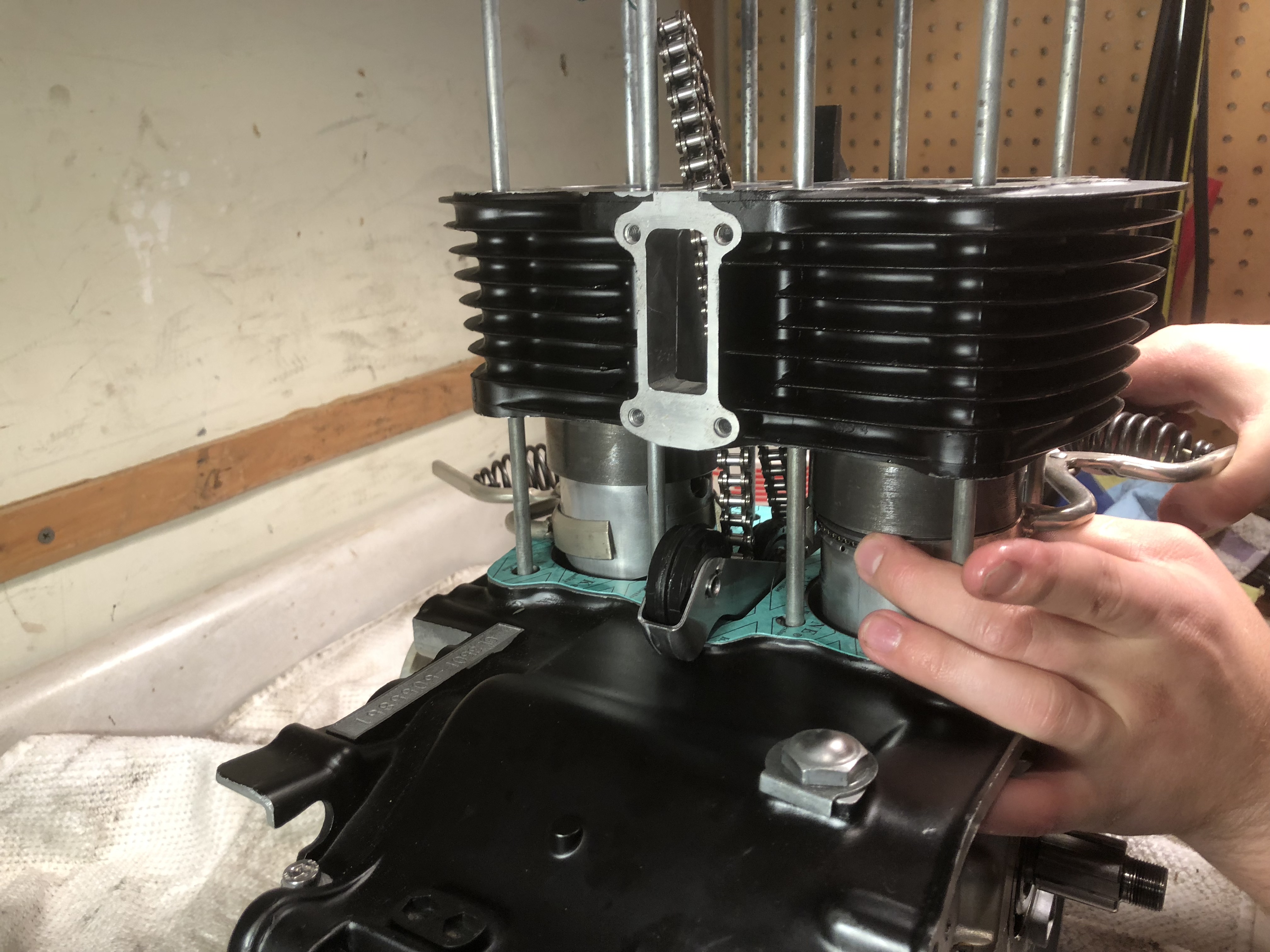
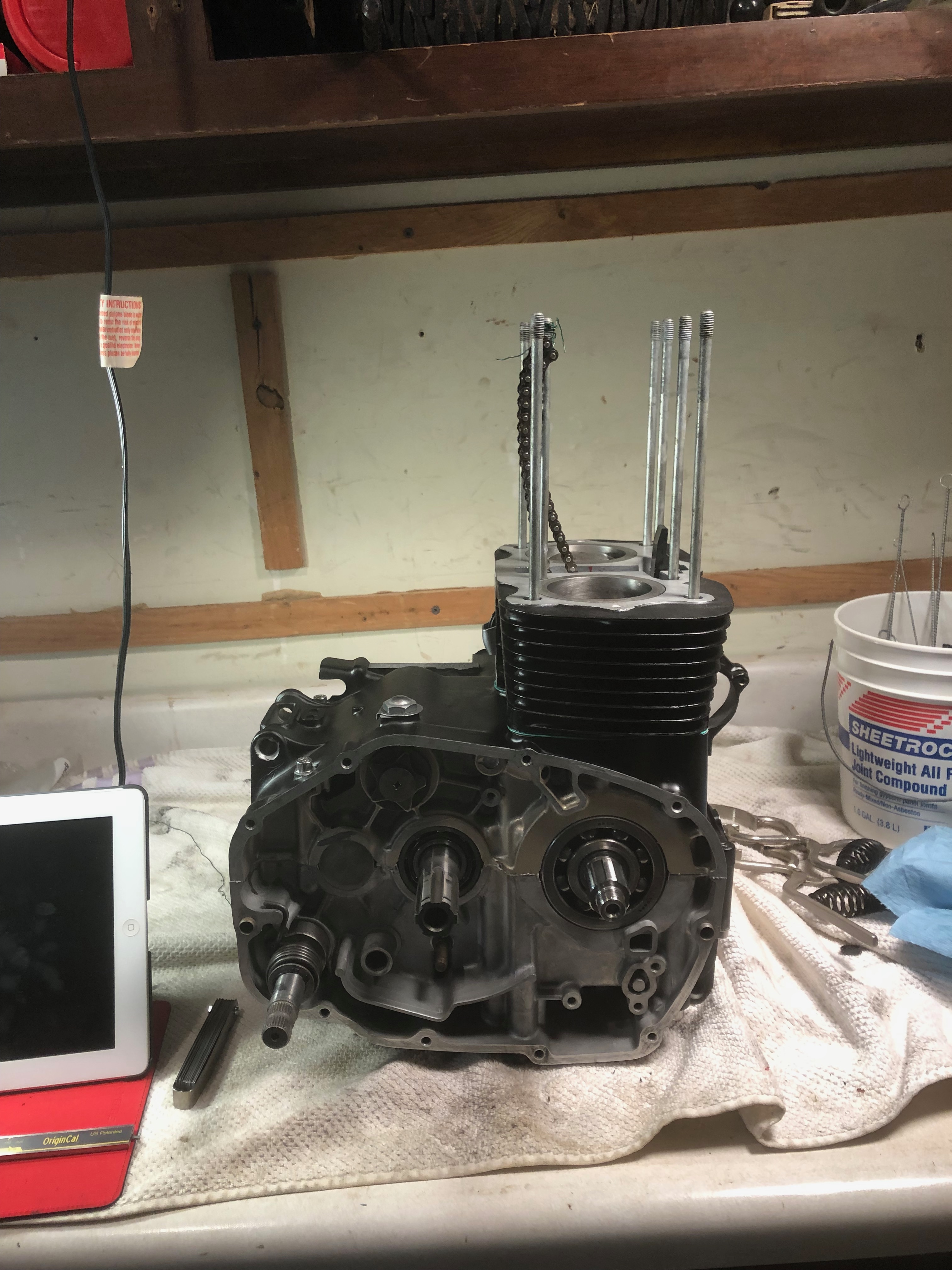
I was lucky to find some OEM ring clamps on eBay, so I got those fitted around the rings with the tapered side facing up. I check, check, double check that I have my base gasket, piston O-rings, chain guide, and knock pins all installed correctly. Then I drop the cylinders over the spindles and thread the cam chain through. I had to make a couple attempts to get the pistons into the cylinders correctly, but persistence pays off. You just have to be patient with it and it will happen.

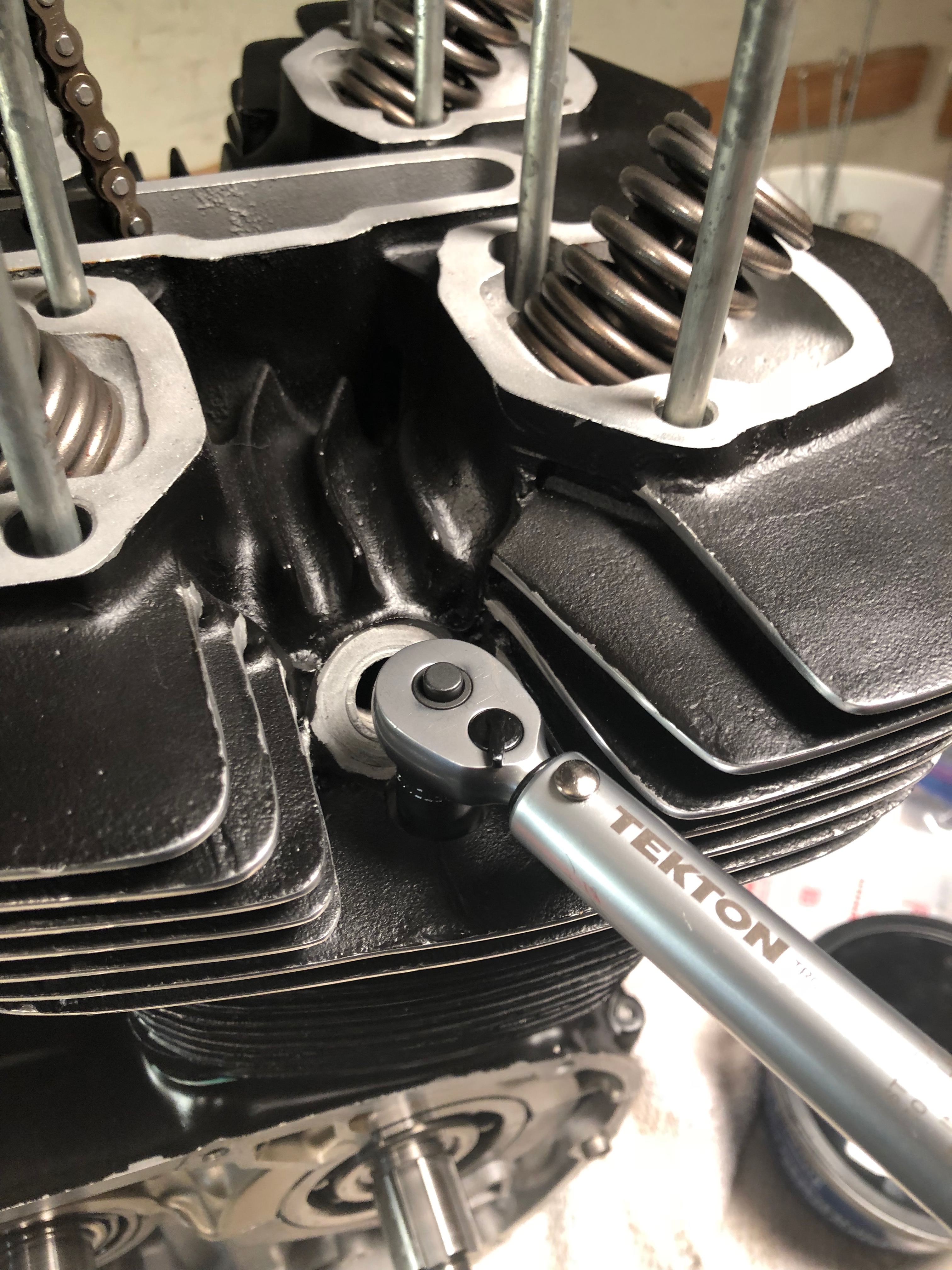
Next, I made sure my two knock pins were in place and dropped on a fresh head gasket. Then I dropped on the cylinder head, feeding the cam chain through the center and tying it off again with the wire. At this point I checked that everything still turns freely, the cam chain tensioner is loose, and everything is lined up evenly. I greased up the two bolts that hold the head to the cylinders and torqued them down to factory torque (6 ft lb I think) with my Nm torque wrench.

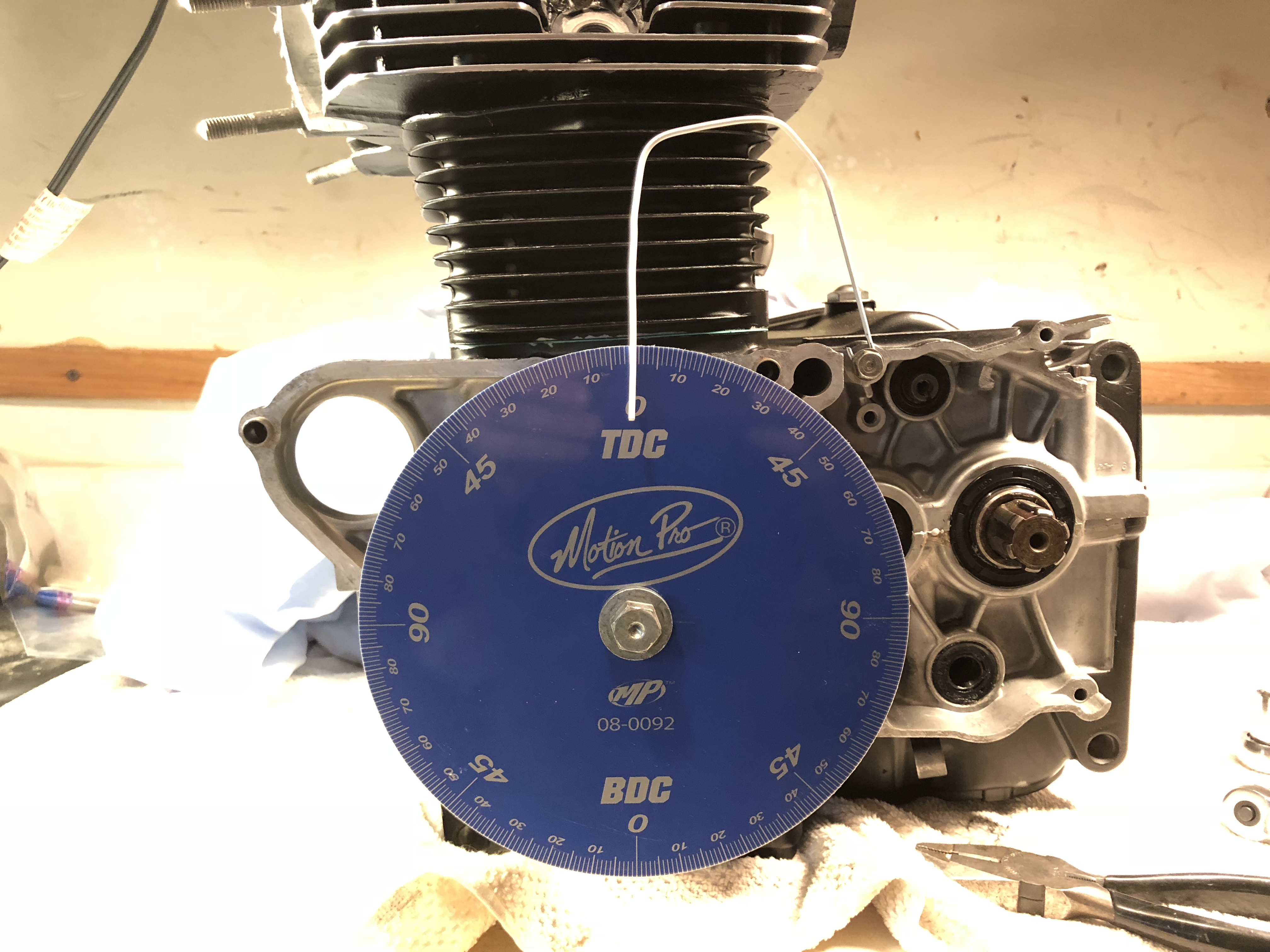
At this point, I had to find top dead center to continue with the installation. I did this with a spark plug stopper and a degree wheel. I lodged a piece of wood into a groove on the side of the rotor to prevent the crank from turning while I removed the rotor bolt. I drilled out the appropriate sized hole into the degree wheel and bolted it onto the crank on top of the rotor. I set up my tick mark by bending a piece of wire hanger and bolting it to any hole on the side of the crankcase. I rotated the engine to my best estimate of top dead center, then tightened the rotor bolt on the degree wheel so that the hanger was over 0 degrees.

Then I turned the motor 90 degrees and screwed the stopper into the spark plug hole of cylinder one.

I continued to turn the motor until the piston gently contacted the stopper and wrote down the degree marking. XX degrees.

I turned the motor the other direction until it hit the stopper again, marking down the number. XX degrees.

I averaged the numbers and adjusted the degree wheel accordingly. Now 0 degrees shows true top dead center.

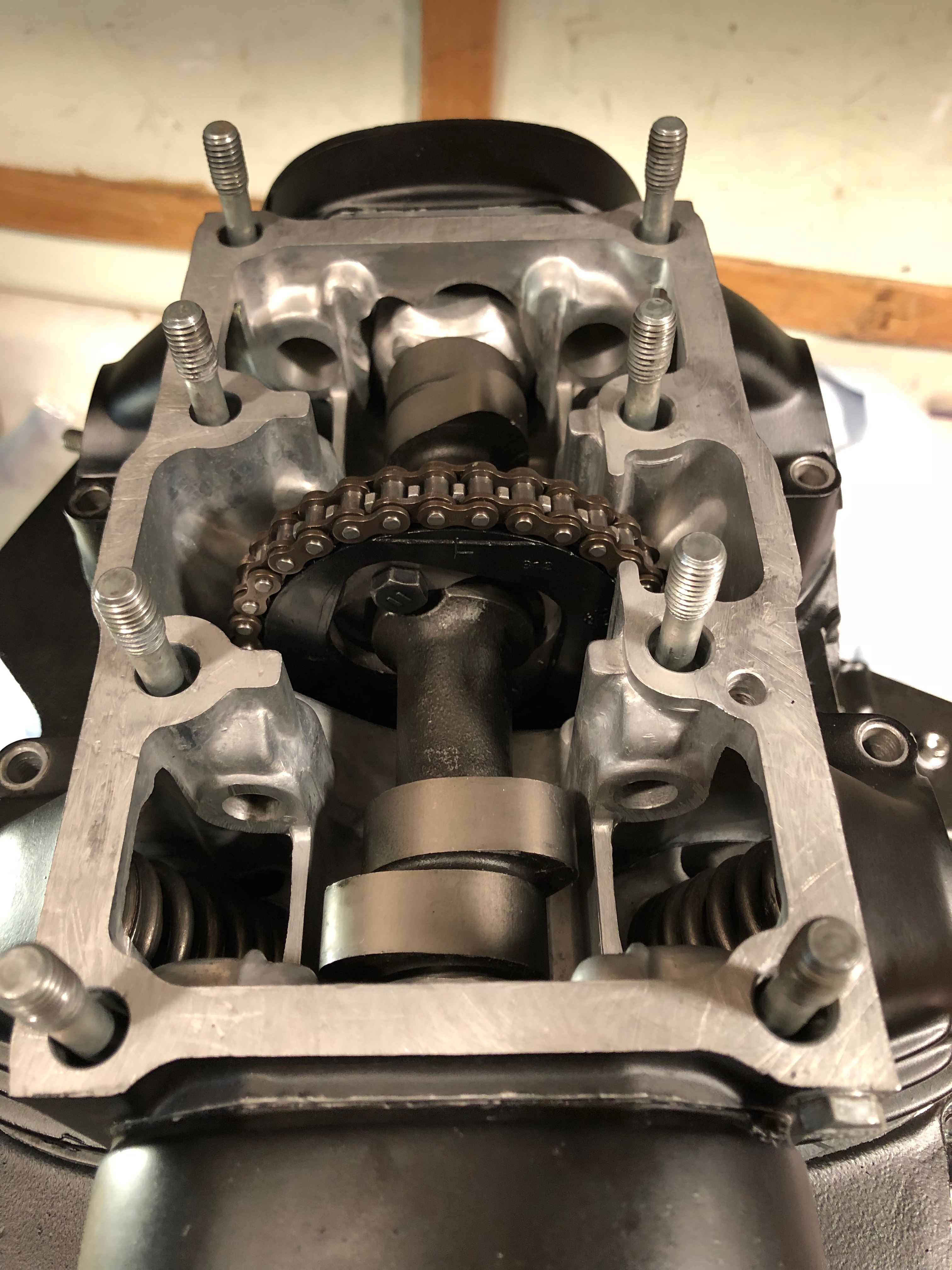
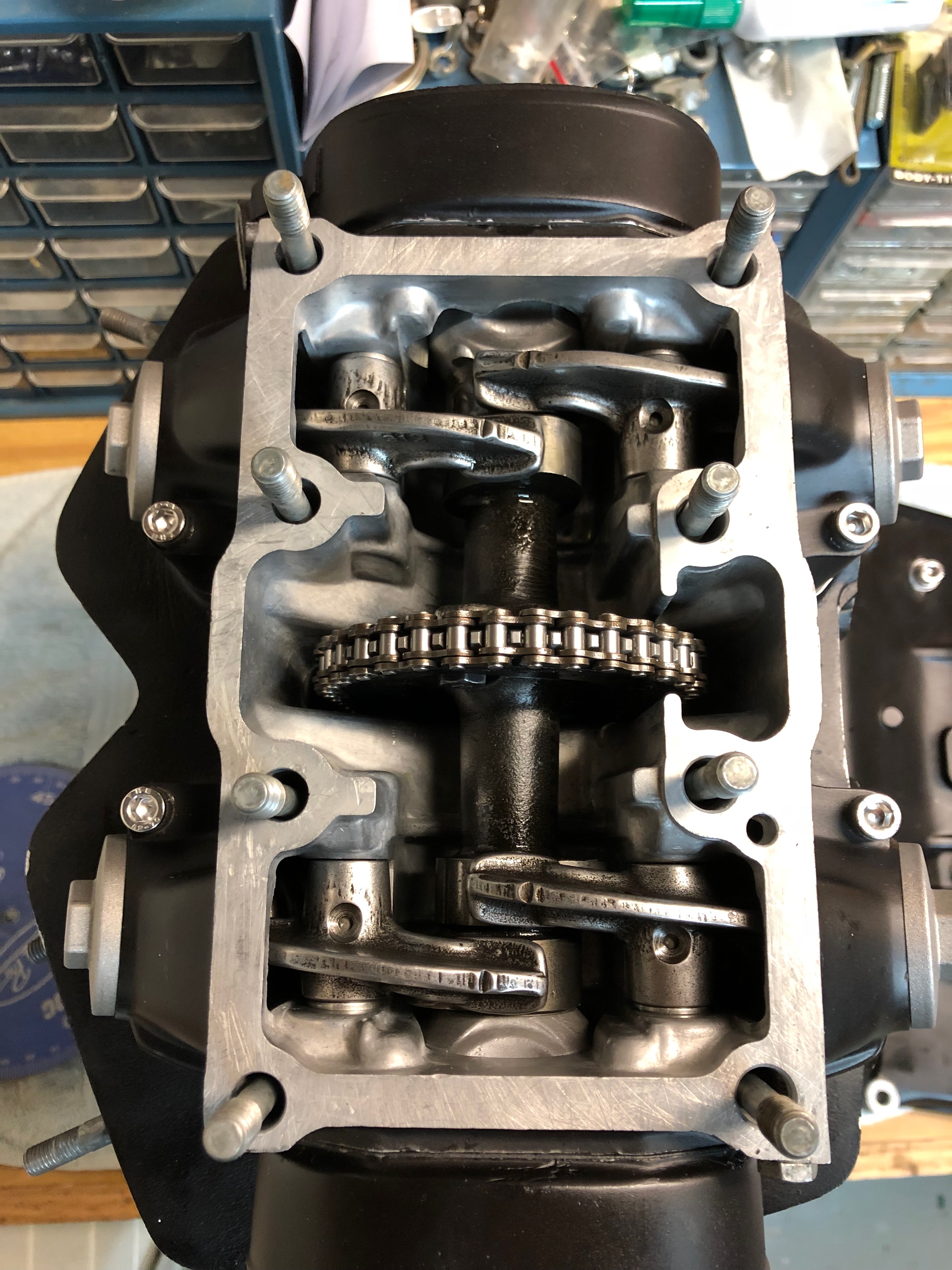
With the motor now at TDC (or as close as possible) I installed the cam sprocket with the L toward the left side of the engine and the line parallel with the cam case. Then I installed a fresh gasket and made sure my knock pins were in place. Then I dropped on the cam case.

40tyiky.jpg


PllLM3V.jpg


qFk0EgK.jpg


2cA1h7D.jpg


5wFFg0k.jpg
 
It's the home stretch, boys! In my last post, I just finished installing the cam case and cam sprocket. In this post I will start with installing the camshaft itself.

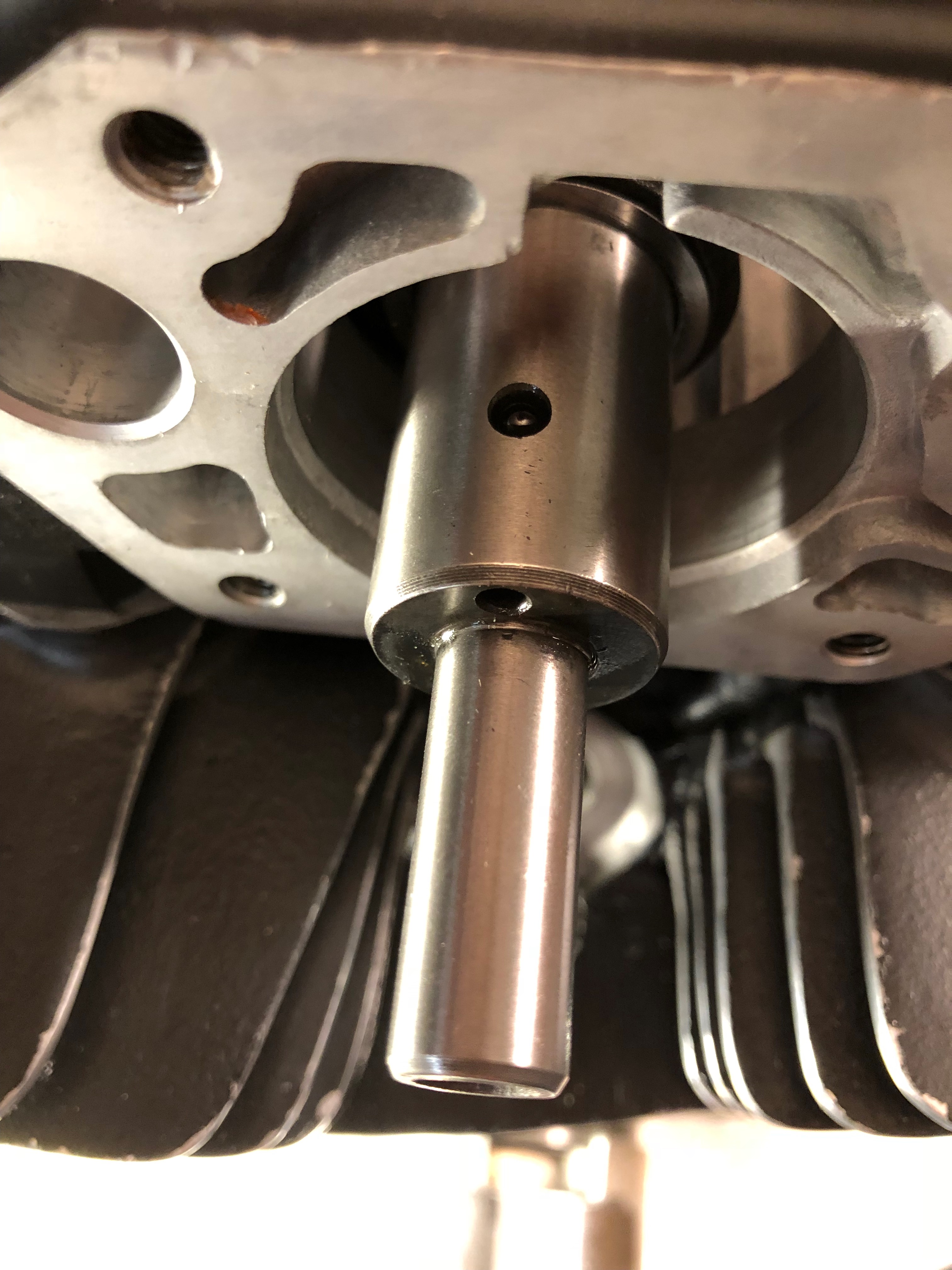
The cam only goes in with the lobes for cylinder one facing down. It rotates as you slide it through to fit through the reliefs in the cam case and sprocket. With the left cylinder at TDC, the horizontal line on the sprocket parallel with the edge of the cam case, the pin on the camshaft should face up.


Secure it with the two bolts. One of them is shouldered and the other isn't. The full-threaded one goes closest to the L. When rotating the motor to access the other bolt, MAKE SURE the cam chain doesn't slip off of the crank. If it does, you'll have to take the camshaft out again, reset TDC, and start over. This is not fun (not that I know from experience or anything...). Also make sure you you don't miss the camshaft shims that were installed from the factory.

I installed the rocker arms and pins one cylinder at a time with the cam lobes facing down for that cylinder. I applied a liberal amount of assembly lube to the camshaft lobes, rocker arm pads and pins. I twisted the pins as I installed them to spread the grease and positioned each one with the tic mark facing the outside of the engine. This positions the rocker arms at a good starting place for setting valve lash.


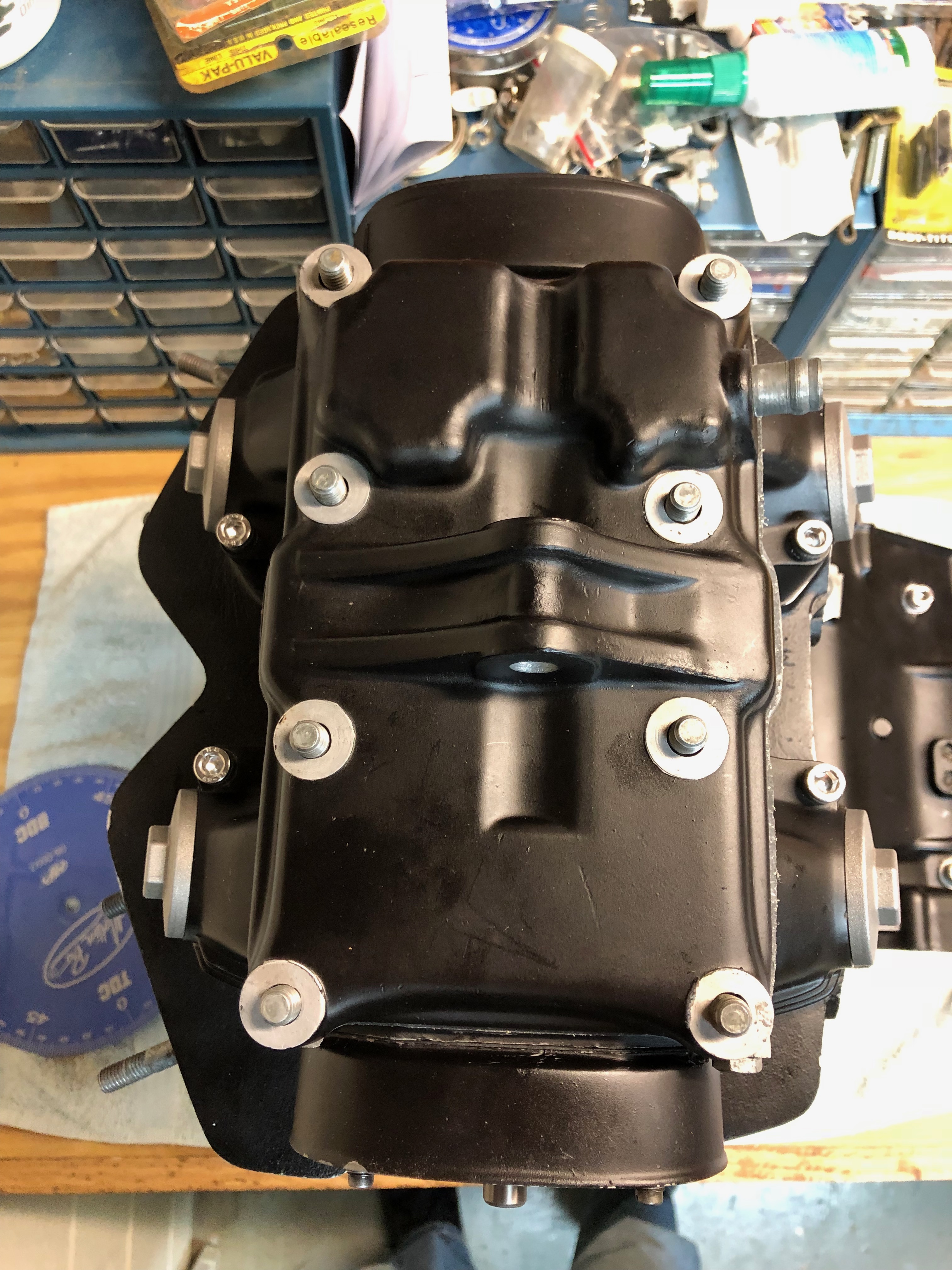
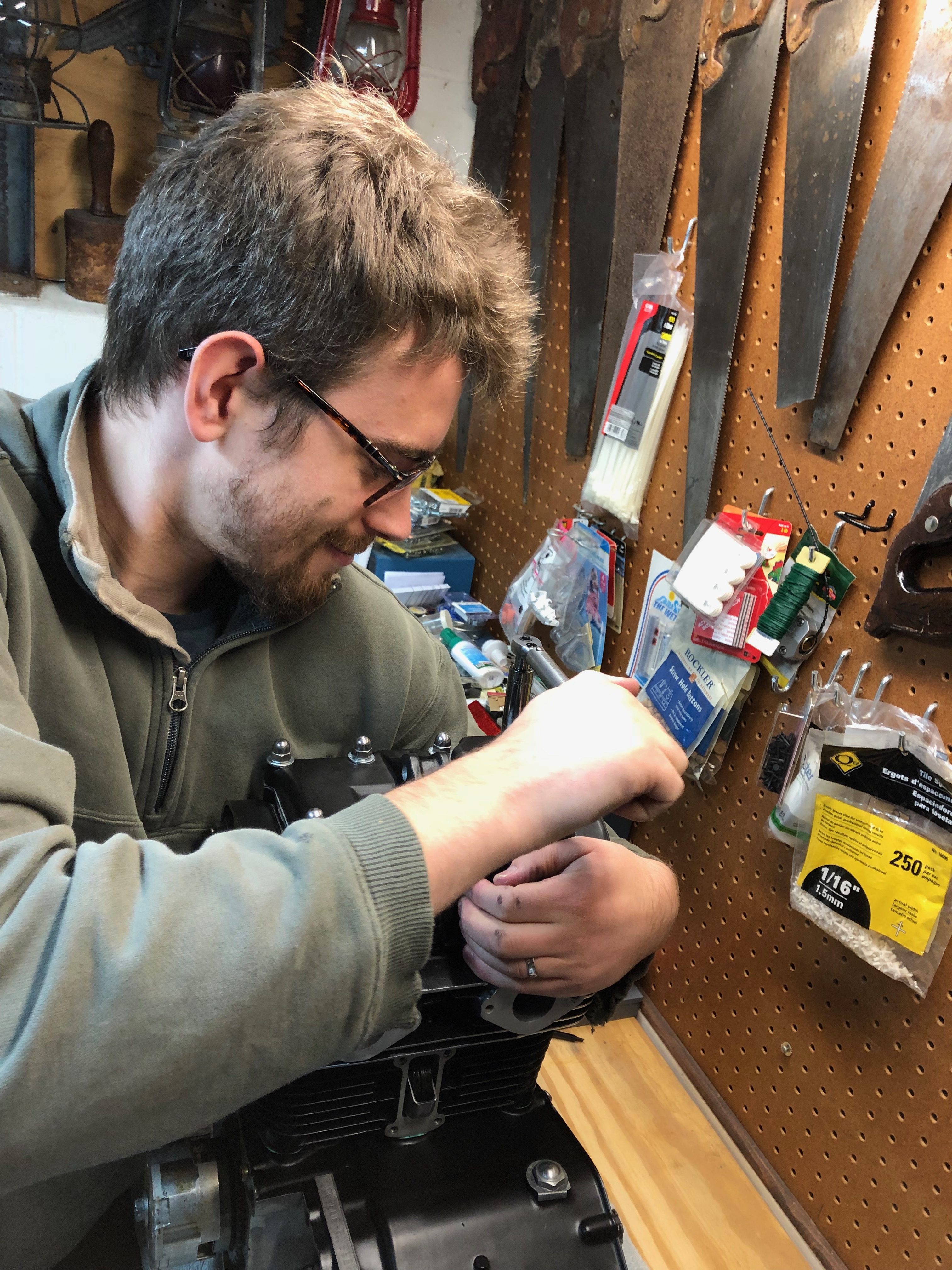
So close! Lastly, I buttoned the whole thing up by installing my soft gasket, metal breather plate, second soft gasket, and the cam case cover. As with all gaskets, double check that all the holes match up with oil galleries and stuff like that. I torqued my new stainless acorn nuts down to factory torque with my Nm torque wrench and marveled at my beautifully restored engine!!!

Last but not least, hug your motor!

tNNbx49.jpg


YI4E49w.jpg


vYtlF0N.jpg


m1ba08t.jpg


m4u3hCj.jpg
 
Ancientdad said:

Mike - nice clean work, well explained, great step by step documenting and persistence. Good job. The pictures (I suspect) are from an iPhone...? Many people here who have a ton of pictures stored in the iCloud account find that if their storage is almost full, the pictures get downsized to make space. Maybe that isn't the issue with yours, but it's something that happens and the results end up looking like yours
 
Outobie said:

curious as to what your objective was with the degree wheel. did you do any measurements on the stock cam?...I always thought I'd like to measure what the actual overlap, opening, closing and duration numbers are on a bunch of the stock cams since it's not published.


for those following this thread for reference, it should be noted that this step is not required to build a stock 350 engine. No degreeing wheel or dial gauges are needed to time a stock motor since there are timing marks on the cam, cam sprocket, and crank that provide TDC alignment. A degreeing wheel IS needed when degreeing in aftermarket Megacycle cams with slotted sprockets. but the above description is missing several steps for that process.
 
SteveCantrell said:

Looks like you and I are on the same path with a 73 CL350. I haven’t done a rebuild on the engine...so far. I got some pretty good results with my initial tests and decided if it was needed, I’d come back to it. So far, so good. I have pretty much EVERYTHING else to do, though.
 

[h=4]mikemill[/h][h=5]Registered[/h]

Joined Jul 25, 2017
453 Posts


Discussion Starter • #143 Feb 10, 2019
Major Update: Frame Teardown

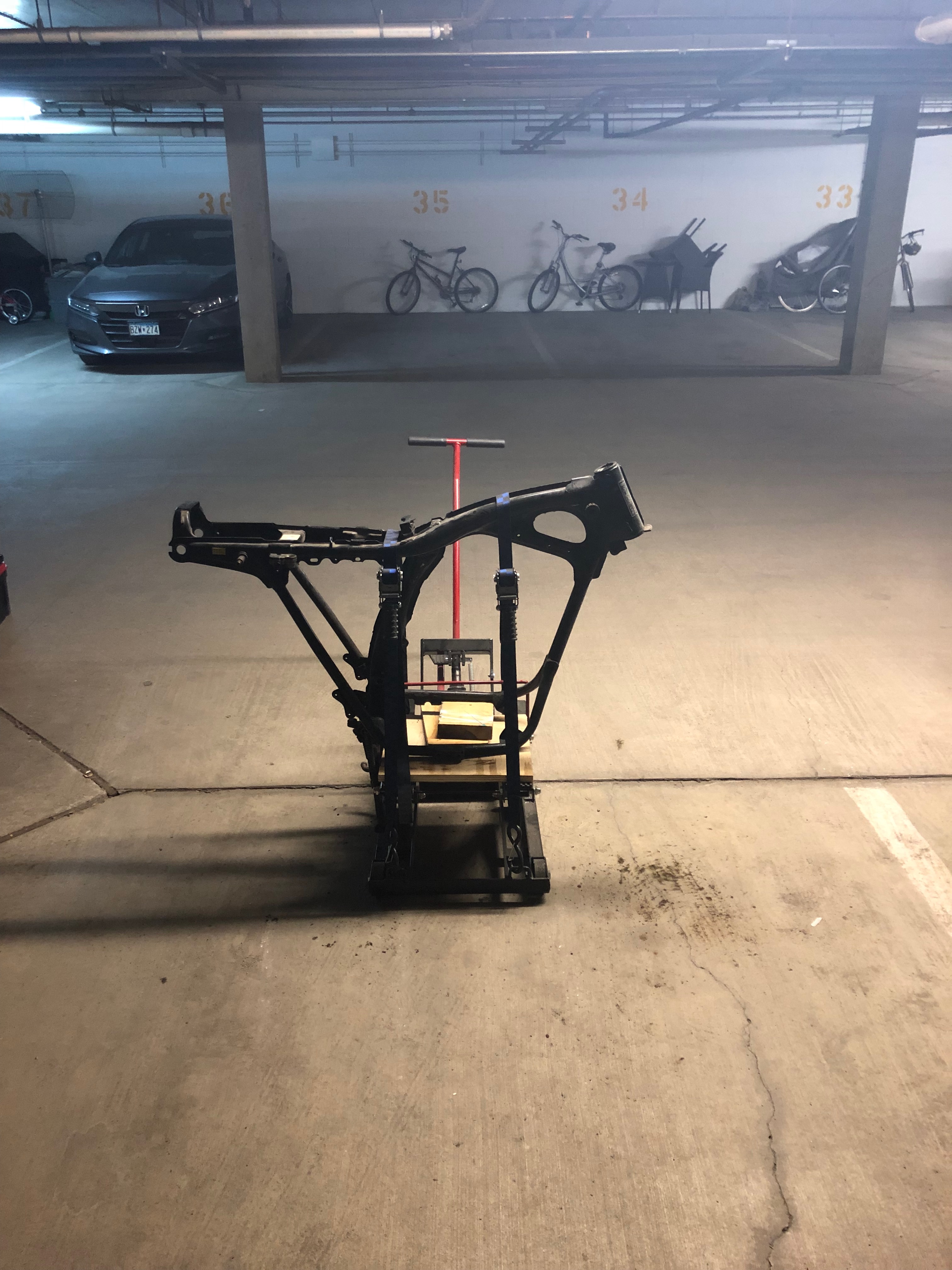
Friends, after working on the motor for an entire year, it feels so amazing to start making quick progress on other areas of the bike. I've accomplished a lot since my last post and I'm really excited about where this is going! For the last few weeks, I've been tearing my bike down to the frame and researching about how to upgrade my electrical system and do frame modifications.

I started out with this:

xYTCMvO.jpg


And with a snap of my fingers, ended up with this:

UH62g1Y.jpg


I'm just kidding, but in all honesty I'm not going to be as detailed about the frame teardown as I was about the engine rebuild process. I followed the Clymer manual to get most of it done, and despite a few hiccups, it was mostly straightforward. I suspect putting it back together will be a different story, but I took as many photos as I could and can count on this bottomless bank of knowledge when I get stuck!!

I removed pieces in the following order:
Grab bar
rear fender
rearsets
rear wheel
Swingarm
Toolbox
front fender
speedo cable @ front wheel
Front brake cable @ handlebar (I was an idiot and couldn't figure out how to remove @ wheel until after I disassembled everything...#fail)
Front axle clamps (bottoms of forks)
Front wheel
Headlight bucket
Disconnected wiring inside bucket
Handlebars (with all wiring attached to switches)
Gauge cluster
Handlebar lower clamps
Front blinker stalks
Upper triple tree
Forks (these were rusted in and I had to snip the coverings with the headlight brackets and yellow reflectors in order to free them)
Horn
Coils
Battery box
Wiring that runs through frame tubes (I snipped this because I couldn't get the connector out)
Center stand (sort of. Axle got stuck. Still figuring that out)


Ancientdad said:

No fails there, Mike - the first time you take something apart is always a learning experience, for all of us. Centerstands can be tough because some wear and/or rust and/or a slight bend in the pivot shaft (which is a tube) can happen. Use plenty of penetrant to help loosen it up and be careful not to mushroom the end of the shaft so it will go through the stand. It's among the parts that are getting harder to find as these bikes get chopped up or junked. As for the reassembly later... slipping the frame over the engine laying on its side is a lot easier. It's how I did mine (twice - see? we all make mistakes)
 
My frame has been at a local shop for about a week now and my Cognito Moto tail loop is tack welded in place and will be permanently fixed before being sent out for blasting and powdercoat.

Here’s the loop I bought:


c17c6f4cf2fdaa4c20d9b6a84cda51bf.jpg


Between the loop being 1” too wide and the CL frame being stamped instead of round, the mechanic had to do some conniving to make it fit.

He cut and bent the loop a bit and cut the crossbar support of the frame to stretch the frame itself about a half inch.

He also cut off all the slop from the inside of the frame and will weld steel tubing inside for support.


d8e3a2b6469ef5dfb93a5b97c605a095.jpg


6031dcb50da68bdf4b2b93c8443f73c7.jpg


Now, although I told the mechanic I wanted to run an m-Unit he used his own tuition for the electronics “tray”. We have this rib to place the battery in and an angle welded to the rear support to hold a couple fuses and relays, which he tells me is all I need on my bike.


26e460d13fdfa4ed69e68c8da615f0a4.jpg


6bf51fbc8c7d609615fdbaa410756a7d.jpg


The battery will rest on that support like so, but it won’t have a fully enclosed box to sit in. Likewise, the electronics attached to that “tray” will be exposed.

Should I be worried about that? Do I need an enclosed box to protect the battery, m-unit and other wiring components from water, salt, dirt, etc?
 
Ancientdad said:

Are you going to have an inner fender? If not, any rain you get caught in will be slinging forward right up and into that area between the frame tubes at the front of the rear wheel. I fashioned a battery box from thin strap steel and had my buddy weld it together, so it had 3 sides, a Honda rubber strap, and bottom support, and I hung it from 2 6mm bolts with rubber grommets from the top so the battery is isolated from engine vibes through the frame
 
I am not going to have a rear fender. This guy is a fantastic mechanic and fabricator, he's been at this stuff for 40 years. But as a consequence, he is sort of set in his ways and doesn't listen too much to my input. I mentioned many times my desire to include an m.Unit and he still came up with that tiny tray that only has space enough for 2 fuses.

I've convinced him to augment his design to include room for an m.unit (by extending that little tray I guess), but he's planning to leave it open like you see above.

His main thing was that for some reason he didn't have the time or something to do a conventional full box. I'll just have to see what happens and hopefully you guys can help me make it work, but I don't have welding skills or any other mechanics willing to work on this bike.
 
Ancientdad said:

Well, from what I see of that strap he intends for the battery, you might be able to fashion strips of metal to go around the battery and drill holes in the side sections of the welded strap to allow small carriage bolts to go from the inside to bolt the perimeter straps to for battery support on the other sides. What was your (or his) plan for securing the battery otherwise?
 
Well, MY plan was to have a contained box with 4 sides and a bottom. He didn't have time for that or thought it was going to be too difficult because of my stamped frame. The battery will be pressed down from above somehow by the seat pan, but that doesn't really do much to alleviate my concerns.

He mentioned I can put foam over electronics to keep the weather out, but that you need to have open air because they get hot...I don't know about that but I see plenty of closed boxes on other bikes across the net and on this forum.
 
He might be a good fabricator, but if he doesn't take input from the customer... well, I'd think about at least fabbing up some straps to enclose the battery on all sides, it wouldn't be that difficult, and carriage bolts have a flattish rounded head so they wouldn't cause issues with the ends of the battery, and you could put a small piece of adhesive foam pad over the bolt heads anyway. If you designed the straps to go on the outside of your existing welded-in-place strap the battery is sitting on in the picture, you'd be able to get the battery out later by just removing the nuts on the carriage bolts from the outside and slipping the strap off. As for the protection for the electrics... maybe you could find a plastic box like Radio Shack used to sell for builder's boxes to enclose the components in. You could drill some holes in it for air movement, but on the forward and side areas to avoid the rain splash from the rear tire if you get caught in a downpour... or, you could just run a plastic Honda inner fender to protect that stuff. that's why I chose to run a narrower, but full, rear fender - stuff happens
 
mountaingoat said:

Impressive work so far Mike. Looking forward to seeing the rest of your progress. I bought my bike as a non runner, got it running and rode it for 6 months before tearing into the motor last week. I’m hoping to have mine done by mid April.

Fantastic write up on the motor build too. It’ll definitely be another reference besides the manual as I put mine back together.
 
Budlite282 said:

Was reading this at work, then boss came by, had to shut it down........been trying to find it for the past week.

Beautiful attention to detail, really need it for me to put mine back together.

I'm thinking of digging into the trans soon.

Why n ot I have it down far enough to go ahead and do it.
 
Got my wheel and rear axle measured up.

Wheel wobble or runout is measured by placing your hub on a flat surface and spinning the wheel while resting a dial indicator on the lip of the rim. The range on the indicator is the runout.


a4f7dc7e995ecf27d2773d0f0f785aae.jpg


Axle runout is measured by setting your axle in a set of v-blocks (I made my own because these are expensive) and rotating it with a dial indicator resting on the shaft. The range on the indicator is the runout.


a37736e73fe145178a09ee132b7e2ab9.jpg


Front wheel runout: 0.04
Rear wheel runout: 0.05

Rear axle runout: 0.006

I think the standard is 0.002 and the max is 0.008 for all.

Are these numbers ok to run?
Are there other measurements I should take?

And the big question is if I don’t take the wheels apart, are they ok to run or do I need someone to true or tweak the spokes?
 
TOOLS1 said

When I true wheels I try for 0.065" However a LOT of rims are off by more than that in just how they are made. I have seen over 0.125" where they are welded together. So, I would not worry about 0.006". As for painting the wheel, why would you need to relace it? I just mask the spoke nipple and then put plastic straws that are slit lengthways over the spokes to keep paint off of them.

TOOLS
 
longdistancerider said:

You're looking good. Front and rear specs are identical for wheels and axles

Wheel run out limit is .080" or 2mm.
Axle run out limit is .008" or .2mm
 
Boys we have an update!!!!!

The powder coater really threw down and I have a fantastic-looking frame!

Cognito Moto tail loop with the LED strip w/ integrated signals was installed on the frame. Unfortunately, the loop was about 1" too wide, so DO NOT BELIEVE COGNITO MOTO when they tell you it fits perfectly, as they told me. It's a lie. No problem though. With a combination of bending the loop in and widening the frame, the mechanic was able to make it fit beautifully.

He also found 4 stress fractures in the frame. I would have never known these were there without stripping the paint, so this is a huge relief to know they were fixed.
yH5BAEAAAAALAAAAAABAAEAAAIBRAA7


He also banged out a nice seat pan for me. I'll be getting a custom seat made soon. I'm a little peeved because he said he was going to put two bolts to secure, but only put one. What's with this guy?? How can you secure a seat with 1 bolt and expect it not to twist under the rider in corners?

I'm also still not super happy with the battery fixture and electronics "tray". He added another piece so I can technically fit my m-unit, but it is a weird contraption that I'll have to figure something out for. I need to figure out where the wiring is going to lay and where the reg/rec is going to go as well.

Without further ado, check this beautiful frame. This feels like a landmark in the project. I have it all the way down; from here on out it's building her back up! It feels amazing to be this far along.


8215f84fbfa8538aaf759868941bf0a3.jpg


54187356864fd7628a1e570d68dbb943.jpg


d86b59240184d42d678b611ec36f4b8f.jpg


8a40bc3ddcaf87a9b08609b523f257e3.jpg


ffa46ac3263455b248e373a440265927.jpg


23c6e5f80e3f0413774ffc9ee49b080b.jpg


97ce21f9fab701a8aeedced6d9743427.jpg

 
bigring911 said:

Looking good Mike! Love getting new parts.

Why did your guy put the bolt facing up into the seat instead of underneath?

Shouldn’t be too difficult to drill a few holes where you’d like them, drop some bolts in with wing nut ends and you’re laughing.
 
66Sprint said:

When your fabricator/"mechanic" widened the frame for the loop, that forced the top shock mounts outwards and wider as well....

Did he ALSO widen the swingarm the same amount so the shocks would retain their original vertical-angular orientation, and fabricate a longer axle and wheel spacers?...
Or, are you assuming that the new "outwards" lean of the shocks will have no effect on their functioning and service life?.....
 
jamesfacts said:

Powdercoat job on the frame looks really nice. Who are you planning to use for the seat?
 
Thanks Bigring! He welded the nut on the top side so I could remove the bolt from underneath to take the seat pan off the bike. Were you suggesting he weld the bolt from the top facing down so I could screw a nut onto the underside? That might have been a better plan, IDK.
 
Steve, I never thought of that...no he did not modify the swingarm. You can probably see from my photos that it's roughly 0.5" wider. How much effect would 0.25" per shock have on their function?
 
Thanks James! I'm really stoked about how the frame looks and excited to get to a roller.

I have a guy lined up for the seat. Dan Knish of Knish Kustomz in Kilkenny, MN. He quoted me $180 for a seat without having to fab the pan, so I think that's reasonable if he sticks to the price.

Here are samples of his work.


And here is my inspiration/vision for what I want him to make me. A lower profile than that blue bike up above, but similar style, and in brown leather.


Back to my axle quickly, do I have to replace it if it has pitting like this?


9807ac99d61cf3518f71c0d67ead3cda.jpg


Also I’m wondering what these “hash” marks could be and if they are a problem at all.


94af8feded6349680b94f2fd06ac95e2.jpg

 
Mike, as long as the axle goes through the wheel without force, it will be fine. The bearings don't spin on the axle, they spin on their own internal races, the inner half of which are clamped still by the axle and spacers when you tighten the nut on the axle
 
Back
Top Bottom