1971 CL450 that sat for 40 years.

I find that a heat gun can help to loosen some of these stuck pan head screws in addition to a penetrating oil. And I sometimes use a Dremel or chisel to convert stripped heads into a giant flat head before resorting to the drill.

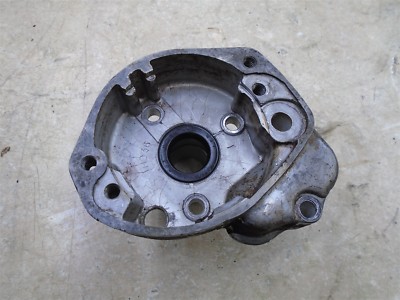
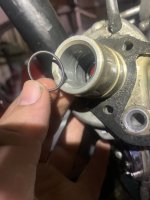
I believe this cam bearing is Honda part 30361-292-000. An eBay search "Honda 30361292000" produced a couple of decent looking parts at around $20. Here's one. I have sometimes found better results using the part number than the name – sellers who use the part number often include more and better pictures, which is helpful.
 
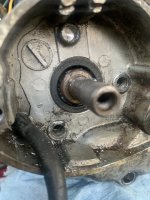
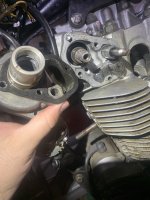
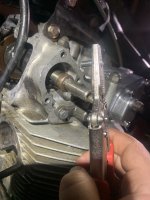
Right exhaust side cleaned and buttoned up. Took a minute to line up that rod, but I’m confident that it’s back in place.
Good to know the white stuff was just 'paint', odd that there was so much of it on the inside of an engine but only God knows what all has happened to this poor bike over the years.

As to the right side being buttoned up okay, it would seem so - but just to be sure, you did not have any issues tightening the 4 screws on the right cam bearing and having the bearing sit flush to the head on the gasket then? Because if the tangs were not lined up correctly on the tach drive in the end of the camshaft the cover wouldn't go all the way on.

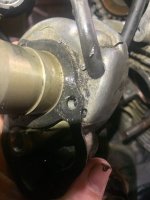
As for your points base/left cam bearing... someone went way overboard trying to loosen the left points cover screw, that's how the left side of the base got cracked. While it should be replaced, once you get it off (after drilling off the head of that screw) you can inspect the backside of it to see if the crack extends into the gasket sealing area. If not, you can use it until you can find a good used left cam bearing to replace it. You'll have to be careful tightening the points plate screw on the left so you don't cause further damage until you can find a replacement and get it installed. By then you'll be an accomplished apprentice at this operation.

Here's a deal on one, I paid that much over 6 years ago from David Silver

 
That NOS listing is fairly tempting. This bike wouldn’t know how to act with something new and shiny on it. I also found these two:


Anything special I need to know about the 1/4in drill bit I’m gonna buy today?

And yes AD, the installation of the right exhaust cover was very smooth. I believe the tangs are lined up.
 
That NOS listing is fairly tempting. This bike wouldn’t know how to act with something new and shiny on it. I also found these two:


Anything special I need to know about the 1/4in drill bit I’m gonna buy today?

And yes AD, the installation of the right exhaust cover was very smooth. I believe the tangs are lined up.
The link Brody (stl360+450) posted previously, before mine, is a good one. Virtually all of the 5 speed 450 engine parts are interchangeable, so the year or CB vs CL isn't important for what you need. It doesn't have to be NOS and for about $20 it will do nicely, as well as the first of your 2 links above for even less at $11 plus shipping. Aside from things like the condition of the threaded holes for the points plate and the machined area where the plate sits, the bearing surface condition is the most important thing for that side as any excess clearance will create lateral movement by the camshaft and will badly affect the points and timing.
 
Anything special I need to know about the 1/4in drill bit I’m gonna buy today?
Just buy one for metal. And the rough edges will want to grab and jerk, so spin the drill and just lightly 'kiss' it a few times, exactly centered until it starts to go smooth. Don't push hard, let the cutting edge do it's work.
 
Last edited by a moderator:
The link Brody (stl360+450) posted previously, before mine, is a good one. Virtually all of the 5 speed 450 engine parts are interchangeable, so the year or CB vs CL isn't important for what you need. It doesn't have to be NOS and for about $20 it will do nicely, as well as the first of your 2 links above for even less at $11 plus shipping. Aside from things like the condition of the threaded holes for the points plate and the machined area where the plate sits, the bearing surface condition is the most important thing for that side as any excess clearance will create lateral movement by the camshaft and will badly affect the points and timing.
I am gonna go ahead and order the one Brody posted.
 
Just buy one for metal. And the rough edges will want to grab and jerk, so spin the drill and just lightly 'kiss' it a few times, exactly centered until it starts to go smooth. Don't push hard, let the cutting edge do it's work.
And spin it to the right correct? Weird question I know, I was just reading about tactics of getting stuck screws out. Some people use left hand threaded. Not trying to make this complicated. Lol
 
And spin it to the right correct? Weird question I know, I was just reading about tactics of getting stuck screws out. Some people use left hand threaded. Not trying to make this complicated. Lol
I was talking about drilling off the old screw head. Special reverse twist bits can sometimes be useful for certain situations removing broken off screws where there is nothing left to grab. I rarely use them. In this case we only want to remove the stripped head of the screw so when you pull the cam bearing off you can grab the threaded stump with a vice grips pliers. A six inch and an 8 inch Vice grips are very handy tools to have for these old bikes. When looking down from over the drill the bit will be turning clockwise with a normal bit. This is like delicate surgery, so proceed slowly and observe how the tool interacts with the material. It's good that you are working on a piece that is going to be replaced anyway so a good way to practice and learn on. Try to drill straight and centered in the steel screw head, the cam bearing box is aluminium and will cut like butter if you let the drill bit wander off the head.
 
I was talking about drilling off the old screw head. Special reverse twist bits can sometimes be useful for certain situations removing broken off screws where there is nothing left to grab. I rarely use them. In this case we only want to remove the stripped head of the screw so when you pull the cam bearing off you can grab the threaded stump with a vice grips pliers. A six inch and an 8 inch Vice grips are very handy tools to have for these old bikes. When looking down from over the drill the bit will be turning clockwise with a normal bit. This is like delicate surgery, so proceed slowly and observe how the tool interacts with the material. It's good that you are working on a piece that is going to be replaced anyway so a good way to practice and learn on. Try to drill straight and centered in the steel screw head, the cam bearing box is aluminium and will cut like butter if you let the drill bit wander off the head.
Will be getting a 1/4in drill bit and 6in vise grips right after work. Will re-read your post before I get started on it. Thanks for the help.
 
And you've resisted temptation to rotate the engine (when a cam bearing is removed) this entire time? :)
Lol. I hooked up a bug zapper to the ratchet and crankshaft just to be sure!

I actually remember the post I read that made me super aware of when/how to rotate the engine. A new person made a post saying they followed those guys in Houston’s video on the valve adjustment and cam chain tension. Once they were done they rotated the engine backwards and it got stuck. I remember this person saying you “unleashed your wrath” when you responded to all of this. I had a very good laugh reading it. But no offense to that person.
 
Lol. I hooked up a bug zapper to the ratchet and crankshaft just to be sure!

I actually remember the post I read that made me super aware of when/how to rotate the engine. A new person made a post saying they followed those guys in Houston’s video on the valve adjustment and cam chain tension. Once they were done they rotated the engine backwards and it got stuck. I remember this person saying you “unleashed your wrath” when you responded to all of this. I had a very good laugh reading it. But no offense to that person.
It was probably in a reaction to the ridiculous statement by those guys in Houston. Look, if the cam chain is loose enough, yes, turning the engine backward could result in a jump of a tooth or more on the cam timing and perhaps those guys in Houston views their minions as being the usual slackers on maintenance that so many noobs to vintage Honda twins are or can be. But to me, that statement is ridiculous when you consider that the engine doesn't know or care which way it's being rotated, the parts all work the same in reverse except it won't run because you can't suck in a fresh fuel/air charge through the exhaust. And, it doesn't seem that they have much faith or confidence in their slick videos getting the point of all that those guys in Houston-styled maintenance across to their minions either, if they think those people will ignore all their directives or not learn from them.

I've turned my own 450, as well as past owned 4 cylinders, backwards many, many times with zero issues. I'm not sure what the hell they think could lock up anyway, considering all the parts work the same way in reverse. It's a bunch of crap.
 
It was probably in a reaction to the ridiculous statement by those guys in Houston. Look, if the cam chain is loose enough, yes, turning the engine backward could result in a jump of a tooth or more on the cam timing and perhaps those guys in Houston views their minions as being the usual slackers on maintenance that so many noobs to vintage Honda twins are or can be. But to me, that statement is ridiculous when you consider that the engine doesn't know or care which way it's being rotated, the parts all work the same in reverse except it won't run because you can't suck in a fresh fuel/air charge through the exhaust. And, it doesn't seem that they have much faith or confidence in their slick videos getting the point of all that those guys in Houston-styled maintenance across to their minions either, if they think those people will ignore all their directives or not learn from them.

I've turned my own 450, as well as past owned 4 cylinders, backwards many, many times with zero issues. I'm not sure what the hell they think could lock up anyway, considering all the parts work the same way in reverse. It's a bunch of crap.
I will have to find the post here for more clarification.
The new user did their valve adjustment through those guys in Houston’s video(which contains a lot of turning the engine backwards, and a lot of errors that you point out).
Once the new user got done adjusting the valves, they tried rotating their engine backwards and it got stuck.(They made a mistake in this adjustment, as well as many others during those guys in Houston’s tutorial).
I can’t remember where the convo ended up, but I always remembered that post for good reasons.
 
Well done. I've taken a fat straw ( from a MickyD's moca cafe) and crudely duct taped it to a vacuum hose to get into tight areas for clean up.
Will do. I don’t think I’ll be cleaning up the original cam bearing, seeing that I have a “new” one on the way. Im gonna get as much metal debris up as I can.
 
The old cam bearing crack was probably your worst leak.
That would be correct.. it was leaking one drop per second out of the very bottom screw. Im thinking it was also dripping it’s way to the exhaust, causing the white smoke. Also, the left crankcase cover was leaking at the same rate. Due to the wrong screw sizes being in there. That has been addressed as well.
 
All par for the course with these old machines. My CB450 has so many replacement parts that I'm sure I'd forget 5+ if I tried to list them all out. The cool thing is that all of this work you're doing makes the bike yours and builds an understanding that will help you notice when if/when something is amiss later on.

One new part worth considering is the gear pump upgrade designed by member @Jays100. He makes them available on eBay. It delivers oil to the head and cam faster and with greater pressure than the original pump — I've been running one for a couple of years now.

Have you read the warm-up procedure that @ancientdad wrote up for the dohc 450/500 models?
 
Last edited:
All par for the course with these old machines. My CB450 has so many replacement parts that I'm sure I'd forget 5+ if I tried to list them all out. The cool thing is that all of this work you're doing makes the bike yours and builds an understanding that will help you notice when if/when something is amiss later on.

One new part worth considering is the gear pump upgrade designed by member @Jays100. He makes them available on eBay. It delivers oil to the head and cam faster and with greater pressure than the original pump — I've been running one for a couple of years now.

Have you read the warm-up procedure that @ancientdad wrote up for the dohc 450/500 models?
Without looking: From what I remember is to let the bike idle at a safe RPM (1200) for a minimum of one minute. (Possibly two). To let the oil travel to the top end of the engine.
 
Without looking: From what I remember is to let the bike idle at a safe RPM (1200) for a minimum of one minute. (Possibly two). To let the oil travel to the top end of the engine.
Yes, and to be on the safe side you should give yourself something to do while you wait for the full 2 minutes. Not necessarily in this order, I usually do the quick safety check while I wait, check brake light from both lever and pedal, taillight, headlight, put my gloves on, roll the trip meter back to zero, then pull the clutch lever multiple times and hold it in for 10 to 15 seconds since my bike sits weeks between runs and the clutch sometimes sticks if I don't. You get a sense of how long it is without watching a clock after you've done it for a while (and I've been doing it since I was 17 and had my first DOHC CL450K4 in high school). The first couple minutes of this video shows you the wait time.

 
Yes, and to be on the safe side you should give yourself something to do while you wait for the full 2 minutes. Not necessarily in this order, I usually do the quick safety check while I wait, check brake light from both lever and pedal, taillight, headlight, put my gloves on, roll the trip meter back to zero, then pull the clutch lever multiple times and hold it in for 10 to 15 seconds since my bike sits weeks between runs and the clutch sometimes sticks if I don't. You get a sense of how long it is without watching a clock after you've done it for a while (and I've been doing it since I was 17 and had my first DOHC CL450K4 in high school). The first couple minutes of this video shows you the wait time.

I am liking the look of your speed and tach gauges. Are those aftermarket?
 
As long as your gauges work decently, the faces aren't bad as used gauges go and the redline area is a lot less faded than gauges on bikes that have spent a lot more time in the sun. If you carefully sand the satin black paint already on them to remove the chipped and scratched areas, give them a good cleaning and prep, then tape off the glass and the chrome ring, you can paint them with satin black and they'll look almost as good as mine. I bought that pair from an HT member who was giving up on his build and selling off his parts, and they looked great but one of them had internal problems. I had to take one of them apart to put the needle back on the shaft, and I ended up using the nice new kmh face on the mph internals so I'd have my original mileage, then crimp it back together and paint them both because he'd had them internally refurbished (new faces) and powdercoated gloss black and it was just too much for the rest of the bike in satin black.
 
Last edited:
Update:
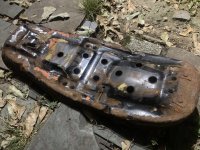
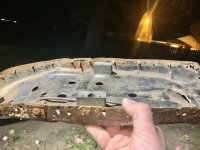
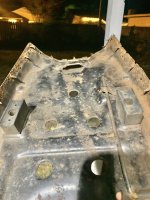
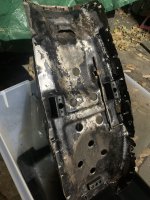
I decided to start on the seat pan yesterday. I did not go with ordering the Texavina seat for a couple of reasons. For one, it would not have the chrome buttons on the side. Reason two, it would not have the square stitching my original one has. This may come off as picky, but staying OEM to the best of my control is important to me. Plus, I will get to acquire new tools and learn about them.

A slight error or two was made, but I adapted to make the situation work for me. First I bought a gallon of Metal Rescue and a 26.5”container. Well, the pan didn’t fit and the curvature of the seat would have required way more liquid to submerge it.

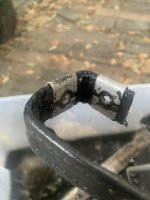
I decided to let one side sit overnight to coat an edge, and then flipped it tonight to coat the other. I added a few nuts/washers/bolts as well and the seat hinge. I also bought a 3” wire wheel per ballbearian’s recommendation. I used that tonight on the middle section. A lot more to go. Next, I plan on using naval jelly to clear out what’s left of the rust. I got referred to someone who is very famous with their metal fabrication skills in Memphis.(repairing and making custom metal for old hot rods). He is very excited to take it in to repair the edges.

Before:
98C185F3-A095-4539-9D6E-5ED078CE2EF2.jpeg
C75DB2C4-9CB3-4AE0-BC85-2EE857084060.jpeg
ED7A4938-6322-4A4A-B684-644C93D324EC.jpeg


Tonight:
23C8ED48-C9C6-4380-B3DB-DFC0011B7901.jpeg
B541E639-A091-419F-8F09-FC4FDAB1493E.jpeg
BD0494F7-56C3-4A35-BBA2-EB9698B00385.jpeg
0DB4CD9B-16CD-4F70-A9AD-197284912379.jpeg

Still a lot of work to do, but thankful from everyone to have even made it this far.
 
That's a huge improvement. And I like this idea of hot rodding the pan, i.e., having this hot rod fabricator do the repairs to the side edges. Should turn out well.

Are you planning to reuse your foam then?
 
That's a huge improvement. And I like this idea of hot rodding the pan, i.e., having this hot rod fabricator do the repairs to the side edges. Should turn out well.

Are you planning to reuse your foam then?
I have been in touch with an upholsterer the last couple of days, expressing my desire for OEM in a kind manner. I will be bringing him the original foam for him to have as an example, and for any circumstance that he has to use some of it. He will be hand-stitching marine grade leather with a square pattern. I have some repro chrome buttons on the way too.
 
That does look great. Sounds like you found the right guy to do the sheet metal work. Those pans look so similar to the 350, I wonder if the Sirius Consolidated pre molded foam that stl360+450 used on his, would fit good.

EDIT: I just missed your most recent regarding an upholsterer who will tackle the foam. Wow, leather is going to be special.
 
That does look great. Sounds like you found the right guy to do the sheet metal work. Those pans look so similar to the 350, I wonder if the Sirius Consolidated pre molded foam that stl360+450 used on his, would fit good.

EDIT: I just missed your most recent regarding an upholsterer who will tackle the foam. Wow, leather is going to be special.
I have personally been curious about a lot of compatible models myself. I’m sure there are a dozen different ways to have gone about this project. I wasn’t sure which model seats were compatible along with foam etc.. I am hoping to be posting the finished product here very soon!
 
Thank you. Nice to finally meet you, Sensei!
He's good like that, eagle-eyed.

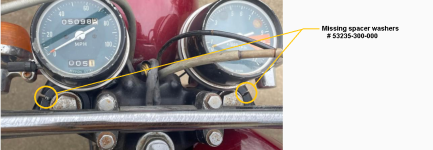
Those D-shaped washers are almost impossible to find, but if they're not present you can almost guarantee the top bridge will crack and honestly I'm surprised it isn't already. Many get cracked despite having the washers present as people get carrie daway with tightening the pinch bolts.
 
He's good like that, eagle-eyed.

Those D-shaped washers are almost impossible to find, but if they're not present you can almost guarantee the top bridge will crack and honestly I'm surprised it isn't already. Many get cracked despite having the washers present as people get carrie daway with tightening the pinch bolts.
Hopefully I just got lucky.

 
There is a member over at the SOHC4 forums who makes and sells the D washers.
(Aw shoot I guess you can't view the For Sale section unless you're a member.)
His forum name is Johnie.
 
Nice job searching for that, though I haven't looked in a while they've been NLA for a long time. Great find, and of course you ordered quantity 2.
The site is mainly built around the smaller vintage bikes. (Z50 etc). I just placed an order. I wouldn’t see it being the wrong ones, if the part# matches.
 
Last edited:
Back
Top Bottom