1966 CT200 stator rewind help

Stevepasc

Member
Joined
Jun 9, 2026
Total Posts
13
Total likes
8
Location
Los Angeles
Rebuilding the engine on a 1966 CT200 trail 90. While disassembling the stator area was full of oil contaminated with water (bike had sat outside for ~5 years before I got it) and the stator was all rusty and the insulation on the wires was cracking and falling off…


I looked on eBay and there were other stators in similar condition for $80-$140 but they all looked in pretty bad shape. They had a N.O.S. One for $200 plus shipping from Thailand.

I found this post on a ct90 & ct110 forum where somebody went over rewinding the coils on a ct90 stator:


I know the CT90 is slightly different then the CT200 so I used this as a starting off point, and I busted out the micrometer and measured the wires on the coils, it was roughly 21awg and 20awg (instead of the 18awg and 22 awg mentioned in the thread I found)


I soaked the stator in acetone and scraped all the old potting compound off the coils, then I sat down, started taking notes, drew up a diagram and started unwinding the coils, counting the number of winds, and the orientation of the windings and how they went from one core to the next. My stator had 150 windings on the 20awg wire coils and 200 on the 21awg coils, different from the 150/170 windings on the stator in the post. I saved the little rubber grommet and the wires that connect to the stator and lead out to the rest of the bike to reuse, stripped everything off the stator core, cleaned it up with a wire wheel to remove all rust and debris, and am ready to start applying potting compound to the iron cores, as mentioned in the post I found, but I have one major issue:

On the post I found the coils opposite from each other were wound opposite directions, one would be clockwise, and the one across from it would be counterclockwise so then the magnets on the rotor were spinning “the electricity would be traveling in the same direction” according to the post I found. In addition to that, the coils next to each other would also go from clockwise to counterclockwise to clockwise as you went around the stator… however when unwinding this stator all the coils were wound counterclockwise. Every single coil. So I have no idea what to do…. Does anybody have experience rewinding stator coils? Especially those on the CT200? Just want some clarification on this before I start winding it and possibly screw up the electrical system by running reversed polarity thru it or something….

Any expertise on this subject would be greatly appreciated, I can’t find much info online except for the forum post I already linked to above…

Thanks in advance 🙏🏽
 
Last edited:
MMM $200 US plus shipping sounds attractive to me personally. Yet it depends on your situation and desire to learn a new skill set.

Regarding the windings, I have no input from any experience myself. If your windings were all in the same direction then that is clearly the correct direction for your system. The other stator is done that way for that particular unit. I personally would follow what you found when you unwound your unit and base the rewind on that information.
It will be interesting to see how it works out for you and credit to your perseverance and determination to try a new skill.
 
Can you describe the pattern by which the coils are linked between poles for the two stators (CT200 vs. CT90)?

I suspect that the patterns are different and by skipping poles that align with opposite rotor magnet polarity, the CT200 stator does not require alternating winding patterns. I can't say I am an expert on this, so consider this to be thinking out loud.

I'm very interested to follow this project. I've never wound a stator, but I think it would be very satisfying to make one work. Very cool if you can do it!
 
Can you describe the pattern by which the coils are linked between poles for the two stators (CT200 vs. CT90)?

I suspect that the patterns are different and by skipping poles that align with opposite rotor magnet polarity, the CT200 stator does not require alternating winding patterns. I can't say I am an expert on this, so consider this to be thinking out loud.

I'm very interested to follow this project. I've never wound a stator, but I think it would be very satisfying to make one work. Very cool if you can do it!
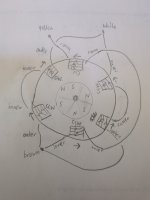
Thanks… yeah I figured it was better to do what I actually took off the bike, here’s the notes I took while I was unwinding the stator, it has the wire size, number of winds, and direction of the winds marked next to each core. Outside the circle is the path the wires take between poles, and where they connect to the wiring harness. On the CT200 diagram I also marked if the wires between the cores came from the start of the winding (inner wire) or the end of the winding (outer wire) as they traveled between cores.

I also drew the CT90 stator based on the forum post I found, but it didn’t have the info on wether the wires traveling between cores came from the outer or inner end of each winding… the wires going to the wiring harness appear to connect to the rest of the bike in the same way, just the CT200 stator used thinner wire, with more windings per core, and all windings oriented counter clockwise instead of switching direction.


And thanks, it is a new skill I would like to learn, and for a price of around $40 seemed like a way better option then shelling out $200+ especially when I don’t know the the bike will even work with a new stator. This is also the first engine I’ve completely torn down and rebuilt, figured the single cylinder pushrod engine would be easy enough to tackle.

I’ll update when I wind the stator with pics, but probably won’t be able to say if it works for a few weeks until I get the engine back together.
 
Interesting. The two left poles and the two right poles appear to be wired in parallel between brown and white and, accounting for alternating polarity of the six rotor poles, I think the two parallel sets will add current, as desired. (If the left two coils are sending current from brown to white, so are the right hand coils.)

On the other hand, the top/bottom poles seem to be in series between brown and yellow and I don't see why the output wouldn't cancel between the top/bottom poles due to the opposite rotor polarity.

Thanks for sharing the schematic and good luck with the power generation. I'm looking forward to future updates.
 
Interesting. The two left poles and the two right poles appear to be wired in parallel between brown and white and, accounting for alternating polarity of the six rotor poles, I think the two parallel sets will add current, as desired. (If the left two coils are sending current from brown to white, so are the right hand coils.)

On the other hand, the top/bottom poles seem to be in series between brown and yellow and I don't see why the output wouldn't cancel between the top/bottom poles due to the opposite rotor polarity.

Thanks for sharing the schematic and good luck with the power generation. I'm looking forward to future updates.
You’re saying that you think the top & bottom poles would cancel each other out because of the windings both being counter clockwise? Wouldn’t the left and right side poles do the same since they’re the same configuration as the top/bottom poles but there’s just double of them?

Sorry, I’m not by any means an electrical engineer. I work as a handyman professionally, and my other hobby besides motorcycles is playing the video synthesizer, so running Romex or conduit and pulling wires for a ceiling fan, HVAC system or new outlet, or wiring up a power supply in a synthesizer case, and reading schematics and soldering is the extent of my knowledge, I can’t really explain why or how…

Like I can definitely “monkey see, monkey do” the stator and recreate what I took apart, but the way it works is a mystery to me.
 
Actually, you're right about the side coils. I was mistakenly looking at them in aggregate as two on the left and two on the right, but the same reasoning suggests that each of those pairs would have zero output on its own with every pole wired in the same CCW orientation.

As a north pole passes by one of the poles it generates current rotating around the coil in one direction and when a south pole passes by, the current goes in the opposite direction. This is the mechanism by which alternating current is generated.

So, the two poles on the right, say, would have opposite currents since one sees a north pole when the other sees a south pole and vice versa. It would make more sense to me if the coils alternated directions.

I imagine once you've unwound that much wire there is no way to confirm what you recorded while doing it, right? Did you take any pictures?

Maybe I'm misunderstanding how it works, but I would want to have a little more confirmation before devoting the time to rewinding.

Do you suppose you could wrap the coils in such a way the you could reverse them later on the outside without much trouble?

Addendum: One of the things I don't know for sure is how the rotor is set up. If the poles go NNNSSS then your diagram might make more sense. My reasoning has been assuming NSNSNS. I've read this can be checked with a compass, but haven't tried it.

Addendum to the addendum: I am able to witness polarity of the rotor magnets with a compass. I'll post a video later.
 
Last edited:
I made a video showing the polarity pattern for an OEM CB350 twin rotor. It would be cool if you could confirm the polarities on your CT200 rotor.


One more thought about the winding directions of the coils on your poles. Suppose that a piece is wire is wound around the coil CCW. One lead is on the inside and one on the outside of the coil. Depending on which lead connects where, you can effectively change the direction of the coil. Starting with the inner lead you have to go CCW to get to the outer lead, while starting from the outer lead you have to go CW. So, regardless of how the coils were physically wound, it's the way the leads are connected that determines the orientation of that coil.
 
Last edited:
Actually, you're right about the side coils. I was mistakenly looking at them in aggregate as two on the left and two on the right, but the same reasoning suggests that each of those pairs would have zero output on its own with every pole wired in the same CCW orientation.

As a north pole passes by one of the poles it generates current rotating around the coil in one direction and when a south pole passes by, the current goes in the opposite direction. This is the mechanism by which alternating current is generated.

So, the two poles on the right, say, would have opposite currents since one sees a north pole when the other sees a south pole and vice versa. It would make more sense to me if the coils alternated directions.

I imagine once you've unwound that much wire there is no way to confirm what you recorded while doing it, right? Did you take any pictures?

Maybe I'm misunderstanding how it works, but I would want to have a little more confirmation before devoting the time to rewinding.

Do you suppose you could wrap the coils in such a way the you could reverse them later on the outside without much trouble?

Addendum: One of the things I don't know for sure is how the rotor is set up. If the poles go NNNSSS then your diagram might make more sense. My reasoning has been assuming NSNSNS. I've read this can be checked with a compass, but haven't tried it.

Addendum to the addendum: I am able to witness polarity of the rotor magnets with a compass. I'll post a video later.
Yes, every coil was wound counter clockwise, I had to unwind them all in a clockwise direction to take the wires off… I got about 2/3 of the way thru unwinding when I realized they were all coming off in the same direction. I thought maybe I was flipping the stator over to get better access to the coils and that was making it seem like they were all unwinding the same direction, but upon further thinking realized that wouldn’t make a difference….

But you’re probably right about where the coil winding starts and ends (so glad I took notes on whether the wire went to the inside or outside of the coils) that’s gotta be it. I have a compass somewhere, let me try to hunt it down and I’ll check the polarity on the rotor.

Thanks so much for your help. Like I knew the basics of how alternators work, the magnet spinning by the coils, and from the forum post pieced together that the alternate windings had to do with the opposite poles on the rotor, but having somebody with more understanding of it then me grok it out is a major help. And like I said before, this is just the next step in a complete engine rebuild, and once I get the rest of the engine apart, cleaned and put back together there’s gonna be a lot of variables on why it might not work, so being careful and eliminating as many of those variables as possible is gonna make the whole project easier.

Appreciate you 🙏🏽
 
I made a video showing the polarity pattern for an OEM CB350 twin rotor. It would be cool if you could confirm the polarities on your CT200 rotor.


One more thought about the winding directions of the coils on your poles. Suppose that a piece is wire is wound around the coil CCW. One lead is on the inside and one on the outside of the coil. Depending on which lead connects where, you can effectively change the direction of the coil. Starting with the inner lead you have to go CCW to get to the outer lead, while starting from the outer lead you have to go CW. So, regardless of how the coils were physically wound, it's the way the leads are connected that determines the orientation of that coil.
Checking the notes I took while unwinding the coils it does appear that every coil is connected opposite to the coils next to it, as well as the ones directly across, so that’s gotta be how they’re doing it.
 
I have a basic understanding of the physics from college, but this application is something that was certainly never discussed in my courses. So, I view this as an opportunity to learn alongside you and appreciate this thread and the discussion.

Does this diagram seem to match what your notes and previous image recorded? I labeled poles that go from inner on the "left" to outer on the "right" as CCW (using the perspective of each pole). I drew in a configuration for a rotor with alternating NSNSNS poles and added current directions just outside each pole that should be produced.

1275.jpg

The arrows on the wire for the poles was meant to indicate that each is wound CCW, but it's the way the leads hook up that determines the polarity of the pole.

It'll be interesting to see how your rotor polarity turns out.
 
Back
Top Bottom