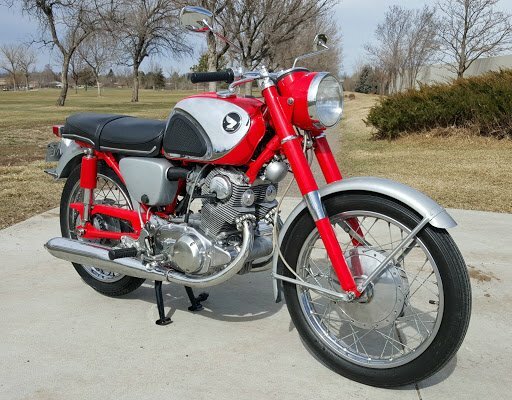
1962 CB72 Rebuild Thread

Probably will split the case later this evening. This gets me to the point of evaluation of parts and pieces that need replacement prior to reassembly, but I will also need to get serious about the tedious steps of cleaning the case and finned sections.

What do yall recommend for cleaning aluminum parts? Were early honda engines clear coated or is just bare aluminum? Looking for tips to make this thing look new and clean.
 
Top and bottom cases, cylinder and head uncoated, all other covers are painted or semi polished and clear coated. If I where you, I would not worry about the finishing but focus on the inside. The devil is mostly in the crankcase, and parts are hard to get. A good wash down before of the cases would be a good thing, I always start with a high pressure wash down at the car-wash, but after that you have to take it apart before it starts rusting.
 
Appreciate the thoughts jensen. You got me thinking. With 3611 original miles on this bike, is there a reason I would expect failed parts that need replacement? The only reason the bike sat for years was simply nobody rode it, but I have no expectation of failed parts that need replacement beyond bearings and rubber based parts like seals? What am I missing?
 
Once, I restored a CB450 K0 with 1250 miles on the odo. Looking at the break shoes and other details, the mileage was correct. However, the (probably original) oil sat for 50 years in the engine and transferred in sludge over time. One thing you need to do is to clean the crank, as mentioned in a few thread on this forum. Another thing to look at is the bearing surface of the kick starter.
 
View attachment 26630

View attachment 26631

View attachment 26632

The engine is different then the more modern engines, but not necessarily difficult to work on. The big difference is the combined kickstarter / secondary shaft.

Since you have an early engine, it can be a little more difficult to find the right parts for it. Parts differ between years, also within one year, it's very important to only buy parts that belong to your engine number.

View attachment 26633
Is that a crack or just an oil mark on the sprocket?
 
Tips on actually splitting case without damage? This thing is stuck together and dont see any obvious places to wedge, jack etc. Trying to be patient and not rush!
 
This thing is stuck together and dont see any obvious places to wedge, jack etc.
Keep up the patience, the last thing you want to do is drive something between the halves and do damage to a well-machined sealing surface. It's probably stuck in part due to some rust on the dowel pins that align the halves, usually one in the front and the back. Here are the locations to help you get a feel for the areas that are probably stuck the most. #30 and #47 in this fiche, and the studs running through the lower case don't make it any easier.


honda-cb72-hawk-1961-usa-upperlower-crankcase_bighu0097e8304_cdb4.gif
 
After bolt removal and flooding holes, edges etc. with WD40 or PBblaster, gentle tapping (not so hard as to leave a mark) will help the penetrant work it's way in. As you tap, listen, and you can hear changes which means what was once frozen as one piece is beginning to remember it's two pieces.
 
After bolt removal and flooding holes, edges etc. with WD40 or PBblaster, gentle tapping (not so hard as to leave a mark) will help the penetrant work it's way in. As you tap, listen, and you can hear changes which means what was once frozen as one piece is beginning to remember it's two pieces.
Yes, I forgot to mention the 'hollow' sound that comes when the lower case is loosening.
 
make sure you took out every bold, this engine has a few bolts in places covered with years of dirt and grease.

take some longer M6 bolts and screw them in the holes where the starter sits, put some wood between these points and use wooden wedge to drive them apart (break the gasket material). Take you time to drive the wedge every hour or so a little further, in the end the crankcase will give up.

Next time I split cases I will take pictures, and make a sticky of it.
 
Yeah, I was looking at those bolt holes where the starter goes and trying to think of how to use those as well. Will give it a try. I am pretty sure I have all the bolts out - followed the clymer book diagram that has them all numbered and the engine isn't real dirty on the bottom.
 
Yeah, I was looking at those bolt holes where the starter goes and trying to think of how to use those as well. Will give it a try. I am pretty sure I have all the bolts out - followed the clymer book diagram that has them all numbered and the engine isn't real dirty on the bottom.
May as well slide out the shifter shaft so it's arm doesn't get bent up.

IIRC, there is a longer bolt on the oilpump plate, not sure if it would go in far enough to be a problem. The two nuts on top from lower studs get forgotten too.
 
I do have the FSM in digital format (haven't printed yet), but the Clymer is on my bench - you can imagine which one I go to first since I don't have a computer running at my house...

The oil pump plate is all out and got the two nuts on top. Not a bad idea on the shifter shaft so will take a look on the one
 
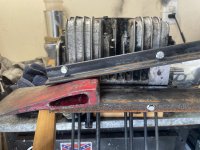
Well folks, got the engine apart! Thanks again for the pointers around using the starter mounting bolt holes. Rigged this up and it split fairly easily with no damage:
IMG_4447.jpeg
 
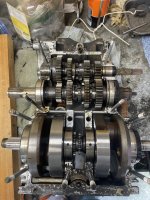
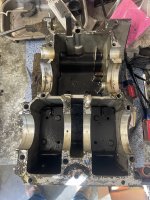
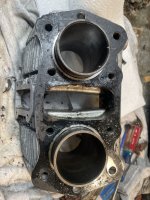
Now, the questions will begin! What sorts of things need inspecting while in here? What parts should I just plan on replacing anyway? Other things to check/clean? I plan on taking tons of pics and pulling all the rotational bits put so I begin cleaning the case halves. Here are a few pics:
IMG_4448.jpeg
IMG_4449.jpeg
 
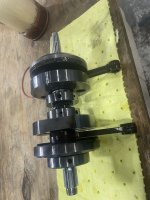
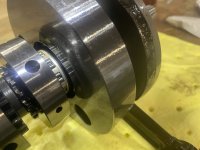
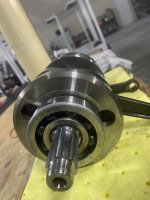
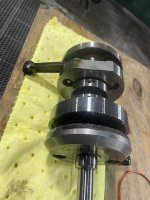
Told yall the questions are coming. Took the crank out. One of the inside bearings between the counterweights is fairly stiff to rotate. Is this a result of sludge? It seems like rolling it by hand is helping to loosen it up so thinking this is crud built up. Should the crank be soaked in something to breakdown all this old oil and then relubricated? Or am I headed towards replacing bearings? If so, how in the world does the crank come apart?
 
Not about the tight bearings - put some assembly lube on the rollers and it loosened up nicely. They turn smoothly now. Still wondering about plugged oil passages and such. Soak in something to break down sludge?
 
Told yall the questions are coming. Took the crank out. One of the inside bearings between the counterweights is fairly stiff to rotate. Is this a result of sludge? It seems like rolling it by hand is helping to loosen it up so thinking this is crud built up. Should the crank be soaked in something to breakdown all this old oil and then relubricated? Or am I headed towards replacing bearings? If so, how in the world does the crank come apart?
Take a look at this thread.

 
And another question - how in the world do the shift forks come off the shift drum? Cant seem to figure IMG_4486.jpeg
 
I would do a patient and thorough clean on both cases and the crank. A soak in gas in a large tub with a cover would probably help to soften and loosen sediment.
 
Money and time are tight, so until I have money to buy parts I have a quick question - will it hurt the aluminum case halves to be soaked in a solvent bath for cleaning? We have one at work I can use for free so was thinking of dipping it in, but wasnt sure if this would do anythinh funky to the aluminum.
 
Depends on what the solution is, but if it's something like automotive shop parts washer solvent like SafetyKleen or similar it won't cause any problems. Just be sure there are no o-rings or other rubber parts left in it if you plan to soak them for a while. I had a automotive speed shop run my crankcases through their hot tank for a couple hours and it cleaned up really well including sludge under the windage tray.
 
This will probably be a 'shake my head' question for some of yall, but before I mess something up. The crank looks really really clean from every angle I can look at. On saturday. I used some carburetor cleaner to flush out the oil ports to the roller bearings just to make sure they were sludge free...and they were. This morning the roller bearings will not roll (one will reluctantly, but the other will not). Did I flush out all the oil and get some kind of minor rust in there from being too clean? Path forward - would be to get some oil down in there and then get it moving again? Please tell me I haven't screwed up a really nice looking crank?
 
This will probably be a 'shake my head' question for some of yall, but before I mess something up. The crank looks really really clean from every angle I can look at. On saturday. I used some carburetor cleaner to flush out the oil ports to the roller bearings just to make sure they were sludge free...and they were. This morning the roller bearings will not roll (one will reluctantly, but the other will not). Did I flush out all the oil and get some kind of minor rust in there from being too clean? Path forward - would be to get some oil down in there and then get it moving again? Please tell me I haven't screwed up a really nice looking crank?
You're fine, but only just beginning to clean the crank. You probably just loosened the crud in the sludge traps that backflowed into the mains. You should follow the crankshaft cleaning thread as there is lots of info about the hidden oilways that need to be cleaned out. I suggested before to soak the entire crank in a tub (#74) above.
 
Yep…I have been following the crankshaft cleaning thread. Trying to avoid taking crank apart as I dont have the equipment. I have the crank soaking in a solvent tank right now
 
Yep…I have been following the crankshaft cleaning thread. Trying to avoid taking crank apart as I dont have the equipment. I have the crank soaking in a solvent tank right now
Great. It's a bit uncomfortable when grit sticks the bearings and rods, just keep flushing and spinning them until they're free. Kind of like passing kidney stones in your other crank. :ROFLMAO:
 
Let the crank soak and everything loosened up beautifully...pics below. Question/Opinions at this point - should I drill and tap the plugs on the counterweights. I struggle with the need for this since everything else is so clean? Bike only had 3711 miles on it, but then again it sat for 40-50 years so not sure whether this step is necessary. I guess I don't really want to do it being concerned with messing something up versus just rolling with it as is...would like thoughts and arguments for either position so I can make a wise decision.
IMG_4551.JPGIMG_4552.JPGIMG_4553.JPGIMG_4554.JPG
 
It sure does look pretty clean. I would say to see if the normal direction of the oil flow is working, then not to drill anything. The top pic shows the bearing slid over revealing the sludge trap which leads to the big end rod bearing. If you can stand the crank on it's end and fill the sludge trap with oil or WD40 and observe it coming out around the rod bearing, then it's good as is.
 
Tips/tricks to removing these gaskets without damaging surfaces? So far, been taking copious amounts of time with a razor blade, but wondering if there is a better way?IMG_4564.jpeg
 
Yep…that thing is harder than chinese math! I decided to just stop whining and go at it with my razor blade. Got it done. I think I still have some more on the heads and such so may try the solvent soak then.
 
I've been doing motorcycle engine rebuilds since the early 70's and still haven't found a good quick way to remove base gaskets from old Honda's (or newer ones :LOL:)
For years I used an old 3/8"wood chisel kept very very sharp.
Still got it but blade in now only about 3" long
 
They sure get cooked on there. Has anyone tried Pam cooking spray? o_O
I've tried paint remover (the good aircraft stuff) and long soaks in parts washing solvent, neither one helps much. It might soften the upper surface but it's still baked on underneath.
 
stanley-stanley-mes-18-mm-10-stuks.jpg

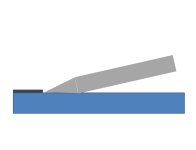
I use these long Stanley blades to remove old gaskets. Long because it can be spanned over large area's to make sure you are always straight. I use the blade at a very low angle, no more then 10-15 degree's from the surface plane.

knife.jpg
The gasket (black) can be "cut" from the surface when the edge of the knife is just above the surface, resting on the transition between the wedge and the flat side. The blade should always be supported on two or more surface area's as wide as possible from each other.
 
Last edited:
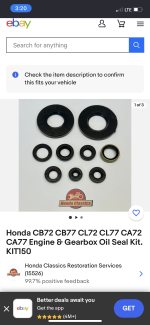
Continuing to think ahead and source parts as I persistently clean engine metal up (boring). Was thinking about shaft seals. I am thinking 60 year old seals,even with low miles, would need to be replaced. I started making a list of them and then discovered this:
IMG_4582.png
Is this a good option? Or should I source them individually from somewhere else?
 
They're a good option, but check their website price to see if you'll get a better deal buying direct instead of from their eBay store. Since they're in the UK, the eBay prices might be better for those of us in the US

 
Kevin at our sponsor vendor Scrambler has them. Darn good price and a VHT10OFF discount too.

 
Most oil seals for the CB72 are standard, some are special. There is a lot of choice in standard seals (for example, material). I like to buy Viton seals as much as possible, especially the ones that are positioned on high temperature area's.
 
Playing around with piston ring end gaps today and have a question I cant seem to find the answer to in the printed materials I have at hand. How far up or down in the bore should the ring be to check ring gaps?
 
Playing around with piston ring end gaps today and have a question I cant seem to find the answer to in the printed materials I have at hand. How far up or down in the bore should the ring be to check ring gaps?
On a used cylinder still in spec, usually an inch down from the top. You want to avoid the lesser-worn area at the top of the cylinder where there might be a slight ridge.
 
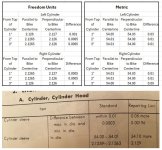
Alrighty folks, I am now to the point of making decisions around the pistons and cylinders. Here is my struggle and where I would like opinions and suggestions. This engine only had 3700 miles on it and I really like originality, i.e. I really do not want to bore this thing oversize unless absolutely necessary. I spent some time with bore gauges and micrometer last night measuring the cylinders and this is what I got:
bore measurements.JPG
Based on my numbers and referring to the specs from the Clymer book, the bores measure out OK. Here is the thing that has me stumped - I bought a new set of NOS rings. Upon measuring the end gap on the rings, it is beyond what the Clymer says is acceptable (Clymer say repair limit is 0.013" and in some areas I am getting 0.016"). I want to measure again this evening if I get a chance because if the bores are in tolerance, then with new rings I should be tighter than that, or at least that is what has me scratching my head. I also will double check the ring part number and make sure I got the right rings as well. Either way, thoughts are appreciated here as maybe I am missing something?
 
The left cylinder is slightly over spec at the top travel but I think you'll be fine with a hone. This is assuming that the pistons are in spec of course.
 
Measured the pistons last night and they are good to go - well within spec
 
Best suggested place to buy the engine gasket set from? Scrambler cycle has one for the 305, but not the 250...imagine the gaskets with the cylinders would not be right. I see a few random ones on ebay, but wanted to ask the group if there is a better place to look?
 
Back
Top Bottom