ignition coil testing question

nabs

Veteran Member
Joined
Jun 4, 2020
Total Posts
269
Total likes
43
Location
Hertfordshire, UK
Hello all,

I have a few ignition coil questions please.


2. My CA95 has a dual output coil. The service manual describes this test:


Conduction test

A conduction test is needed to check whether there is a disconnected wire or short circuit in the ignition coil.

Use a tester by connecting one lead wire to the terminal and the other to the
earth or core of the coil. The service tester 122) can be used. The earth conduction test should show no resistance, but the connection coil core must be an open circuit.
If the coil fails either test, replace it.

is it possible explain this test in a way that might be understood by someone who does not understand electrics (both how to do the test, and what it is proving).

3. I can measure resistance across the two leads as per the below - what, if anything, does this show?

ACtC-3fOPg-aiThglbxLMR6JRMi-MR7t2cOS25iMfCbENbq5vJZHa6z89F7DckdKG_z7riELF2qjbmc9r-KrQhx4-w2nHbHqUahUHTtH6_KILM2lSrI0ZtjMApN3RkfBZqK1u3xTQWYqF_pJccFjxbnrpkMo7w=w2042-h1532-no
 
I'll answer #3 first....... That shows 1.7 Ohms resistance in the primary.......

Now for the fun...... NEITHER wire (Green or Black) should show continuity to the core (the mount bracket basically), so set as it is on Ohms, you should get an infinite reading from either wire to the mount/core bar (Meter should show a capital letter I instead of any numerical value).......

IF it passes that test, and you have a fully charged 6 Volt battery, a roll of PVC tape, and two new sparkplugs, we can test the coil in operation off the bike.....An additional length of wire (12 to 18") with alligator clips on both ends will be helpful, .......
 
thanks - I got an infinite reading from both tests and I am charging a 6v battery in preparation for the next test.
 
Install new plugs in the plug boots and holding the "hexes" of the plugs in physical and electrical contact, wrap pvc tape to maintain that connection.....
As both coil primary leads have female ends, find a couple screws or nails to install in them so they approximate male ends.....
Connect Black wire end to battery positive......
Touching and withdrawing or brushing the Green wire end (so it makes then breaks connection) with battery negative mimics the function of the points, so if coil is good, plugs will spark as you BREAK the connection.........
Let us know results.....
 
Last edited:
Install new plugs in the plug boots and holding the "hexes" of the plugs in physical and electrical contact, wrap pvc tape to maintain that connection.....
As both coil primary leads have female ends, find a couple screws or nails to install in them so they approximate male ends.....
Connect Black wire end to battery positive......
Touching and withdrawing or brushing the Green wire end (so it makes then breaks connection) with battery negative mimics the function of the points, so if coil is good, plugs will spark as you BREAK the connection.........
Let us know results.....

I've tried the test but do not get a spark 66, could I just check that I have done the connections properly?

ACtC-3fSG2pfBRbU7tYe3RfPN5-Mf7Qb5bXz6XjoAJ96JCwdvh-3bClqwHht5nrlAtjnSbfjIlrZyPFU2SYHhUQbQRauNRxGEbUmfImv_7IVi8P0BngSc0V-Jbij0Sa6PGLvY8bUa9N0XP6ukTh1Br_d_pcz9Q=w1912-h1435-no
 
Steve's offline now Nick, probably after another late night and calls from who knows where. Did you test the white (seemingly in the picture) wire coming from the fuse holder for 6v? Are the two plugs tightly together with the tape wrapping? The plugs both have to be grounded and if there's a slight gap or looseness between them the spark might jump between them inside the tape wrapping. Otherwise it looks correct. If for some reason the white wire isn't live, though it seems it should be, the red wire should be live through the fuse.
 
Steve's offline now Nick, probably after another late night and calls from who knows where. Did you test the white (seemingly in the picture) wire coming from the fuse holder for 6v? Are the two plugs tightly together with the tape wrapping? The plugs both have to be grounded and if there's a slight gap or looseness between them the spark might jump between them inside the tape wrapping. Otherwise it looks correct. If for some reason the white wire isn't live, though it seems it should be, the red wire should be live through the fuse.

thanks Tom, yes the spark plugs are taped up tight and there was 6v from both the wire from the fuse holder and the other one, but now I check the voltage again it has dropped from 6.6v to 6.3v so I wonder if the battery is bad. Also I am using one of the plug caps that came with the bike (the other was broken) and the other one I found in a box of parts so I can't really be sure of them either.

I was due to replace the battery anyway so will test again when the new battery + caps arrive. Will report back then!
 
Recharge THAT battery.... Remove plugs and plug caps from the coil output wires....
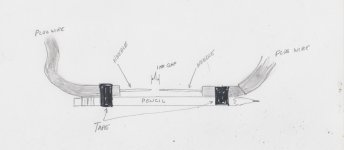
.Insert a sewing needle or thin nail in each plug wire and position/affix as below....

coil test sub 001.jpg

Pencil, broom handle, ruler, 2X4..... anything you can affix to......
Test is otherwise the same....Look for spark between needle points......
Sorry for the crude drawing.....But it was quick.......
 
Last edited by a moderator:
Recharge THAT battery.... Remove plugs and plug caps from the coil output wires....
.Insert a sewing needle or thin nail in each plug wire and position/affix as below....

View attachment 2160

Pencil, broom handle, ruler, 2X4..... anything you can affix to......
Test is otherwise the same....Look for spark between needle points......
Sorry for the crude drawing.....But it was quick.......
that's clear, thanks - will try tomorrow!
 
Could be a contributing factor, BUT I expect the 1.7 Ohm reading from your earlier post to be the actual problem.....
I would expect the primary to have at least a 4.0 Ohm reading for a points ignition.....Possibly even 5.0 Ohms.....
So, I assume yours has an internal short that's limiting the "active" windings down to the 1.7 figure.....
Secondary should be able to jump across a 6 mm spark gap, possibly 8 mm.......
That 1/2 a mm just won't do......
 
oh dear. There is someone in the UK is breaking a c95 and selling the parts on ebay so I'll see if he still has the coil. Is it common for them to go wrong?
 
I don't know if it's common so much as it could be someone left the key on too long at one point and got the windings hot, and it may have led to early demise
 
I did notice what appeared to be melted glue (perhaps where the wires were glued to the back of the device) so may be that is it. The ebay chap has got one for sale so fingers crossed... I'll report back.

Out of curiosity, what would the options be for getting a modern replacement without knowing the specs for this model? The secondary measures 9.8k ohms, but perhaps that can't be trusted either?

ACtC-3fcUutavCQ3B-oqWsISrqIyK3RJMrGkd6WnAEWcZ-O3e7QIwlaWs3cc7zAtetparmW4KO0hy1vQVc-GVqK3hVvxH8jOHZxBNX2Ub0gjShqyAh1BGFTE-yfXvwrd_N38HqbjsufWz4EFMq7r68Tx1sLtYg=w2288-h1530-no
 
IF you cannot find an exact replacement, the twin lead ignition coil from a 6 V CD175 or a 6 V points CD/CM 185/200 (1980 or earlier) should work......
Worst case Two single output 6 V coils (70's Honda 100/125 singes) can be wired in parallel.....
Lots of options IF you can find 6 V parts...They are getting scarce.....OR expensive......
 
Nice, well done and detailed. And the proper music in the background for the testing... :lol: "a jolt from my electrode..." (y)
 
Nice, well done and detailed. And the proper music in the background for the testing... :lol: "a jolt from my electrode..." (y)

There are more elaborate methods like using a milling machine to machine away the plastic but I guessed a lot of folks won't have access to that level of machinery. I found that a flap disc on an angle grinder is great for removing the plastic and also a power-file (belt sander).... but a hand coarse file is fine too. On the Honda CB350K twins coils there is a wooden securing dowel ... the only place on a Honda I have found, where wood is used :)
 
I need to do a bit more testing on the replacement coil, but here is a quick update.

I can get a consistent (weak) spark on the plugs, and an erratic spark over two thin nails plugged directly into the wires that will jump about ~5mm.

How does that look?


thanks all!

in case it of interest to someone in the future both the coils had similar resistance:

  • original: 1.9 primary, secondary = 9.16
  • replacement 1.7 primary, secondary = 8.96

I repeated the tests on both coils with a new battery and new caps and the old one still did not work properly so I am pretty sure it is a dud despite the similar resistance measurements.

Part of the insulation is missing from one of the spark plug leads on the replacement coil and the other lead feels rather fragile, but luckily they are a push fit (held in place by a bit of epoxy glue and a clip) so replacing them will be easier than with the ignition coil designs shown in Ash's instructions


ACtC-3cmwi3GpdGDkhI7ovYyr93Td7uY1BpDxCgsMd95BkKEWxa8b9SAiDiQtvYdB83iTdVWJXO2z_-OW4LdSg6smLiT9O1s1C5J6Iwlu06mWzBZQGnGwDkSL1gUOR8Z6oosh7A4Ey_2q3Iru9N5Ey4fjq4gJw=w1149-h1530-no


I suppose I could use the cables from the old coil since they appear in good nick, but I will get replacements if possible. Please could someone let me know what to search for in the way of new leads?

Also, I had to cut the black and green wires back to a few inches because of damage to the wires and insulation - please could someone give me an idea of the correct way to extend the short wires to the original length?

sorry if these are basic questions, but I am even more inexperienced with electrics than I am with engines and I'm not sure where to start my reading :)
 
You want metal core wires for the sparkplugs, the automotive graphite ones will work temporarily but fail quickly.
To extend wires you need solder, flux paste and heat shrink tubing.
Strip @1/2" of insulation off each wire end, add @1" of heat shrink to one wire and push away from the new joint, dip the ends in the flux, twist the ends around each other so it resemble a regular wire. Now solder the wires with just enough to get a good shiny coating. Let it cool and pull on each wire to check they are secured. Slide the heat shrink over the joint and heat it with a flame or hair dryer to shrink. You're done.
 
thanks Jim, I will have a go.


For the sake of my curiosity, is anyone able to explain how the equivalent bench test would work for a single output coil?
 
Coil positive (black or black/white) connected to B+
spark plug base connected to B- with a jumper wire so it is positionally away from the B- terminal so spark can be easily observed....
Touch and remove coil negative wire (yellow or blue) to B- battery terminal....
 
Despite the fact that I will turn 50 this year I am embarrassed to say I have never soldered anything before, so I did a few practice attempts. I don't think I will be getting a job in an electronic repair shop any time soon, but they did not come apart when I tugged on them:

ACtC-3diuufLRMxysmmdqfCztyVV-5wyIuwwSSSQvkVciemDRK7Z_ir0KopNtg9E2t1ipSSLcbbOzg42fp7NXht6ZbdhGkihl94NXLPwFG7naYwWfOnFeIEx7xZRC2i9jjk8di07TxCI01a-4HETO2a8rtSkiw=w1912-h1435-no

As I mentioned earlier it is easy to replace the HT leads on this type of coil as they are a push fit: I just reinserted the new leads, tightened the metal clamps and then applied some epoxy to seal the ends.

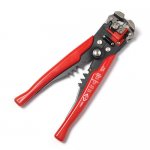
I have treated myself to a wire stripping tool and luckily it includes the two different profile crimps needed to properly clamp the bullet connectors: the first one is "w" snapped and folds the smaller tabs over to grip the exposed wire and the second is a rounded valley to clamp the other tabs on to the insulation.


It is called the C K Automatic Wirestripper and only cost £16. I'm most impressed and it seems very good quality for the money.
84xGxVaXxPRQMr3L7


ACtC-3coYwNWfiZnYjT8NlVfz8l-FxVlC8heh9e0wGsuMDol59ETfS361u_MB70cyvpb5drETxtCGj_5IOlNOXvau4rAvPEJJZLjFodYkxRWVeeXm4F_4lvY1fw0hV2kwvYzBwpso4kkBL3f20E6efVkMbj25w=s500-no


ACtC-3exhwBUIVdfHvH2W8oQmNASjerTO7kccFhgohNzsJrfdoYs9RWAjZV6ZE4SAeUlS7AmEu1Mk1_nlmrhQAotH-kWfNoIbGHZ_vyznvJG36pi3R_C998DscS5KL9NmQ8dj-qGXI04aBPffGW7WDpgFQWlAg=w1075-h1433-no


the last job was to test it still worked:


thanks again for all the advice.

ACtC-3dt3GK4CIAeLyqtWP6044QRuHKP0hLIQbYPZRWLFvA5N9Er494p0G1-UjcD7TyZURRMrMrECNsHOKQs1alfXugo6CeRVGTc9c-rGiMKwo13d9Qbr-N1GUJ7P0vHIsSKTkiy5BCWwj3IWCMNh1Wm5Ofd2w=w1745-h1433-no
 

Attachments

  • CKT495001.jpg
    CKT495001.jpg
    24.6 KB · Views: 4
Hard to see the actual solder joints but looks pretty good. The solder should have a bit of shine to it when done, dull grey almost like lead appearance is a "cold" solder joint and bad.
After I solder a joint I use the VOM to check resistance if I'm not quite sure it's good enough.
Be sure to use heat shrink tubing on the open joints, tape will only last for awhile before coming undone.
 
Back
Top Bottom