Front wheel rubbing on something

Randall

Veteran Member
Joined
Jun 26, 2021
Total Posts
648
Total likes
43
Location
Cape Coral, FL, USA
I pulled my front wheel yesterday to get it trued. Today I put it back on, and it seemed fine until I torqued down the axle nut. After that I hear a rub on about half of the rotation. Back off the nut, and it gets better, but not perfect.

I took the wheel back off and pulled the hub, which I have already cleaned up and serviced about 4 weeks ago. I also pulled the bearings and cleaned and regreased them. It has been fine ever since now. Everything in the hub looks good to me, and I have done nothing to it but take it off and place it in a cardboard box for a couple of days. So I carefully put it back together, axle from the right into the spacer that sits in the dust cap, thru the right bearing, distance collar, and left bearing. Then thru the hub, left fork and washer, and axle nut. Tighten down lightly, and all is smooth. Following procedure, I torque down the axle nut to spec, and without the right side axle holder being tightened, I have some resistance along with a rubbing sound. I have made sure the shoes are in the relaxed position (the brake cable is not connected at this point). The brake torsion bracket is not connected at this point, but the holes are lined up, so the hub is in the correct position. Tach is disconnected, but it is spinning in the hole that the cable connects to when the wheel is rotated.

What am I missing? Remember, I have had this wheel off a couple times before without this problem. and I have ridden a couple of hundred miles with it without issue. The only variable I can think of is the wheel was trued today at a shop I trust. But, I don't even see how that could cause this issue.

What is going on?
 
LDR, I tried your suggestion, and it seems to have help somewhat. I tightened the axle nut first, the the axle holder nuts, front one first, then the rear. But I still have a slight "bloop.... blap blap, bloop....blap blap" that is relative to places on the wheel about 180 degrees apart. Also, it doesn't spin as freely for as long as it seems like it should, as though there is a slight drag. I don't THINK it is the brake shoes. Weird that I didn't have this before the wheel was trued.

Also worth mentioning is I had it trued because I had a bit of a hop in my front wheel that was exacerbated by wonky forks. I rebuilt the forks this week. But he told me the wheel wasn't out of round all that much, and wasn't something he could really get a good visual on. He seemed a little surprised I noticed a hop.

So I wonder, could a bearing be my culprit here? Someone with lots of opinions on another forum told me a while back that it could be.
 
I don't THINK it is the brake shoes.
So I wonder, could a bearing be my culprit here?

(I have my front wheel off, and my brake hub in pieces on the floor for new brake shoes, and wheel bearings.)
Did you replace your front wheel bearings, or service your old bearings? Brake shoes, new?
You haven’t mentioned the torque link for the front brake (or I missed it). Have you tried spinning the wheel on the axle WITHOUT the brake hub? That may be a way to isolate the bearings. Or rotating the brake hub in the wheel while it’s off of the bike? Or even try it with the brake shoes removed - just thinking of ways to narrow it down.


Tom - 1982 CM450E
 
As mentioned, I pulled, cleaned, and repacked the original bearings. They have 5K miles on them. Brake shoes are not new, but look good, with plenty of life left. Hub stripped and soaked in Kerosine for an hour, then brushed out and dried. Reinstalled shoes and springs with a touch of new grease at the moving points. Speedo drive gear completely cleaned and repacked with new grease, cable currently not connected. Torque link currently has the bolt in a few threads to position hub, but it's not tightened down. It acted the same when it was tightened down at first. Hub spins freely in wheel off the bike. Sound does not sound like shoes rubbing to me.
 
How were you able to remove the existing bearings without doing damage to them? I'm not at all familiar with your bike but most, if not all, of the wheel bearings in our bikes generally get destroyed or at least damaged by removal since there usually isn't a way to drive them out by the outer race as should happen to preserve the bearing health, they usually have to be removed by driving against the inner race
 
The FSM just says to remove the right bearing first, but doesn't say how. Then it says to pack bearings with grease and install right bearing first. I took this to mean removal for inspection and repacking. However, Clymer says only remove to replace, as there will be damage. I didn't have the Clymer at the time I removed them.

This bike has had a front wheel hop since the day I got it. First I tore down the wheel, and removed, inspected, and repacked the bearings. They seemed fine to me, with no play in them, so I put them back in. Maybe I caused damage to them, I don't know, but it had no effect on the hop, it was still there. After reassembling the wheel it rode quiet and fine, aside from the hop, no rubbing and no noises. Then I pulled it again to get the wheel trued, which I cannot yet check the effect that might have had because the bike is still on blocks for a few more days for other reasons. This latest issue only came after putting the wheel back on after the truing. Nothing else was done.

Hell, for the price 4into1 has for after market dual sealed bearings, I am just going to order a set and see where that gets me. Could it be the bearings had an issue causing the hop right from the start? Can bearings even cause a slight hop?
 
My suspicion is the front wheel is simply out of balance, it happens on occasion when a tire has a particularly heavy area is in and needs weights opposite that heavy spot to offset just as car tires need to be balanced. Driving ball bearings out from the inner race will almost always cause damage so replacing them is best. The FSM was written with translation issues at the time, far greater than if it had been written today, and many of the more obvious steps were left out as Honda likely assumed a good mechanic would know the basics and be able to read between the lines. The FSMs were not originally written for the public as the Clymer, Haynes and other manuals were.
 
The wheel had no weights on it before yesterday, so maybe you are on to something. But, it is now balanced and trued, so that rules out my current noise. I won't be able to roll on it for a few days to see how it acts now. I will put in new bearings if even just to rule that out. Most of the OEM bearings I find are around $40 shipping per pair, which I believe are single side sealed. 4into1 has dual side sealed kit with seals for $20 shipped. Click.
 
The FSM just says to remove the right bearing first, but doesn't say how.

My work around for anything in the FSM I do not understand, is to ask HERE in the forum FIRST.
As AD said, if your bearings were removed by striking the inner race, most likely they are damaged. I don’t see how they can be removed without striking the inner race unless you used some type of puller.
I drove out the right side first also. The distance collar has just enough wiggle room to get to inside edge of the inner race and drive it out - remove distance collar, flip wheel over, and now you can see the entire left bearing and pop it out.
Your bearings have possibly been struck multiple times on their inner races, and maybe more if they were serviced and not replaced 5k ago. And if they were driven back IN by their inner races also, they are certainly damaged. Problem is you may not see, feel, or hear the damage until the bearing fails under load.
This rubbing may well be a godsend.
Whether it’s the cause of your hop or rubbing, which yes it could be, it’s not safe to use them, they should be replaced as you mentioned. The All Balls set #22-51319 (bearing #6302) includes new dust seals.

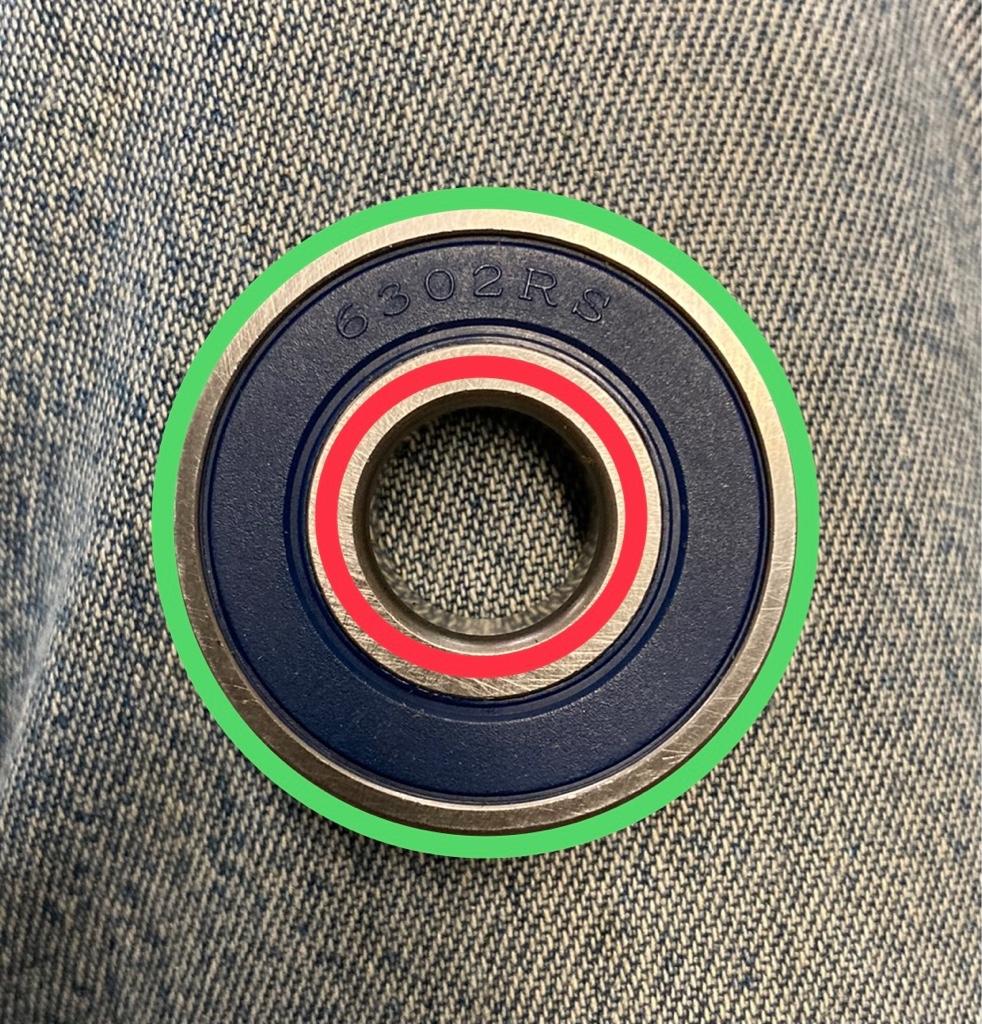
1af24c45957653003eb17a32eb2ef6ff.jpg


RED: inner race - DO NOT STRIKE!
GREEN: outer race - DRIVE HERE.

The bearing OD is 1.654”
30mm socket I have OD is 1.642”, and slides easily in the bearing recess in the wheel - I’ll be using it to seat the new bearings.

EDIT: Posted during your reply with AD, disregard as you wish. Hope your new bearings solve your issue.

Tom - 1982 CM450E
 
Yes, new bearings to be on the safe side but they will have absolutely nothing to do with the wheel hop, that would either be an out of round rim or out of balance tire. Hopefully once you get the new bearings in place you'll be good. And in case it isn't obvious, drive the new bearings in by the outer race to avoid damaging them.
 
Sorry, no one was posting when I started. Did I get your toe? [emoji41]


Tom - 1982 CM450E

No need to apologize, we posted 2 minutes apart, you before me... sometimes it goes a bit weird like that. I don't recall sitting still on it. Your description was more elaborate and comprehensive than mine and is better for those reasons. And, as I've tried to say so often, when in doubt for any reason, ASK HERE FIRST. And the reason for that is that some of us here have previously done every single thing that others are about to do, and often we've done it dozens or hundreds of times so we can provide insight that many can't - which is the whole reason we started this effort a little over a year ago, to get the truth out there for those who want and need it.
 
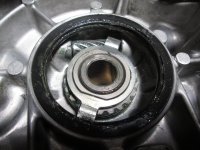
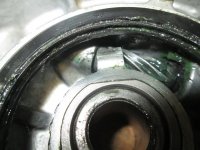
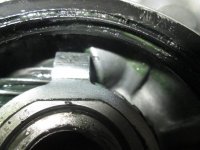
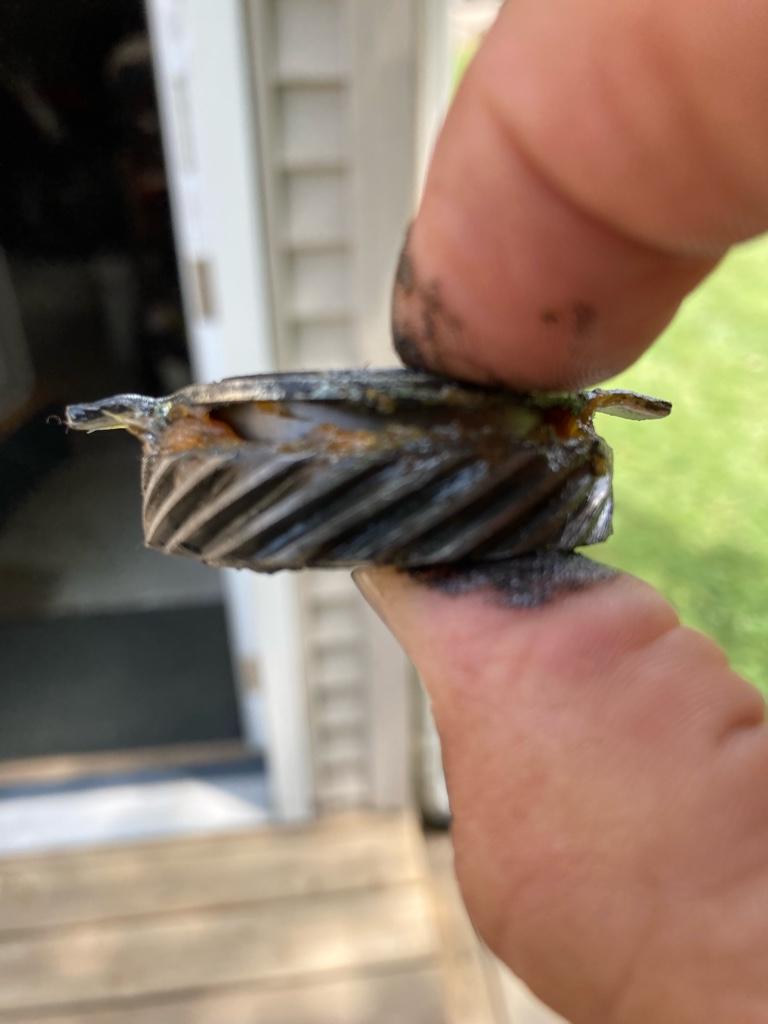
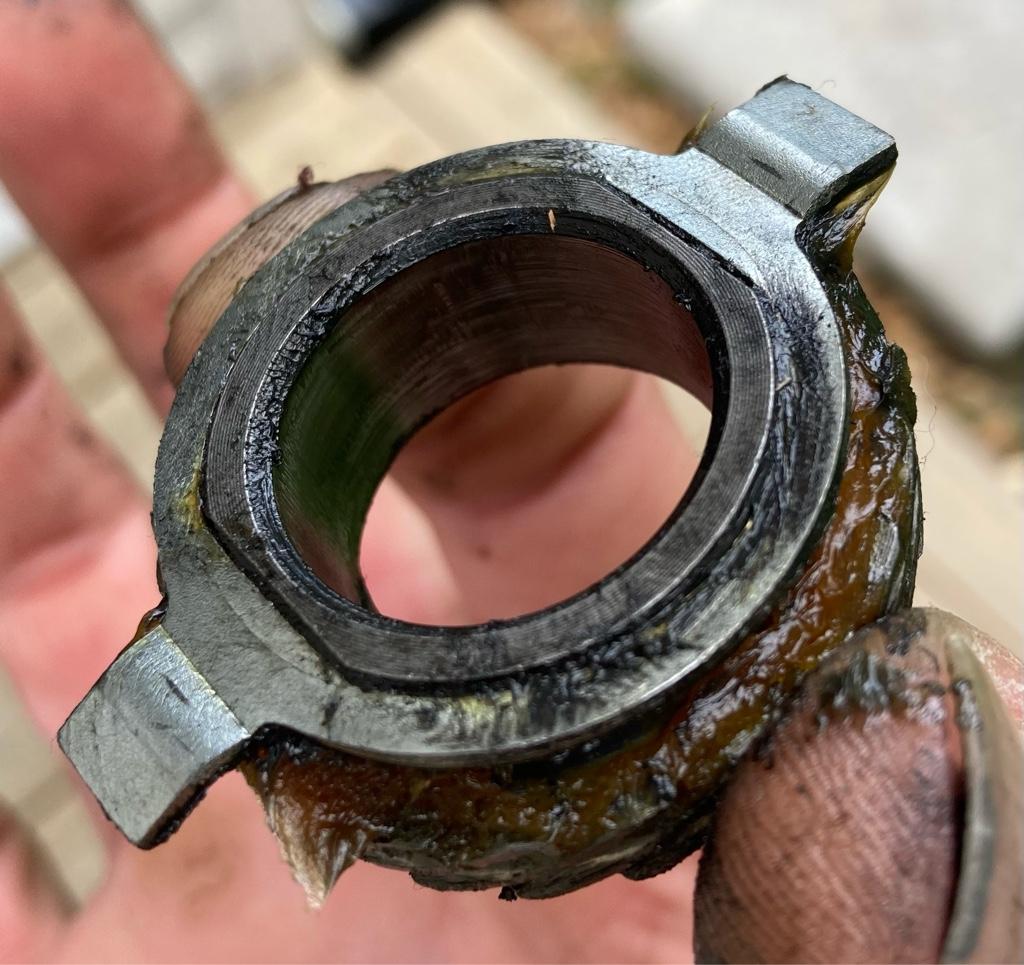
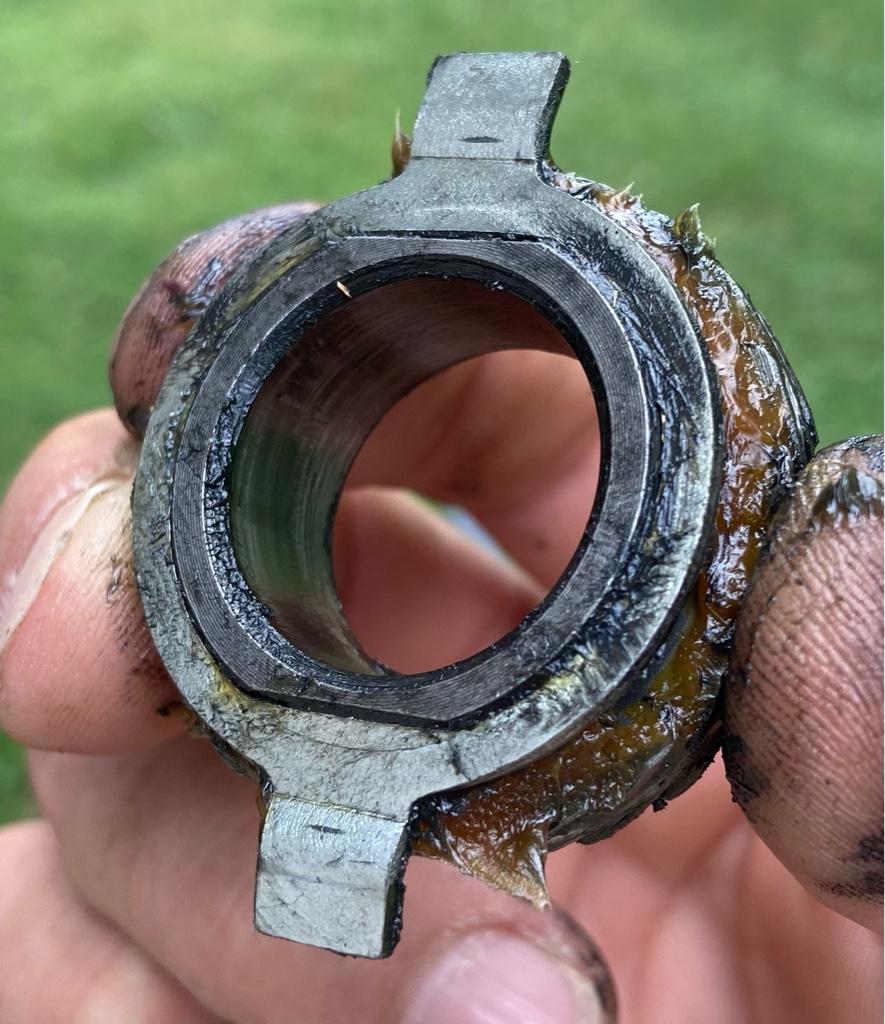
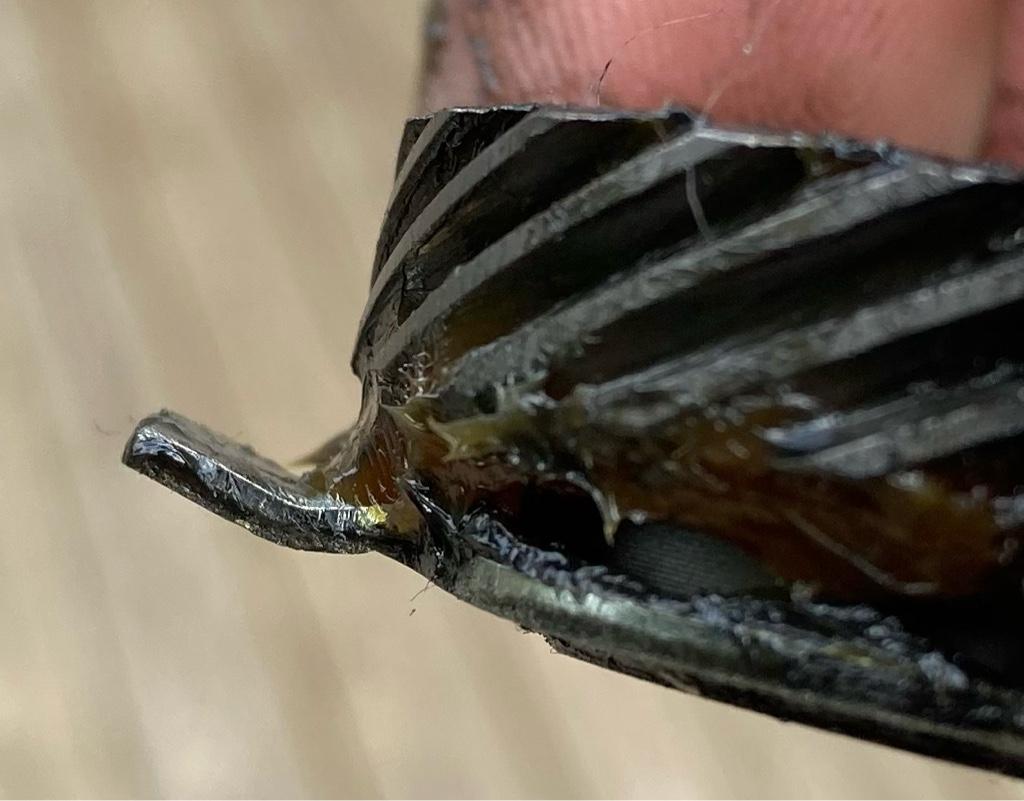
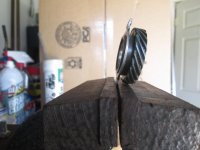
Mystery solved, at least partially. The tabs on the top of the speedo gear are rubbing in two places against where the internal worm gear is housed. This makes total sense in terms of the noise I described, and it's relation to the position of the wheel. But why? I have both thin washers installed under the gear as shown in the Partzilla diagram. What could possibly make this gear ride down a tiny bit too low, and hit the aluminum like this? And why didn't I notice it before?

003.jpg001.jpg002.jpg

https://www.partzilla.com/catalog/honda/motorcycle/1982/cm450e-a/front-brake-panel
 
And, as I've tried to say so often, when in doubt for any reason, ASK HERE FIRST. And the reason for that is that some of us here have previously done every single thing that others are about to do, and often we've done it dozens or hundreds of times so we can provide insight that many can't - which is the whole reason we started this effort a little over a year ago, to get the truth out there for those who want and need it.

Thanks, and absolutely true!
Case in point;
I’ve never removed/replaced wheel bearings on a motorcycle before yesterday - haven’t replaced them yet - but I read here, in Post #26 by TMSHORT:

CL350 tire change (etc)
https://r.tapatalk.com/shareLink/to...hread.php?t=3459&share_type=t&link_source=app

… that he mangled his spacer while removing a wheel bearing. That alone made me extra careful, and probably saved me mangling my spacer. If you ever wonder; yes, this whole crazy forum thing works, and it works well!


Tom - 1982 CM450E
 
Mystery solved, at least partially.

Uh oh, just looked at mine and I don’t see any washers? Found ‘em, buried in the grease.

3da30b929e33d606c0212a5f9bbc43cd.jpg


Possibly the tabs are bent? Mine have a very slight hook to the end, but they don’t rub. Can you carefully bend them slightly?


Tom - 1982 CM450E
 
First of all, what are the chances that you and I are working on the exact same vintage thing at the exact same time? Boggles the mind!

As I look at mine more closely, I do think my tabs are bent slightly, because one looks a little different from the other, and they both don't strike at the exact same way. How they got bent, I have no idea, but I bet bending them a tad up will solve this issue. AND get me new front bearings in the process.

And btw, I removed and reinstalled my back bearings as well, but I don't believe the inner races were damaged as I used a large socket, and the inner distance spacer as drivers. But, if it makes you guys feel any better I will get around to replacing them too!
 
First of all, what are the chances that you and I are working on the exact same vintage thing at the exact same time? Boggles the mind!

Who woulda thunk! Small world, eh? It all started with finally getting new tires, and now having a new wealth of info here in the forum about old (vintage sounds better) motorcycles. Decided it was high time to perform some maintenance - bearings, brake shoes, and rear shocks. Parts came in yesterday; I removed the front bearings is as far as I’ve gone. And, no, I’ve never done any of this before on any bike.
(I should do swingarm bushings, too…)

And btw, I removed and reinstalled my back bearings as well, but I don't believe the inner races were damaged as I used a large socket, and the inner distance spacer as drivers. But, if it makes you guys feel any better I will get around to replacing them too!

Would I replace them, yes. There are too many what-ifs on two wheels to not do what I can to insure I’m safe. I understand how bearings work, but I’m no engineer. If there’s any chance they’re damaged, that’s all I need to hear. They spin pretty darn fast in there and we can see them! Also, I don’t remember how long you’ve owned your bike, or it’s mileage, but if there’s any chance you’re riding on original bearings, they’re 39 years old. My opinion, no judgment.


Tom - 1982 CM450E
 
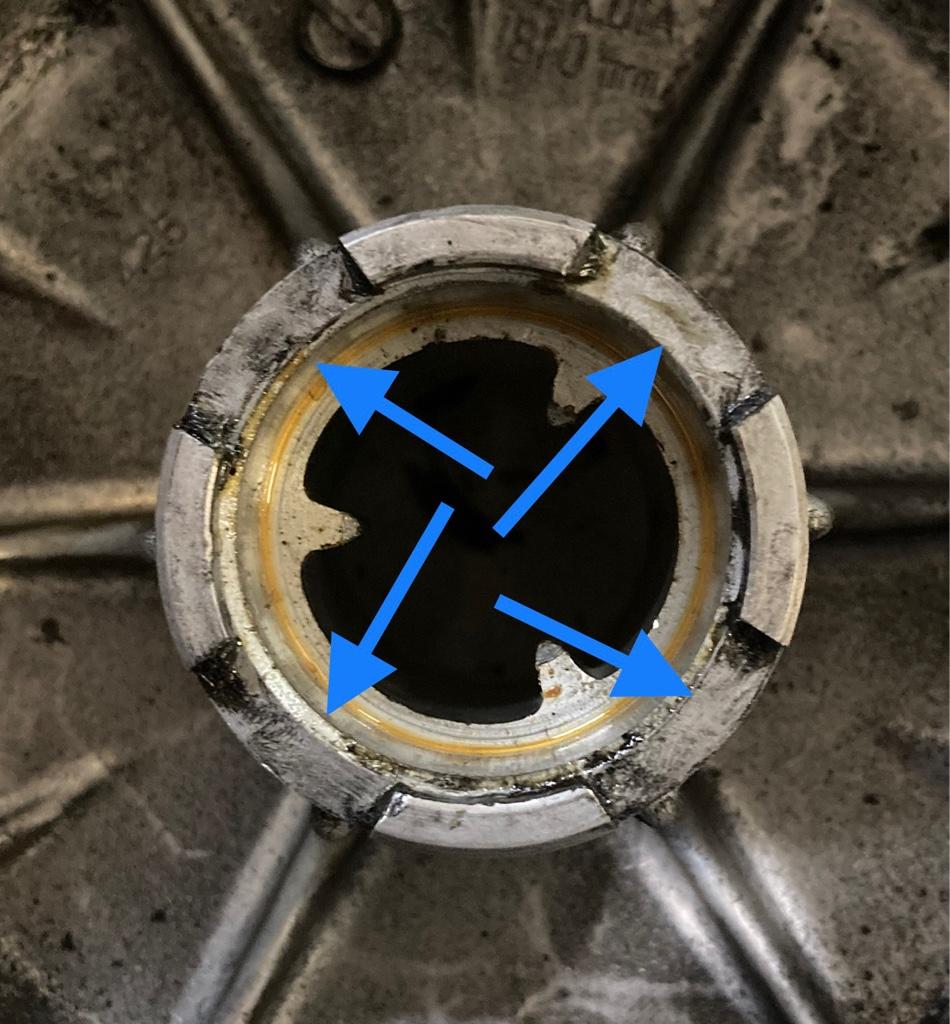
The tabs on the speedo drive get bent when the tabs are not correctly aligned in the notches in the hub when the backing plate is put back on, they end up on top of the notches the tabs are intended to sit in to properly turn the speedo drive. When not seated correctly the speedo drive will turn, but when the load of the cable is place the drive often slips during rotation due to the tabs being bent downward by tightening the axle when the tabs aren't properly located in the notches. VHT member Ribrickulous discovered that during his front wheel work.
 
The tabs on the speedo drive get bent when the tabs are not correctly aligned in the notches in the hub when the backing plate is put back on, they end up on top of the notches the tabs are intended to sit in to properly turn the speedo drive.

And there you have it, Randall (and myself)… be careful installing the brake hub, and verify before you torque the axle nut.
These notches:
103c1fa924a421aa2016e1f76d0e3c0a.jpg


Thanks, Tom… I remember this with Ribrickulous now that you mentioned it. [emoji1303]


Tom - 1982 CM450E
 
And THIS is an example of having seen it many times before, and even having made the mistake myself when a teenager and still learning.
 
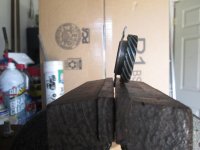
Problem solved. As you can see mine were bent down and twisted also. It is easy to see while it's in the vise. Also, notice the tab flange is a press fit arrangement onto the speedo gear. You can see how mine moved somehow and wasn't properly seated home. I found the tabs quite easy to bend back while on the vise, and I used a big socket (1 1/16") to tunk her back down. See before and after photos.

I put it all back together, and this time quiet as a mouse peeing on cotton. Thanks for the input fellas. This place is great!

004.jpg005.jpg
 
Problem solved.
Thanks for the input fellas. This place is great!

Great job re-checking your install and all of the puzzle pieces! And the prize also goes to… mike in Idaho with the closest reference to speedometer.
This place is great, and glad you got it solved and fixed. You’re very welcome, glad to help/assist.
(And I am glad you’re getting new bearings either way.)


Tom - 1982 CM450E
 
Problem solved. As you can see mine were bent down and twisted also. It is easy to see while it's in the vise. Also, notice the tab flange is a press fit arrangement onto the speedo gear. You can see how mine moved somehow and wasn't properly seated home. I found the tabs quite easy to bend back while on the vise, and I used a big socket (1 1/16") to tunk her back down. See before and after photos.

I put it all back together, and this time quiet as a mouse peeing on cotton. Thanks for the input fellas. This place is great!

Thanks, we certainly try... but I've never heard it put that way before. :)
 
First of all, what are the chances that you and I are working on the exact same vintage thing at the exact same time? Boggles the mind!

As I look at mine more closely, I do think my tabs are bent slightly, because one looks a little different from the other, and they both don't strike at the exact same way. How they got bent, I have no idea, but I bet bending them a tad up will solve this issue. AND get me new front bearings in the process.

And btw, I removed and reinstalled my back bearings as well, but I don't believe the inner races were damaged as I used a large socket, and the inner distance spacer as drivers. But, if it makes you guys feel any better I will get around to replacing them too!

YES, replace them.... Whenever/however you side-load the bearing centers is bad for them...Driving them with the wheel-center spacer is as bad as striking them directly with a hammer
 
Bearings: Any driving impact force applied to the inner race runs the high probability of denting the race and/or the balls. Since there's so little area to see a visual check is worthless. IF you are able to load the bearing and rotate it you have a good chance of finding out if there's a bad spot. This is done by applying lots of pressure on the inner race every 5 degrees and rolling the bearing on a hard surface, any resistance felt means it's bad. I don't bother since bearings are cheap if you source them from your local bearing supply house. As pointed out the ONLY place to hit a bearing is the outer race. Packing the bearing usually means there's a lot of excess grease, ball bearings need some grease but not packed full. Excess can/will fling out at high rotation speeds and can make it's way to the brake linings in a lot of cases, nothing like trying to stop on well lubricated brakes.
Tire hop: In some cases it's severely unbalanced tire, rarely a bad wheel bearing. Most likely cause is the tire bead is not evenly seated. There's a small narrow raised line near the bead that has to be even all the way around the wheel edge, that's the seated reference line. Low oil in the forks or bad shocks will accentuate the issue but not be the cause.
 
Glad I could provide the common learning experience for the forum [emoji14]

But yes, getting that sorted out and getting a free-running, quiet wheel back felt great.

The marks where my Speedo drive punched into the hub high spots are there as a reminder to think through what you’re doing. I’ll see them again when I replace and lace up my front wheel shortly.


-Ed
1972 CL350
 
Back
Top Bottom