CB125 K5 '76 - 1st weekend.

Hello again VHT friends,

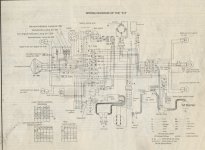
Here's an update. It's been a crazy week. I've had plenty of time to work on the bike. But it's just been a Pandora's box of stripped screws, dodgy wiring, dyslexic poring over of wiring diagrams and 1000 yard stares.
The claim of the previous owner that it was working fine the last time he put it away in the garage - is laughable. An insane, crazy laugh that is coming from the basement accompanied by a nervous tik of the eye.
Only kidding, but it has been one job creates another five jobs - and I've got quite a few bits and pieces off the bike now - waiting for parts to put them back together.
The main 'oh no' moment was when I took the headlight dimmer / starter switch off the handlebars (right hand side).
I had been testing the wiring - seeing whats working and what isn't - trying to work out why the starter button and hi-beam headlight switch didn't have continuity.
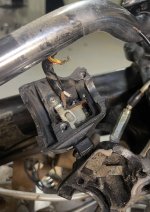
So I took it off to look inside as I suspected it was broken. Straight away I see the YELLOW/RED wire is not connected to the starter button (should soldered to plate opposite the button). Then I also see the white wire is also unattached - which I know is the low beam wire - from the headlight selector part of the switch. So, fixable thinks I.
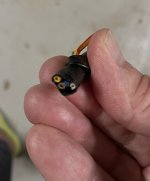
But then the loom pops out of the inside of the handlebar - with about an inch of loom - it had been cut! see pic.


Screenshot 2026-06-01 at 16.09.41.jpeg

Screenshot 2026-06-01 at 16.09.17.jpeg

"Oh, joy, another stripped screw to dig out" - was my first reaction. But on closer inspection it looks like I can save the switch - just needs a cleanup and some soldering.
It explains why the headlight only has one beam and why the starter button isn't working. But the cut cable leads me back to where the other end should be - nothing in the rest of the handlebar - so I follow into the headlight birds nest of wires.
I untangle it and find a loom of wires that look like it should be the collection of wires that goes to the switch. But something doesn't add up. The wires attached nay, decapitated - from the dimmer / starter switch at present are WHITE (low beam) - BLUE (hi-beam) - BROWN/BLUE (?) - and the YELLOW/RED (from the AC) for the starter. Right?

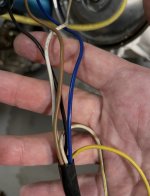
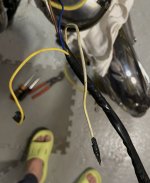
The wires I've got in my hand from the loom in the headlight bowl do not match up.. see photo below.
In this loom I have BLUE, WHITE, BROWN, BLACK, a YELLOW which is out of the loom and taped up and a WHITE/YELLOW which is also taped up. see photo. The loom then ends in a board similar to the one that's in the dimmer / starter switch (only fewer wires). ??

So maybe this is not the loom from the dimmer/ starter switch after all. ??
In the headlight bowl I see no evidence of the former loom at all!

I will share the wiring diagram here also - because I've been staring at it too long - and I'm dribbling out of the corner of my mouth - electrics is NOT my strong point.
If any of you can spot something I've missed I'd be super grateful.
The kettle is on.

Screenshot 2026-06-01 at 16.27.57.jpeg

Screenshot 2026-06-01 at 16.27.47.jpeg
Screenshot 2026-06-01 at 16.28.25.jpeg


K5WD.jpeg
light switch diagram.jpeg
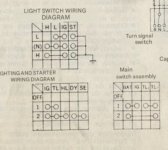
..NB, does anyone know what these abbreviations mean? DY, SE?
 
DY = Dynamo (white wire coming from alternator)
SE = Selenium (Yellow wire to the selenium rectifier/alternator.
A common modification is just to tie these together and eliminate the switched component of this - when combined with a modern rec/reg unit. This improves the low speed charging. It looks like they may have been taped together?

That "board" also belongs in the switch. When you slide the switch over to Hi beam, it automatically connects the white/yel circuit described above to bring both phases of the alternator into the charging flow.
 
DY = Dynamo (white wire coming from alternator)
SE = Selenium (Yellow wire to the selenium rectifier/alternator.
A common modification is just to tie these together and eliminate the switched component of this - when combined with a modern rec/reg unit. This improves the low speed charging. It looks like they may have been taped together?

That "board" also belongs in the switch. When you slide the switch over to Hi beam, it automatically connects the white/yel circuit described above to bring both phases of the alternator into the charging flow.
Ahhh, right. I knew they went to and from Alternator or AC - but now it makes sense. Thank you so much. I'm starting to see the light again, after a couple of days in the wiring doldrums. Cheers.
 
Hello,
The hearness modification described by EzPete will work with modern voltage regulators and will result in higher grounding current to dissipate energy from stator coils. With original selenium rectifier the charging voltage regulation was done only by balancing energy output and input.

Proper charging values for battery are specified with regards to lights off (one stator coil as energy source) and lights on (all coils as energy source) and engine rpm speed for charging current. You will find proper table in the FSM. If current load will be reduced or power generation will be higher (by replacing bulbs to LED or using all stator coils with lights off) the charging current at idle will be improved, but at higher rpm You will slowly boil Your battery. Please, check charging voltage for this matter.
 
Noted. I think for now, because I'm a bit overwhelmed, I'm going to just keep going to slowly put it back as it was - the whole starter and its wiring just seem to have been chopped out / bypassed. I want to see why.
Is the starter buggered? Was it because the dimmer / starter switch had failed? I don't know. But it would be a good start to take it back to how it should be first. So I understand it (if possible with my pea-sized brain) like that.. and then move on to upgrades or modern parts for better running. Hope that makes sense.
 
There are versions with and without starter. All are 6V, so battery capacity combined with starter consumption results in small startup margin. As such there engine covers with slot for starter as well as covers without this slot. My bike (red) does not have starter. My brother's bike (gold) has starter from the factory.


The OFF switch is on key. The unit pointed by AncientDad is starter indeed.

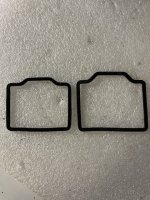
Rubber gaskets for carbs expands while contacting modern fuels. Use hot water bath to shrink them to the original size. Otherwise bowl assembly will be tricky.
Hello sir,
I just ordered some carb gaskets from ebay. They arrived but they are too big. You mentioned shrinking with hot water. Do you think that would work in this case? The original is on the left.
carbgaskets.jpeg
 
Others here may say different but I have had zero success with aftermarket carb bowl gaskets, they are ALWAYS just slightly wrong in shape and impossible to keep properly in the groove when reassembling. Then they leak

I have not myself heard of shrinking gaskets with hot water, doesn't hurt to try I suppose. Please report back on that one
 
..I boiled one and then put in the oven for ten minutes. It shrunk about 2-5% in size. Very precise science going here you know. But it may have shrunk.. But it hath not shrunketh enough.
But if you needed one to tighten one up just a tad - it could be the way.
I've had my arm up the handlebars today. Cajoling a loom.
Which is the first time in my life I've used that sentence.
So, you know, I'm grateful. 🙏
 
Hello sir,
I just ordered some carb gaskets from ebay. They arrived but they are too big. You mentioned shrinking with hot water. Do you think that would work in this case? The original is on the left.
View attachment 58174
That's not going to work. Given the number of "CB125" models over the years, it's not surprising to find these packing sets mislabeled. You're looking for part number 16010-304-305 On that side of the pond, CMSNL and David Silver Spares both show them in stock (although less expensive at CMSNL)
 
Back
Top Bottom