A meticulous restoration of a CB72 '67 (and a SS50Z K3)

Nicely laid out and compact too, with space for a spare fuse. Where do you plan to mount the fuse box?

I went for a modern battery, much smaller (height) then the original one, the fusebox and Sachse control box can be mounted on top of the battery, there is plenty of room. The original battery (137 x 77 x 132 mm) has a height of 132 mm, this one only 92 mm (https://www.landportbv.com/nl/produ...ten/category/3-motor/?page=1&subbrand=Lithium), gaining an extra room of 132-92= 40 mm
 
Last edited:
After Christmas and new year, finally some time spending in the shed.


WhatsApp Image 2026-01-03 at 11.47.jpeg

The wiring at the rear is finished and tested, ready for taping in, so now the front side.

WhatsApp Image 2026-01-03 at 11.47.48.jpeg

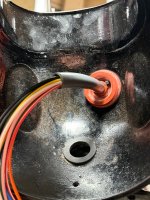
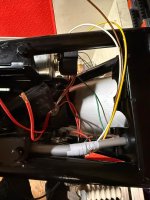
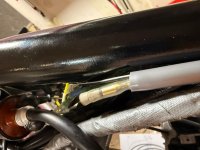
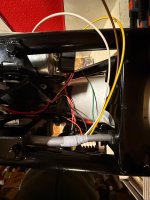
To make sure that the wiring harness doesn't slip out of the headlight, I added a rubber plug and secured it with a tyrap.

WhatsApp Image 2026-01-03 at 11.47.49.jpeg

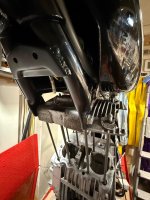
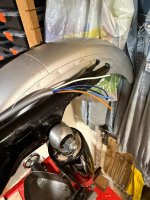
The harness is sliding trough the headlight shell, and gastank, while turning the frontfork.

WhatsApp Image 2026-01-03 at 11.47.50.jpeg

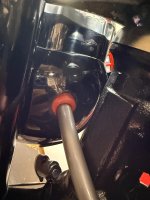
The harness is guided over the frame, and can move freely to a certain extend.

WhatsApp Image 2026-01-03 at 11.47.51.jpeg

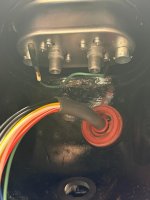
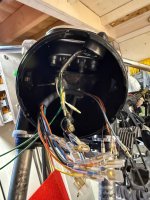
View from the back-side of the headlight.

WhatsApp Image 2026-01-03 at 11.47.52.jpeg

And room enough for the speedo combination, speedo cable and tacho-cable.
 
I like the sealing grommet for the headlight, where did you obtain them?
Which one ? the black or the red one ?

The black one is a standard rubber tule, bought at https://www.technirub.nl/ , the red one is taken from a machine that was scrapped. Usually I try to salvage interesting parts for "you never know when it comes at hand", and yes I know, I'm a bottom feeder / scavenger.

zwerver.jpg
 
Last edited:
and yes I know, I'm a bottom feeder / scavenger.
Few people scrounge up any more bits and pieces of leftover junk to use (hardware, brackets, road signs, etc) on these bikes than I do, and we've seen your "hoard" of NOS and other similar-level quality parts already... so you taking a grommet or two from something scrapped would hardly constitute "bottom-feeding". :giggle: At the age of our machines, doing a bit of scavenging is practically a necessity and to have that talent is almost a prerequisite for owning one of these bikes. And, I'd have to guess that very few things scrapped by your company and industry would look anywhere near "junk" level unless it was totally destroyed while in use. I'd love to look through the scrap pile where you work, I'm sure I could find all kinds of stuff that would be useful and spark the imagination for other applications.
 
Few people scrounge up any more bits and pieces of leftover junk to use (hardware, brackets, road signs, etc) on these bikes than I do, and we've seen your "hoard" of NOS and other similar-level quality parts already... so you taking a grommet or two from something scrapped would hardly constitute "bottom-feeding". :giggle: At the age of our machines, doing a bit of scavenging is practically a necessity and to have that talent is almost a prerequisite for owning one of these bikes. And, I'd have to guess that very few things scrapped by your company and industry would look anywhere near "junk" level unless it was totally destroyed while in use. I'd love to look through the scrap pile where you work, I'm sure I could find all kinds of stuff that would be useful and spark the imagination for other applications.
Unfortunately, we sometimes have to scrap new, never used machines because the customer changed his mind, or governments changed the rules. The most expensive parts are rescued, but we throw away for hundred thousands of euro's. Since we make special machines, sometimes just one-off, we can't sell them to other costumers, and we can't keep them, because our warehouses are full of (spare) parts.
Most NOS parts are bottom-feeding as well, most parts came in bulk, nobody wanted them, nobody cared, and nobody had the room for it. It is only for the last 10-15 years that parts are valued decently (except for some body-parts like fuel tanks, mudguards and mufflers).
 
Most NOS parts are bottom-feeding as well, most parts came in bulk, nobody wanted them, nobody cared, and nobody had the room for it. It is only for the last 10-15 years that parts are valued decently (except for some body-parts like fuel tanks, mudguards and mufflers).

My brother-in-law worked for American Honda in Gresham Oregon in the 70’s in the parts warehouse. They would get lists of parts to destroy and toss in the dumpster. Inventory control. 😠
 
My brother-in-law Yes, and worked for American Honda in Gresham Oregon in the 70’s in the parts warehouse. They would get lists of parts to destroy and toss in the dumpster. Inventory control. 😠
Yes, and that didn't only happen in the 70's, but also the 80's and 90's, at least here in the Netherlands. Property per square meter is expensive here, so clearing out is the only way of keeping things manageable. I ended up buying these clear-outs from small businesses (specifically the 250/305 &450 parts, NOS and used), before the smell of money reached the owners.
 
Last edited:
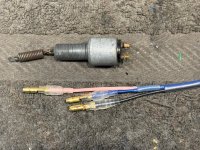
Yesterday I opened-up the headlight switch for the CB72. I had a bunch of switches, some NOS and some used, and one in particular was in very bad shape (mechanically and electrically). Since I wanted to alter the wiring colors to adept to the relays set-up, I used the worst one, since the state of that switch couldn't get worse. It was clear that someone was in-there before, because the switch had a natural short cut build in (sorry, no pictures this time, my phone was updating).

Anyway, when I opened it up I found the reason, the red isolation plate under one of the rotating contact was missing, the little steel balls and springs were mounted wrong, and the contacts were very dirty. I cleaned everything, and put the switch together after cleaning and lubricating everything in the right way. I de-soldered the old oxidized wires (copper-core was dark-green) and replaced them with new fresh wires in the colors that will adapt one on one to the new setup, displayed in the drawings. Some of the wires are directly connected to the relay's some are not. It saves wire complexity and connectors, focusing on a relatively clean headlight wiring.
 
It's busy at work, so not much time to work on the bikes, and inbetween I did a CB450 K complete engine overhaul for someone else, so I was happy I could spent a few hours working on the wiring.

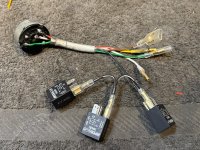
The headlight is now looking like this:

WhatsApp Image 2026-01-14 at 22.48.52 (Gemiddeld).jpeg

I found a nice rubber cap, that fitted precisely around the three relays, keeping them together as one. Testing the set-up was OK, everything works like it should. It's a nice sound, hearing the relays switch when turning the key-switch or the headlight switch.

At the rear everything works as well, but I have to bundle the wires together after adding the wires for the voltage regulator and the ignition.WhatsApp Image 2026-01-14 at 22.48.53.jpeg

And finally, the wires that go the the tail-light are ready for their connectors.

WhatsApp Image 2026-01-14 at 22.48.54.jpeg
 
The headlight shell of the CB72 has more room then the CB450 K1-K7. The K0, just like the CB72 has the speedometer build into the headlight, which gives an extra area for the relay's. I'm also designing a similar setup for the CB450 K1 and K2, and the relays are situated under the gas tank, since there is almost no room in the head light shell.
 
I tried a few things to keep my connectors dry, even when it's raining or due to condensation, I made a few test connectors, and put them in water for a few days, and when taking them out, they were bone dry.

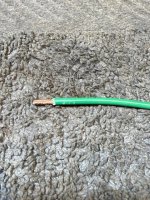
First I strip a wire:

WhatsApp Image 2026-01-18 at 16.13.49 (1) (Klein).jpeg

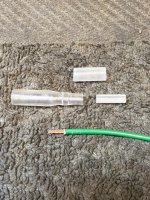
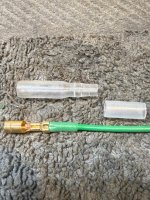
Then I take a tule, and two small pieces of shrinking tube with adhesive.

WhatsApp Image 2026-01-18 at 16.13.49 (2) (Klein).jpeg

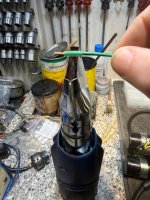
Putting the small piece of shrinking tube around the wire, and heat it up.

WhatsApp Image 2026-01-18 at 16.13.49 (3) (Klein).jpeg

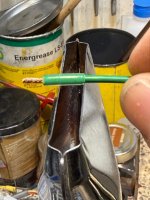
The result:

WhatsApp Image 2026-01-18 at 16.13.49 (4) (Klein).jpeg

The I crimp the (in this case female bullet) connector:

WhatsApp Image 2026-01-18 at 16.13.50 (Klein).jpeg

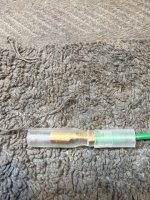
Next step is to put the tule over the connector and wire:

WhatsApp Image 2026-01-18 at 16.13.50 (1) (Klein).jpeg

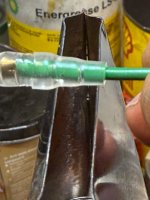
Next I use the larger piece of shrinking tube and place it over the backside of the tule:

WhatsApp Image 2026-01-18 at 16.13.50 (2) (Klein).jpeg

And use heat to shrink it. The adhesive will make a watertight connection with the tule and the wire:

WhatsApp Image 2026-01-18 at 16.13.50 (3) (Klein).jpeg

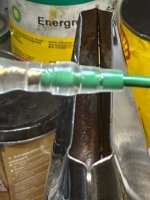
I heat the whole backside if the tule, the shrinking tube, and the wire, in a way that everything fuse / melts together.

WhatsApp Image 2026-01-18 at 16.13.50 (4) (Klein).jpeg

The other side is done the same way, and since the shrinking tube is a large diameter, both connectors, once connected, from a watertight connection. Unfortunately, it doesn't work with dual contacts.
 
A good approach to keeping out moisture and corrosion.
The trick is to weld everting together, I tried to peel the shrink tube off, but it took parts of the wire isolation with it, so the connection between both is solid. I only do this with connectors out in the open, the ones in the headlight are done in a normal way.
 
That's a lot of work for bullet connectors, I decided to swap to modern sealed connectors on a few 'resto-mod' bikes.
Only real problem with them is they are a bit square and bulky
I didn't think Holland was as 'wet' as Britain or is it to have a 1000 year wiring harness?
 
That's a lot of work for bullet connectors, I decided to swap to modern sealed connectors on a few 'resto-mod' bikes.
Only real problem with them is they are a bit square and bulky
I didn't think Holland was as 'wet' as Britain or is it to have a 1000 year wiring harness?
Holland is wet, but even worse is the moistures air that penetrates everything. I do ride in the morning, and those little foggy droplets will make their way into the electrics. And yes, it's a lot of work, especially because I made a whole new wire harness with lot's of new connectors.
 
I did finish the wiring for the ignition, and I can easily switch from E-ignition to points and vica-versa by using two extra connectors on the main ignition wiring. Since I start with points first, I plugged the connectors for the E-ignition. After everything runs good, I'll switch to E-ignition. And if the electronics breaks down, I can always ride home with a tested points set-up.

WhatsApp Image 2026-01-18 at 22.14.55 (Gemiddeld).jpeg

and from below:

WhatsApp Image 2026-01-18 at 22.14.56 (Gemiddeld).jpeg

One of the last things to wire up are the rear brake switch and the neutral indicator. Tonight I started with the break switch, which came original with the bike, but with broken wires. Since I added a front break switch, I had to alter the wiring a bit and used the pink wire in the harness to connect to the front brake switch. Normally pink is for the generator, just like the yellow and brown wires, but since I use direct wiring from my generator to the regulator (no connectors other than the connector to the regulator), I can use these wires for other things. The brown and yellow wire will be used for the side stand switch.

WhatsApp Image 2026-01-18 at 22.14.57 (Gemiddeld).jpeg

The male bullet connectors are made in the same way as the females, adding an extra piece of shrinking tube to make sure these connectors stay dry.

This week I have to do the side stand switch connection and the neutral switch and indicator wires before I can put my box of electric parts and electric tools away.
 
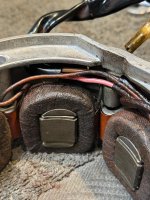
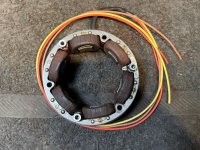
The last item that has to be modernized is the generator wiring. The wiring seems OK-isch, no open wires, no damaged connectors, but a damaged and hardened sleeve and stiff isolation on the wires close to the heated engine parts were the reasons for replacement of the wires with heat resistant wires and sleeve.

WhatsApp Image 2026-01-22 at 09.47.18.jpeg

The resistance measurements of the coils were OK, no connections to ground, no (mechanical) damages visible on the coils and wiring between the coils, in short, a good candidate for my CB72.
 
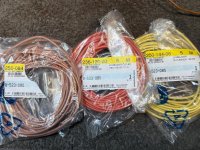
Yesterday Ifound some time to proceed with the generator, and replaced the wires with heat resistant, oil resistant wires. Luckily I could get my hands on the same colors that Honda used, being pink, yellow, and brown.

WhatsApp Image 2026-01-25 at 09.18.59 (5).jpeg

Heat resistant wires from Germany in my Japanese bike, I hope that they work together ;)

WhatsApp Image 2026-01-25 at 09.18.59 (1).jpeg

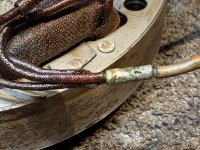
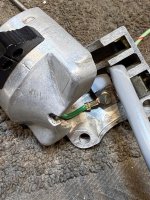
This is how Honda connected the wire to the generator, they sliced a small koper tule around the wires and soldered them together.

WhatsApp Image 2026-01-25 at 09.18.59 (3).jpeg

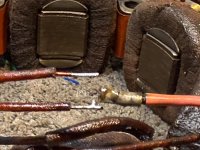
All it takes to disconnect is to heat them up, using my soldering station, and viola, nicely disconnected.

WhatsApp Image 2026-01-25 at 09.18.59 (6).jpeg

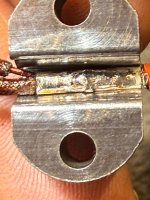
I use aluminium tules, and with a saw blade I make a small cut in the tule for soldering later.

WhatsApp Image 2026-01-25 at 09.18.59 (7).jpeg

First I press the tule with my tools

WhatsApp Image 2026-01-25 at 09.18.59 (8).jpeg

And solder them afterwards

WhatsApp Image 2026-01-25 at 09.18.59 (9).jpeg

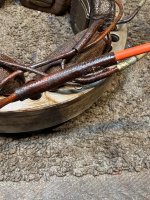
Push the original tube in place, and ready for a lifetime service.
 
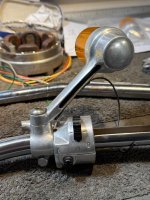
The CB72, like the CB77, doesn't have a nice bolt around the steering handle were I can connect a ground wire to the frame, but I need to make a good ground since the handle-switchgear rely on a good ground (horn and starter button).

So I thought, why not connect a ground wire in the place where it matters most ? I opened the switch-gear and found the perfect place to connect.

WhatsApp Image 2026-01-25 at 09.18.58.jpeg

I did this for both switch-gears, and these wires will connect to the headlight bolts, were all the ground wires are connected to. Fromboth head light bolts, two wires are connected to the frame, directly to the engine bolts were the main ground strap is attached to the battery.
 
It's too bad the PO cut a notch in the top of the switch. How do you plan to seal that up to keep out moisture?
 
The notch is used to locate the switchgear in position. I think I add a pin at my handle with the same function. Both sides have the notch.
 
Is this notch to allow the wiring to exit the switch and into the hole in the handlebars without getting trapped ?
 
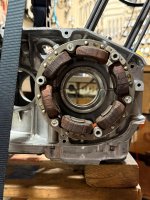
Finished the generator and mounted it on the (empty) engine for routing details.

WhatsApp Image 2026-01-25 at 22.32.01 (1).jpeg


WhatsApp Image 2026-01-25 at 22.32.01.jpeg

Later, will add the sleeve, cut the wires to length, and add a connector that connects directly to the voltage regulator.

All coils had the correct resistance. One coil (there are six) has a resistance of 0,85-0,9 ohm, so yellow to brown has two coils, being 1,7 ohm, red to brown has two sets of coils parallel, so the total resistance should be 0,85, and yellow to red has 0,85+1,8=2,65 ohm, and that was exactly what I measured . No ground connection, thus all good.

If someone needs the complete scheme of the generator, and the calculations, just ask.
 
Not done much, too busy with other things in live, but tonight I could escape to the garage, and made some progress on the wiring. I had to wait for the battery to arrive, and that came in last week. It's a LifePo4 battery, light, and much smaller than the original battery. The voltage rectifier can handle this type of battery, so I decided to go for this type of battery, it saves a lot of space, space I can use.

bedraad.jpeg

I had to solder some ground contacts while the main harness was on the bike, a third hand makes your work easier.

soldeerhulp.jpeg

I decided to add two main ground points for the wire harness, one at each engine bolt. The battery ground is also attached to one of these bolts.

groun.jpeg

This week will be busy, our oldest son comes home from Germany (he works in germany) with his Spanish girlfriend for a week, so I guess it will be quit for a while around the build.
 
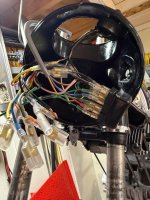
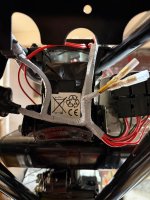
It's getting crowded in the headlight case....

WhatsApp Image 2026-02-07 at 19.26.06 (Gemiddeld).jpeg

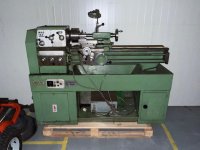
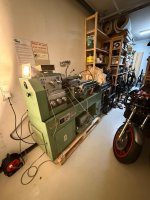
I didn't do much on the bike last week, I needed to make some space in my shed for a lathe I got (a left-over from the company I work).

WhatsApp Image 2026-02-07 at 19.26.06 (3) (Gemiddeld).jpeg

It has digital read outs, a pump for lubricating fluids, and isn't too big. And it's larger and more precise than the lathe I had (sold it to make room for this one).

WhatsApp Image 2026-02-07 at 19.26.07 (Gemiddeld).jpeg

It's an Italian machine, robust, and the electrics work (for now). No play in the main bearings, and a good to go frame. I'm happy, especially because this one is a little bigger and can handle 2800 rpm, fast enough for small diameter parts.
 
Last edited:
I'm envious of your source for good used things like this (at a reasonable price I'm quite sure). I've wanted a lathe for decades but have never had either the space or the money at the same time.
 
I am almost ashamed to say that I got it for free. It was standing in a corner for a year, catching dust. Today, a lathe is seen as old fashioned, old technology, heavy and needing maintenance.

Young people in our company make the drawings, and a few weeks later they get a crate from some asian country with the parts in it.

And since I’m one of the few elderly men in our company, it got my attention, since I’m used to work with a lathe or a milling machine.

In other words, no one wanted this lathe.
 
Last edited:
I am almost ashamed to say that I got it for free. It was standing in a corner for a year, catching dust.
No reason to be ashamed and honestly, with the amount of time you've been there it seemed likely they would have given it to you. Anytime a big business offers something it is no longer using free to an employee, that's a good thing. And I would damn sure have taken it myself if I'd gotten the offer. :giggle:
 
I have a little bench-top lathe that is great for making bushings, spacers and the like that are perfect for motorcycle projects.
 
3 phase, another reason that others couldn’t take it. When we bought our house (new), a 3 phase powerline was an option, normally I don’t care about options, but this one I wanted.
Good thinking, without 3 phase supply in most of our domestic properties we have to use an inverter.
 
The only thing I did in respect of last week (post 533), is adding the winkers, including the wires in the way Honda designed it. No lose wires outside the handle-bar, all wire protected by a steel tube.

Well, that wasn't easy, but finished for now. So much wires, and hardly any room inside the handle bar. I used a handle bar off a SS50, it has the same width, is all 22 mm, has the same shape, and is cheap. The original handle bar is +200,00 Euro, and the one that came with the bike is a high bar. The only set-back are the toothed parts where the handle is clamped, these area's aren't at the same location (too close together). I like the European style flat bar, so the choice was simple. I mounted the winkers with temporary bolts, but only for now. These will replaced by mirrors in a later phase, due to the hight of the bike, and the height of my ceiling.

IMG_0275.jpeg


PHOTO-2026-02-13-11-59-40.jpg

Now the last step :

IMG_0277.jpeg

For some reason I want to eat Italian food tonight, spaghetti bolognese :cool:
 
Last edited:
Next week I will replace the front forks with NOS ones, and salvage these for the next build, or spare. Many years ago I got multiple sets of front forks for these bikes, these were part of a large pile of stuff from a Dutch motorcycle company who wanted to get rid of old parts which were out of their bags / boxes, having small damages and (mostly) without part numbers. I recognized these forks as being CB72. Just a few scratches through the paint are not the reason for me not to use them (and these came with the chrome bushes).
 
A little low, but steady ongoing work on the electrics. Tested the headlight switch, completed the wiring en added the relay's for the headlight (lights on/off, hi-beam and low-beam).

View attachment 54171
Hi Jensen, while you are working on the electrics, perhaps you can help me, I have two headlight switches, one has 4 wires, and one has 5. The wiring diagram I am working to show 5. any ideas as I am attempting to keep it as near to original as possible.
 
Hi Jensen, while you are working on the electrics, perhaps you can help me, I have two headlight switches, one has 4 wires, and one has 5. The wiring diagram I am working to show 5. any ideas as I am attempting to keep it as near to original as possible.
Do you have the parking light in your headlight set-up ? Yes ? the extra brown wire connects to the instrumentation light and parking light. No?, you should wire the instrumentation and parking light in the headlight directly.

It depends on your wire harness and headlight type. Since I have a Dutch version, which is the same as the German version, it uses the 5-wire switch.
 
As mentioned earlier, I will replace my front forks by a NOS pair, so I decided that this weekend and the coming week(s) should be front fork time. I have a few used sets lying around, and I want to use the NOS set for my 1966 build, and the pair that came out of that bike, together with 3 other used sets, I would like to save the good parts, and build myself one or two spare sets. I also have 3 sets of early (steel) front forks, and want to do the same with those.

The later aluminium forks are easy to dissemble, but the early ones are, just like the CB450 K0 forks, sometimes very stubborn (the chrome busing is threaded).

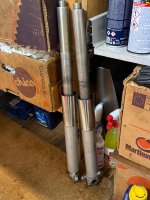
WhatsApp Image 2026-02-22 at 15.46.30.jpeg
The above set will be replaced by these:

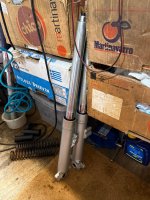
WhatsApp Image 2026-02-22 at 15.46.31.jpeg
Fresh NOS ones, ready for mounting after flushing with front fork oil.

WhatsApp Image 2026-02-22 at 15.46.31 (1).jpeg

I needed all my weight, plus the weight of the stand including the bike, and a large pipe (1m) to get this one dissembled (after using penetrating oil and heat for a week). I got 5 out of 6 in parts, one is still testing my patience and force, and will try next weekend after the whole week adding penetrating oil and heat cycles.

That last one is the hardest I ever tried to dissemble, including all the CB450 K0 front forks.

I need one good set at least for my 1962 build (doing this build simultaneously with the 1966 build).
 
Last edited:
Not ready jet, found another set of legs (new type aluminium lowers). I wonder where I got all these front forks. What I'm looking for is a set of legs with good chrome, because letting those legs re-chrome is expensive. The NOS ones are in perfect condition, that's why I'll use them on my rider.

WhatsApp Image 2026-02-22 at 18.12.59.jpeg
 
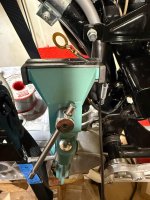
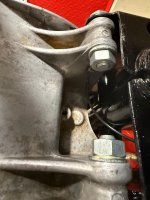
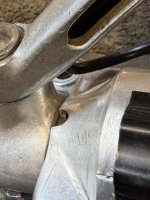
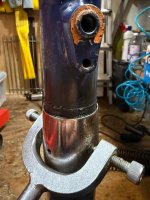
Last night I tried again, but now with more heat (see the discoloration), and finally it gave up. had to use lot's of force. After disassembly it wasn't clear to me why this one gave me such a hard time.

WhatsApp Image 2026-02-23 at 09.33.54.jpeg


WhatsApp Image 2026-02-23 at 09.33.54 (1).jpeg

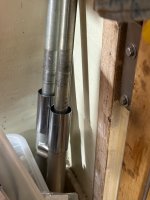
But after solving one problem, another problem came up (as usual). The inner leg doesn't want to come out, it's impossible to move the inner leg furtehr then a certain point, no matter how you rotate or pull.

As far I can tell, the inner leg is straight, so it must be a dirt or mushroom shape of the inner leg, or lower bush, or both. I filled the leg with gasoline, and will flush a few times, but I think that won't help.
 
Last edited:
Last night I tried again, but now with more heat (see the discoloration), and finally it gave up. had to use lot's of force. After disassembly it wasn't clear to me why this one gave me such a hard time.

View attachment 55367


View attachment 55368

But after solving one problem, another problem came up (as usual). The inner leg doesn't want to come out, it's impossible to move the inner leg furtehr then a certain point, no matter how you rotate or pull.

As far I can tell, the inner leg is straight, so it must be a dirt or mushroom shape of the inner leg, or lower bush, or both. I filled the leg with gasoline, and will flush a few times, but I think that won't help.
Don't light a cigarette whist it's full of gasoline :oops:
 
Back
Top Bottom