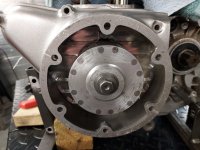
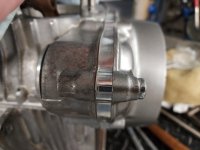
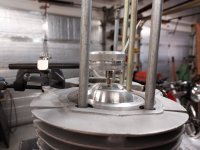
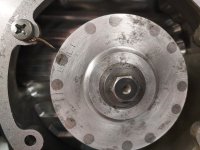
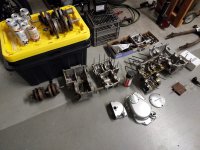
After multiple weather, household and doctor appointment occurrences over the last few weeks that prevented me from getting much garage time at all, I'm finally back to the engine.
My borrowed dial indicator was requested to be returned (and he told me he'd bring it back over when he was done using it to check a front brake disc, now over 2 weeks ago) so I ordered an inexpensive one from Amazon. Probably would have worked if only the @#$%& magnetic base (which I did not want but the others were a LOT more expensive) is a POS and won't stick strongly enough to the metal plate I found that I bolted to the intake port. After much frustration, cursing and many times getting it
almost set up only to have it fall off again, it went back in the box. Yeah, the hard plastic case it came in
that they decided to ship in a paper envelope - despite it weighing a few pounds because of the mass of the base. The evidence of it being brutalized on its way here was clearly visible on the outside of the plastic case. When I opened it I fully expected the precision part of it to be damaged but amazingly it wasn't.
So, moving on to actually making some kind of progress. After a few failed attempts to modify an old torsion bar for less valve seat tension (including drilling the retaining bolt hole larger to allow it to "relax" a bit, as well as trying the opposite of what I'd read in the past when people wanted to make them tighter by grinding off a spline - which did work, but made it
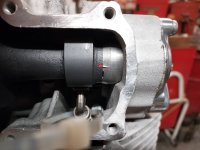
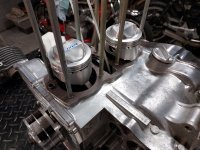
too loose, no seat tension at all) I used an old set of torsion bars (hopefully weaker just for testing and measurement purposes), timed up the cams and put a link in the chain so I could at least rotate it. That went well, but having never used cams with this high a lift previously I can tell you,
@EzPete was right - man is there more rotation resistance now compared to even my red bike which does have modestly higher lift than stock. Guess I'm going to teach myself to use Terry Naughtin's clearance check method, little hockey sticks of solid core solder through the plug hole and between the valve and piston. That's gonna take some practice.
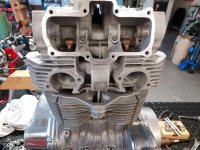
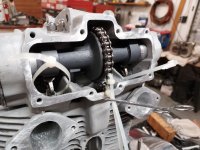
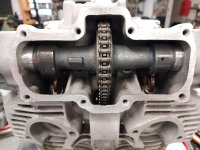
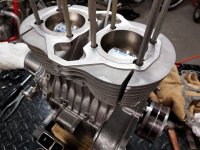
View attachment 55848
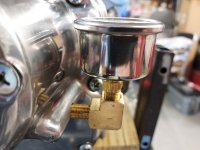
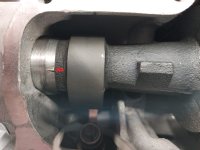
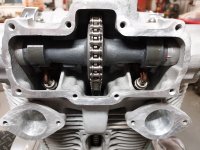
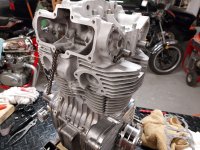
View attachment 55849
The funky look of the cam lobes is a combo of oil I put on them during assembly over the coating Terry had done following the weld-up and regrind process.
And hey, the 4 old used torsion bars didn't snap during rotation so that's a plus.





 . I'm glad I don't like there.