Newbie Engine Rebuild? CA160

Still don’t have my case split yet but was wondering, as I’ve been looking at replacement crank options, is the cb and cl160 cranks the same as the ca160?
I can't speak from direct experience, but typically Honda parts will interchange if the 3 digit middle number is the same on both parts. But, the CA160 crankshaft was apparently sold in separate pieces while the CB/CL crankshaft was sold as a single unit and the middle numbers are not the same (CA - 216 on all the pieces, CB - 217 for the unit). I have no idea what, or if there are, differences unfortunately but I'm surprised to see that personally. Someone here who as more experience with them will know.

Edit: not sure who is right or wrong, but Partzilla's listing differ with CMSNL and show all 3 to use the same crankshaft, part # 13000-217-010 (or -020)
 
Last edited:
One thing I'm learning real fast with this era of Hondas is that the parts fiches take some detective work at times. That said, if you cross reference the CA crank it'll show those individual parts are all cross-compatible with the CB and CL lines. Additionally, the crankcase and cylinder part numbers are the same for all CA/CB/CL 160's. I'd personally be pretty comfortable including the CB and CL cranks in the search as well.
 
One thing I'm learning real fast with this era of Hondas is that the parts fiches take some detective work at times. That said, if you cross reference the CA crank it'll show those individual parts are all cross-compatible with the CB and CL lines. Additionally, the crankcase and cylinder part numbers are the same for all CA/CB/CL 160's. I'd personally be pretty comfortable including the CB and CL cranks in the search as well.
I did find that the Partzilla CA listing showed the crank as available in complete form while CMSNL's listing showed all individual parts. And I'm sure that isn't the extent of the errors and omissions unfortunately. I guess we're kinda lucky to have them at all really, considering the span of decades after production.
 
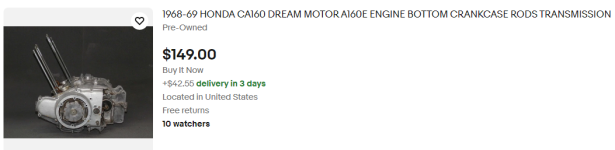
So I have found these two bottom ends on eBay. Still don’t have my case split open yet but assuming I for sure need a new crank, was thinking one of these would be good to have in case I need anything else. What are your guys thoughts on these two on eBay?


Last edited:
If I was going to roll the dice on one of them it would be the the one with the painted case as it at least it is not physically damaged as far as I can tell. The seller says it is ready to go but I would take it apart to make sure it was assembled properly and check the components. The other one has case damage and one thing that threw me it shows the country of origin as Sweden.
 
The other one has case damage and one thing that threw me it shows the country of origin as Sweden.
It's interesting because one of their links to their other items for sale doesn't work, but another link does and it shows that the bottom end with the cracked crankcase (likely from a thrown chain) is in the US

1766413822347.png

And honestly, the visual condition of the small end of the rods looks really nice, light in color with the bronze-y look of a good crankshaft. But overall the crankshaft in the black bottom end seems to look decent as well, and I'll say that the crankcases actually look a tad better internally (no cam chain wear visible in the tunnel). As long as the big end rod bearings are good either one of them would seem to be usable. Both accept returns though it doesn't say anything about refunds if there's a problem.
 
Thanks guys! Appreciate the feedback! I'm thinking maybe the painted one might be a better option. Also, if it is in good condition overall, and checks out, maybe I just put the head from my motor on it and run it. Especially if once I get my case opened up and I see other internal damage. I did find the what was remaining of the piston skirt that had broken off. It was basically disintegrated into tiny pieces in the bottom end once I pulled the clutch cover off below the oil screen.
 
Thanks guys! Appreciate the feedback! I'm thinking maybe the painted one might be a better option. Also, if it is in good condition overall, and checks out, maybe I just put the head from my motor on it and run it. Especially if once I get my case opened up and I see other internal damage. I did find the what was remaining of the piston skirt that had broken off. It was basically disintegrated into tiny pieces in the bottom end once I pulled the clutch cover off below the oil screen.
I would never trust a used bottom end you find on eBay without at least pulling the outer covers to see a bit more of the interior condition, and on the 160 you can pull the small cover for the drain plug as well. If it has any appreciable sludge in the bottom end you'd want to try to clean the internal passages in the crankshaft or potentially suffer top end damage later from lack of oil to the small end rod bushing surfaces and piston skirts.
 
Any thoughts on the two above linked eBay bottom ends?
It's difficult to assess the usability through pictures, so you will always be relying on the description and seller to a certain extent. That said, I'm sure most here have gambled on similar purchases as you did when you acquired your project. (Part of the fun, part of the challenge.)

You might compile a list of questions for the seller before purchase to address reasonable concerns, like sloppiness in the rods or bad main bearings. Hopefully, whichever way you go will work out!
 
I would never trust a used bottom end you find on eBay without at least pulling the outer covers to see a bit more of the interior condition, and on the 160 you can pull the small cover for the drain plug as well. If it has any appreciable sludge in the bottom end you'd want to try to clean the internal passages in the crankshaft or potentially suffer top end damage later from lack of oil to the small end rod bushing surfaces and piston skirts.
You are absolutely correct. I would not trust the ebay seller without opening this one up to do an inspection as well. I'm just hoping to get something that will run either way I go. I'd like to get the engine together and put aside to move on to frame. However, I am learning a ton while working through this engine process and it has been extremely enjoyable to this point. I'm also getting my 9-year-old son to help out and he is having fun turning some wrenches for me. :)
 
You are absolutely correct. I would not trust the ebay seller without opening this one up to do an inspection as well. I'm just hoping to get something that will run either way I go. I'd like to get the engine together and put aside to move on to frame. However, I am learning a ton while working through this engine process and it has been extremely enjoyable to this point. I'm also getting my 9-year-old son to help out and he is having fun turning some wrenches for me. :)
That last part makes it worth it.
 
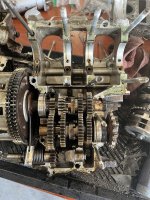
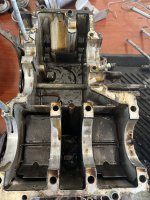
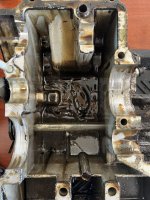
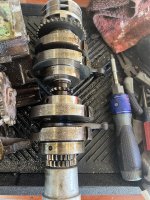
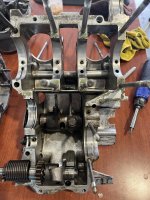
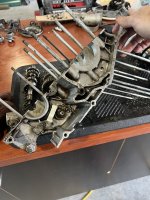
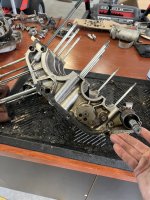
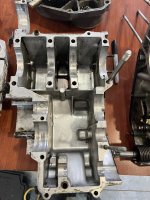
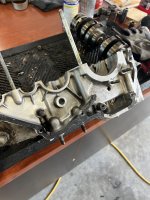
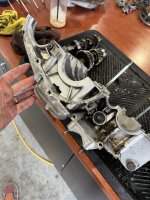
Finally got my case split and crankshaft pulled. Rest of the mechanics look to be ok and move freely and smooth. The one rod on the crank definitely was shot though. You can also see a lot of crud and thick muck in the bottom of the case. I’ll be getting all this cleaned up. I do have that other bottom plate and coming from eBay so I hope that crank is in good condition.IMG_0234.jpegIMG_0235.jpegIMG_0236.jpegIMG_0237.jpeg.
 
Finally got my case split and crankshaft pulled. Rest of the mechanics look to be ok and move freely and smooth. The one rod on the crank definitely was shot though. You can also see a lot of crud and thick muck in the bottom of the case. I’ll be getting all this cleaned up. I do have that other bottom plate and coming from eBay so I hope that crank is in good condition..
Good progress. I know you're new to this so I should point out that the clutch, oil filter cup and shift shaft should have been removed before removing the lower case. You will reassemble the bottom end in the upper case and the weight of the clutch will be a problem doing that later.
 
There were chunks missing in at least one piston, right? Did any of the missing pieces turn up in the sludge?
Yes I found a couple chunks of what assume was pieces of the broken piston.

Good progress. I know you're new to this so I should point out that the clutch, oil filter cup and shift shaft should have been removed before removing the lower case. You will reassemble the bottom end in the upper case and the weight of the clutch will be a problem doing that later.
Thanks for the tip. I’ll disassemble those items as I clean everything before proceeding with reassembly of the case. I may have some questions as the clymer manual is leaving a little to be desired.
 
I may have some questions as the clymer manual is leaving a little to be desired.
The FSMs for the '60s bikes are less informative but still the better choice for information overall. Did you not get a download from our library yet?
 
Not sure why, it's there for everyone and part of my Welcome Package. :giggle:

PM sent
Thank you! I did look for one but did not see one specific for the CA160. It wasn’t until here recently when trying to source a new crankshaft that I realized the CL and CB models were mostly the same. So thank you again for the PM.
 
Take a lot of pictures as you disassemble the top end in particular, along with the shift detent layout and orientation. Both manuals absolutely suck for visual aids in these areas, and the parts fiches are really inconsistent.

Same with the knock pins and locations - if you follow the fiches only you end up with extras and have to go on a hunt to figure out where they’re from.
 
So I’ve been working on cleaning things up inside the lower case and so far making good progress. Running things through my ultrasonic washer and regular parts washer. I m for sure going to need new cm chain rollers though. Do you guys think the metal replacement rollers found on eBay are worth it? Or just replace with like kind hard rubber rollers?
 
So I’ve been working on cleaning things up inside the lower case and so far making good progress. Running things through my ultrasonic washer and regular parts washer. I m for sure going to need new cm chain rollers though. Do you guys think the metal replacement rollers found on eBay are worth it? Or just replace with like kind hard rubber rollers?
Post links to things you find on eBay that you have questions about so we can check them out with you.

I've not tried to search for typical top end rebuild parts for a 160 anytime recently but regardless of availability of new cam chain rollers, never bother with used ones you might see on eBay because they get brittle and will come apart quickly.

Just checked a few sources and saw these


These are the ones I saw
I've seen that set discussed here before, can't recall who used it or what was said. Something about a steel roller in the middle of the chain run just doesn't feel right but that's just me, I suppose it works okay.
 
I think I tend to agree. Seems like the rubber might be a little more forgiving in the instance something were to happen. Thanks for the feedback.
 
I am cleaning parts and pieces in my ultrasonic cleaner, should I put my transmission shaft/gears in it as well? Would the bearings be ok?
 
Decided not to clean shafts and gears in ultrasonic cleaner. Used a tabletop parts cleaner from harbor freight though to clean cases etc. turned out ok but still have some more scrubbing to do and possible bead blast the outside of cases. I also got the other bottom end I ordered off eBay. The crank is in good shape it seems and rods are tight with no slop. I’ll be tearing into it soon to get the crank out and swappedIMG_0251.jpegIMG_0253.jpegIMG_0254.jpegIMG_0252.jpegIMG_0255.jpegIMG_0256.jpeg
 
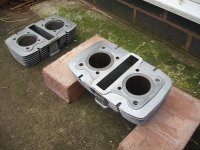
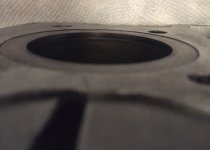
I got the jug all cleaned up and while I was cleaning it, the cylinder sleeves slid out. This has me thinking, if the cylinders need anything more than a simple honing, would I not be better off to buy new sleeves versus getting them re-bored? I already have to buy new pistons and rings anyway.
 
I got the jug all cleaned up and while I was cleaning it, the cylinder sleeves slid out. This has me thinking, if the cylinders need anything more than a simple honing, would I not be better off to buy new sleeves versus getting them re-bored? I already have to buy new pistons and rings anyway.
New sleeves have to be bored after installation to match the pistons.
 
I got the jug all cleaned up and while I was cleaning it, the cylinder sleeves slid out.
Were you using any heat while cleaning the cylinder? I assume the sleeves on this motor are pressed in and should not come free easily. I wonder if the cylinder/sleeves can be used in this state. Maybe share some pictures?
 
Were you using any heat while cleaning the cylinder? I assume the sleeves on this motor are pressed in and should not come free easily. I wonder if the cylinder/sleeves can be used in this state. Maybe share some pictures?
Yes I had heated it up in my ultrasonic cleaner to about 120F and ran for about an hour. When I removed it from the cleaner the sleeves slid out. Back at room temp they are tight now.
 
Yes I had heated it up in my ultrasonic cleaner to about 120F and ran for about an hour. When I removed it from the cleaner the sleeves slid out. Back at room temp they are tight now.
I'm not an expert on cylinder sleeves by any means, but it seems undesirable for the sleeve to come free at such a low temperature (well within the normal operating range of the motor).

I also wonder about the orientation of the sleeves after reinsertion. Do the sleeves sit flush in the block afterwards?

I hope others will chime in here.
 
I'm not an expert on cylinder sleeves by any means, but it seems undesirable for the sleeve to come free at such a low temperature (well within the normal operating range of the motor).

I also wonder about the orientation of the sleeves after reinsertion. Do the sleeves sit flush in the block afterwards?
Aside from any existing wear on a cylinder (sleeve) like more on the thrust face than the sides 90° to it, I doubt there is a need for specific orientation. I believe all Honda sleeves sit flush in the cylinder aluminum and the fire ring clamps between the top of the sleeve and the combustion chamber in the head so in theory the sleeve should be clamped and sit still but that said, I don't think you want them to be a slightly loose fit either.

Not necessarily the same situation, but I remember VHT member Mike having trouble with a head gasket leak on a 305 engine he rebuilt during a restoration and it turned out to be the sleeve had slipped in the cylinder and was slightly elevated.

 
Aside from any existing wear on a cylinder (sleeve) like more on the thrust face than the sides 90° to it, I doubt there is a need for specific orientation.
This is what I was thinking about. I've read that used sleeves are sometimes rotated 90° for this reason. If these cylinders are bored out, then I guess this concern should go away.

I was also worried about the possibility of a head gasket leak arising from a loose sleeve or a sleeve that is not properly seated in the jug.
 
I actually had a typo in my previous response, it was heated at 150 degrees, but that said, they did slide back in and are sitting flush in the block. My initial concern was that if they needed to be bored, how will they stay in place and not spin? But after reading some of the other comments here, should I have additional concerns or do anything different? Buy new sleeves, etc.?
 
I actually had a typo in my previous response, it was heated at 150 degrees, but that said, they did slide back in and are sitting flush in the block. My initial concern was that if they needed to be bored, how will they stay in place and not spin? But after reading some of the other comments here, should I have additional concerns or do anything different? Buy new sleeves, etc.?
There are plenty of used cylinders out there on eBay if needed. A good machinist could tell you if your existing cylinders/sleeves would be usable.
 
But after reading some of the other comments here, should I have additional concerns or do anything different? Buy new sleeves, etc.?
I certainly don't mean to cause undue concern, but want to make sure your rebuild goes smoothly. In my mind, pressed in parts with an interference fit are meant to stay put, so I wouldn't want to risk running the motor with a loose sleeve. Even though it would be clamped in place, perhaps it could still rotate or vibrate in ways that the original design does not account for. The motor will certainly exceed 150° when warm.

I wonder if the ultrasonic cleaner helped loosen the sleeves in any way beyond the introduction of heat.

I would probably prefer to move forward with another used cylinder. It would be disappointing to pay for machine work and then find out they are not usable.

Have you examined the cylinder casting carefully for cracks or anything like that? Something like that could explain the looseness. The broken piston skirt suggests that something pretty serious went down with that motor, so that's another reason for me to be suspicious (or superstitious) in this situation.
 
The 175 cylinder block doesn't have to be heated very hot for the sleeves to drop out. I found this out accidentally when I put a cylinder block into the domestic oven set at 180c, to cure some paint. But they dropped back in easily while still hot, and have not given any trouble. I've repeated the process several times now with out issues, once when I wanted to swap some good liners out of a jacket with some broken fins, for rusty liners in a jacket with good fins

1767710429174.jpeg
 
When I had my CB160 cylinders bored, the machinist pointed out that one liner was ’loose’ and that it was sitting slightly low. He suggested that I shim the liner so or was level with the deck and that I use Locitie 660 to set it (as there was a slight possibility that it might rotate while running).
this pic is before it went to the machine shop
IMG_4351.jpeg
 
Last edited:
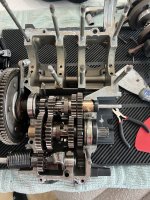
Loose sleeves,in the 160s, are more common than you think. I've seen several of them,over the years. One old guy,who I used to trade parts and labor with, decided he needed to pin the sleeves so they couldn't turn. The guy who bored My last set of barrels said"it shouldn't matter, with head bolted down it can't go anywhere anyway". Logic dictates that the top of the sleeve should be flush with the top of the cylinder block, for proper sealing. I've heard of the use of LocTite discussed, as a way to secure loose sleeves, but you gotta wonder how that would affect heat transfer between the sleeve and the barrel.
 
So my sleeves are actually still able to be removed by hand with everything at room temp. This just makes me nervous and after several conversations seems to be a potential problem. Although, sounds like some movement is not inherently abnormal. I guess I’ll see if I can source a “good” used cylinder jug as a replacement. I just don’t want to spend the money and time getting everything running to only have engine failure because of something like this that was a known possibile problem. On another note, as soon a my intake valves show up, the head is off to Schumann Motor Works for a valve job.
 
I wonder if the old punch/divot trick would well here. I've had success doing it with bearings where the outer races spin in the case housings. Would avoid any possible heat transfer issues arising from using locktite, But yeah if used cylinders can be had for cheap, by all means.
 
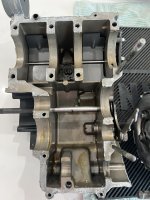
While I’m waiting for my head/valve job to be finished up and returned, I decided to go ahead and get the crank shaft out of my spare EBay bottom end that I purchased. It’s actually a CB160 bottom end but I was surprised by its condition. Got the crank out and now just need to get the magneto/rotor off the end and put my CA rotor and sprockets along with oil slinger on it. Here are a couple pics of the spare bottom end
IMG_0295.jpegIMG_0294.jpeg
 
Last edited:
Hey guys, I found this article today on Rural Missouri about a guy in northern Missouri who builds and restores classic motorcycles. Lots of work on vintage Hondas. Here is his Facebook page. I’ve not used his services before but might be helpful for anyone in the Midwest. I wasn’t sure where to actually post this so admins please feel free to move this post to the appropriate section.

https://www.facebook.com/share/1DZSaA6HsJ/?mibextid=wwXIfr
 
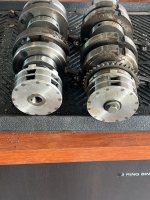
Looking for some advice here on how to get the rotor off the end of the crankshaft from my bad one to the new (used) one I got. Also, I need to move the gears that are right behind the rotor as wellIMG_0305.jpeg
 
Are you familiar with a rotor puller? It's basically a bolt that matches the larger bore thread diameter and pushes the rotor free as you turn it in. I can't say for sure with your model, but an axle bolt is sometimes the right diameter and pitch.

Probably this size.
 
Last edited:
Back
Top Bottom