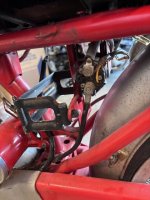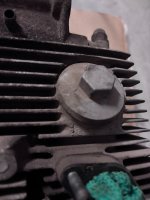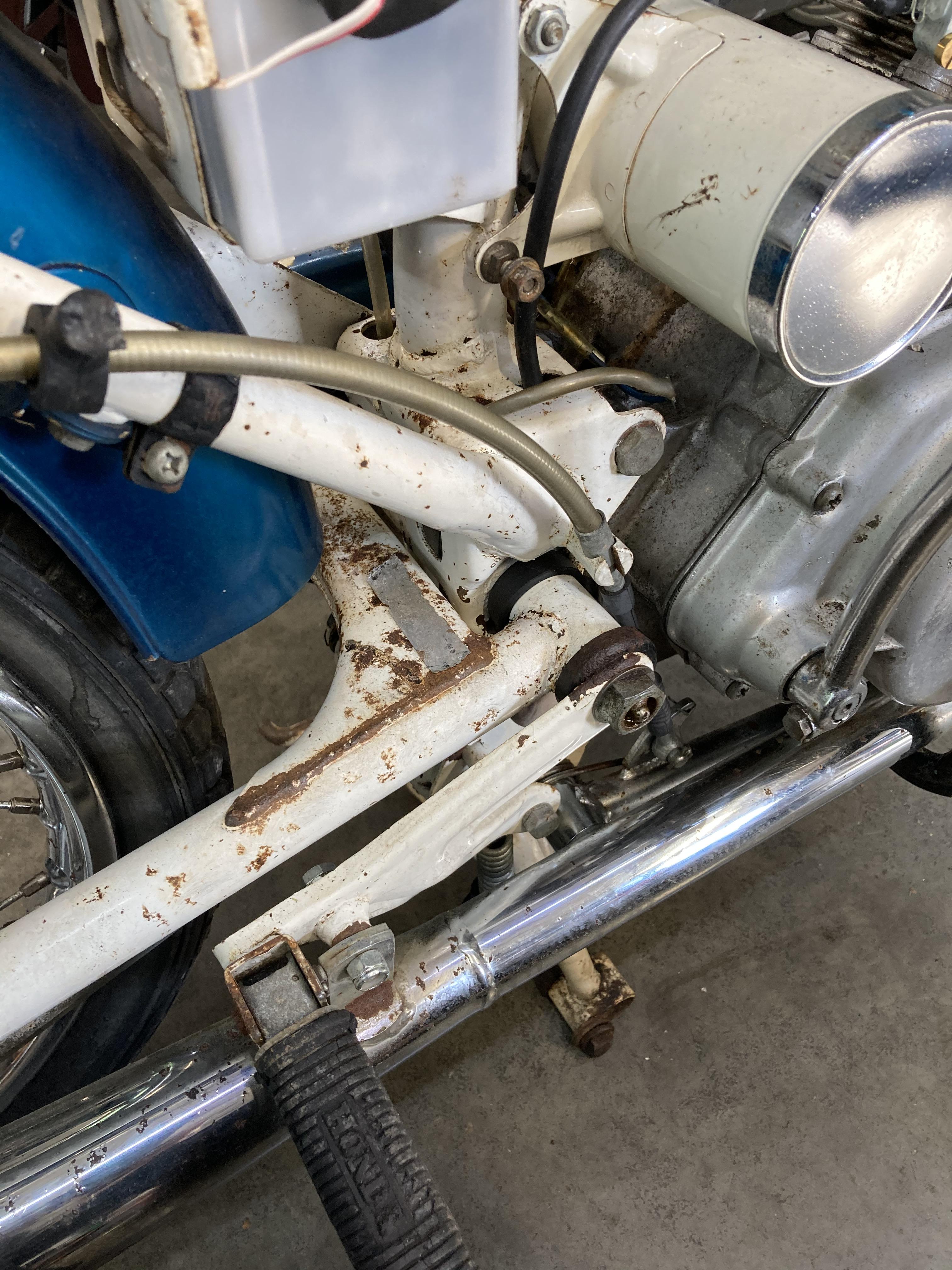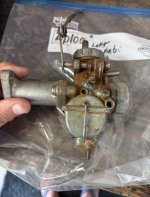
Twin 160's - since you can never have too many projects

EzPete

Veteran Member
Joined
Dec 27, 2023
Total Posts
2,983
Total likes
2,992
Location
Texas
Made the run up to OKC to pick up the two 160's that @Sponserv was passing on to the next set of hands. I had been hunting for a lower-displacement project for a while, the red one really grabbed my attention, and the deal was just too good to pass up. Incidentally, Joe's shop up there really should be on the workspaces thread - that thing is a work of art.

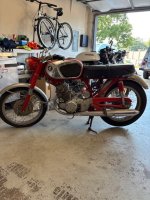
So onto the projects - I'm kind of toying with a "good twin/bad twin" since both are almost identical foundations: B160-1044878 and 1069023 - based on some rough googling likely late 66 to early 67 production runs - albeit totally different lives since then.

B160-1069023/E1058172 - the "good" twin


For the most part, complete and unmolested (foot pegs, side covers, air filters and carbs are in the box o parts.) rims however, were replaced with some MX aluminum rims at some point, which have corroded.
IMG_0320.jpg


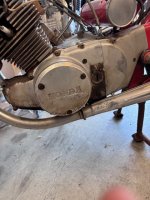
Relatively unmolested JIS screws on all engine covers.
IMG_1530.jpg
IMG_1525.jpg

Wrong kickstart lever added at some point in the lifespan
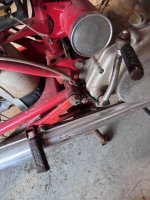
IMG_1527.jpg


Rough repaint at some time. Front fender may take a miracle.
IMG_1515.jpg


Now onto the other guy - this one did not experience quite the life of leisure, and it’s

B160-1044878/E1044662


Looks like someone was trying to replicate a CL with this guy at some point.
One of the factory CL colors was the candy orange - but this one was originally red.
IMG_1553.jpeg

15K on a Speedo in remarkably good external condition. Aftermarket signals added (sadly with an aftermarket LH switch replacing the factory horn/light switch.
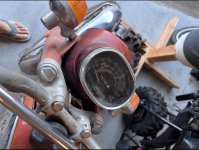
IMG_1556.jpeg

Funky chrome rear fender. Either aftermarket parts front and rear or repurposed from another model.
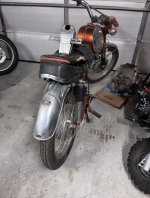

IMG_1554.jpeg

Original engine, rather unmoleted as well. Based on head bolts and tappet caps, it may never have seen service either. Turns over though.
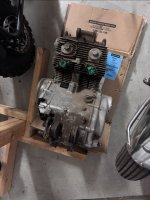
IMG_1555.jpeg

IMG_1560.jpeg


IMG_1559.jpeg

So far, way better than anticipated. The few mismatched parts on the “good” twin I can backfill from the other one and restore back to its former glory, the “evil” twin is going to get a bit more of a stripped down build for my son to start flinging around a larger bike.

Alright. Onto tear down and cataloguing.
 

Attachments

  • IMG_1523.jpg
    IMG_1523.jpg
    68.2 KB · Views: 10
Last edited:
Cool. Double-mint fun. I have seen very few with chrome fenders, mostly very late ones. Both early forks till 107xxxx, steel lower legs. I think your kicker is original.
 
Very good find and mostly complete with parts as you noted in unmolested condition in much of the bike. Unlike my little project which has continued to unfold with more surprises than expected.
 
Cool. Double-mint fun. I have seen very few with chrome fenders, mostly very late ones. Both early forks till 107xxxx, steel lower legs. I think your kicker is original.
Something is off then, that kickstart lever smacks into the muffler - you can see the big dent/scrape right at the end of the kickstart “throw”.

The one from the other engine is a tad different - has a slight bend near the base
 
Based on head bolts and tappet caps, it may never have seen service either.
At least the bad twin looks to have gotten the oil filter opened if not cleaned but aside from that, surprisingly undamaged. Based on the good twin, nicer score than I thought it was going to be, sweet.
 
The one from the other engine is a tad different - has a slight bend near the base
This shows the base. I can get a better pic if needed.
btsOaVG.jpg
 
Interesting. Well, with all the 160’s going on right now hopefully we can nail it down, could also be installed wrong, rotated too far back maybe.
 
Interesting. Well, with all the 160’s going on right now hopefully we can nail it down, could also be installed wrong, rotated too far back maybe.

Count mine among them. I started about the same time you did. Are you in the DFW area?
 
Count mine among them. I started about the same time you did. Are you in the DFW area?
Yep. I’m over in Plano. I haven’t done much in the way of “starting” outside of parts sorting/locating and working my way through the FSM.

The orange one of mine the PO had done the scrambler “conversion”, but that exhaust was shot,
 
With all the scrambler conversions done there ought to be some street exhausts out there.
 
With all the scrambler conversions done there ought to be some street exhausts out there.
Quite a few. Some aftermarket ones too - which is probably what the orange one will get. It’s missing the side covers and air filters so it’s going to get a bit of a different look when it’s done.
 
Cool, I'm also working on a 67 cb160 right now. My exhaust pipes are totally rusted out so I'm going to have to find some aftermarket ones. I think there are some out there that are pretty close reproductions of the originals. Good luck!
 
Time to start diving in. Cleared the project bins and got the tank and seat off.

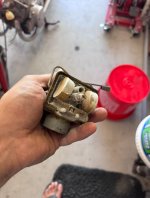
Figured I’d give it a start with the carbs as they tend to give an idea of what kind of storage condition and maintenance was done.

Ooof. This is going to be a long road.

IMG_1655.jpeg
IMG_1656.jpeg
IMG_1657.jpeg

Everything is so frozen in place they’re going to take a long dip in the ultrasonic before I even begin to try and pull jets or that float pin.
 
Pete,

If you find their pooched. My friend Joe who we did the 1968 CL175 Scrabbler restoration on last year has a decent set I believe of the PW Series that fits the 160. I am going to say PW20's, as I think the CL175's use PW22's?
So if your stuck there maybe a source with Joe, as he will never use them. They came with a parts lot when he bought a spare CL175 roller frame for his bikes restoration.

Also as an aside I know your doing a modified version of the bike. When I was perusing CMSNL for jets sizes for the 160. They have an aftermarket kit with 5 main jet sets from size 90 to 98 for about $16 US. for the set. When I clicked on the set and looked closely all the jets had the Keihen stamp on them. They maybe a cheap option for tuning a carb with non original air filters.
 
Last edited:
Pete,

If you find their pooched. My friend Joe who we did the 1968 CL175 Scrabbler restoration on last year has a decent set I believe of the PW Series that fits the 160. I am going to say PW20's, as I think the CL175's use PW22's?
So if your stuck there maybe a source with Joe, as he will never use them. They came with a parts lot when he bought a spare CL175 roller frame for his bikes restoration.

Also as an aside I know your doing a modified version of the bike. When I was perusing CMSNL for jets sizes for the 160. They have an aftermarket kit with 5 main jet sets from size 90 to 98 for about $16 US. for the set. When I clicked on the set and looked closely all the jets had the Keihen stamp on them. They maybe a cheap option for tuning a carb with non original air filters.
This particular one (red one) I’m doing a bone-stock resto on. (Well, LED bulbs and a modern rec/reg,) but everything on this one is going to be stock carb/cleaners - although one of the cleaners appears to be missing the rubber isolator… may be an issue there.

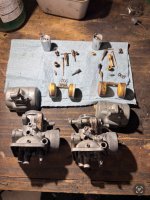
They seemed to do pretty well in the ultrasound. Got all the jets out although one drain bowl screw was sacrificed.

IMG_1662.jpeg

They’ll be going into some carb cleaner dip tomorrow to see if some of that chemical scale might begin to break down.

Pretty impressed with that ultrasonic cleaner stuff that was discussed in another thread. Ran it with a 1:10 mix for basically the entire bills/pats game.
 
Wow what a difference there. The carbs on Chris’s CL160 are very good and clean inside and they have stock Keihin jetting it seems. They are 90 main and 38 slow speed sizes. What sizing do you have in your carbs?
 
Wow what a difference there. The carbs on Chris’s CL160 are very good and clean inside and they have stock Keihin jetting it seems. They are 90 main and 38 slow speed sizes. What sizing do you have in your carbs?
Running 98/38 (oops) in these as well. I'm effectively at sea level so I doubt I'll need rejetting of any kind. I may pick up a couple of sets of those keihin jet kits just in case (more for the next one than this one, but one of the 38's does not appear to be a Keihin).

Side note, if you remove the choke linkage on the 160's to clean it and lube it - don't tip the carb body upside down, the internal mechanism drops out and getting it back in is not as easy as removal. Sadly, I had to since it was so crusted it wouldn't slide easily.
 
Last edited:
So Pete are your jets a 98 main and did you mean a #38 slow speed jet and not a #30 as you typed? I too am at sea level or close enough. I wonder it my #90 main jet is too small for the carbs?

Pete,

I just added to my existing orders at CMSNL a set of that jet kit. So I will let you know if they are original Keihin parts as their picture shows. They are a good deal if so, since a single jet is $7.00 each. These were about $22.50 Canadian total for 5 different sizes between #90 and #98.
 
Last edited:
So Pete are your jets a 98 main and did you mean a #38 slow speed jet and not a #30 as you typed? I too am at sea level or close enough. I wonder it my #90 main jet is too small for the carbs?

Pete,

I just added to my existing orders at CMSNL a set of that jet kit. So I will let you know if they are original Keihin parts as their picture shows. They are a good deal if so, since a single jet is $7.00 each. These were about $22.50 Canadian total for 5 different sizes between #90 and #98.
Correct 90/38 - just fat fingered it.
 
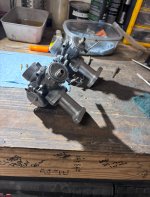
As expected. I don’t think those carbs had been apart in a very very long time. One minor hurdle I’ll have to figure out - the threads on the fuel/air mix screw for the left carb are peeling a bit so I need to figure out what that pitch is and get a tap to see if it’ll reform them.

Otherwise, all original jets and needles intact and just needed a little CLR and some cleaning. And about 4 oz of Red River clay removed. IMG_1672.jpeg

If the carbs are salvageable, the rest of the bike is - although a quickie compression test points to either some really big leaks in the ol air pump, so next up will be engine and cross fingers that not too many unobtanium parts will need to be replaced.
 
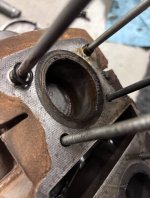
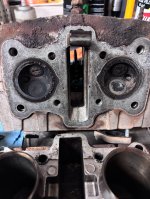
Starting in on the teardown. Never had an engine this gross just have the head gasket come clean off with zero residue.

IMG_1687.jpeg

Bores are looking toasted - obvious signs of blow by. Found an NOS set of .75 over w/rings and pins at NOSpartsnow (FYI, their website is 15% cheaper than eBay). So these will head off to get those fit once I can de-crud them a bit.

Valves may also need to be replaced. I’ll pop them out for a chem dip soak and see, but that sourcing hunt is underway.
IMG_1691.jpeg

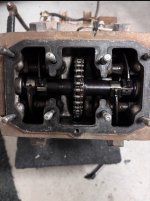
Bright side, cam looks great at first glance.
IMG_1686.jpeg

Now to de-crud, break down the bottom end, get the cases cleaned enough to get vapor blasted and get everything off to the shop while I get to work on the frame.
 
Pete,

Are you planning to strip the engine down completely? I have a question on the upper case crankshaft locator pins and the oil feeds. BB an I have possibly answered the question, as I needed to repair a damaged pin on the roller bearing side of the crankshaft.
If you get the cases down to that point let me know and then I can confirm the oil feed passages.
 
Pete,

Are you planning to strip the engine down completely? I have a question on the upper case crankshaft locator pins and the oil feeds. BB an I have possibly answered the question, as I needed to repair a damaged pin on the roller bearing side of the crankshaft.
If you get the cases down to that point let me know and then I can confirm the oil feed passages.

Testing it down completely since I want the cases super clean and this thing has been sitting with some pretty dark oil in it for a while, so everything needs to get cleaned out.

I’ll get pics all along with way since this is my first 160 - I know damn well I’m not going to remember everything and the FSM is very light on photos.
 
Thanks Pete when you get the cases split I am interested in some of the oil passages. This motor I am working on was a case switch with a CB motor, hence the goofy serial numbers. The person didn't align the crankshaft dowels correctly when transferring over the parts and drove two outer knock pins flush into the upper case.
BB and I have been discussing the repair I did to try and save the cases. I want to ensure the oil pathway (if there is one) for the large outer ball bearing wasn't compromised in that repair.
 
The right side crank has a ball bearing, not rollers, it has a knock pin (possibly shorter) and a partial strange slotted journal spanning upper and lower cases without any oil system openings. Quite curious. Any pics of parts involving total length and right/left end thrust would be appreciated.
 
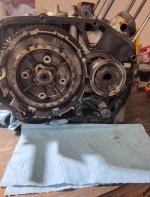
Finally got some down time to get to breaking down the rest of the engine on the red bike. The more this thing goes the more it looks like the orange bike is definitely going to be a donor for some of this and get rebuilt when I get to that one.

Case in point. After navigating the completely seized on screws with many blows from the impact and the hot air of many curses - I uncover this.

Thank you last person to get this far into the motor!

IMG_1811.jpeg

I’m thinking my only option here is to run a couple M6 through the cap and use those as tabs to twist it off.

Anyone else run into this one along the way?
 
What about a small toggle bolt that you could slip in behind the cover and then use the screw to pull on with a pair of vise grips.
1761361873300.png
 
As long as you have the JIS screw out of the spinner if that is your issue then many don’t realize Honda did this for the removal. The outer section with the broken off ears is threaded with a 8mm X1.25 TP inner section. Use a longer bolt which bottoms out on the end of the crank and pops the cap off easily.
Then you can access the castle nut to remove the oil spinner and inner twin gears.
 
I think the 6mm screw (20mm long) was supposed to be an FSM secret. Once it's out, it's so easy you'll want to give yourself the secret handshake.
 
As long as you have the JIS screw out of the spinner if that is your issue then many don’t realize Honda did this for the removal. The outer section with the broken off ears is threaded with a 8mm X1.25 TP inner section. Use a longer bolt which bottoms out on the end of the crank and pops the cap off easily.
Then you can access the castle nut to remove the oil spinner and inner twin gears.
Oddly it was the Clymer book that had this tip in it.

Sucker was glued in there with the sins of of the past, but some heat and slow tension popped it off.

I do love how the FSM just says “remove X” - when the engine hasn’t been touched in 40 years, nothing just “removes”.
 
I forgot to put it back in and had a mystery extra case screw. Fortunately discovered it when I did the first post rebuild oil change and checked the filter. The pressure relief transfer collar had held it in place, sort of.
 
Finally got the Red bike completely stripped down. The level of past PO disrespect just kept growing as I went along, and the list of new hardware needs tracking in a linear fashion. Oh well, at least it's still got all the important/NLA parts - although I haven't tested the sealed beam... cross that bridge when I get there.

Couple of things I do have questions on:

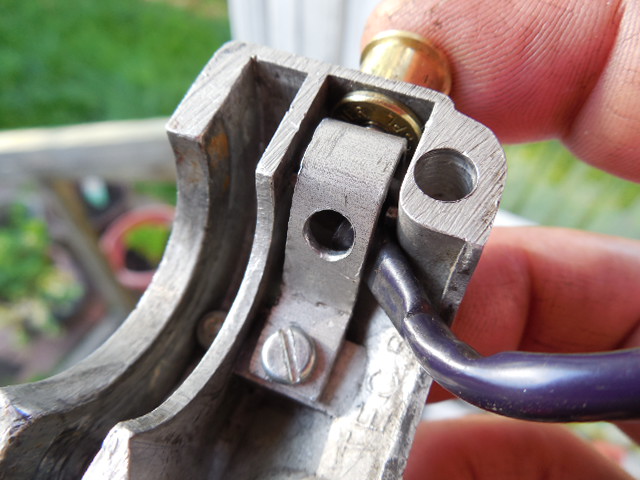
1. Does anyone have an intact RH switch they could grab a photo of how the Y/R starter button wire is oriented internally? PO must have gone kickstart only and just ripped the wire out entirely rather than drilling the aftermarket bars or modifying the switch housing to allow the wire to pass externally. Follow up - where does the factory design have the wire exiting the bar to get to the harness?

2. For the crank oil pathways and sludge traps - it looks like it's essentially a soak it and periodically lift it out to drain and put it back in, hoping that breaks everything down? Or can you force air or carb/parts spray through these passages as well?
 
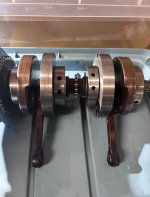
Adding this, as it’s a bit unexpected. I happen to be swinging by the house today at lunch and figured I’d take a peek at the crank - it’s flash rusting inside the kerosene?
Anyone else see this?IMG_1819.jpeg
 
Do you mean what I see on the crank throws? Was it fully submerged? Certainly strange if so.
 
Yeah. Completely submerged in the kerosene, it’s on the rods and the outer races.

Might put a pause on this tonight - maybe do a evaporust bath to stop this and switch to diesel for the soak.
 
In some circles that is called patina. ;)

I see mine has a little rust too. I am not concerned as with this bike that has been the least of my problems. I have had it in there for about a week now, so tomorrow I will remove and blow it out. I hope to see some movement of fluids from the two centre bearings into the two lower conn rod big ends.
 
1. Does anyone have an intact RH switch they could grab a photo of how the Y/R starter button wire is oriented internally? PO must have gone kickstart only and just ripped the wire out entirely rather than drilling the aftermarket bars or modifying the switch housing to allow the wire to pass externally. Follow up - where does the factory design have the wire exiting the bar to get to the harness?
wlfV9nO.jpg


Wire goes into hole in bars.
Do you have the D shaped insulation board chip and bracket? Ground occurs when button tip touches soldered wire end in chip
 
wlfV9nO.jpg


Wire goes into hole in bars.
Do you have the D shaped insulation board chip and bracket? Ground occurs when button tip touches soldered wire end in chip
Awesome. Thanks. Switch does appear to be complete, to include the little tension spring that attempted to escape. Looks like I’ll be drilling holes in these bars - I’m guessing they exit in the center?
 
In some circles that is called patina. ;)

I see mine has a little rust too. I am not concerned as with this bike that has been the least of my problems. I have had it in there for about a week now, so tomorrow I will remove and blow it out. I hope to see some movement of fluids from the two centre bearings into the two lower conn rod big ends.
I’m beginning to wonder if the rust was there and just buried under old oil or something. It was pretty gross inside that engine case - I’m still working all of the baked on crud off before getting it blasted and bored/honed.

Hopefully it’s not making it worse, but I figure worse case scenario I end up having to evaporust it when I get back to it this weekend. Best case, I can give a passageway check a first go round - I’m still trying to orient the oil flow pattern in there to check and see if it is actually clear somehow, but that seems to be a mystery - or impossible?
 
I’m still trying to orient the oil flow pattern in there to check and see if it is actually clear somehow, but that seems to be a mystery - or impossible?
Both myself and Flying900 have been on that quest to first, find the passage from center bearings to crank pin/big ends and second, to find a way to access and clear them, both on his thread and even more head scratching via PM.
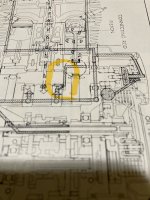
It seems the center bore of the crank pins show a plug, that could be drilled out, blown or dug out but the radial drilling to pin surface would still be a question, as well as the passage through the flywheel from crank center to pin pocket.
If you have access to a large press and fixtures, have at it and take good pics to enlighten us.
I'm thinking the FSM diagram does show sludge trap type channel on the inside surface of the flywheels but with the center bearings so tightly positioned it is hard to gain any access.
 
When I slide back the roller pin bearing with the C clip removed I could see the metal pin in the outer web of the weight. It would need to be drilled out to access the one side of that upper section you highlighted. The issue would be leaving metal shavings in there. The other is on the opposite side where that large ball bearing is pressed onto the crank end.
How do remove that bearing without damaging it for reuse. It looks like there clearly is a more complicated passageway into the conn rod big end oil ways.
Today I am going to try blowing the two centre bearing feed holes to see if there are any changes after this latest kerosene soak.
 
Last edited:
Well, that’s odd. Seems like a really inefficient way to get oil to those spots. No press here, so I’m going to probably just gauge based upon the amount of oil separated in the kerosene.
 
Yes, the oval hole for both sides switch wiring to exit is bottom center of the bars.
Cool. No holes on these bars (look to be period-accurate aftermarket) so I’ll have to add those and some grommets.
 
Back
Top Bottom