Crankshaft Cleaning

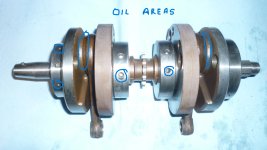
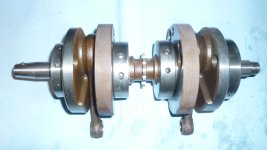
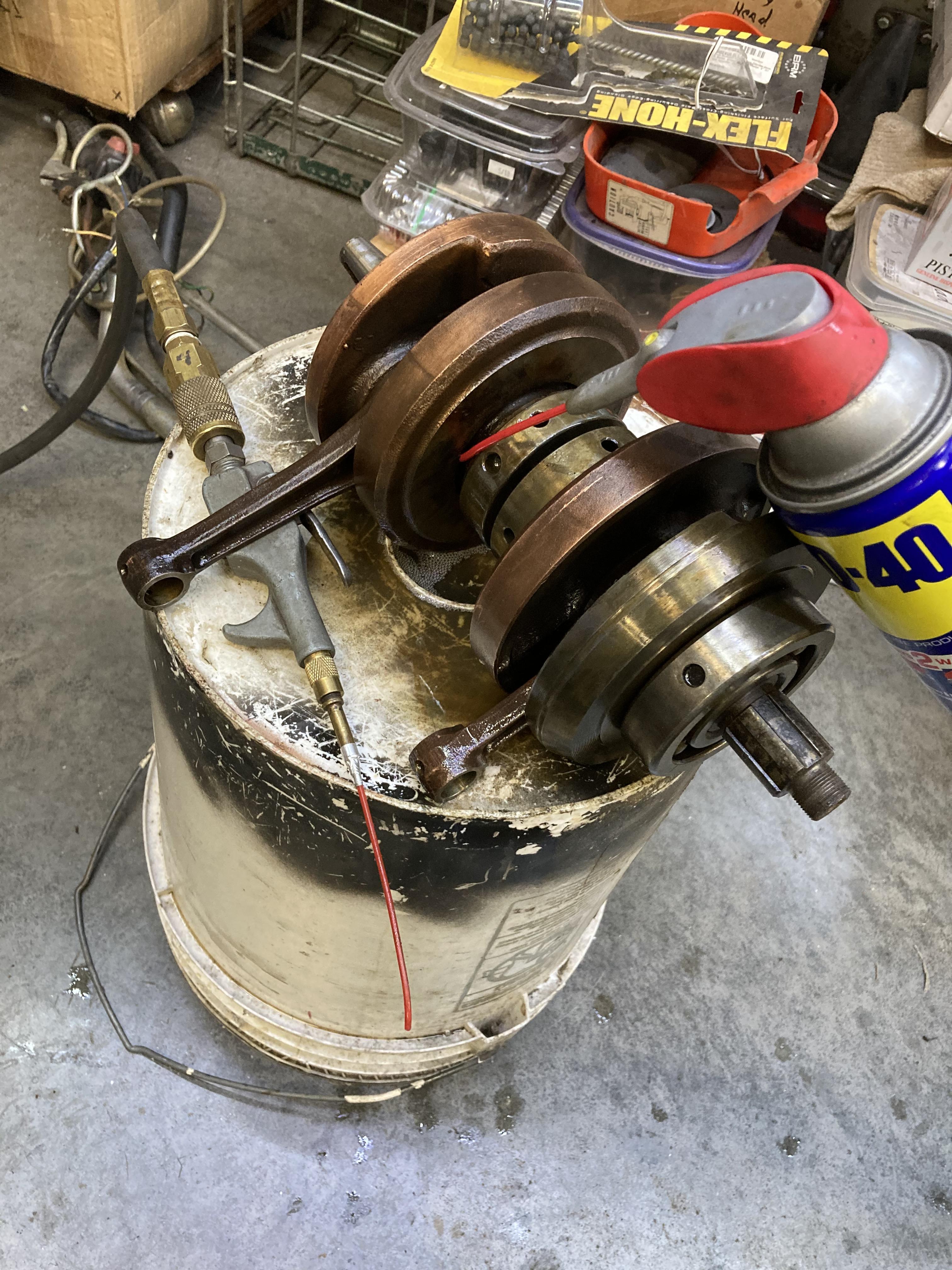
As far as cleaning a dirty crank goes, it seems the small passages radiating out from the center hole of the rod pins are the last likely place to have blockages. We must do what we can with air pressure, WD40 spray, solvent, movement, whatever to open these up because that is really the only source for oil to lube our big ends, and ultimately small ends and piston skirts and cylinder walls.
Remember the crank is above the windage tray and so there is no splashing up from the sump.

Hopefully those folks doing cleaning will post pics of their cranks here so we can see what the different models look like.
 
This is my 1968 CL175 "Sloper" crankshaft that I would like to add to this thread with the route I took in cleaning the bearings and big end journals. This is in no way a choice that compares to taking the crankshaft apart to clean every sludge trap or oil passageway.

I don't have the skill level or the equipment to venture into that realm of work. So I chose to soak the whole crankshaft for over a week in a solution of Kerosene and work at spinning the bearings daily for 4-5 days while soaking. The Kerosene did become quite dirty with lots of sediment on the bottom of the container over these days. I filtered the solution a number of times to remove the sediment and there were fine metal particles in the sediment. One of the shift forks was badly worn, so I attribute some of those metal particles to that area.

The past few days I have been blowing compressed air through the oil holes in the bearings at a low flow rate to clean not only the bearings, but also confirm there is solution getting into the big end of the conn rods bearings too. I am satisfied that the crankshaft is as clean as it is going to be using this method of cleaning and so onward.

Oh I did take the end roller bearing apart to clean it up and what a joy that was to get all the roller pins back in their cage.... kinda like herding cats! :mad: Heavy grease is your friend here.


P1090508.JPG Crank cleaning.JPG
 
Sounds like all the sediment is your evidence you've done your due diligence.
By the looks of the picture, it still looks to me that those center bearings will slide towards the center partially exposing the rollers and cages and also exposing the edge of the sludge traps.
Did you try standing the crank on it's end and running WD40, whatever from the center to see if it oozed out the rod big ends? That would definitely be as good as it gets.
If you do stand it up, duct tape that loose bearing so you don't loose your meatballs. :ROFLMAO:
 
Sounds like all the sediment is your evidence you've done your due diligence.
By the looks of the picture, it still looks to me that those center bearings will slide towards the center partially exposing the rollers and cages and also exposing the edge of the sludge traps.
Did you try standing the crank on it's end and running WD40, whatever from the center to see if it oozed out the rod big ends? That would definitely be as good as it gets.
If you do stand it up, duct tape that loose bearing so you don't loose your meatballs. :ROFLMAO:
No cigar on that one. The centre bearings outer shell will move about 2 mm before hitting the tang stop and the aluminum roller cage won’t move away from the crank weight at all. I cannot see anything down there at all against the inner weights, there is nothing to move away to get anything in there.
I used compressed air through the oil holes in the two centre bearings and did see some minor bubbles around the big end rod bottoms. Minimal yet there was some action there.
I will try that WD40 trick once I am ready to oil the rollers to put the crank back into the case.

There is no loose bearing. The outer ball bearing is pressed on the one shaft end and the roller bearing on the other side that I took apart is held on by a C clip. :)
 
Here is a trick for installing the bearings. I believe credit goes to the late Bill Lane for this video.
I knew that video was out there, though I think Bill Lane only referred people to it based on the YT channel name. But it's certainly a genius method.
 
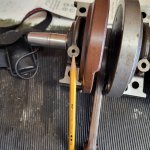
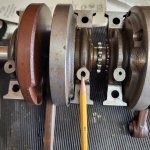
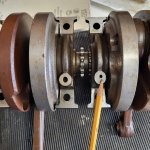
I'm looking at the crankshaft in my K0 now, too. The oil passages from the block to the bearing holders are all different sizes. They are all clear and the sizes are in the metal, not the result of accumulated junk. In photos of the crankshaft on another K0 at the beginning of this thread I see that variation as well. Why aren't the openings all the same? These photos show the 4 oil passages, engine left to engine right.

And, yes, there is some dust and other stuff that has yet to be rinsed off.

C-shaft oil passage 1.jpgC-shaft oil passage 2.jpgC-shaft oil passage 3.jpgC-shaft oil passage 4.jpg
 
Probably to restrict flow so the head and cams get enough. Make sure there is flow from the sludge traps to the big ends. I'd stand it on each end and let gravity show you while flushing.
 
Probably to restrict flow so the head and cams get enough. Make sure there is flow from the sludge traps to the big ends. I'd stand it on each end and let gravity show you while flushing.
This is what I was thinking. The ones on the right are closer to the pump, so smaller to give enough pressure to the left?

They seems to be similar to mine. So not accidental it would seem.
 
Yes teebo, I was looking at your photos as well as some from the Ebay listings out there now. It does not look accidental. And it's not the kind of thing I would think Honda would do, by accident. What it is, is strange.

Don't forget the crank is lying on the bench with the splined shaft that rotates the oil spinner on the right, so I assume the oil flows into the system from right to left. Why is the 3d hole from the right the biggest? It looks to be true in your photos, too.
 
The two center ones would feed the bearings and the big end on the conrod, which then produce splash for the pistons.

My guess is that both have a similar flow. There is probably considerable force on all of those bearings. But I can’t say if one particular one gets more oil. For example the main bearing that drives the gears?

I’m sure one of the actual experts here could confirm or deny. My assumption when I noticed this is what ballbearian said. To balance flow around the engine. Jensen has mentioned in the past about people changing port sizes in other places and the expected ill effect of that.
 
Obviously I'm no engineer, but my guess would be the sizing is about oil flow as others have mentioned. It does seem odd that the inner two are both different, but only the Honda engineers who designed this very durable crankshaft would know for sure. When speaking of durability I only have my experience with 4 speed and 5 speed crankshafts to go by, but I can tell you the 4 speed bottom end I used on my first drag bike 50 years ago was in a used bottom end of unknown history and it was clean enough at the time (1973) that I didn't even disassemble it except for the clutch side. That engine did hundreds of runs at the quarter mile while nearly every minute it was running it was being thrashed soundly, and it never broke.
 
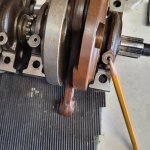
I spent some quality time with the crankshaft and really looked carefully in the centrifugal oil cavities. There was a lot of light gray glop in there! I dug out what I could and rinsed them out with WD-40, then set out to find the oil passages to the big ends of the connecting rods. It took a lot of messing around with lighting and peering in from all sorts of directions before I saw one, fed in a squirt tube and blasted a lot of WD-40, until it came out reasonably clear. Found the other one and did the same. Tomorrow I'll squirt them again.

Thanks to everyone for pointing me in the right direction.
 
I spent some quality time with the crankshaft and really looked carefully in the centrifugal oil cavities. There was a lot of light gray glop in there! I dug out what I could and rinsed them out with WD-40, then set out to find the oil passages to the big ends of the connecting rods. It took a lot of messing around with lighting and peering in from all sorts of directions before I saw one, fed in a squirt tube and blasted a lot of WD-40, until it came out reasonably clear. Found the other one and did the same. Tomorrow I'll squirt them again.

Thanks to everyone for pointing me in the right direction.
Stand up the crank vertically on end then the WD should flow through the counter weight and the rod pin and out around the rod bearing. Plus, you can spin the rod as the crud works it's way out. Then you know for sure it's open all the way to the rods.
 
I'm looking at the crankshaft in my K0 now, too. The oil passages from the block to the bearing holders are all different sizes. They are all clear and the sizes are in the metal, not the result of accumulated junk. In photos of the crankshaft on another K0 at the beginning of this thread I see that variation as well. Why aren't the openings all the same? These photos show the 4 oil passages, engine left to engine right.

That puzzled me as well, but it doesn't make sense to think that this will influence the flow because the real restriction is the opening to the bearing surface, and those are having more or less the same diameter. And since that diameter is much smaller than the opening you point out with your pencil, fluid dynamics is clear about it. Since the ratio in diameter between the large hole you point out and the diameter of the bearing surface is larger than a certain value, the smallest hole (in this case the diameter of the oiling hole at the bearing surface), the diameter of the large holes you point out, even with this difference in size doesn't have much influence on the flow.
 
That puzzled me as well, but it doesn't make sense to think that this will influence the flow because the real restriction is the opening to the bearing surface, and those are having more or less the same diameter. And since that diameter is much smaller than the opening you point out with your pencil, fluid dynamics is clear about it. Since the ratio in diameter between the large hole you point out and the diameter of the bearing surface is larger than a certain value, the smallest hole (in this case the diameter of the oiling hole at the bearing surface), the diameter of the large holes you point out, even with this difference in size doesn't have much influence on the flow.
The Bernoulli effect at work here?
 
Bernoulli (did you know he was Dutch ?), one of the founders, or the founder of modern hydrodynamics with his own law, the Bernoulli law. I have to dive in my books to see if the Bernoulli law may be applied. The fluid isn't stationary, and an inhomogeneous viscosity.
 
When your fitting loose rollers into cage and think they may fall out during assembly, use Vaseline (petroleum jelly) not grease as it has a much lower melting point so clears out quicker and easier.
Isn't it the Bernoulli Principle and not law?
Used to teach it as part of how carbs operate
 
When your fitting loose rollers into cage and think they may fall out during assembly, use Vaseline (petroleum jelly) not grease as it has a much lower melting point so clears out quicker and easier.
Isn't it the Bernoulli Principle and not law?
Used to teach it as part of how carbs operate
I don't know. Maybe you got to die first before graduating from principle to law :ROFLMAO:
 
When your fitting loose rollers into cage and think they may fall out during assembly, use Vaseline (petroleum jelly) not grease as it has a much lower melting point so clears out quicker and easier.
Isn't it the Bernoulli Principle and not law?
Used to teach it as part of how carbs operate
It would be a principle, derived from or explained on the basis of laws like Newton’s
 
Not sure if I posted this pic here about the need to clean out the sludge traps and oil ways in the hidden parts of the crank. And to bump this thread for any recent engine builds on the forum.

k2AilBV.jpg
 
It's interesting that the 4 speed engines use a different way of securing the bearings of the crankshaft to the upper crankcase. The shaft itself looks very similar and the oil circulation seems the same.
How do you know when you're done with the cleaning?
 
It's interesting that the 4 speed engines use a different way of securing the bearings of the crankshaft to the upper crankcase. The shaft itself looks very similar and the oil circulation seems the same.
How do you know when you're done with the cleaning?
It's not easy. Post #119 showed one approach and later #121 shows how plugged they can get. Oil must get from the centers through to the large end rod bearings, I eventual got WD40 to flow through but a lot of crap came out.
 
It's not easy. Post #119 showed one approach and later #121 shows how plugged they can get. Oil must get from the centers through to the large end rod bearings, I eventual got WD40 to flow through but a lot of crap came out.
Same here. The stuff that came out was light silver gray - aluminum color. It did make it easy to see when it ran over the crank, so I kept doing it until I ran the WD-40 can too low to work on the angles I was using.
 
Same here. The stuff that came out was light silver gray - aluminum color. It did make it easy to see when it ran over the crank, so I kept doing it until I ran the WD-40 can too low to work on the angles I was using.
I think we have to face up to the fact that our normally robust, invincible Honda motors, after 50 or more years need extra help if we expect them to hold up after our expensive and labor intensive builds. My last two scuzzy barn find builds had serious ring, cylinder and small end rod bushing wear, which means the two notches in the edges of the con rod big ends aren't splash feeding the way they should.
Either Teebo's pump fed irrigation in a tank or a vertical stand up with a gravity flow through while spinning the rods is going to be my SOP going forward. I almost feel like pulling the two builds I just did and doing them right.
 
Back
Top Bottom