Ignition Advancer Rebuild Information, all 450/500T Models

Jays100

Veteran Member
Joined
May 29, 2020
Total Posts
1,494
Total likes
1,024
Location
Enfield, CT USA
I wrote this and posted it on another site. They're being annoying just now so am bringing that post over here. I believe everyone can benefit from this information. I learned it the hard way. Please feel free to post your experience(s) too.

Part 1 (of 2)

There are three ignition advancers from different manufacturers used on the 450/500Ts, their markings are CB450 (65-72) TEC292 (71-74) and TEC375 (75-76).

The manufacturer (Kokusan or Nippon Denso) determined how the points cam is mounted on the advancer mechanism.

They all mount and identically on the engine but the ignition advance curve varies with the year.

They’re quite simple with typically two fail mechanisms, there are more but primarily two. Btw, depending on your year 450, there are three suppliers of advance mechanism. Their parts do not interchange generally, However, they do interchange on engine.

Failure modes
1. Advancer stuck/points cam results in non-advance and low power output
2. Cam moves but idle hangs, results non-return to idle rpm

Tools needed
Scotchbrite pad, small (1/8” across blade max) flat blade screwdriver, can of brake-clean aerosol cleaner, 3 in1 oil, shop towels/rags, patience and a well lighted workspace, solvent/soap cleaner of choice.

Both failure modes require disassembly to solve.
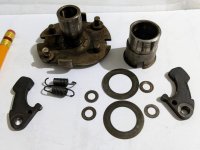
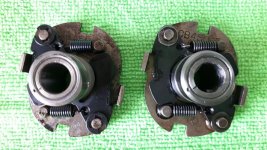
-Take a before condition pic, both sides. This may be optional to some but future you will thank current you if a piece is lost or you forget how it all goes together.

-Spread the centrifugal weights and remove the cam. If rusted, you’re hosed as they require heat a Herculean effort to remove without damage. If solidified/aged grease, the cams can generally be separated and once they start to move they’re easy. Aside.

-With the small screwdriver, remove the E-clips from the weights pivot post, remove springs, shims (flat and wavy). Keep the shims in order but it’s flat on the bottom and wavy top.

-Remove all grease, clean thoroughly. This is the critical step
Note I’ve found the best tool to remove accumulated, mung, grut, spooge rust and other nastiness (and you’ll find it all) is new Scotchbrite. With adroit treatment of all sliding surfaces, base plate armature, cam inside diameter and the outside too, remove all nastiness encountered. Don’t be shy, it’s hard steel and scratches are no harm (they retain oil). Next, do the pivot posts, get into the corners, bucko, as well as the weight pivot holes.

-Spray brake clean (or use soap and water with an old toothbrush) all parts, do it twice and check if naughty or nice, redoing missed or questionable areas.

-Wash your hands and clean the area, not losing anything. Laying out the dry parts on a clean towel helps inventory, quality inspection and is the gold star of good work practice.

Reassembly in Part 2.
 
Part 2

Reassembly

It’s easy to say just reverse the order of disassembly but there are things you can do to help yourself.
-Dry fit the parts together, all pieces in intimate contact should be a slip fit, particularly the weights. Fit the weights on either post and by feel, try to selectively fit so they’re identical,

-With liberal 3in1 oil or other thin film lube/grease on the pieces, hook one end of the spring to the one weight, repeat for the other. Whether top down or bottom up, it doesn’t matter, just do them both the same.

-If you elected to replace the springs, (I utilized a set from MikesXS from a 650 Yamaha. With some fussing, they will work. I don’t know who else supplies them though)

-Place a thin shim on each of the oiled posts, hook the return spring on the spring anchor post and slip the weight on the pivot post, repeat for the other side. Remember the before photo you took earlier? Refer to it if you don’t remember where stuff goes. Install the top shims on each pivot post, another drop of oil will celebrate assembly.

-The E clips are directional, feel the outside edge - the sharp edge installs up, or away from the weight. Slip it in it’s groove on the pivot post. Pay attention that the middle part of the E is in the groove. They’re quite thin, easily bent and we don’t want them to come loose in operation. Check movement again, all should be smooth from stop to stop, both weights. If not, repeat your cleaning process. It’s critical the weights have absolutely free motion.

-More oil on the base plate armature, or spindle and inside of the cam. Install cam onto the spindle with the slots at bottom. Spread both weights and worry the cam until the centrifugal weight levers engage the cam slots and drop it home.

-Important-ensure the dots, or pips, align. They are located on the end of the cam and armature. If they don’t align, your timing is 180 deg off and your engine will never run. Ever.

-Check the function of the cam. When turned, it should return quickly, even snap, back into its at-rest position. If it does, well done! If not, check springs and any other portion of your cleaning and scouring work. Either install immediately or wrap in a dry, oiled, paper towel and seal in a plastic bag for later use but protected from moisture intrusion or other damage.
 
A question to the forum at large. Is there an outlet that specifically markets the advancer springs?

My daily rider consistently hangs up at 2500-3000 rpm once warm. At cold startup, it barely idles letting me know that the advancer is free to move, it just won't return to the at-rest position for a good idle.
 
No, and they were never offered separately by or through Honda (too many subcontractors, and parts don't always interchange)......
You can clip off one hook and turn up the next half loop on one spring (to form the "new" hook)....
The unit will average out the tension difference and usually it is close to the original "pull".....
On very high mileage units I have had to clip and bend on both springs, but try only one first......
 
A question to the forum at large. Is there an outlet that specifically markets the advancer springs?

My daily rider consistently hangs up at 2500-3000 rpm once warm. At cold startup, it barely idles letting me know that the advancer is free to move, it just won't return to the at-rest position for a good idle.

I don't know of anyone selling them, but I suppose it's possible someone does. I saw someone discussing XS650 springs on HT the other day but I have no idea if they're similar enough to use.
 
Love this - I'm having the 'not dropping back to idle problem' intermittently and I've chased all the regular issues. This is my next stop. Thanks Jays.
 
...You can clip off one hook and turn up the next half loop on one spring (to form the "new" hook)....
The unit will average out the tension difference and usually it is close to the original "pull".....
On very high mileage units I have had to clip and bend on both springs, but try only one first......


Performed this fix with one spring yesterday. I adjusted the idle (1200 rpm) after a test ride with the engine hot. Today it started well - idled at 1K and after a ten minute ride it was falling back to around 12 - 1300 rpm instead of hanging at 2500. I may go in and turn up a half loop on the other spring if it seems to need it, but for the time being it seems to solve the issue.

All the parts on the advancer were clean from my spring tune-up. Carbs are in excellent shape - Idle is rock solid when spraying starter fluid around the intake boots (new), carbs, etc. Throttle cables aren't binding in any way.

This was the final idea on how to attack the hanging idle issue. I've been chasing that for some time.

This seems to have worked.

Cheers and thanks guys.
 
This thread seems like it could help me, but I'm stuck with an advancer that is missing some of the correct shims. Where do I go looking for them, and what specs are they anyway? I'm sure I need both flat and wavy, and I remember that I had to reuse the e-clips because my usually reliable hardware store doesn't have metric e-clips.
 
Unfortunately, Honda only assigned a part number to the advancer itself, not for any parts for it. So, that means you're on your own for finding the correct diameter and thickness shims. Or buy a couple of old advancers in hopes they have a shim or two.
 
Unfortunately, Honda only assigned a part number to the advancer itself, not for any parts for it. So, that means you're on your own for finding the correct diameter and thickness shims. Or buy a couple of old advancers in hopes they have a shim or two.

I'm hoping someone has an advancer in their box of stuff and can tell me the measurements of the pieces.
 
I'm hoping someone has an advancer in their box of stuff and can tell me the measurements of the pieces.

I had two advancers. Disassembled one about a year ago and both of the e-clips snapped. I believe I have all of the other parts. The flat shim is about 0.23 mm thick, the wavy one about 0.06 mm thick with an outer diameter of about 23.9 mm and an inner diameter of about 15.3 mm. Happy to send any/all spare parts to Oakland — excluding the pencil. Feel free to PM.

PXL_20230823_010647458.NIGHT.jpg
 
There are three ignition advancers from different manufacturers used on the 450/500Ts, their markings are CB450 (65-72) TEC292 (71-74) and TEC375 (75-76).

The manufacturer (Kokusan or Nippon Denso) determined how the points cam is mounted on the advancer mechanism.

They all mount and identically on the engine but the ignition advance curve varies with the year.

Btw, depending on your year 450, there are three suppliers of advance mechanism. Their parts do not interchange generally, However, they do interchange on engine.

Am I reading this correctly that the TEC375 advance mechanism is suitable for 5-speed CB450s? Without any other modifications? I recently acquired one that appears in better shape than my original CB450 advance mechanism.

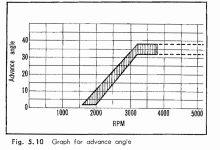
I couldn't find an advance curve in the 500T manual that I have, but the 450 FSM includes the following graphic.

Screenshot_20240315-073846.png

Does anyone have something similar for the 500T? Or, Jay, could you possibly comment on the difference for the TEC375 advance curve?
 
From what I understand, the point at which full advance is reached is around 2300 for the earlier models and creeping up to around 3300rpm on later models / 500T. The graph you posted confirms this. I haven't seen the total advance bandwidth change, just the slope.

From a practical standpoint, the later advancers tend towards better return to idle but they all require servicing at every points change. I'm working on finding replacement springs and will have better information this spring once riding season starts.

As to interchangeability, the advancers are forwards and backwards compatible with all 450/500T models.

You will notice a difference between advancer and engine performance simply idling around town / stop to stop in that the bike will encourage you to keep revs up (at least that's what I've found in my own riding).
 
As to interchangeability, the advancers are forwards and backwards compatible with all 450/500T models.
Thanks for confirming, Jay.

I'm working on finding replacement springs and will have better information this spring once riding season starts.
I just ordered three types of potential replacement springs on eBay. If any of them seem close, I will test them out and report back. It may be a month or so before I get my hands on them.
 
This forum rocks. I've cleaned my advancer and did the 'spring clip' method. She still wants to idle high but not as high as before and now, finally, I have both cylinders firing. Am I at a carb adjust mode now or is there something else I should be addressing with the hi idle (about 2500).?
 
My question back is what do you think? You’ve been over most everything with a fine toothed comb, we’ve simply helped interpret what the bike is telling you, but it’s been your work. Do you feel confident in your work? We’re still here whatever you decide.

IMO, you’re at a place of taxi testing before flight. That is, the bike starts, idles, returns to idle, keeps running, responds to throttle inputs. Not much left without riding.

You could run through the gears with bike on the center stand (and at idle conditions) to check shifting and rear brake.

Then it’s no excuses bucko, flight test/test ride time!
 
Oh yeah-critical-, at idle, turn the bars from lock to lock (gently feeling change in throttle play) to ensure no change in rpm. It’s a safety thang.
 
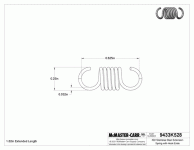
Jay, I'm curious if the springs you found from McMaster-Carr have the 90° twist found between the ends of the OEM springs. I've ordered some extension springs with the hope of finding something that will do the job, but so far have not found springs that have the twist.
 
Here’s what I’m currently running, it returns to idle but I don’t have the curve.
No, they do not have a 90deg hook offset. Spring-wise, simply turn the 90deg with the coil. No change in load or rate.
IMG_0724.gif
 
Oh yeah-critical-, at idle, turn the bars from lock to lock (gently feeling change in throttle play) to ensure no change in rpm. It’s a safety thang.
Thanks for this. And no, I'm not confident in any of my work. :) I find when i close up the choke a bit she idles much better. Going to play with that for a awhile. Also took her for a spin around the hood and it wasn't bad. Got some chug-chugging for a bit but you can tell she wants to go. The high idle freaked me out a bit so I kept the journey short.
 
…one more thing (in best annoying Columbo voice) This is the first time I’ve noticed the cam. It looks really worn on marked area. What would cause something like this?IMG_1594.jpeg
 
Need a side view bit from the top view, looks like new. The side view will show where the points actually rub.
 
Thanks for this. And no, I'm not confident in any of my work. :) I find when i close up the choke a bit she idles much better. Going to play with that for a awhile. Also took her for a spin around the hood and it wasn't bad. Got some chug-chugging for a bit but you can tell she wants to go. The high idle freaked me out a bit so I kept the journey short.
At this point, as Jay mentioned about being confident in your timing adjustments, if the timing is right (or plenty close enough) then simply dial down the idle with the idle speed screws on the carbs (not the mixture screws, the ones in the throttle arms on the outsides of the carbs). With the engine warm from a short ride, go equal amounts at a time, say a quarter to a half turn until the idle gets to 1200 rpm. You can worry about the mixture screws later as long as it runs okay at idle and still returns to idle well. Baby steps, which will be more learning steps as you go. (y)
 
…one more thing (in best annoying Columbo voice) This is the first time I’ve noticed the cam. It looks really worn on marked area. What would cause something like this?
It's not worn (though a side view would confirm), it's the way the cam lobe is shaped from the factory. The points are open about 270° each, then closed for the rest of the cam's revolution which is where the coils build the next spark.
 
  • Like
Reactions: stu
If I may, what's your preferred way to set the timing on a 74 CB450 K7. Do you use test light and see that it lights on the LF and T marks? Feeler gauge? Timing light? I don't know why but I can't seem to get it right. It looks as though I have plenty of spark on the left side point but minimal/inconsistent spark on right point. I used the those guys in Houston method (test light and finding the sweet spot of 'just on, just off' then locking point in position, making sure both sides are on the compression stroke). I have cleaned the advancer and clipped the springs to tighten it up. What I'm still getting is a 3000 rpm at startup that won't come down along with good exhaust on the right but noticeably weaker on the left. I have traced and retraced my steps and just can't seem to come up with a solution.
 
The static method I use.
My start point is a gap of .014" (mid-spec requirement of .012-.016") for both points at full open condition.

For a tool, I soldered a couple of leads on an instrument light bulb but any 12v bulb will do. One end of the lead is to an engine fin and the other to that side points spring.
The bulb then "dangles" near the timing pointer. (I typically unplug the coils and remove the sparkies)
When the crank is rotated to near the F mark, the bulb condition will change (on or off) then repeat for the other side. (This gives the difference between the two)
There are two primary adjustments to bring them together:
- turning the points plate which effects both cylinders.
- adjusting the lead or lag cylinder points gap. (stay within the .012-.016 limit) This adjusts one cylinder independently of the other. With worn points, it's possible to be .012" gap on one side and .016" on the other. This is fine.

Then, with everything together, and running, check the timing dynamically. This ensures the advancer both moves to full advance then (importantly) returns to the F position at idle. If it doesn't do that, service the advancer and start again.

By the way, if you still have a center stand and plan to take the rotor cover off, put a block of wood under the left side leg to lean the bike slightly right. you'll thank me later.
 
Jays, thanks a pile for this. Great help as always an yes, after a particularly nasty episode where I forgot about an oil container, I use a wood block.
 
Finding this thread is quite timely for me as I am going through my new to me CB450K7 and I had put a thread up about having to change my ignition advancer due to potential damage to the one that was on.
I have managed to source another one, which turns out to be a CB450 Advancer, which seems to have been fitted from '65-'72, the question was would it be compatible with my K7 which has/had a TEC292 fitted, Ancientdad kindly replied and said that either one would be fine to use which is great.

I notice in the first post Jays mentions, ' They all mount and identically on the engine but the ignition advance curve varies with the years'.

Can I just ask, does the 450 advancer unit just slot right onto the spigot on the camshaft that drives it?, and therefore should the cam on the advancer be in the same orientation as the 292 when fitted and not, say, 180 degrees out ?

Also with the ignition advance curve varying, that wouldn't be enough to avoid swapping the advance units over?

Sorry if it's a daft question!


Cheers
 
Finding this thread is quite timely for me as I am going through my new to me CB450K7 and I had put a thread up about having to change my ignition advancer due to potential damage to the one that was on.
I have managed to source another one, which turns out to be a CB450 Advancer, which seems to have been fitted from '65-'72, the question was would it be compatible with my K7 which has/had a TEC292 fitted, Ancientdad kindly replied and said that either one would be fine to use which is great.

I notice in the first post Jays mentions, ' They all mount and identically on the engine but the ignition advance curve varies with the years'.

Can I just ask, does the 450 advancer unit just slot right onto the spigot on the camshaft that drives it?, and therefore should the cam on the advancer be in the same orientation as the 292 when fitted and not, say, 180 degrees out ?

Also with the ignition advance curve varying, that wouldn't be enough to avoid swapping the advance units over?

Sorry if it's a daft question!


Cheers
I think it's 90 degrees. I know on the electronic ignitions that use the mechanical advance (like Charlie's) have a different initial sensor mounting orientation between the CB450 and 292/375 advancer models. At the end of the day, it doesn't matter, as you're adjusting the point gap to the firing point and a 90 degree, 180 degree 135 degree starting point difference is basically immaterial, as you're setting the points to the cam itself.

The differences in advance curves are fairly minimal - you might want to look up some of @jensen 's posts, he does some really deep dives into the spec differences between K series on the 450's.
 
Thanks, I just wanted to make sure things weren't going to get too complicated regarding different cam positioning etc.

I will check out the posts you recommend with regard to the specs differences.
I think I have won a watch finding this forum as there seems to be a vast source of knowledge from different people who do not mind imparting it.

Cheers
 
I think I have won a watch finding this forum as there seems to be a vast source of knowledge from different people who do not mind imparting it.
Thanks, it's what we do here, and what the core group of members here has always done since their days at our previous home (HT). When HT went corporate in late 2019 and it ruined the friendly environment, we decided to start over in 2020 and do it right again.
 
Two things, firstly, all of the 450/500T advancers fit forwards and backwards (with reference to models and years. They fit and notch interchangeably onto the various camshafts.

Secondly, so long as the pip marks align, see previous posts, the ignition will adjust to time normally. Ignore the advance curve, that’s not relevant to your question. So long as the engine revs then returns to idle, you’re good.
 
Two things, firstly, all of the 450/500T advancers fit forwards and backwards (with reference to models and years. They fit and notch interchangeably onto the various camshafts.

Secondly, so long as the pip marks align, see previous posts, the ignition will adjust to time normally. Ignore the advance curve, that’s not relevant to your question. So long as the engine revs then returns to idle, you’re good.
Great, simply explained.....I like simple, it suits me :D
 
One more thing regarding interchangeability. My previous posts are limited to the advancer assembly. Inside of the various numbers, their detail parts only interchange with themselves. That is, a 292 base won't interchange with a 347 cam and work properly. You have to keep 292 parts within the 292 family, same with the other manufacturers.
 
No, and they were never offered separately by or through Honda (too many subcontractors, and parts don't always interchange)......
You can clip off one hook and turn up the next half loop on one spring (to form the "new" hook)....
The unit will average out the tension difference and usually it is close to the original "pull".....
On very high mileage units I have had to clip and bend on both springs, but try only one first......
Sometimes the simplest fixes elude us, but are brilliant none the less.
Thank You.
 
Somewhere in my internet travels whilst looking for advancer springs I found a couple places that could make custom springs. Required some maths and gazuntas. And likely an accurate measure of tension.

I didn’t happen to note minimum order. I have suspicion it’s large. Hard to imagine someone making 2 custom springs. Maybe?

I went with the xs650 springs on my 450 and it’s checked out so far with timing light.
 
I used XS650 springs on my advancer from Mikes XS. Generally they worked but recently my idle would hang up so I cleaned the unit but that didn't help so looked for new springs. Incidentally, the XS springs are stainless steel.

Then, changed to the spring in the post from Apr 7 from McMaster.
 
I used XS650 springs on my advancer from Mikes XS. Generally they worked but recently my idle would hang up so I cleaned the unit but that didn't help so looked for new springs. Incidentally, the XS springs are stainless steel.

Then, changed to the spring in the post from Apr 7 from McMaster.
Thanks, Jay. I’ll get the McMaster version. I used the MikesXS springs too.
 
I wrote this and posted it on another site. They're being annoying just now so am bringing that post over here. I believe everyone can benefit from this information. I learned it the hard way. Please feel free to post your experience(s) too.

Part 1 (of 2)

There are three ignition advancers from different manufacturers used on the 450/500Ts, their markings are CB450 (65-72) TEC292 (71-74) and TEC375 (75-76).

The manufacturer (Kokusan or Nippon Denso) determined how the points cam is mounted on the advancer mechanism.

They all mount and identically on the engine but the ignition advance curve varies with the year.

They’re quite simple with typically two fail mechanisms, there are more but primarily two. Btw, depending on your year 450, there are three suppliers of advance mechanism. Their parts do not interchange generally, However, they do interchange on engine.

Failure modes
1. Advancer stuck/points cam results in non-advance and low power output
2. Cam moves but idle hangs, results non-return to idle rpm

Tools needed
Scotchbrite pad, small (1/8” across blade max) flat blade screwdriver, can of brake-clean aerosol cleaner, 3 in1 oil, shop towels/rags, patience and a well lighted workspace, solvent/soap cleaner of choice.

Both failure modes require disassembly to solve.
-Take a before condition pic, both sides. This may be optional to some but future you will thank current you if a piece is lost or you forget how it all goes together.

-Spread the centrifugal weights and remove the cam. If rusted, you’re hosed as they require heat a Herculean effort to remove without damage. If solidified/aged grease, the cams can generally be separated and once they start to move they’re easy. Aside.

-With the small screwdriver, remove the E-clips from the weights pivot post, remove springs, shims (flat and wavy). Keep the shims in order but it’s flat on the bottom and wavy top.

-Remove all grease, clean thoroughly. This is the critical step
Note I’ve found the best tool to remove accumulated, mung, grut, spooge rust and other nastiness (and you’ll find it all) is new Scotchbrite. With adroit treatment of all sliding surfaces, base plate armature, cam inside diameter and the outside too, remove all nastiness encountered. Don’t be shy, it’s hard steel and scratches are no harm (they retain oil). Next, do the pivot posts, get into the corners, bucko, as well as the weight pivot holes.

-Spray brake clean (or use soap and water with an old toothbrush) all parts, do it twice and check if naughty or nice, redoing missed or questionable areas.

-Wash your hands and clean the area, not losing anything. Laying out the dry parts on a clean towel helps inventory, quality inspection and is the gold star of good work practice.

Reassembly in Part 2.
Question on this. My 1968 K1 450 has a 292 advancer that has loose springs. My 1968 K1 parts catalog specifies advance unit
30220-292-670. Does the 292 in the parts number not correspond to the 292 stamped on the advance unit?

Also when I say weak springs, I mean there’s movement available in the unit, the rubber pads are not contacting the shaft at rest, there is squeezable give.

Thanks,
Mike
 
Suzuki is the only manufacturer I know that has ever supplied advancer springs.
Problem is, they are different rate to Honda ones. (I still have a few)
Clipping off one original loop then bending next one down was a common 'performance mod' for CB750 in mid 70's to modify advance curve.
It's what I usually do when springs have stretched from 40~50 years use, easier than sourcing new ones.
The McMaster spring looks like a good starting point when I eventually get round to changing springs.
 
Last edited:
Question on this. My 1968 K1 450 has a 292 advancer that has loose springs. My 1968 K1 parts catalog specifies advance unit
30220-292-670. Does the 292 in the parts number not correspond to the 292 stamped on the advance unit?

Also when I say weak springs, I mean there’s movement available in the unit, the rubber pads are not contacting the shaft at rest, there is squeezable give.

Thanks,
Mike
Yes, the 292 middle number of the parts number means one of the iterations of the DOHC 450, and the number stamped on the advancer means it is from a 450 of that series. The DOHC 450 had a few different middle numbers over the years starting with 283, then 292, 293 and 294, then later 319, 320, 346, 347, 457 and 458 covering all the models to the end. I know there aren't different advancers for all of them, but any advancer in that group would work on your bike.

As to the spring slack, CrazyPJ mentioned what we typically do as a first effort when the springs have some slack in them. There shouldn't be any free movement in the weights or the engine can be slow to return to idle.
 
Great info, thanks. This is a clean unit, like new, but the weights are not tight. CMSNL offers the part number, anybody have experience with their products?
 
Great. Seems worth it over trying to do new springs, although I’ll give the calipers a workout and see if my local has springs.
 
Great. Seems worth it over trying to do new springs, although I’ll give the calipers a workout and see if my local has springs.
But again, you could try repairing your existing unit by simply cut off the last coil that hooks through the hole, fold over the last coil of the spring and clip it through the hole to test it. If the weights return fully with no free movement it should work fine.
 
Unless your doing high mileage, a cut spring should last decades.
Feels a bit strange to fit part with one spring very loose in holes but does give a better advance curve, as weights start to move the 'weak' spring starts to get stretched so can give better timing 'off the line' around town
Cutting both springs would mean you don't get full advance until closer to 4,000 rpm (of course I tried it, full advance happens real sudden)
It works on CB500F or CB550 when you change cam and use 10~12,000 red line but I wouldn't do it on stock engine.
 
Back
Top Bottom