Brand New CDI for CB400T/CM400T/CM400E/CM400C/CB450SC

You're accumulating all the equipment for a full diag and post-production testing facility. Since the engine is a spare, you should pull the lower case and remove the rods so you can mount the bottom end to a platform and freely spin the crankshaft with a motor of some sort.

That's what I'd like to do eventually. I'd have to take it to one of my body shop buddies to fab up something for that. For now, I may just leaves the rods intact and see if I can free the pistons enough to move. Compression won't matter as long as I can spin it with the drill.

I'd like to do the same for a 400A one of these days, but finding a trashed motor or bottom end is more difficult for those. Might be easier to just get another trashed 400T and swap the stator/rotor.
 
The A stator and rotor will bolt up to the T engine, people have done the reverse to make a runner in the past.
Pop the rods off and mount an electric motor on top with a chain drive to the crank.
 
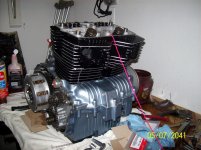
Got that engine, and it was clear it had some water and rodent exposure. He had the old carbs, which the shafts were rusted. I managed to get one bowl off and the floats are still good so yay free parts!

The left piston was stuck and hit it with a block of wood and a minisledge and it freed up. It was stuck on the exhaust stroke but I was able to get the cam chain sprocket loose enough to slip the chain over. Amazingly the cylinder is serviceable.

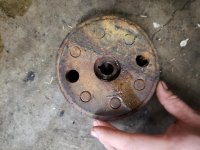
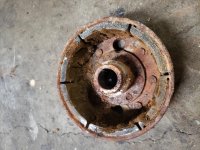
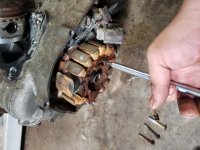
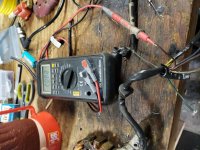
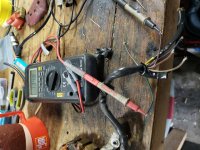
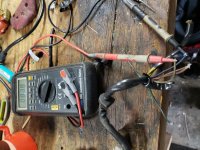
It was difficult to get the stator out, but did it. I cleaned it up and was amazed that the readings are within spec.

20230617_071646.jpg 20230617_071655.jpg 20230617_072712.jpg 20230617_075541.jpg
20230617_075618.jpg 20230617_075650.jpg

I dont know if I have faith in the rotor, but who knows it might work after its cleaned up. If not, those are fairly cheap.
 
Last edited by a moderator:
Got that engine, and it was clear it had some water and rodent exposure. He had the old carbs, which the shafts were rusted. I managed to get one bowl off and the floats are still good so yay free parts!

The left piston was stuck and hit it with a block of wood and a minisledge and it freed up. It was stuck on the exhaust stroke but I was able to get the cam chain sprocket loose enough to slip the chain over. Amazingly the cylinder is serviceable.

It was difficult to get the stator out, but did it. I cleaned it up and was amazed that the readings are within spec.


I dont know if I have faith in the rotor, but who knows it might work after its cleaned up. If not, those are fairly cheap.

(y)(y)(y) I like that the stator is within spec ! Do you know which model/year bike that engine is from ?
 
Last edited by a moderator:
(y)(y)(y) I like that the stator is within spec ! Do you know which model/year bike that engine is from ?

78 CB400. Cylinder is good candidate for machining. I might just try to get 0.5 oversize one of these days and use it on my 79 CM400A (cylinder is same part number)
 
Update 06-23-2023:

Got the engine apart with chains, con rods, etc. removed. Spins freely. Now to get a motor so I can get the bench setup done. I think you could just spin the 17mm bolt on the oil sprocket and really simplify things, at least for testing until I can come up with a better solution.

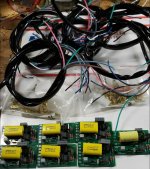
Prices increased due to shipping and component cost. However, there is now a discount for VHT Forum members which will bring the total price down to about ~$245, Use code 'VHTMembers' at checkout. The more bulk orders I can do, the cheaper it gets. I've also done some research into simplifying the diodes. I was right that they 1N4002 and 1N4004's in different spots for cost reduction. It's safe to use overrated 1N4007s and simplify cost and me having to pay attention to which diode goes where. I'm researching the option to use a beefier SCR that is rated for 800V and 13A to replace all the SCRs. The specs are the same, just higher rated. I believe they used 5P4M and 2P4M as a cost cutting move. Using a higher rated SCR should also help with stators and coils that are getting closer to being out of spec. If they end up drawing more current because of the increased resistance, the higher rated components should be able to keep up with that.
 
Jim sent me Rex's unit to compare. Some very interesting comparisons with regards to cost cutting moves. If you want the real deal that just works you can always order it from me.

Size comparison of my case and their case. Theirs is thin plastic and is actually longer in length
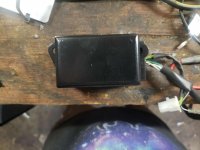
20230622_121626.jpg

Size comparison of my unit and the bracket. As mentioned before, this interferes with valve adjustment. Rex's unit is zip-tied onto this bracket. This means that eventually UV exposure will weaken those zip ties:
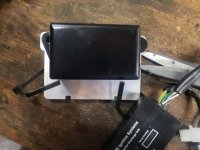
20230622_121729.jpg

Potting compound on one of the canon plugs:
20230622_165727.jpg

Large amount of potting compound on the side of the plastic case:
20230622_165723.jpg

Poor quality crimps, not even crimped the whole way. Jim mentioned that one of the crimps already failed when he was removing the unit to test mine:
20230622_121641.jpg

More of the poor quality crimps. Notice the brown wire is already exposed from a few times of disconnecting it. Now that it's exposed it's more likely it will build corrosion at some point:
20230622_121656.jpg

The wires themselves are the incorrect colours or shades in some instances. The wiring itself is also a smaller gauge compared to OEM and my unit.

The sleeving is not the glossy PVC type as OEM or my unit. It appears to be flat heatshrink tubing. I'm unsure if this electrical tape (not harness tape) is a repair from Jim or from Rex's:
20230622_165759.jpg

The B/W bullet plug is supposed to come out of this hole where the electrical tape was. Again, if this was Jim doing a repair, please let me know and I will remove mention of this. If Rex's did it, then this is wrong and they put electrical tape over it to hide the fact they cut too short:

20230622_165815.jpg

Once I get some more professional pictures done of the unit I intend to remove the potting compound and see what components are in there. The potting compound is similar to what I use, but is poorer quality.
 
Jim sent me Rex's unit to compare. Some very interesting comparisons with regards to cost cutting moves. If you want the real deal that just works you can always order it from me.

Size comparison of my case and their case. Theirs is thin plastic and is actually longer in length

Size comparison of my unit and the bracket. As mentioned before, this interferes with valve adjustment. Rex's unit is zip-tied onto this bracket. This means that eventually UV exposure will weaken those zip ties:

Potting compound on one of the canon plugs:
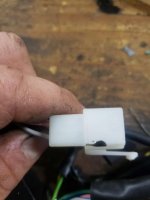
Large amount of potting compound on the side of the plastic case:
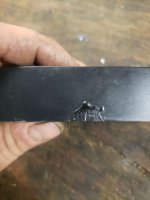
Poor quality crimps, not even crimped the whole way. Jim mentioned that one of the crimps already failed when he was removing the unit to test mine:
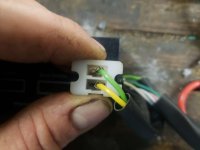
More of the poor quality crimps. Notice the brown wire is already exposed from a few times of disconnecting it. Now that it's exposed it's more likely it will build corrosion at some point:

The wires themselves are the incorrect colours or shades in some instances. The wiring itself is also a smaller gauge compared to OEM and my unit.

The sleeving is not the glossy PVC type as OEM or my unit. It appears to be flat heatshrink tubing. I'm unsure if this electrical tape (not harness tape) is a repair from Jim or from Rex's:
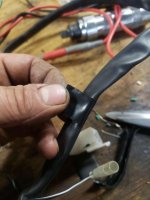
The B/W bullet plug is supposed to come out of this hole where the electrical tape was. Again, if this was Jim doing a repair, please let me know and I will remove mention of this. If Rex's did it, then this is wrong and they put electrical tape over it to hide the fact they cut too short:
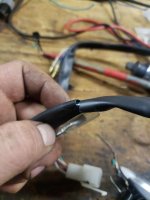

Once I get some more professional pictures done of the unit I intend to remove the potting compound and see what components are in there. The potting compound is similar to what I use, but is poorer quality.


Unsurprising and pretty typical little details from a company mass-producing anything, and it shows how much better a hand-built product can be and why it would be worth buying one of yours even if it costs a bit more.
 
I can't say for sure if I cut the cover and repaired w/electrical tape, I don't think so since the only thing I needed to do was change to bullet ends for the Blue/White power wires.
My biggest complaints with it are the overall size and the poorly done crimps.
Having to remove the unit to do get the valve cover off and adjust the valves just means more wear and tear on the flimsy harness besides being a PITA.
The bad crimps mean a roadside failure at some point in time.
 
One of the replacement SCRs had the wrong specs so for the 400A it was always thinking it was in Neutral. The beefier main SCR works fine however. Find a better option from the same series for SCR2 going to test that as it arrives and I think that will work just fine.

In the mean time, the stator/rotor assembly is disassembled and ready to be hook up to a motor. I have no idea what I would need. However, I see no reason that I can't get the motor to spin the 17mm bolt on the right side of the crank. I am having a hard time finding a 12V (or 120V doesn't matter to me) motor that can spin up to 5000RPM. I'd prefer a 120V that I could just run on a variac/light dimmer to start it at 800RPM and go up. Does anyone know where I can find one or have an idea of what could work?
 
FWIW, I talked to my EE guy at work. He said most ACs cap out around 3600 RPM. He thinks he has a DC motor at home he doesn't use that goes up to 5K that would have enough torque. Grainger has motors, but they want $350 starting out and I'm not interested in paying that much. I'll keep you posted.
 
If any electric motor you find has decent torque, you could increase the rpm of the crankshaft if you drove it through a pair of pulleys at less than 1:1 ratio
 
I'm trying to keep it as simple as possible to reduce the size of it on my bench. But yes, I may have to do that.

Since it's an early 78 it doesn't have the starter clutch or gears or the cut out for it. I was thinking I could be very lazy and just spin the starter and using a speed controller, but can't do that. :lol:
 
The A stator and rotor will bolt up to the T engine, people have done the reverse to make a runner in the past.
Pop the rods off and mount an electric motor on top with a chain drive to the crank.

I think the main issue with doing this is the Hy-Vo chain. Pitch is drastically different and I don't know if they even make master links for that.
 
Frank,have you considered using a motor motorcycle and spinning the engine through the transmission countershaft sprocket ?
I'm not sure if shifting would be possible to step-up the rpms,but it could work..
 
Frank,have you considered using a motor motorcycle and spinning the engine through the transmission countershaft sprocket ?
I'm not sure if shifting would be possible to step-up the rpms,but it could work..

I already stripped all of that out. The goal is to just have the bottom end with the crankshaft and flywheel only and spin it to save space on my bench and weight.
 
I already stripped all of that out. The goal is to just have the bottom end with the crankshaft and flywheel only and spin it to save space on my bench and weight.

Frank,will you use some type of grease for the crankshaft plain bearings ?
 
Frank,will you use some type of grease for the crankshaft plain bearings ?

That's actually a good point, I'm so used to the other engines with all ball and roller mains. I wonder if some heavy grease would last, I don't think he'd be spinning it too long each test.
 
That's actually a good point, I'm so used to the other engines with all ball and roller mains. I wonder if some heavy grease would last, I don't think he'd be spinning it too long each test.

I was envisioning a type of 'test stand' with wheels that he mounts the complete bottom-end(less rods)into it and it's got transmission,clutch,clutch cable and shift lever with engine oil;kind of like a 'battery cart' type idea. I was imagining it to have a motor with chain drive hooked up to the countershaft sprocket and he could shift through the gears to achieve different rpms.
 
I was envisioning a type of 'test stand' with wheels that he mounts the complete bottom-end(less rods)into it and it's got transmission,clutch,clutch cable and shift lever with engine oil;kind of like a 'battery cart' type idea. I was imagining it to have a motor with chain drive hooked up to the countershaft sprocket and he could shift through the gears to achieve different rpms.

I think that would be a difficult task for an electric motor to rotate the crankshaft by way of back-feeding through the transmission except in maybe first or second gear, and he mentioned wanting it on the bench but the plain bearing situation might cause the need to have the oil pump and oil in it. It's a shame the whole rotor, stator and CDI couldn't be adapted to a bottom end that had ball bearing mains
 
CURRENT STATUS 06-30-2023:

SOLD OUT TEMPORARILY! Awaiting cases from metal manufacturer. Will be available 07-18-2023. You can still back order.

After next round of batches the metal manufacturer intends to always keep 10 in stock at any given time. Depending on how orders go, I may start keeping 20 in stock.
 
I'll go back to using an electric motor mounted on the case but a driving a 219 chain to the oil pump drive gear instead of trying to use the cam drive gear.
Looks like there's plenty of clearance
201_4551.jpg
 
If someone could fab up something for me to make it work I can ship it to you with return shipping. I'm just not equipped to make something and not mechanically inclined enough to invent stuff like this.
 
If you left in, the tranny main shaft and bearings with only the clutch basket and it's big gear, you could drive the clutch basket and get big rpm's at crank.

Cheap skate idea: Cut a wooden plate from 2x8 and drill through clutch fingers, then use deck screws to mount plate in clutch. Fat hex bolt lock-nuted in center of plate for drill drive.

optical sensor on flywheel to track rpms.
 
I figure if I go to all that effort might as well just spin the 17mm nut on the clutch side of the crankshaft that's for the oil pump. And yes, I was planning to use an optical RPM meter, but if it's sparking a regular inductive clamp meter in theory should work.

Ahh, nevermind I see what you mean now. The big gear will help change the ratio and should in theory make a regular drill do the work.

FWIW: I did find a great deal on the automatic model stator and rotor. Have not received it yet, but should help immensely.
 
I currently have 7 pre-orders already. All for 400T's! Metal manufacturer is slightly behind, so cases will be available next week. This means as soon as I get them, there will only be 3 cases left for this round. One of them in the batch is for ballbearian.

Capture.jpg
 
Progress on the test bench. I just ground down a 3/8 extension and put a 17mm socket on it and spun the clutch side of the crank by hand. This has a CM400A stator in it with CDI. It works. Can't spin it fast enough to trigger advance, but can at least verify if the thing works.

Still have to come up with some nicer way to spin it faster.

 
Use the gear on the crank for the oil pump chain? Or get a V-belt pully machined to fit the crank there.
1/4 HP motor with speed control should be enough. Most of those motors are running 1000-1800 rpm
 
Use the gear on the crank for the oil pump chain? Or get a V-belt pully machined to fit the crank there.
1/4 HP motor with speed control should be enough. Most of those motors are running 1000-1800 rpm

That's why I said to spin the clutch basket with it's big primary drive gear to get more crank rpm's.

The unopposed crank counterweights sure caused a lot of shaking going on :lol:, I can imagine how bad it will be at the target rpm's. Are the rods still there?

This reminds me, I need to fix the drum mounts on my front load washing machine before it goes full cataclysm on spin cycle.
 
Use the gear on the crank for the oil pump chain? Or get a V-belt pully machined to fit the crank there.
1/4 HP motor with speed control should be enough. Most of those motors are running 1000-1800 rpm

The only real thing I have to do any kind of fab work is a drill press and a dremel. So I'm very limited at this point with what I can do. I guess I could find a pulley off a lawn mower or a junk car and drill it out to fit, remove the oil pump holder bolt and fit it in there. What do you think?

That's why I said to spin the clutch basket with it's big primary drive gear to get more crank rpm's.

The unopposed crank counterweights sure caused a lot of shaking going on :lol:, I can imagine how bad it will be at the target rpm's. Are the rods still there?

This reminds me, I need to fix the drum mounts on my front load washing machine before it goes full cataclysm on spin cycle.

I removed the rods but I still have them.

It's also shaking a lot because there is no bottom cover. It's just resting on the bolts for the crank holder and that drill is pretty vibey on it's own. I might put the bottom case back on, but in an effort to reduce weight I haven't yet. I want to be able to move it around easily.

The shaking doesn't really matter to me all that much I just want to spin it enough to verify that it sparks, it sparks at the right time, and that the advance works.
 
Can't use the clutch basket for the drive since it's the opposite gear ratio.
If the motor turns 1,000rpm then with a 10 tooth drive gear to a 50 tooth driven gear you get 5000rpm. So small drive pulley/gear on the motor and large driven on the crankshaft.
One issue that hasn't come up is using the case and crankshaft the plain bearings won't have an oil supply. In very short order the bearings will fail since they need a film of oil covering them at all times the crank is spinning.
What I envision is a stand where the Manual and A model stator/rotor assemblies are mounted on opposite sides permanently. An intermediate shaft with pulley mounted and ball bearings supporting the shaft, ball bearings need very little oil so a squirt before operation will suffice. Motor mounted below the stator assemblies so weight is low centered. Top plate with speed controller and rpm meter. Now just need to draw it out and figure out things like belt tensioning, etc.
 
With belt and different sized pullies you could get more or less speed. A common light dimmer can be used to get different speeds. I used an autotransformer on a hand circular saw(6k RPM) and also a hand grinder(10K RPM). I was testing a common auto probe that picks up on toothed gear. Learned some interesting things about those. They are not just a simple hall sensor, but have additional electronics built in to adapt. The speed with light dimmer is going to vary, but if you had a RPM reading that could make up for that. I think it is nice to use the whole rotor, real pulse sensors and charging coil. It might also be useful to have a electronic faked system to approximate the real thing, as an alternative.
 
Can't use the clutch basket for the drive since it's the opposite gear ratio.
If the motor turns 1,000rpm then with a 10 tooth drive gear to a 50 tooth driven gear you get 5000rpm. So small drive pulley/gear on the motor and large driven on the crankshaft.
One issue that hasn't come up is using the case and crankshaft the plain bearings won't have an oil supply. In very short order the bearings will fail since they need a film of oil covering them at all times the crank is spinning.
What I envision is a stand where the Manual and A model stator/rotor assemblies are mounted on opposite sides permanently. An intermediate shaft with pulley mounted and ball bearings supporting the shaft, ball bearings need very little oil so a squirt before operation will suffice. Motor mounted below the stator assemblies so weight is low centered. Top plate with speed controller and rpm meter. Now just need to draw it out and figure out things like belt tensioning, etc.

Yeah, I guess I'll have to put a few drops of oil on it when I go test. I wonder if you could just pack it really well with marine grease and it would last longer?

With belt and different sized pullies you could get more or less speed. A common light dimmer can be used to get different speeds. I used an autotransformer on a hand circular saw(6k RPM) and also a hand grinder(10K RPM). I was testing a common auto probe that picks up on toothed gear. Learned some interesting things about those. They are not just a simple hall sensor, but have additional electronics built in to adapt. The speed with light dimmer is going to vary, but if you had a RPM reading that could make up for that. I think it is nice to use the whole rotor, real pulse sensors and charging coil. It might also be useful to have a electronic faked system to approximate the real thing, as an alternative.

I figured a light dimmer would probably work for this application. Since I'm spinning it and it's generating the spark pulses it's trivial to hook up an inductive tach attached to a car battery. This is what I did to trigger the timing light.
 
...and he mentioned wanting it on the bench but the plain bearing situation might cause the need to have the oil pump and oil in it.

One issue that hasn't come up is using the case and crankshaft the plain bearings won't have an oil supply. In very short order the bearings will fail since they need a film of oil covering them at all times the crank is spinning.

Yep, except it was actually mentioned already.
 
Can't use the clutch basket for the drive since it's the opposite gear ratio.
If the motor turns 1,000rpm then with a 10 tooth drive gear to a 50 tooth driven gear you get 5000rpm. So small drive pulley/gear on the motor and large driven on the crankshaft.
One issue that hasn't come up is using the case and crankshaft the plain bearings won't have an oil supply. In very short order the bearings will fail since they need a film of oil covering them at all times the crank is spinning.
What I envision is a stand where the Manual and A model stator/rotor assemblies are mounted on opposite sides permanently. An intermediate shaft with pulley mounted and ball bearings supporting the shaft, ball bearings need very little oil so a squirt before operation will suffice. Motor mounted below the stator assemblies so weight is low centered. Top plate with speed controller and rpm meter. Now just need to draw it out and figure out things like belt tensioning, etc.

I think it's: For every revolution of the clutch, there will be 5 revolutions of the crank. It usually takes me 5 mistakes for every correct answer. :rolleyes:
 
I'm discontinuing the kits except on a per-request basis. Causing too many problems with people assembling them improperly or outright asking extremely specific information out of them to fix their own unit. My intentions are not meant to be rude, but if you are asking these kinds of specific questions then you are likely not qualified to solder the kit yourself. If you think you can fix your own unit even though you're unsure of your stator or coil with proper techniques then you are not qualified to do it. If you think getting the component values out of my kit will fix your own unit that you've already disassembled then you are definitely not qualified as desoldering and testing the component should be easy for you.

If I am confident that you're competent to solder and isolate and debug properly then I will sell you one. Because of the above mentioned problems they no longer come with a guarantee or warranty.
 
Status Update 08-01-2023:

Cases back from Manufacturer and I must fulfill 7 back-orders(!) for those who are waiting I am soldering the harnesses today, running them on the test bench, then potting them tomorrow and should be shipped Friday.

This means there are only 3 cases left this run and the next availability will be at the end of September.

I have been keeping this a secret for a month or two, but David Silver Spares will be selling the CM400T CDIs. The price is the same as purchasing through me. They are doing an initial run of 5 to gauge interest. They were not interested in the Hondamatic CDIs because the bike was only available in 1978 in the UK. I'm not sure when they will be available on the site. I will be bringing the units to the Hanover, PA location to help save them on shipping. Just FYI to anyone who gets it through DSS: it will be the last superseded version number. This means it will have the 2-pin canon plug for blue and white. They were not interested in stocking up on adapters or having a separate run of 78 years.
 
We'll see how it works out. The advantage for people here is that if you're ordering a bunch of stuff with DSS then you can get it all in one go.

4-into-1 was not interested, after repeated attempts. They moved the goal posts so to speak. First they wanted 5 available products from me and proven reliability. After that was achieved, they then told me they wanted 20 available products from me. And no, this is not why I disdain 4-into-1. I do not like them because they sell a lot of harmful products such as carb rebuild kits and crappy aftermarket coils, etc. They want a vendor that can do high volume; so it makes sense they are not interested in dealing with me. This is unfortunate because there are a lot of people who shop with 4-into-1 who do not know where else to go and if they need a CDI they don't know where to get one.

I did try contacting CMSNL, never heard back. But, I have heard from others on here that they have been really slacking on answering emails lately.
 
When all this success brings an end to the "Hand made by Frank" items, they will be collector's items.


I want mine autographed, Ok?
 
When all this success brings an end to the "Hand made by Frank" items, they will be collector's items.


I want mine autographed, Ok?

Hah, well I saw your email to me last night before bed. I already shipped yours, but all of them have FHS'23 #<SN> written on the back. However, per Tom's good advice it's very small, in the corner where you can't see it when bolted to the frame.

For DSS ones I won't do that at all to keep it a touch more professional.

They will always be made by me, and if not me it would be a family member. If it got that busy where lead time increased to 3 or 4 weeks... well them's the breaks. I have zero interest in trying to get it assembled overseas to push more units. Can't trust anyone to do it right except yourself.
 
Back
Top Bottom