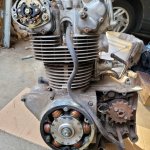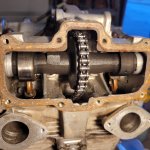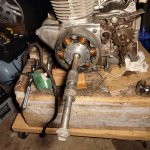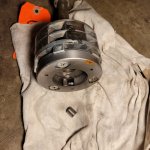
Kbongos 1972 CB450 K5 engine disassembly

kbongos

Veteran Member
Joined
May 30, 2022
Total Posts
1,074
Total likes
609
Location
Minneapolis, MN, USA
So I bought a CL450 engine from CL for $80. AD says CL450 same as CB450 so I titled it as a CB450 as I think this is more common. Started with parts for sale by others post: https://www.vintagehondatwins.com/f.../73-cl450-motor-100-bought.10248/#post-124802
I don't need the engine, I have a few other later year bikes, 81 CM400, 82 CM450. These engines are quite different with there DOHC. Just thought it would be fun to do a tear down and learn. I had the top end off on my CM400 and did some cleanup, but that's the extent of my experience on motorcycle engine internal servicing.

The engine was just a spare for PO that sat in garage for a long time, never used(got it from estate give away). Said it was stuck in the ad. And I have tried some gentle coaxing of both rotor and starter, but nothing moves. So cleaning it up for start. After a rough clean up start to apply penetrating oil. Start loosening a few bolts with care. Got the two spark plugs loosed, apply some penetrating oil and work them back and forth a little to avoid ripping threads up. Dribble a little mix of oil in exhaust/intake valves, figure it might reach the piston tops that might enjoy it. Checked oil, not up to stick but there is some old oil in there. I figure that's good, better than bone dry. And it didn't leak at all even on drive home where I didn't have it braced well and it fell on it side and moved around some on the way home. That was first mistake.

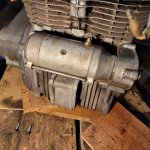
Started cleanup just a floor on some cardboard. The thing does not balance well on the big oil pan bolt. Made something up as a work bench for it with my old wood car blocks. There is a ramp part for driving a car up on the blocks, these were home made many years ago and served me well. Just having big blocks and wedges has proven handy. These sitting on a home made 2x4 coaster cart. Then a few odd wood pieces wedged to keep it a little stable. I also have a nice stout oak tree log I keep in garage, and of course the collection of plastic pails.
For the most part the engine looks fairly decent, so time will tell. Any suggestions on tear down welcome!
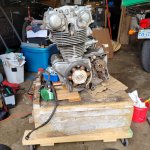
20240303_142616.jpg
 
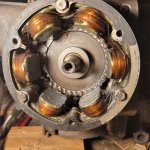
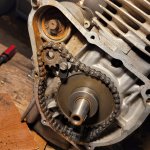
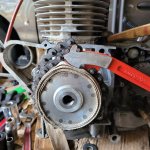
The view of this side shows the intake cam bearing doesn't look like it's been removed, screws look undamaged. The left exhaust cam bearing has definitely been removed, but that's not really a surprise for these engines (mostly due to poor warm-up or running low on oil, or worse). Points cover screws are not original. Large washer and circlip on the shift shaft is in place, but curiously the chain oiler is missing. This would allow a fair loss of oil right out of the countershaft, hard to believe it was run that way because it wouldn't have run too far without grinding up cam lobes, followers (think rocker arms but different) and cam bearings without oil flow. Can't quite tell from the picture if the intake valve adjuster shaft is turned the right way, the index mark is not clear. And the exhaust valve adjuster is under the points cover so it remains to be seen. Hopefully you get it unstuck so you can rotate the engine to find the cam chain master link.

Next!
 
I use a hunk of all thread through the rear motor mounts and some kind of base because they are so tippy. You do not want to have it fall and break any fins.

Loosen the rotor bolt and oil filter nut before you undo anything up top.
 
@AD:
In this older thread you say that the oiler was only on some older models.
So maybe it was just not on this one?
Or is this just a mix-up with a rear wheel chain oiler, versus cam chain?
I was looking for something missing in the pic, but couldn't find anything obvious.
I found a thread that shows it sticking out of the end of the output chain:

Is this the dreaded automatic chain oiler? CB450K6

So I assume your reference just a mix up, that cam chain gets oiled more naturally spinning in the engine.
Or is there supposed to be a bolt in there or you loose oil resulting in oil loss?
The oil was low, worst case I cut the chain where it is, right? But then I still need to loosen pistons
eventually, but I suppose soaking those and pounding on those directly is better than ripping the
rotor bolt apart.

So the cam chain needs to be broke, it's riveted on, no snap rig arrangement. And it wraps around
both cams so if I loosened head bolts it would stress parts(chain, cam) out? It would only tighten
chain? So, what is best way to rotate this stuff. What I know is to lever crankshaft bolt. The
kick start lever pushes down about 90 degrees and stops. I suspect cranking on the kick start is a bad idea.
I don't want to apply to much force before
getting advice. Now I suppose you can just cut or unlink the cam chain where it sits if no rotation
is feasible, and you just have to get a new chain. In the end you have to move those pistons to get
them out. I recall a thread of someone going to extreme measures to unstick rusted pistons, acid bath,
physical force applied to piston heads. I will guess the answer is try to turn rotor with reasonable
force - that would be tightening rotor bolt I assume. I did try tightening to turn it, but just lightly,
then I was able to take it out with not much torque. Now I assume squirting some light oil in the
spark plug holes could only help, give it time to loosen piston, and I'll probably do that unless some ones got better ideas.
,Then try a little more force on the crank bolt, see if it turns.

I did loosen a few head nuts, not much, not too tight, easy enough, but the inner ones I need a thinner socket, so
no harm done I believe.

The cover over points was loose, I did take that off to have a look and take a pic(AD mentioned exhaust valve adjuster is under the points)
20240302_155343.jpg
Thanks for advice, FSM is interesting read, but obviously they can only include so much.
And this engine does appear to be an interesting complex beast, I'll bet the SOHC like my CM400
is a simplification cost cutting effort.
 
Last edited by a moderator:
@AD:
In this older thread you say that the oiler was only on some older models.
So maybe it was just not on this one?
Or is this just a mix-up with a rear wheel chain oiler, versus cam chain?
No mix-up. The chain oiler was on some early models and not on others, the CL seems to have it earlier than the CB and this oiler was also on the early CB750s. There's no part numbers for the rest of the pieces but #5 is part of it, and inside the shaft on yours looks like it had one. This is one of the few little things you'll see different between CB and CL engines. Obviously the cam chain is always in oil.

honda-cl450-scrambler-1969-k2-usa-transmission_bighu0101e3314_8d4f.gif

still need to loosen pistons eventually, but I suppose soaking those and pounding on those directly is better than ripping the
rotor bolt apart.
Do not pound on the pistons once the head is off, you could damage the rod bearings. You can use a steering wheel puller to push the pistons loose. He suggested the rotor bolt loosening early because after the engine is apart, it's harder to hold the crankshaft still to get it out.
So the cam chain needs to be broke, it's riveted on, no snap rig arrangement.
It has a staked master link, it is not an endless chain originally. So if you can rotate it you can find the link, if not then cut it anywhere.
So, what is best way to rotate this stuff. What I know is to lever crankshaft bolt.
If you can get it loose, yes.
The cover over points was loose, I did take that off to have a look and take a pic(AD mentioned exhaust valve adjuster is under the points)
And both index marks are pointing the correct direction, and the points screws are in really good shape too. Blue terminal was turned wrong so it might have shorted on the points cover. No washers on the 2 screws for the points plate. Advancer washer looks funny, maybe just the pic angle.
 
Ideally, I'd reverse the torque pattern and gradually loosen the head nuts to avoid warping it or stressing the studs.
Don't overdo that rotor bolt, it's only an 8mm, snapping that would be a hateful thing.
 
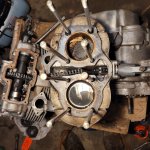
Had to take a peak under both hoods. Intake side chain was tight, I believe cam pushing valve, exhaust side chain had some slack and I was able to jiggle the cam some. Had plugs out and sprayed a little penetrating oil in there. I suppose next step is pulling that oil pan bolt out and drain the old oil. I did look for the different chain link on what is showing, but did not spot it. I did tighten the rotor bolt a bit more, but the rotor does not want to budge. I picked up a rear wheel bolt that I'm told can work to remove rotor on my cm400, hoping that applies to this one for when I try to remove that. But I have to find it first in my chaotic garage. I know I put it somewhere.
20240305_180711.jpg20240305_190218.jpg
 
A cheap steering wheel/bearing puller is the easiest way. You need some pipe or long sockets to stack on the studs to mount it. Auto parts stores often 'rent' them for free (leave a deposit).
 
Last edited:
I did find the rear axle bolt and it worked fine for pulling the rotor off.20240305_212455.jpg20240305_212719.jpg20240305_212752.jpg
I did find a puller and I'm a little confused on what that could be useful for, AD mentioned unsticking piston with one, but I can't picture how that would be used. Finding that bolt was a challenge, digging threw my big bolt collection, no. On the work bench? Dig threw the disaster area I call a work bench, nope. Hmm, maybe I put it on shelf by the big monster wrenches and pry bars, Bingo! I got that bolt for around $10 delivered, such a deal.

A recent query on new bolts for some front end work was a shocking experience, very expensive! So I find myself at the junk yard this summer and I'm just picking up a collection of bolts and nuts off the ground. In the old bolt bucket they go. I'm sure I only paid pennies on the dollar for these compared to buying new high strength bolts. People probably looked at me and wondered if I was alright. A junk yard zombie picking up random stuff out of the dirt.
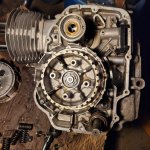
 
I assumed you were going to leave the rotor on the crankshaft until you let the pistons soak for a while to try to get them unstuck, no way to attempt to rotate the engine now that the rotor is off. At this point just cut the cam chain, remove all 8 cylinder stud nuts (acorn nuts on top of the head) and lift the head off as one piece.

Stater clutch and rotor look good, and surprisingly the cams look decent considering though the inside of the engine is more gunked up than one might have thought. And I see virtually all original parts in those pics, so it looks like this engine somehow avoided the meddling hands of a hack along the way.

Getting that drain plug out (not really a bolt, notice the outer diameter of it) will be a challenge with the engine not in a frame to hold it still.
 
With the rotor put back on, a non-marring strap wrench might be worth trying on the rotor, but I bet the steering wheel puller will be the final solution.
 
With the rotor put back on, a non-marring strap wrench might be worth trying on the rotor, but I bet the steering wheel puller will be the final solution.
I may tray some of this, I've got a oil filter wrench with the chain loop. Along with a towel wrap I'll see if I can get it to wiggle without too much force. The large diameter of the rotor would give a good mechanical advantage, just have to avoid damaging of magnets.
It might be if it's stuck enough. And I meant to find pics of the steering wheel puller in use during my last post, got distracted and forgot.

Here it is, courtesy VHT member @JAYinNY

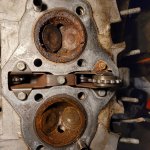
Thanks, I see so using the head bolts to lever and push on the piston heads, get them moving. I did make some progress. Here are some pics to show. Got the head off fairly easily. There was a pool of water on one piston top and a few helicopter seeds on the other that was dry and had the exhaust valve open.
20240308_213233.jpg
So before that I got the starter detached, two bolts on the side, and then gave it some gentle whacks with wood and hammer to work it back from it's pressed in collar. The starter sprocket just came loose in this process and then able to remove the sprocket on the main rotor just pulling it off. Interesting how the sprocket collar acts as one way grabber with those 3 little bearings(one shown loose in previous picture).
20240307_224817.jpg20240307_224832.jpg20240307_230706.jpg
I get to try out my JIS screw drivers. The Vessel with the bit ends fit in my Bosch impact driver, and that worked nicely. The Bosch tools being christmas present from my son this year, came with a matching battery power drill. The Vessel Impacta I had picked up with the other set and get to try them out. Tried it on some stubborn bolts but it seems limited with it's impact ability. There are a few stubborn JIS screws, larger case covers, that I have not been able to budge yet, taking it slow. Wishing now I had ordered the set of old school JIS bits.

Cleaning as I go, things look OK. I did find this fragment of what appears to be aluminum case, I believe it was just by the oil hole under the rotor, I don't think I busted it off, and it will be interesting to find out what it was from. Here's pic:
20240307_230907.jpg It's got a tight lip on what appears to be a inside curve.
20240308_213441.jpg20240308_213458.jpg20240309_151017.jpg
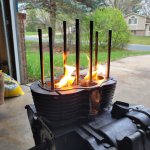
Now, Here's a screw up, I was giving the jugs some love with the hammer and some 2x2 pine. Trying to be careful, try to direct the force on the larger tabs, but I broke some fins. I believe I split the wood and that offered it the opportunity to impart it's force onto them.
20240309_151122.jpg Live and learn. It does seem like the lower jugs can wiggle a little at the base, but I believe those pistons are probably holding it tight and I need to try the steering wheel puller idea, try not to be such a brute with my hammer.

20240309_161443.jpg

Cleaning up some with wire brush wheel on drill, apply some more light oil.20240309_161536.jpg

I'm finding the whole CAM arrangement to be interesting, haven't taken the torsion bar out yet, just half the one side of the cam. Haven't figured out where the advance mechanism is, expected to find that behind the points plate, and maybe it is in there somewhere, I suppose I could consult my FSM some more. I am enjoying the process. Get's me out in the garage, I can wheel it out in the sun, and it's certainly a pleasure compared to working on cars. Thanks for your input!
 
I've learned the Impacta works best holding totally straight with some twist pressure and whack with a pretty big hammer so you don't have to swing like a wild man. I almost never strip them this way.
If the cross in the screw head starts to flare, Stop. Tap it down flat and smooth before the next whack.
I've learned to never tap on fins the same way. :rolleyes:
ATF is a good ring soaker too. Patience Grasshopper!
 
The starter clutch and alternator rotor look good. The woodruff key is about to fall out of the crankshaft, don't lose it. I didn't mention it because this is just practice for you, but the right way to remove the cam bearings is to remove the valve adjuster lock nuts first so the follower shafts don't get pulled pout with the cam bearings. But obviously no harm done. I'd be curious to see what all 4 followers look like up close, and all the cam lobes too. Also, for future reference, these two places marked below are safe to bang on a stuck 450 cylinder with a rubber or wooden mallet (obviously the cam chain tensioner body has to be removed from the cylinders first for the rear point of impact). Anytime you hit an area of the cylinder or head that has fins, it has to be directly 90° to the fins with no downward or upward angle at all or you can get that result you got.

cylinder.jpg
 
You might want to be careful using a wire wheel on the aluminum gasket surfaces. It looks like it put some pretty good scratches on there.
Yes, the wire wheel is a little aggressive. It is a fresh one, BB has pointed out he likes to use older ones that are probably wore done some. It might be an idea to take new ones on a stone or brick, try to wear down the sharp edges. And I should probably keep it away from the aluminum surfaces. I did arrange a chain puller around the rotor with some buffer nylon strapping to try and not damage rotor, but rotor does not want to move and I don't want to crank on that excessively. I did pound a wood wedge in on the back side to try and give it some pressure over time. Otherwise I am going to try and rig up something like that steering wheel puller arrangement on the bolts and see if I can nudge the pistons into movement. What about taking it apart from the bottom side, is that a useful option? Last resort?
 
What about taking it apart from the bottom side, is that a useful option? Last resort?
Due to the design of the bottom end, there's no advantage. The crankshaft is a pressed-together one piece unit with ball and roller bearings and the rods are not replaceable without pressing the crankshaft apart.
 
I think the advance mechanism was just missing, must have been used by the PO. I can see where it goes behind the plate. Not a whole lot of room there, but I guess they squeeze it in there.

So I've been trying a few things, no luck so far getting rotor, pistons or jugs to loosen. Here are some pics that tell the story. I am trying to take it slow and not go all cave man destructo on it. I'm trying to hold back on the cave man techniques but eventually I will get this apart and I'll bust it in two if that's what it comes to.

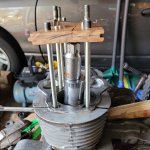
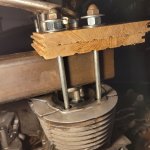
As you can see I tried arranging a press with a board and the 4 surrounding head bolts, no love, busted the somewhat wimpy board. I used the metal plate under the wood, you can see the bend it put in it after the wood cracked.

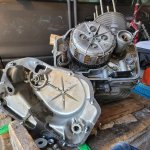
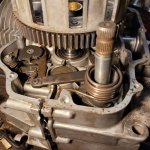
As you can see I took the side over off along with clutch to have a look, and I did loosen the case bolts, gave the case some nudging love but it did not want to separate, and so maybe it's back to trying to nudge the pistons.
20240310_174730.jpg20240310_174823.jpg20240310_175725.jpg20240311_170622.jpg
 
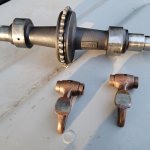
The exhaust cam, what I can see of it, looks surprisingly good. The followers do as well, though a side (edge) view of the pad where the cam lobe rides would show any 'dishing' of the pad from accumulated long term wear. The inside of the bottom end looks pretty clean.

If you find or buy a few pieces of metal pipe to slip over the studs you can borrow a steering wheel puller from an auto parts store and follow the procedure in that thread I posted (link well above), it will work.
 
I’ll throw in a couple of ways I’ve managed to get stuck stuff free with corroded blocks/pistons.

Due to the orientation and design, AD’s method is definitely the easiest. If you’re unable to procure a wheel puller, you’ll want to at least use angle iron or heavy plate to use the method you’re currently employing and use some heavy pipe to provide more room for pressure application.

Option C the surgeon. Take a heavy syringe full of evaporust gel (not liquid), finding a weak spot in the rings or a corroded gap, sliding the syringe in and injecting until it starts backing out, then leave it in there for 24-48 hours. After which, apply heat with a heat gun (not a torch), while rapidly tapping on the top of the piston. For this, I use a sawed off baseball bat - hard wood.

Option D the sous vide. Fill the piston chambers with your evaporust gel, then place the entire block in a large cooler full of 30% vinegar/water mix. (Enough to reach about the level of your pistons inside the cylinders.
Place a sous vide attachment in the cooler and let it ride at 160-170 for about 2 days.
 
Thanks for the suggestions guys. I will arrange a steering puller like better try. Certainly I can borrow one or buy one at HF, I've got some iron piping I could cut to size, etc. And maybe some other options to try like the evaporust gel as well(thanks EzPete). I'll get those pistons moving. Now I think the good news is that they should NOT both bottom out at the same time being the 180 degree timing, that if I push one down the other should rise, eh. Unlike maybe a CM400 with 360 degree timing where think they would both bottom out together. And obviously I'm in no hurry so great, I still need to pull apart that top side and we can get a look at the intake side cams and stuff. AD, I did have a few more pics of the exhaust side cams sitting on their side. In the end I guess they will just go in a big bucket and they can be some useful parts for some one that could use them.
20240309_151611.jpg20240309_151552.jpg
 
What is a sous vide?
Cooking technique involving basically really hot water baths to cook vacuum sealed meat. As a collector of random crap, I thought something you could immerse in water like that could also clean things. Works surprisingly well for really heavy baked on crud.
 
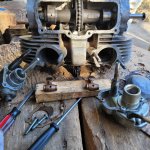
I am letting the block sit alone in the corner for a time out. See if it wants to cooperate later. I did get the head mostly taken apart. Attached a few pics. I next need to just give a tap to the end of valve holders to knock those loose and remove the valves. I learned that by this guys disassembly video:
He also had some interesting info on making gaskets, tools with 3-D printer. Says the TPU material is good up to 90C and stands up to petro/oil. A family member got a 3-D printer lately and I was duly impressed with what they do. He used a FreeCad program to make some of his own items. I am see if they will print me a que tip for a break jump que I have that needs a hard tip. See how that works.

Bagging and marking items and packing in a box so I don't trip over all of these and can ID them at some later point.
20240316_120052.jpg 20240316_130426.jpg
I was wondering how to do the thumbnail image, where it shows small and you have to click on to get full detail, but have not figured out how to do that yet.
 
I found a nice scrape 1/4 inch square steel piece in my garage, and it had some useful holes cut near the end that I arranged a piece of big threaded rod to act as a lever. Tightened it up as much as I could with what I have. Pistons still don't want to budge. I tried it on both sides. The pistons are stuck somewhere in the middle of their travel I believe, but I can't be certain. One piston is about 1/4 inch higher than the other. Since it's 180 crank one should move up while the other goes down I would think - so hopefully they would not bottom out together giving me no where to go.

20240420_215857.jpg
The head and valve parts came off easy - no springs to mess with, retainers fall out easily, that was nice. Got those parts bagged and boxed up.

Maybe I'll get next size up threaded rod. Maybe I'll have to get into more destructive methods.
 
I found a nice scrape 1/4 inch square steel piece in my garage, and it had some useful holes cut near the end that I arranged a piece of big threaded rod to act as a lever. Tightened it up as much as I could with what I have. Pistons still don't want to budge. I tried it on both sides. The pistons are stuck somewhere in the middle of their travel I believe, but I can't be certain. One piston is about 1/4 inch higher than the other. Since it's 180 crank one should move up while the other goes down I would think - so hopefully they would not bottom out together giving me no where to go.

View attachment 31873
The head and valve parts came off easy - no springs to mess with, retainers fall out easily, that was nice. Got those parts bagged and boxed up.

Maybe I'll get next size up threaded rod. Maybe I'll have to get into more destructive methods.
Hope it's been soaking for many days in PBlaster, kerosene, Kroil.
 
Yes, but it didn't seem to seep in mutch. I'll add a more generous amount, maybe add kerosene or gas, try to cap it so it doesn't evaporate.
 
I found a nice scrape 1/4 inch square steel piece in my garage, and it had some useful holes cut near the end that I arranged a piece of big threaded rod to act as a lever. Tightened it up as much as I could with what I have. Pistons still don't want to budge. I tried it on both sides. The pistons are stuck somewhere in the middle of their travel I believe, but I can't be certain. One piston is about 1/4 inch higher than the other. Since it's 180 crank one should move up while the other goes down I would think - so hopefully they would not bottom out together giving me no where to go.

View attachment 31873
The head and valve parts came off easy - no springs to mess with, retainers fall out easily, that was nice. Got those parts bagged and boxed up.

Maybe I'll get next size up threaded rod. Maybe I'll have to get into more destructive methods.
I remember Bill Siver did this press maneuver but had to let it sit a couple days under heavy screw tension and soaking. It eventually gave in and moved.
Then switch to the other one and try to get it to move down a bit. Back and forth. Grind the rust away above the pistons so the other can rise.
 
Have you tried getting at this from the other side? Just leave that attached and separate the cases. It might allow you to get some rust eaters on the other side.
 
Have you tried getting at this from the other side? Just leave that attached and separate the cases. It might allow you to get some rust eaters on the other side.
Not a bad idea. Just lay the hole saw next to it on the bench. Maybe it'll get the message.
 
Have you tried getting at this from the other side? Just leave that attached and separate the cases. It might allow you to get some rust eaters on the other side.
Took another try at splitting the case with success this time. First time it didn't cooperate, but I wasn't sure I should be doing that at the time and backed off. Now it's loose, but I believe just hung up on some linkage under the clutch housing and I would guess I need to remove that. Just need to get some of those slip rings off I presume.

Yes I was thinking if I could get some penetrating oil or other helping fluids on the other side that might help. Otherwise it sounds like cutting, melting, decomposing the aluminum piston top out is the destructive method that it may come to. And you could buy new pistons so it wouldn't be totally stupid. While this is just a learning exercise, it's would be nice to approach it like it was to go back together or at a minimum try to not wreck everything.

20240428_221352.jpg
 
Oil filter first, it has a 6mm bolt hole to pull the cover out, straighten the washer tabs and use the 4 dog tool to undo special nut from the crank. That'll be easy since the crank is held fast by the pistons. Then clutch basket and oil pump together. Then the shifter shaft with it's arms. You may need to knock the case back together so nothing binds while you're removing it.
May as well take the rotor, stator, starter sprocket off the other side too.
Then you can flip it and pull the lower case off. Then take another picture so you can put it all back the same later.
 
Man, stuck engines are the bane of the restorer's existence. Every 450 I've ever gotten has had a frozen motor.

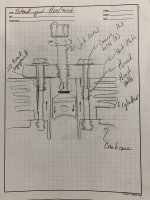
I'm toying with this idea, that is, secure a thick plate (aluminum or steel) to the cylinder. Then turn screws that directly impinge on the pistons. Perhaps this would be a last resort.

To make this happen involves removing the cylinder studs, then, threading the cylinder through holes. To those now threaded holes, the thick-ish plate could be securely fastened. That plate will be of a design that has jack screws that can be turned against the stuck pistons.

So far, I can't think of any operational downside. There may be threads but they won't interfere with anything. The only consideration would be to the right side oil feed galleries. they might require larger bolts? All should be of at least 2D thread engagement and of coarse thread.

What do you all think?

thick plate.jpg
 
Man, stuck engines are the bane of the restorer's existence. Every 450 I've ever gotten has had a frozen motor.

I'm toying with this idea, that is, secure a thick plate (aluminum or steel) to the cylinder. Then turn screws that directly impinge on the pistons. Perhaps this would be a last resort.

To make this happen involves removing the cylinder studs, then, threading the cylinder through holes. To those now threaded holes, the thick-ish plate could be securely fastened. That plate will be of a design that has jack screws that can be turned against the stuck pistons.

So far, I can't think of any operational downside. There may be threads but they won't interfere with anything. The only consideration would be to the right side oil feed galleries. they might require larger bolts? All should be of at least 2D thread engagement and of coarse thread.

What do you all think?

View attachment 32080
It's essentially the wheel puller with spacer technique that uses the existing studs to mount a cross bar. I'm going to be dealing with that shortly on one of the CX's to get that motor torn down and using a very similar method to try and free it up for disassembly - albeit with leftover hardware and steel plate from building a smoker, and not a purpose-built tool.

Spacers, a flat steel plate with 4 holes drilled to match up with the cylinder, and an 8" bolt driving against a flared cap. I've used this same thing to push seized pistons out of air-cooled race engines. Because the pistons are slightly domed, and in many of these cases structurally compromised, you do need to make sure to distribute the pressure as much as possible on the top of the piston, and I like having the visibility the spacers give you to make sure you're not just punching straight through the top.

IMG_9536.jpg
 
yup, likely a simpler approach. Just have to ensure the crankshaft is totally free from the upper case by removing the center bearing block. This approach has limited stroke, the last 2-ish inches won't work with this way.
The advantage is constant pressure, can heat around the cylinder (though I don't think nearly enough to do any good) and constant pressure is still the key.
 
Thanks for suggestions! It's roughly what I have rigged up to press on it, and I'm able to get what seems like a ton of pressure on it. So I'm using the long existing cylinder head bolts, a couple stacks of oak plates and the heavy 4" x 1/4 square metal shown in pic. Then a piece of threaded rod - granted it's a cheap stock, not hardened steel. I put a nut on the end with a large washer to spread the force out. I do get some good force with the threaded rod, then I can get more tightening nuts on the end of the 4 cylinder bolts.

I got a little further getting circlips off, the filter end cap off with a case bolt used to press it out. But I'm stuck not having the 4 dog tool spanner to remove the filter housing on end of crank, and the clutch outer housing will not lift past the lip of that while on. I'll see if I can find 4 dog tool for reasonable price or maybe I'll look into making one from an old socket cut up with the grinder.

I'll try the press again later tonight, trying a little brake fluid to see if that seeps down. And having that lower end apart I don't have to worry so much about putting pressure on crank if it hung up on that somehow. I do see some rust on some items under clutch so I'd guess those rings and cylinder barrels are probably to blame, getting rusty from moisture over the years.

20240429_174449.jpg 20240429_174556.jpg 20240429_174812.jpg 20240429_175231.jpg 20240429_183950.jpg 20240429_174536.jpg
 
Last edited by a moderator:
Put pressure on it, your brake fluid in, then let it sit with maybe another half turn - when you hear that oak flex.

Leave it be for about 45 minutes, then use a heat gun - not a torch - heat gun and start heating the piston from the other side for a good bit, give it another half crank and just leave it for a while.
 
I had a movement! It felt so good! One side pushed down about 1/4 inch. Other side not, I'll leave the pressure on over night, got the brake fluid sitting, and I'll try the heat gun after letting it sit for a day.

I used this 24mm by 20mm spanner from Amazon. Got it for my S90 and then was able to use it for the 450. Only about 9 bucks.


Yes I think I will pick up one of these, no sense grinding away on a socket if I can get one for $10.

Here's a better shot of the jig.
20240429_211746.jpg
 
Be careful with the twist that’s starting, it’s going to bend your head studs and start tipping the piston to the side, locking it up even more. You also want to lower that top down a bit by not using acorn nuts. Remember, those things aren’t really torqued down that hard and have a coarse thread, easier for threads to fail. If they do so, you want to not be on the part that you’d use to bolt down the head. You’ve got a chance at salvaging those, provided they haven’t been weakened by corrosion.
 
Be careful with the twist that’s starting, it’s going to bend your head studs and start tipping the piston to the side, locking it up even more. You also want to lower that top down a bit by not using acorn nuts. Remember, those things aren’t really torqued down that hard and have a coarse thread, easier for threads to fail. If they do so, you want to not be on the part that you’d use to bolt down the head. You’ve got a chance at salvaging those, provided they haven’t been weakened by corrosion.

Yes, the threaded rod can tend to go off center some. I haven't busted one of those acorn nuts yet, preferably I'd have some normal ones to use instead of those. Thanks for all of the suggestions. I never would have imagined these pistons could get stuck as well as these are.
 
Ah the sweet sign of success!
As EZPete noted, there is twist happening at the crankshaft now that the one side has moved. In essence, when one piston is going down, the other is rising so if both pistons are stuck, its time to transfer your press setup to the other side and push the crankshaft assembly down from the upper crankcase. And watch that the crankshaft main bearings don't come awry!
 
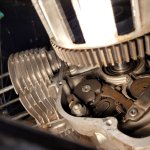
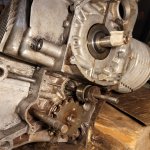
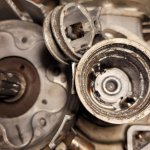
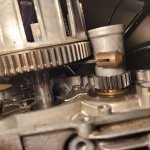
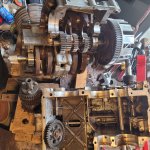
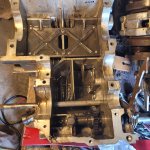
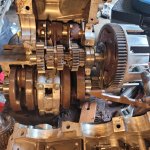
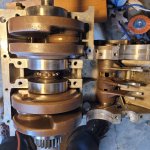
So the lower half did finally come apart. Leaving it sit under pressure didn't seem to change anything, I just wiggled the case a and the gears a little more and blam, I've got gears falling about and lower case detached. Unbolt the inner crank bracket bolts and that gave enough room to wiggle the clutch base free around the filter housing lip. I've got a bit of a mess on my hands, but I'm going to try and not loose any of the small parts. Got the upper half upside down in a bucket for support and squirted penetrating oil along the edges of the pistons. Hopefully gravity will work that down. I ordered the funky 4 dog spanner tool to get the filter housing off. Nothing looks horribly wrong or tore up so on we go. The inner bears are able to spin nicely about 180 degrees. The lower rod connections seem to jiggle a little, I'm thinking they probably shouldn't.
20240430_165910.jpg 20240430_170335.jpg 20240430_170345.jpg 20240430_182109.jpg
 
Last edited by a moderator:
Back
Top Bottom