1971 CB350 . . . 40 year hibernation

Yes, any crankcase wall that has outside exposure gets sealant, inner areas are covered by the crankcase cover for that area. The countershaft seal is sturdy and typically clamped well in the case halves so it isn't a risk (never seen one get blown out) but the clutch rod seal is somewhat notorious.

Not that I will do this, but does it seem like one could drill a pin hole in the case and in the clutch rod seal to secure it that way? Maybe there isn't enough room or material to drill in the case? Or is it a bad idea because there would be no way to remove it without splitting the cases?
 
Not that I will do this, but does it seem like one could drill a pin hole in the case and in the clutch rod seal to secure it that way? Maybe there isn't enough room or material to drill in the case? Or is it a bad idea because there would be no way to remove it without splitting the cases?

While it's an interesting idea, a single pin would still allow movement on the other side of the seal. It would probably work since the seal would have to tip sideways to move outward, but I've never been inclined to drill into an undamaged crankcase without a really good proven reason. You could use one of the neutral switch mounting screws to hold a thin metal plate over the seal with a hole in it for the clutch rod, essentially what I did with my 450. Someone here did it on a 350, maybe Boomer343.
 
While it's an interesting idea, a single pin would still allow movement on the other side of the seal. It would probably work since the seal would have to tip sideways to move outward, but I've never been inclined to drill into an undamaged crankcase without a really good proven reason. You could use one of the neutral switch mounting screws to hold a thin metal plate over the seal with a hole in it for the clutch rod, essentially what I did with my 450. Someone here did it on a 350, maybe Boomer343.

Somehow I thought the plate required a new threaded hole. Using one of the neutral switch screws makes sense since it requires no machining of the case. I guess the plate should be shaped so that it won't or can't rotate?
 
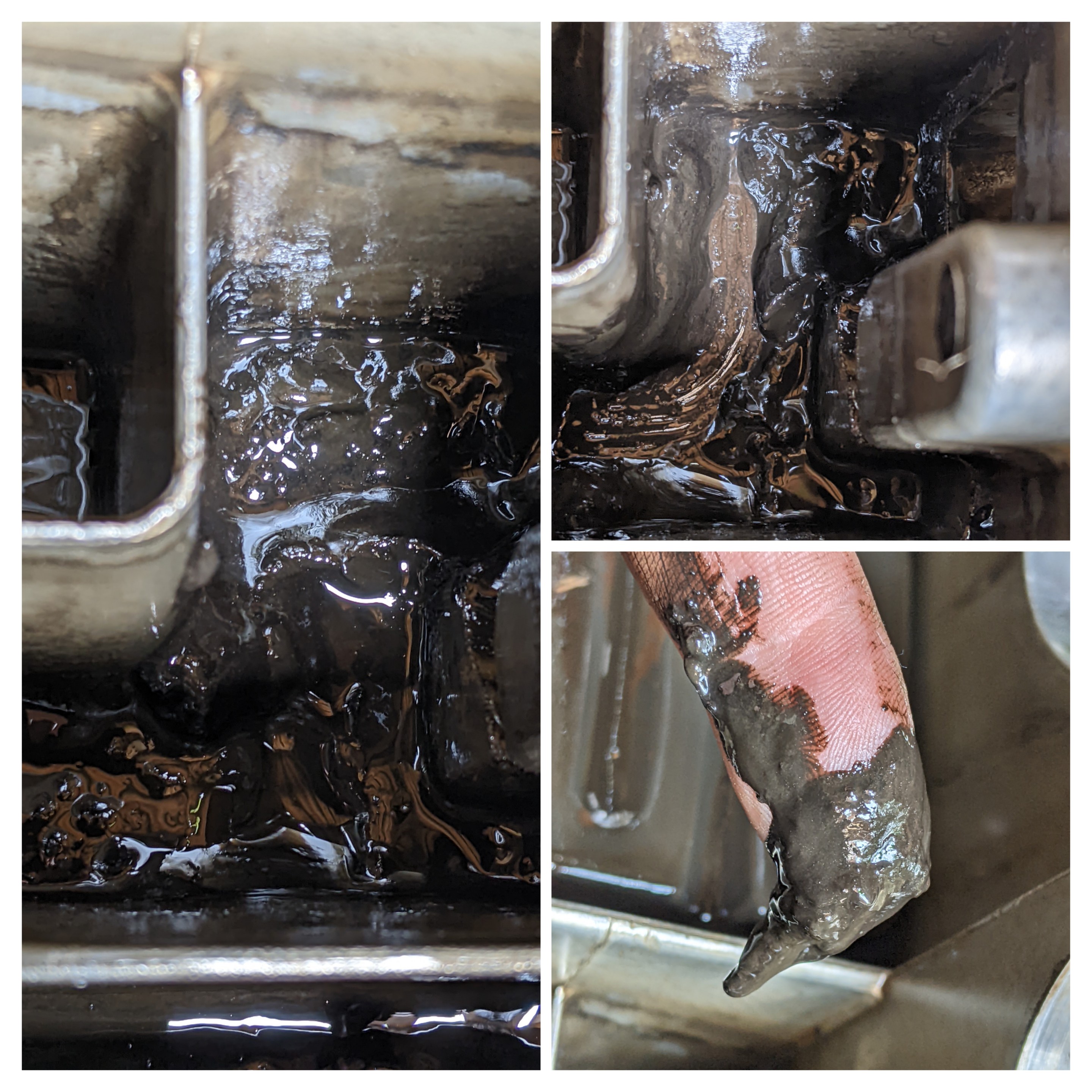
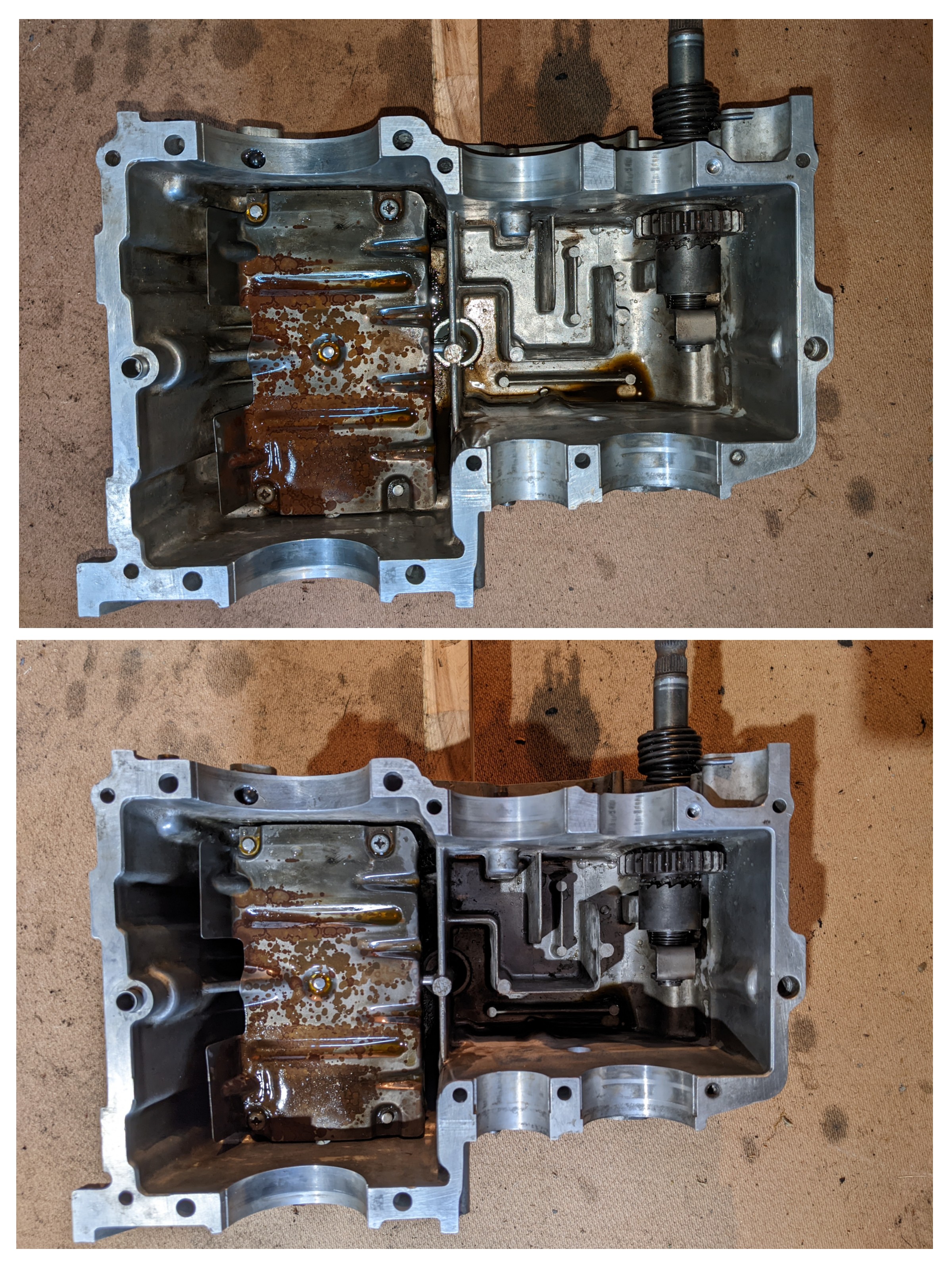
Here is a shot of the sludge that Bob (wentwest) cautioned me about. I got some of it out of the lower case this afternoon, but I think I will ask/pay to use the parts washer at the shop that did my powder coating and will do my cylinder and head work.

Ifwai7Z.jpg


I invested a lot of time cleaning the gasket/sealant surfaces on both the upper and lower cases to get ready for the rebuild.

CluqGzC.jpg


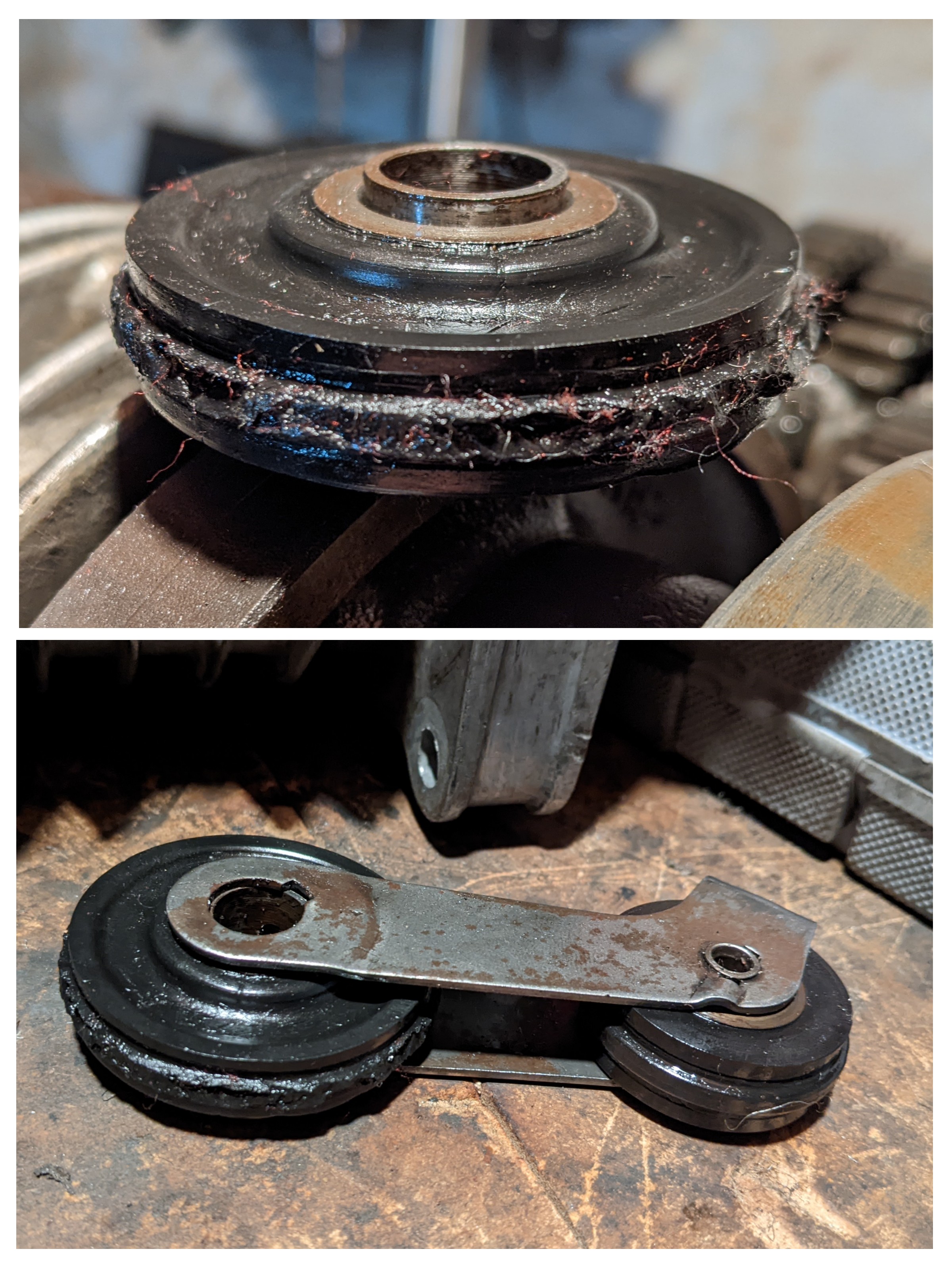
The large cam chain roller looks like it should be replaced. The red fuzz in the photo is from a shop rag. Spectrum Moto has a fancy looking replacement, but I think I will order a replacement for the large roller from 4-into-1. It looks like CMSNL has it in stock right now as well.

QKb6k2n.jpg


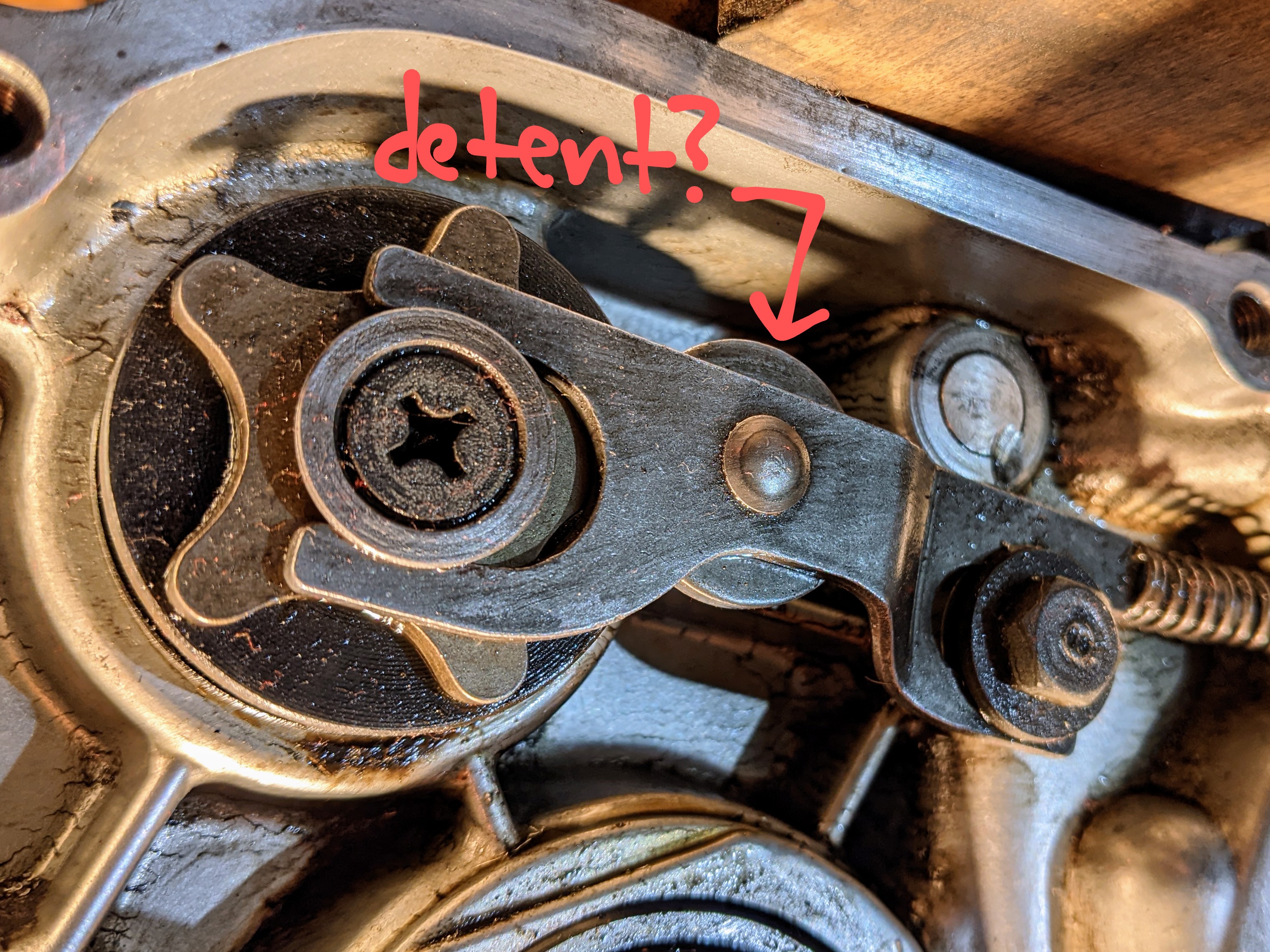
Finally, here is a picture of the shifting gizmos. Is the shift drum stopper the same thing as the "detent" as I attempted to indicate in the picture below? I checked this for play and it seems solid, so hopefully all is well here.

yWbuUyq.jpg


As always, thanks for any and all input.
 
I would manually scoop out as much glop as possible (to save contaminating the solvent) then run it through the parts washer (or dish washer if you like to live dangerously).

Then use carb spray and compressed air on each and every passageway in the cases and the crank drillings, side covers, head, shafts and rockers. It's easy to miss something and there isn't enough oil pressure to assume any blockage will clear itself.
 
I would manually scoop out as much glop as possible (to save contaminating the solvent) then run it through the parts washer (or dish washer if you like to live dangerously).

Then use carb spray and compressed air on each and every passageway in the cases and the crank drillings, side covers, head, shafts and rockers. It's easy to miss something and there isn't enough oil pressure to assume any blockage will clear itself.

Hopefully parts washer, if I am granted access. I got a lot out already, but I did not remove the oil separator so far and I think the heaviest deposits left are under the plate. I wasn't sure if the plate was meant to be removed.

You anticipated one of two questions I was going to ask, so thanks for the suggestion to make sure all oil pathways are clear. Based on the condition of the top end, this is definitely a concern.

Here's the second. I want to make sure the transmission is installed correctly. How can I shift with the cases apart to make sure everything is working? It was in neutral when I removed the shafts to inspect the forks, but after reassembly it seems to be in gear.
 
Thanks for the Spectrum Moto link. I may have to get their dimensions on the sprocket to see if it could work in 305's. Decent price on the long Uni filters, which do work pretty good. And they're in PA!
 
Hopefully parts washer, if I am granted access. I got a lot out already, but I did not remove the oil separator so far and I think the heaviest deposits left are under the plate. I wasn't sure if the plate was meant to be removed.

You anticipated one of two questions I was going to ask, so thanks for the suggestion to make sure all oil pathways are clear. Based on the condition of the top end, this is definitely a concern.

Here's the second. I want to make sure the transmission is installed correctly. How can I shift with the cases apart to make sure everything is working? It was in neutral when I removed the shafts to inspect the forks, but after reassembly it seems to be in gear.


An old metal tub with gas and a days soak is my parts washer.

Here is a vid that AD posted, maybe it'll help. I just turn the star detent on the shift drum to move through gears.

https://www.vintagehondatwins.com/f...cond-or-higher&p=100553&viewfull=1#post100553
 
I think the oil separator (windage trays) can come out and I would for sure. Some have rivets that get drilled, tapped and screwed/bolted back in. I'm a 350 rebuild virgin so someone else should weigh in on this.
 
An old metal tub with gas and a days soak is my parts washer.

Here is a vid that AD posted, maybe it'll help. I just turn the star detent on the shift drum to move through gears.

I think the oil separator (windage trays) can come out and I would for sure. Some have rivets that get drilled, tapped and screwed/bolted back in.

I'll try soaking the remaining sludge in gasoline today. What do people do with the contaminated gas? Let it evaporate? I read a post from Boomer343 in a galaxy far, far away suggesting that the oil separator need not be removed.

Thanks for the link to the video about the CB750 transmission. In the video he's able to use the normal gear shifter, which makes it easier to turn the shift drum. I'll have another go at this and see if I can turn it. If not, maybe I didn't install it correctly!
 
I'll try soaking the remaining sludge in gasoline today. What do people do with the contaminated gas? Let it evaporate? I read a post from Boomer343 in a galaxy far, far away suggesting that the oil separator need not be removed.

Thanks for the link to the video about the CB750 transmission. In the video he's able to use the normal gear shifter, which makes it easier to turn the shift drum. I'll have another go at this and see if I can turn it. If not, maybe I didn't install it correctly!


I try to use as little gas as possible, soak only half, rotate, soak the other (don't need to soak very long). Use gloves and an old toothbrush to work quick. Let it settle, pour off in covered container for the next batch of parts, wipe out the sludge and pitch or burn the rag/paper towels. Between splashing, sloshing, evaporation, etc. a gallon becomes a pint before long (recycle, recycle). It does kill weeds on my gravel drive really well.
After the gas gets the worst, use a double dose of Dawn detergent and hot water to get really clean.

What is required is common sense and consideration for Life and the Land. Governmental agency edicts provide neither. IMO.

Don't forget the trans only can shift if the sprocket is being turned as well, there are no syncros in these transmissions.
 
I tend to call all shift stopper, etc parts 'detent' parts simply because of the implied function of the name. Some of Honda's terminology makes more sense than others and I suspect translation is sometimes behind the thinking (like in Spanish it's said "sky blue" instead of blue sky). You may recall the video I posted in my maintenance thread when I replaced the large detent roller and shift drum star, I turned the drum with my JIS t-handle for test shifting. Of course, it also helps when the engine is held still for you to exert the appropriate amount of pressure on the screw head to be able to generate rotation without the screwdriver slipping. If you didn't remove the shift forks or detent mechanism, there's no reason it shouldn't shift just like it would have previously unless you don't have the shafts properly seated or if a gear or two slipped off a shaft and were put on backwards or a thrust washer is missing and I'm sure you were careful with that.

I personally don't care for drilling out the riveted aluminum posts holding the windage tray in place, but if the sludge level is bad enough that it won't loosen and come clean underneath then you may have to. Much like factory-installed cylinder studs and leaving them undisturbed when it is not necessary to remove them for any legitimate reason, I like to leave the windage tray alone too if possible. Another thing to remember is with a huge amount of sludge being loosened and moved around in a small amount of solvent, grit and other crud can accidentally sift its way into places it wasn't previously if you're not careful which is why a large basin parts washer helps so much. Scooping out as much as possible as Tom suggested will help minimize that possibility, and just be careful to keep the goo away from the oil galleries in the upper case to lessen the amount of final passage spraying-out you'll end up doing (in lieu of a full soak and rinse in a larger wash basin). And of course, blow out all passages with air. I learned at my last Honda shop job that a clear water rinse will take away 90% or more of any solvent remaining and when blown dry, will leave a nice oil-free surface quickly without waiting for any evaporation but of course it works better on aluminum parts than bare steel like gears and shafts where flash rust could happen.
 
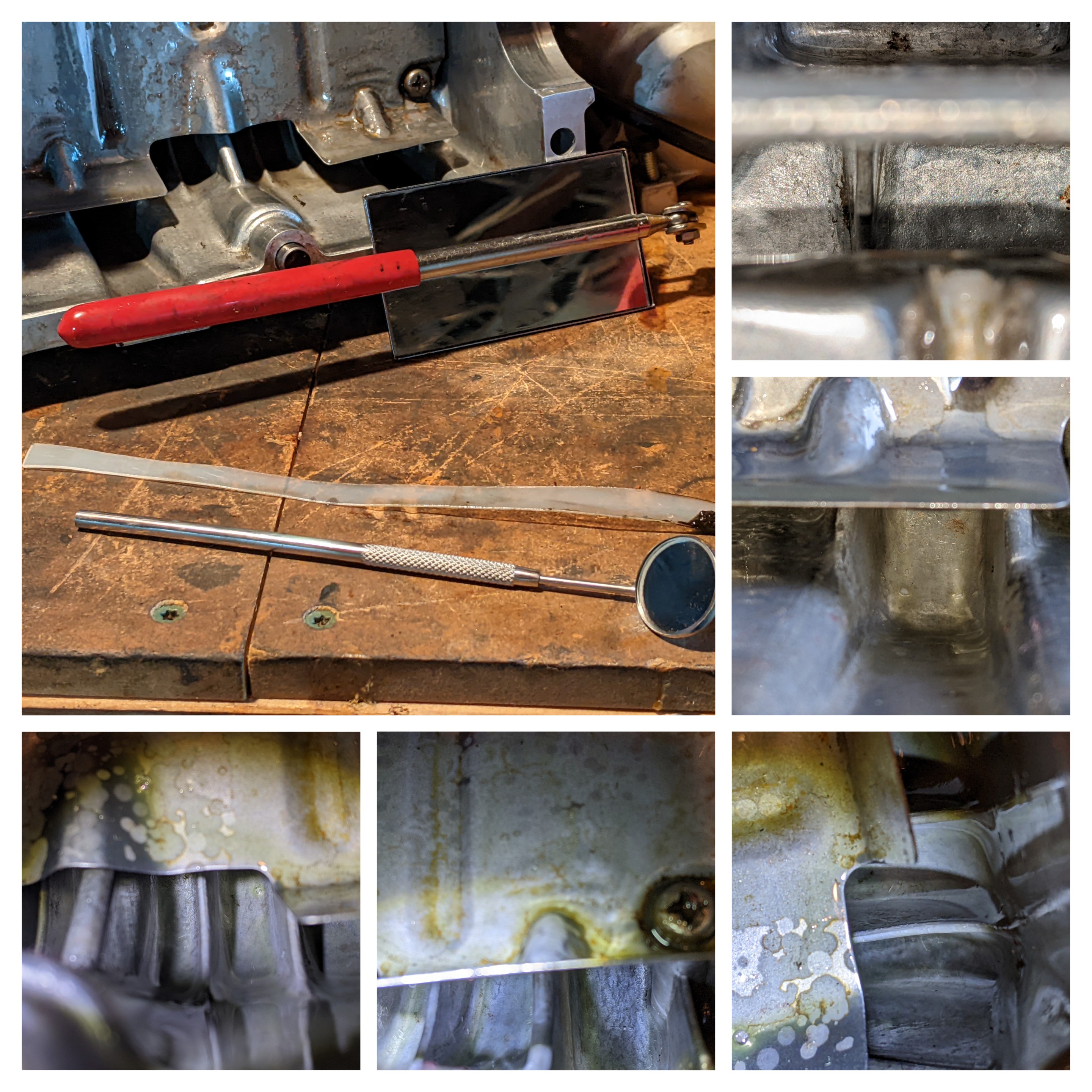
Harbour freight used to sell little cheap dental mirrors or one of those boroscopes (endoscope?) for the phone to see up and into the windage area to see what is still there, would be handy before removing riveted trays.
 
I'll try soaking the remaining sludge in gasoline today. What do people do with the contaminated gas? Let it evaporate? I read a post from Boomer343 in a galaxy far, far away suggesting that the oil separator need not be removed.

If you have an automotive speed shop in your area, you could take your crankcase halves to them and have them hot-tanked. That's what I did with my sludged-up 450 crankcases and I did not have to remove the windage tray as a result, and mine was pretty nasty too.

20170115_170245.jpg

Thanks for the link to the video about the CB750 transmission. In the video he's able to use the normal gear shifter, which makes it easier to turn the shift drum. I'll have another go at this and see if I can turn it. If not, maybe I didn't install it correctly!

He uses the shift lever in that video in part because of the design of the 750 shift drum and detent mechanism, larger heavier gears being moved as well. The 750 makes a significant 'clunk' when put in gear compared to the smaller transmissions.
 
ballbearian said:
I try to use as little gas as possible, soak only half, rotate, soak the other (don't need to soak very long). Use gloves and an old toothbrush to work quick. Let it settle, pour off in covered container for the next batch of parts, wipe out the sludge and pitch or burn the rag/paper towels.

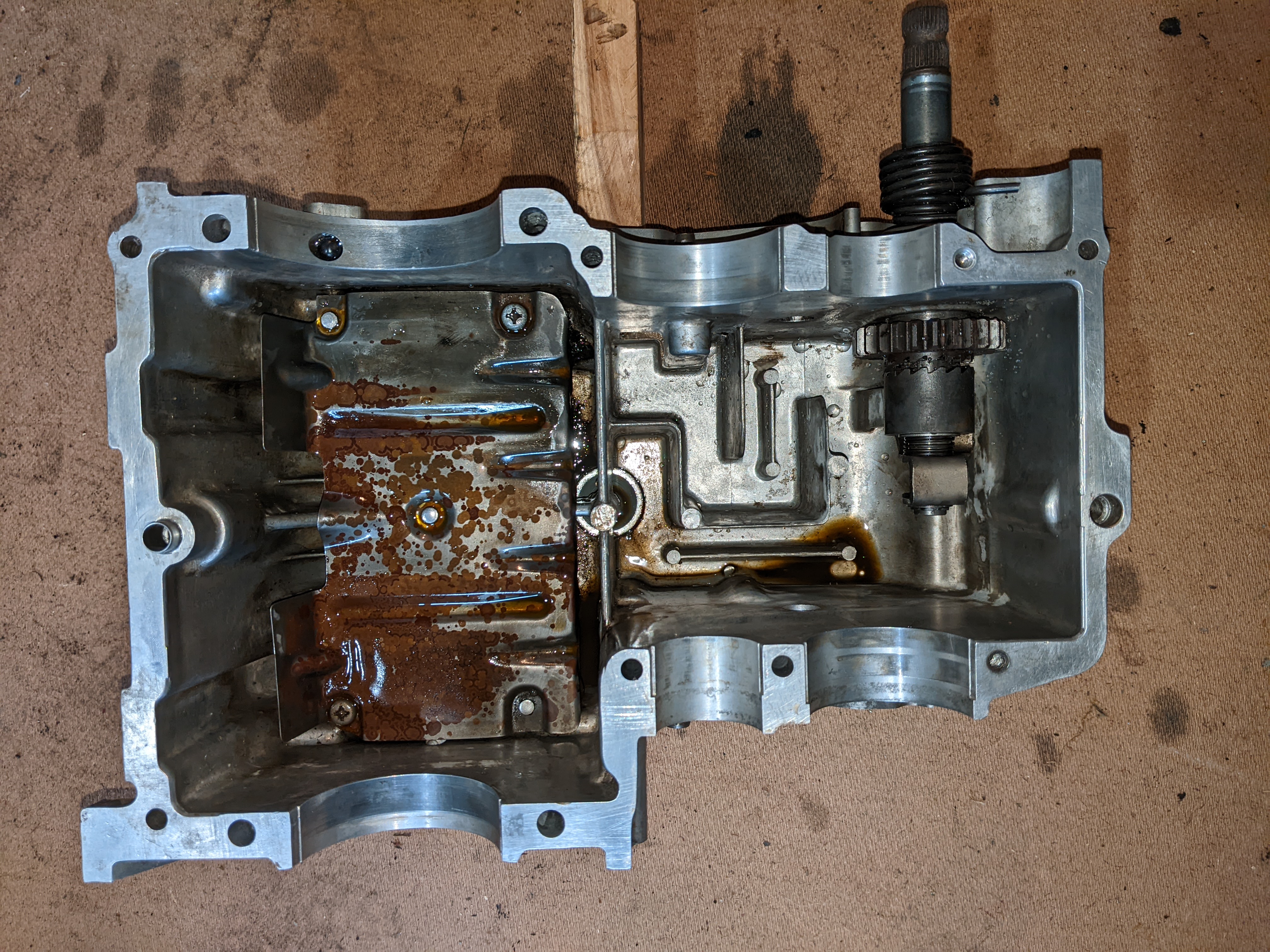
Thanks. It helped a lot to use some old gas and I think it's fairly clean now. You can see a little PB blaster in the bottom case that I sprayed in after rinsing with the hose. I saw one or two little spots under the separator that should be attended to, so I sprayed a little more blaster in and will rinse that out later. Top picture with flash, bottom without.

488Bc4Y.jpg


I may take a peek with the endoscope later, too, that's a good idea.

ancientdad said:
You may recall the video I posted in my maintenance thread when I replaced the large detent roller and shift drum star, I turned the drum with my JIS t-handle for test shifting.

Perfect. I haven't watched the video recently and wasn't tuned in on that detail at the time. Very relevant now, so I should rewatch. I hadn't wanted to disturb the screw, but it's staked, so I shouldn't have worried about that. Much easier than what I was doing.

I thought I was having trouble finding neutral until it dawned on me that both shafts were moving because there was enough oil adhesion on the free gears to transfer motion from the main shaft to the countershaft. When I held the free gears it was obvious that it was in neutral. So, everything seems to be in good shape.
 
Has the tray been out before? The crosshead screws would seem to indicate so? If so, I think I would drill/tap the other two for peace of mind.
 
This post is really just a test of a Google Chrome extension that is supposed to allow Google Photos to be shared via BBcode, but it's a picture of the assembled rear wheel. I was surprised by the number of balance weights used to true the wheel.

Edit: The Google Photos BB code kept disappearing so the picture now uses an imgur link.

xC6uj1H.jpg
 
Last edited:
If the factory used screws then what would be possible in the universe of intended or expected consequences? My meager logic says that the engineers knew that the factory trained service mechanics needed a little help to perform a complete and competent job.

If you can get it clean, great, if not take it out. The screws are just a tease.
 
I'm curious about the extension for Chrome, mine doesn't have it. I'm guessing that's because you're using Windows 10 or 11, or a Mac
 
I'm curious about the extension for Chrome, mine doesn't have it. I'm guessing that's because you're using Windows 10 or 11, or a Mac

Mac. The extension has the clever name "Create Embeddable Links for Google Photos" and I only found it by doing a Google search, but it seems to work. The link is a lot longer than what imgur creates, but it will eliminate a step for me if I continue to use it.
 
This post is really just a test of a Google Chrome extension that is supposed to allow Google Photos to be shared via BBcode, but it's a picture of the assembled rear wheel. I was surprised by the number of balance weights used to true the wheel.

Cool. Nice looking wheel. I could even zoom in to see if those weren't Chicklets gum, left as a garnish.
 
Mac. The extension has the clever name "Create Embeddable Links for Google Photos" and I only found it by doing a Google search, but it seems to work. The link is a lot longer than what imgur creates, but it will eliminate a step for me if I continue to use it.

I suspected you used a Mac. However, I did find I could add the extension so I did. I'll be happy to be able to easily share some of the pictures I have in Google photos because there are some I haven't taken the time to upload to Imgur. Thanks for the mention of it, I'm so disconnected from new tech and the connection to my own computer use now that I'm not working on them anymore that I wouldn't have known about it for a lot longer had you not said anything.
 
I suspected you used a Mac. However, I did find I could add the extension so I did. I'll be happy to be able to easily share some of the pictures I have in Google photos because there are some I haven't taken the time to upload to Imgur. Thanks for the mention of it, I'm so disconnected from new tech and the connection to my own computer use now that I'm not working on them anymore that I wouldn't have known about it for a lot longer had you not said anything.

I thought you might find it interesting. I don't keep up with all of the available extensions, but occasionally run into one that will do something good for me like this.
 
I used Three Bond to seal the cases on my CB450 in 2019. It worked fine and I have 80% of the tube remaining. Unfortunately, that 80% is unusable. What is the recommended variant of Hondabond to seal the upper and lower cases? Is this the right stuff?
 
Stl360, cleaning under oil wind tray.

I think it is definitely worth the effort to remove the oil wind tray and properly clean the accumulated sludge from underneath.
I tried several methods to clean mine out before I decided to remove the tray. Glad I did as it was “ cruddy” under there.
I wrote a thread on what did here at VHT but I can’t find it. Trying to blast it out from the sides may just loosen some of it to later get mixed in with circulating oil. There is only one stand off that is limited for access when taping but easily enough done 1/4 turn at a time when taping. Also you will be able to deal with the rust shown on the top of your tray. Pound to a pinch it is also rusty underneath. I recall I used 6mm domed machine screws, Allen heads. You need to make sure enough clearance under one of the flywheels.cheers

488Bc4Y.jpg


I may take a peek with the endoscope later, too, that's a good idea.


Perfect. I haven't watched the video recently and wasn't tuned in on that detail at the time. Very relevant now, so I should rewatch. I hadn't wanted to disturb the screw, but it's staked, so I shouldn't have worried about that. Much easier than what I was doing.

I thought I was having trouble finding neutral until it dawned on me that both shafts were moving because there was enough oil adhesion on the free gears to transfer motion from the main shaft to the countershaft. When I held the free gears it was obvious that it was in neutral. So, everything seems to be in good shape.[/QUOTE]
 
AD, I think I stuffed up the placement of my reply.
I tried to do it with a quote from the thread I am answering.
can you check and correct for me please.
gary
 
Thanks for the recommendation, Gary. I'll have a look at your thread, which will give me another chance to admire the beautiful paint on your bike.
 
I used Three Bond to seal the cases on my CB450 in 2019. It worked fine and I have 80% of the tube remaining. Unfortunately, that 80% is unusable. What is the recommended variant of Hondabond to seal the upper and lower cases? Is this the right stuff?

Yes, that is what you need.
 
Stl360,
ha, when I was a new numpty on VHT I didn’t have a coherent thread and ran several seperate ones.
I have tried Google search and even just looking through posts to no avail.
from Memory this is what I did:
1. Centre drilled each rivet head and drilled the top off each one. 8 mm drill I think. Unscrewed the two JIS screws with the right screw driver.
2. Using small cold chisel I dressed the tops of each stand-off flat, carefully.
3. Centre drilled each and drilled using what ever tap drill for the chosen machine screw. There is plenty of depth in the standoffs but 5 to 8 mm should be sufficient.
4. tapped each but there is one corner one the T bar wouldn’t fit so I used a 4 inch small adjustable spanner, 1/4 turn at a time. Being aluminium it doesn’t take long.
5 then cleaned out the hardened sludge by scrapping with a flat blade screw driver to get most off.
the vapour blaster did the rest.
6. rust treated the tray but didn’t apply any paint of other preservative as may come off due to temperature of oil detergent activities and you don’t want the debris travelling around with the oil!
7 refitted the tray but used engineers “ feel” to tighten the machine screws, a bit of thread locker would be good.
before fitting the tray have a careful look over it, both sides for any tell tail cracking. They do crack and break off at the corner standoffs probably due to vibration over time.
there is a mention and photographs of this in the Haynes 250/350 workshop manual.
the bike they pulled apart , a CB250 ( in the UK ) had only low miles but had high oil consumption. The broken try was causing far too much oil to splash around.
cheers
 
Thanks, Gary! You are too kind. I appreciate you collecting your steps here. I was able to find your thread by going to your profile and viewing the latest started threads. I saw that Mike Pacific even replaced his baffle/separator with an aftermarket plate. I wasn't aware that anyone was making those. Cheers.
 
Yes it shouldn’t be too hard to make up a new plate.
you could use Aluminium but vibration affect could be of concern.
2mm plate with some relief drilling on each corner might do it.
I recall seeing a picture somewhere of a billet made plate…Cheers
 
I will vote for removing the windage tray. After having the case hot tanked at the machine shop, to try cleaning up the exterior, I removed mine and found hard baked deposits of debris that took a hammer and screwdriver tip to break free. That's when I decided to vapor blast everything. Of course that means you have to strip the engine down completely. When it's all stripped down is when you find out the little things that are not quite right like I found the big bearing on the main shaft was starting to fail, little bit notchy feel when turn with pressure applied, and the small bearing end of the counter shaft was pitted from corrosion. Both shafts replace w/new.
I like those diamond hole saws, now if we knew which size to get rather the the 15 assorted ones of which 14 will never get used.
HondaBond HT is designed for metal to metal surface sealing, it'll work w/gaskets also.
 
If you take out one of the two screws and measure the holes in the tray, it may give an indication of how fat the peened posts are. Maybe go up 1/8" or 3mm in size from the hole and go from there.
Can always go back to drill and tap the posts for screws/bolts. 305's have all 6mm bolts.

Probably can't buy a single hole saw bit for the price of the cheap set.
 
The community is of two minds on the topic of windage tray (a.k.a. oil separator, baffle plate, splash guard) removal/replacement in the process of cleaning the lower case. I interpret this is an indication that both approaches can be carried out successfully, while the particular advantages and disadvantages of each method lend individuals to different personal preferences.

In my case, the tray is in good condition and I think I can clean underneath it successfully, so at this moment I am leaning towards leaving it alone. I will describe in another post what I've done to clean underneath the tray as well as remove surface rust from the tray itself. I will remain open to further discussion.

Just for the fun of it, I did a little research on the forums and collected opinions from this and other [old] threads. This summary is intended for fun and is not meant to put words in anyone's mouth, so let me know if my research is in error and I will make a correction.


Camp 1 — Do Not Remove Windage Tray for Cleaning:

  • ancientdad
  • Bill H* (old timer on VHT)
  • Boomer343*
  • 66Sprint*
  • tbpmusic*
  • 76Twin*


Camp 2 — Remove & Replace Windage Tray for Cleaning:

  • ballbearian
  • GaryJames
  • longdistancerider
  • Richard_Pitman* (Richard Pitman on VHT)


*Indicates a vote in absentia — taken from another thread here or, more likely, outside VHT.


Notes:

  • 66Sprint (Steve) once wrote "You CAN drill them off and then drill and tap, but better to leave the windage tray in place and Power wash underneath it ......." I'm counting Steve as a "Do Not Remove" unless he weighs in to the contrary. In another post, Steve mentioned a pattern he created for fabricating a new tray, which was then hand-peened for stiffness.
  • Richard Pitman once described being able to pull out the retaining pins with pliers in another old post. If possible on the CB/CL/SL350, that sounds much nicer than drilling them out.
  • Mikepacific60 found and installed an aftermarket tray on his SL350 project. That looks pretty slick, too, and would be a great option when the original tray is damaged.
 
Here is what I have done to clean the lower cases so far:
  • Sloshed gas around to remove the majority of sludge.
  • Sprayed brake cleaner on trouble spots to remove small bits remaining in exposed areas.
  • Washed with dish detergent and a high pressure garden hose nozzle.
  • Sprayed brake cleaner (almost two cans) into the slotted grooves beneath the windage tray.
  • Fashioned a plastic slot scraper to assist with removal of tough spots underneath the tray.
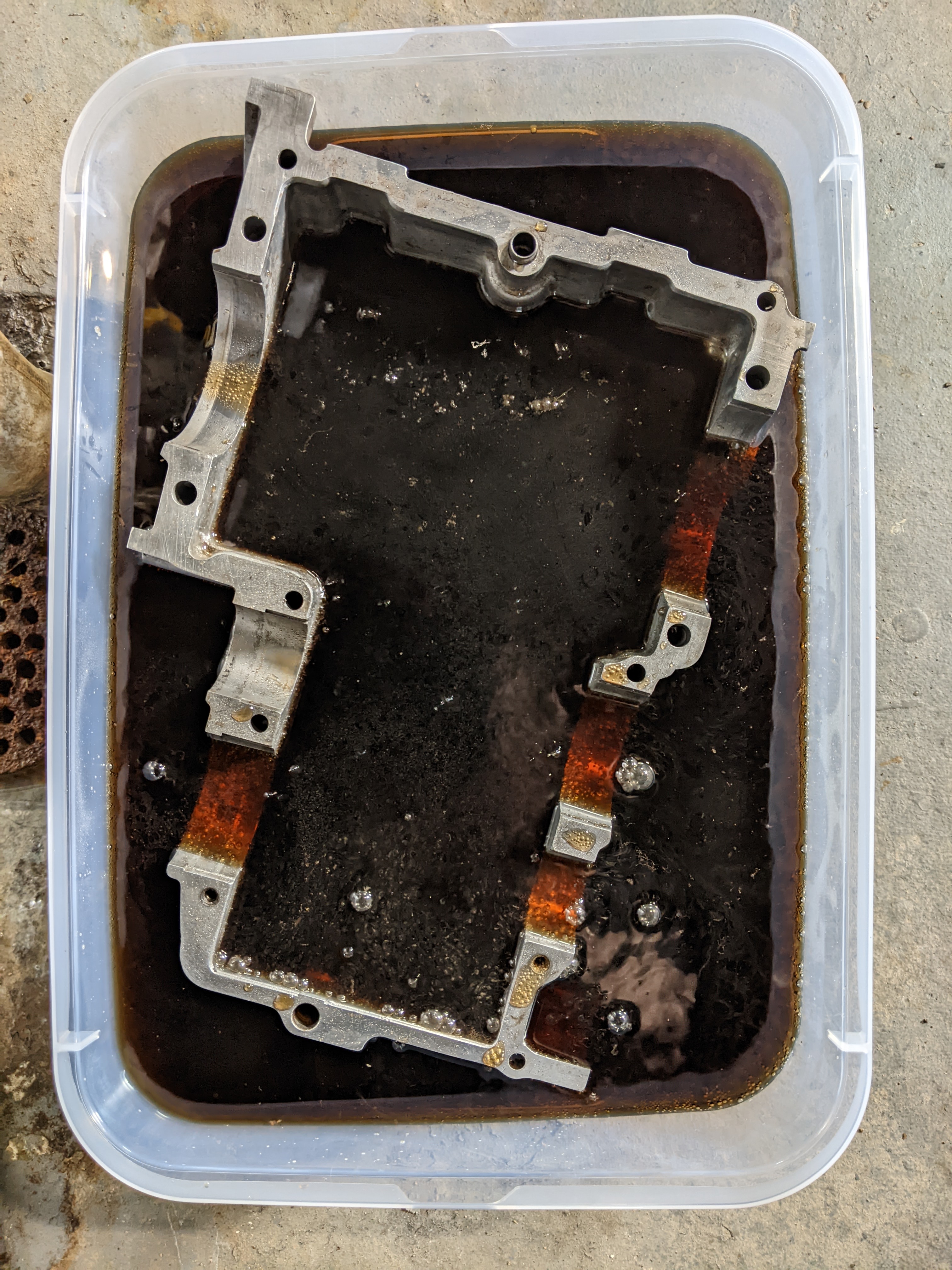
  • Soaked overnight in 10 liters of Coca Cola to remove surface rust on tray.
  • Bathed in dish detergent and cleaned with garden hose again.
  • Sprayed ferrous components with foaming chain lube to prevent flash rusting.
  • Used more brake cleaner, chain lube, flexible plastic scraper scraping until grime was not prevalent in the solvent.

Here is the case about half-way through the process. Sludge already removed. Rust still present.

7hroPm9.jpg


Here is the case soaking in Coca Cola.

s2RXEsY.jpg


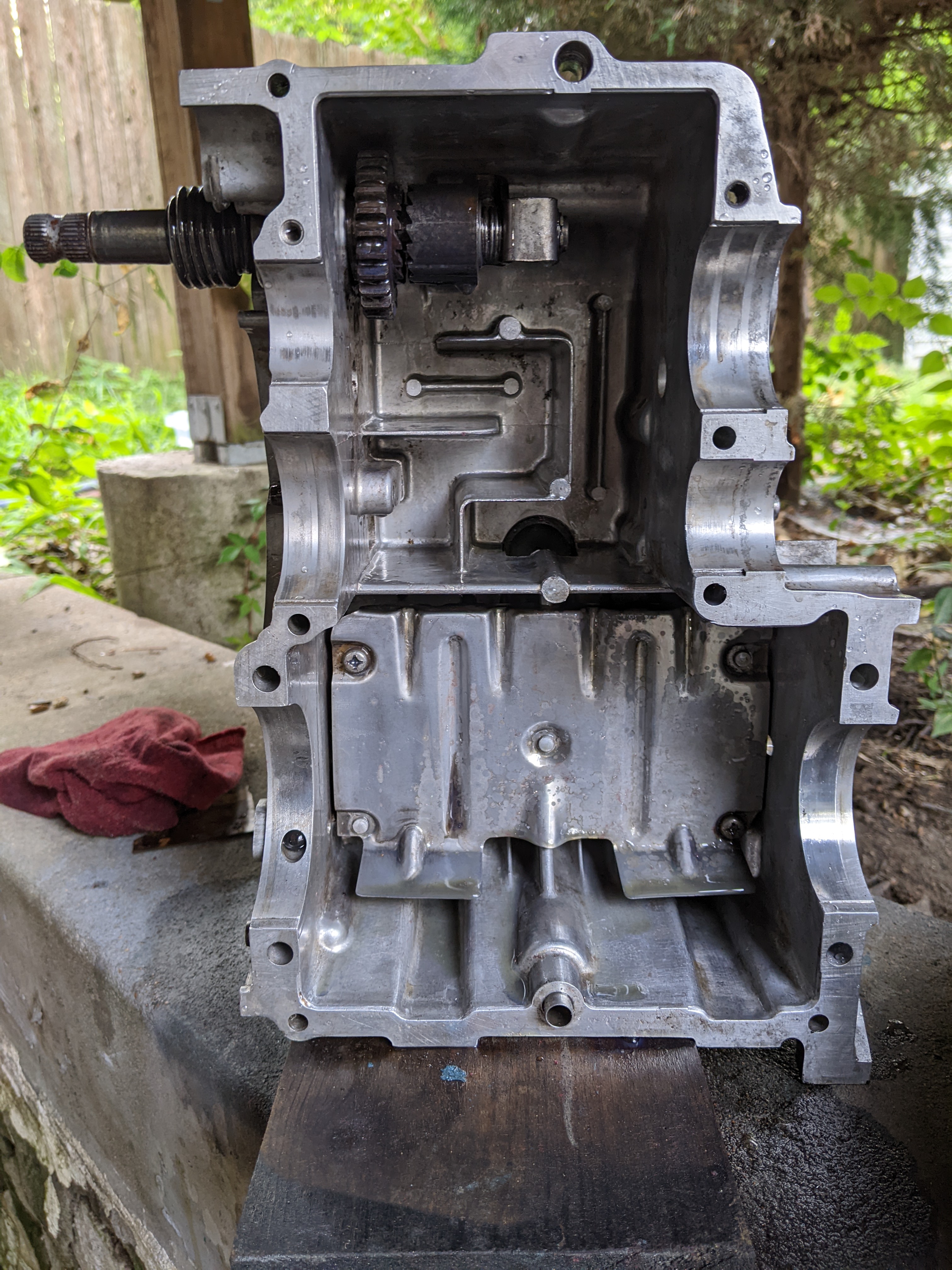
Here is the case after the Coke-Soak and spot cleaning with foaming chain lube and brake cleaner.

96jdd0S.jpg


Finally, here are a few peeks at the area under the tray. The yellowish color is the foaming chain lube.

oqwc3iK.jpg


Opinions vary and you get to make up your own. Looks like you've spent the time to get it as clean as possible so I don't know that removal would give any better results. Nice job.
I would tap around each of the peened standoffs and listen for any sound of loose. Start around the screws to get a good idea of what it should sound like. Re-peen any that have an odd sound, looseness is where the plate will start cracking from vibration.
 
Opinions vary and you get to make up your own. Looks like you've spent the time to get it as clean as possible so I don't know that removal would give any better results. Nice job.

I would tap around each of the peened standoffs and listen for any sound of loose. Start around the screws to get a good idea of what it should sound like. Re-peen any that have an odd sound, looseness is where the plate will start cracking from vibration.

Thanks, Jim. I think there's merit to both approaches. If my tray was damaged, I wouldn't hesitate to remove, repair, or replace it.

I'll take a closer look and listen to the tray. I'm pretty sure I could hear it ringing while I was convincing the cases to come apart. I think that's a good indicator it's held firmly and is intact (resonance of the tray).
 
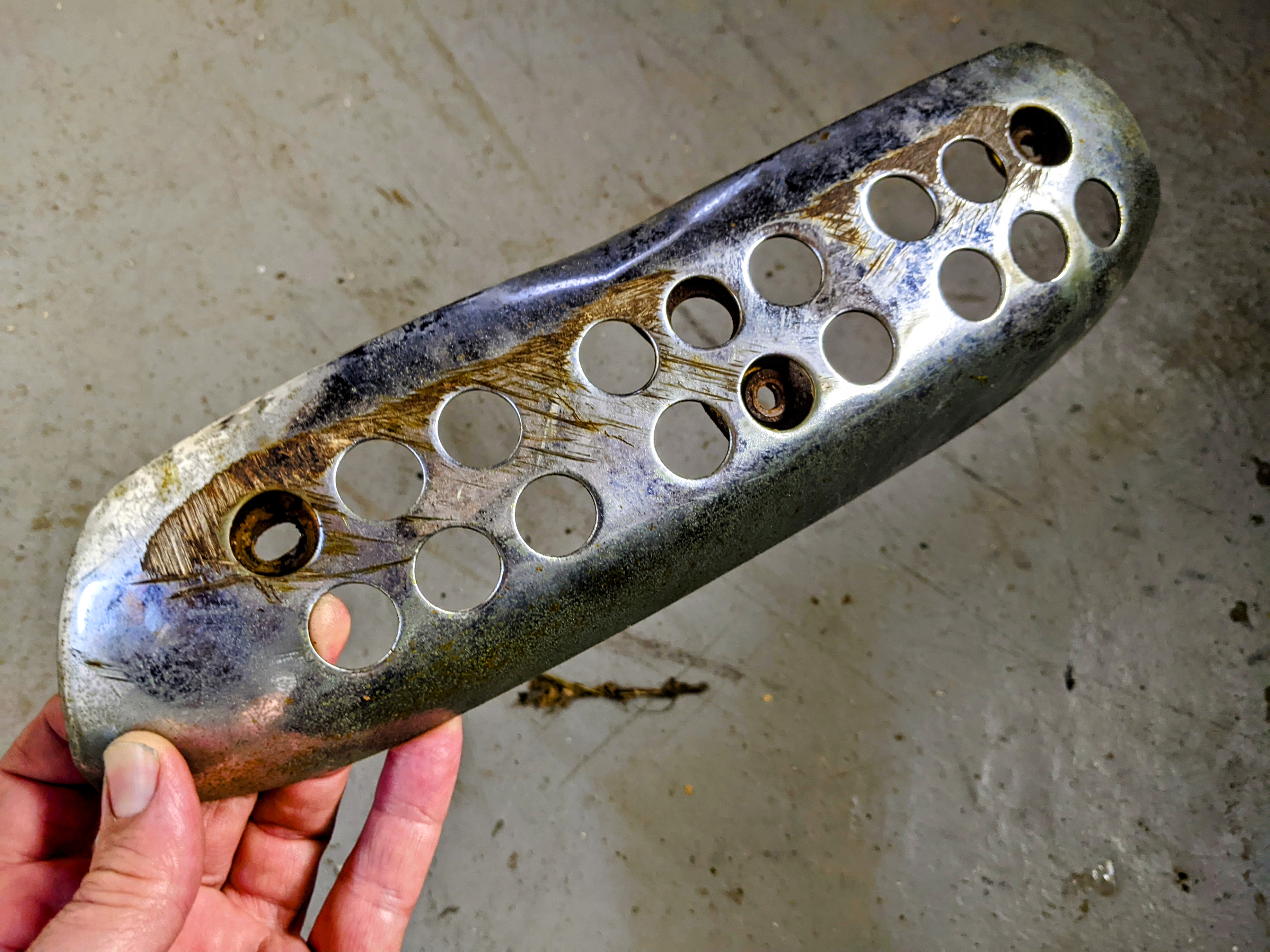
I'm planning to have my exhaust pieces ceramic coated (black) by the shop where my powder coating was done. The heat shields have some big scrapes and I was thinking to use an orbital sander to smooth them out a bit before taking the parts in. Does this seem like an okay approach? Other ideas?

NAJ5ocA.jpg
 
They're definitely going to need something done to clean them up, that's an obvious road rash situation there and it's ugly. Did you check with the powdercoat shop to see if they could improve the finish of them, or for the method they might use if so?
 
I do some metal fabrication and I think it will take a long time to remove those marks with an orbital sander. If you have access to a belt sander you may have a better go of it.
 
They're definitely going to need something done to clean them up, that's an obvious road rash situation there and it's ugly. Did you check with the powdercoat shop to see if they could improve the finish of them, or for the method they might use if so?

Thanks, Tom. I showed it to the shop owner and he said go ahead and sand them out. Also, I received an email notification of your reply in Gmail for this post. First one since the blackout!

I do some metal fabrication and I think it will take a long time to remove those marks with an orbital sander. If you have access to a belt sander you may have a better go of it.

Thanks, David, I appreciate you checking in on my current project! I have a flap disc for my angle grinder that will enter the field of play if needed. I'm always afraid of taking too much off with that, hopefully it will work out cleanly.
 
Thanks, David, I appreciate you checking in on my current project! I have a flap disc for my angle grinder that will enter the field of play if needed. I'm always afraid of taking too much off with that, hopefully it will work out cleanly.

I know you are powdercoating but while researching chrome restoration I found this video:
https://youtu.be/RU9l66_XmDk?t=245

They go after these vintage (likely irreplaceable) bumpers with a serious belt sander.
 
I know you are powdercoating but while researching chrome restoration I found this video:
https://youtu.be/RU9l66_XmDk?t=245

They go after these vintage (likely irreplaceable) bumpers with a serious belt sander.

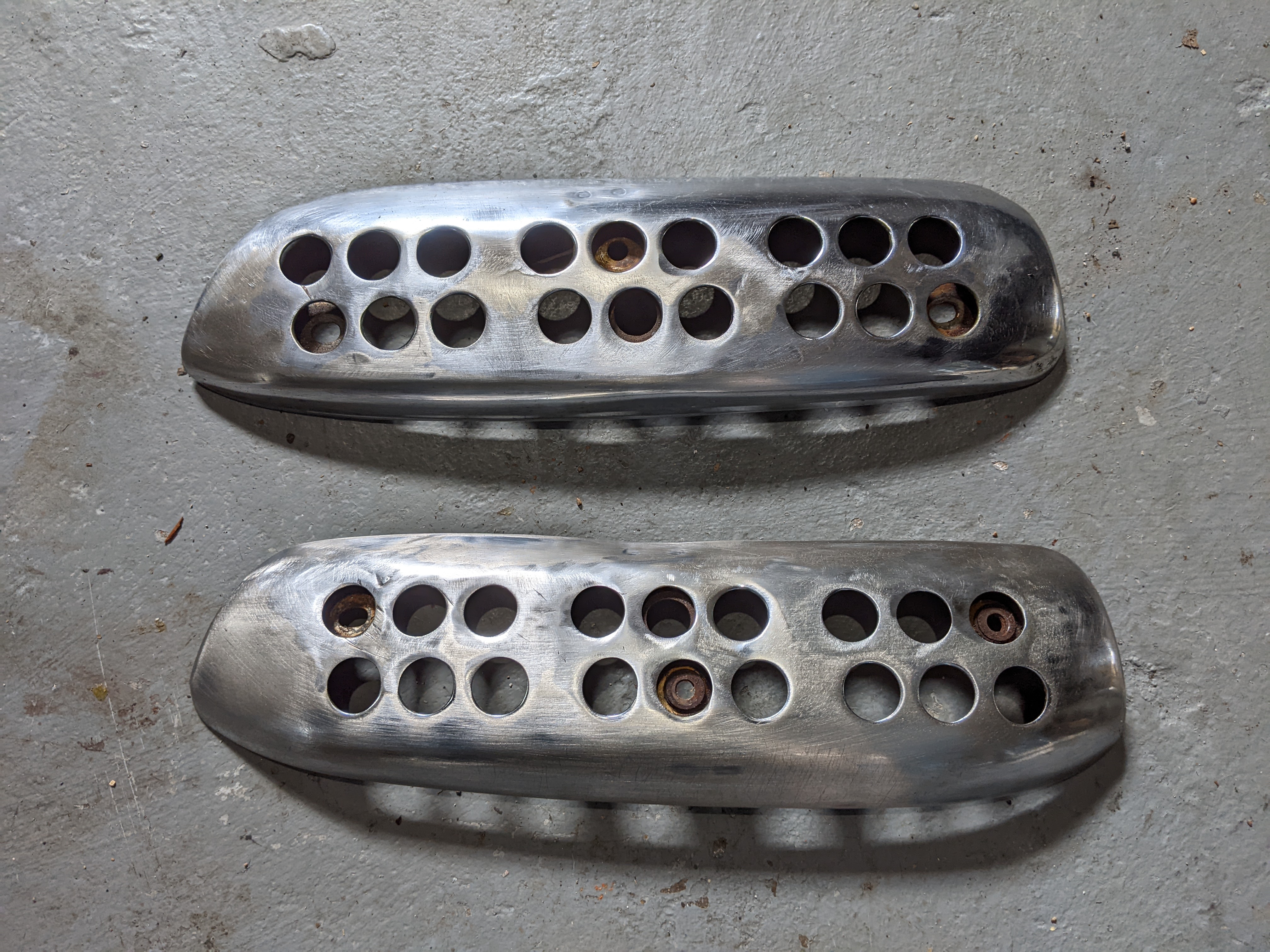
Neat video. Their technique definitely works better than what I was just doing. Unfortunately, I don't have a belt sander, only hand-held power tools, but I'd gladly let those guys have a go at it! Here are my shields after a first round of sanding and grinding. The roughest spots are better, but there are still some grooves and scratches that I haven't cleaned up. Each shield has one spot where the metal was dented inward and, unless I try to bend it back out, I'm afraid I would burn through somewhere before cleaning up the gouges. Imperfect is okay, but I didn't want it to look like I was frequently riding the motorcycle on its side. I hope that a flat black will minimize the visibility of these imperfections.

wjqvj6S.jpg
 
Those look good. If you go up in grit you'll gradually get smaller and smaller scratches.

Thanks. You're absolutely right. The flap disc did most of the scratch and gouge removal and then I used a 150 grit disc on the orbital to try to smooth the surrounding area out. That creates lots of random fine scratches that I then tried to remove with sand paper and steel wool by hand. I used 80 grit, 150 grit, and 400 grit sometimes with a little water and also some steel wool. I'll have another go after a break and see if I can make some more progress on the many small scratches I introduced.
 
Back
Top Bottom