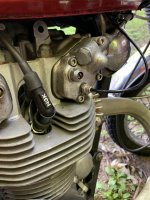
Introducing A Better Oil Pump, New For 450 & 500T

Jays100

Veteran Member
Joined
May 29, 2020
Total Posts
1,493
Total likes
1,022
Location
Enfield, CT USA
This is a multi-part series on a new design oil pump for the 450 & 500T's. Stay tuned, its a fun read, gives some insight into my quirky self and ultimately reveals a new, improved and superior Oil Pump that will bolt-in to your DOHC twin!

Part 1, Discovery

When I first encountered the small Honda twins, I was a young man and the local Honda shop had a SL175 on the showroom. I think this was 1970-ish? Later, a science teacher had a CL450 that I really, really liked. Then, nothing, (well, a lot of history in this gap but no ownership) until relatively recently when a 71 CB450 turned up on Craigslist with a parts bike in the photo background - I jumped on it hard. The background bike was a 95% complete ’68 CL450 in pretty rough shape, lots of rust, engine stuck but the front fender, pipes, tank, side covers and instruments were all there. It had 29K miles on the clock.

A complete rebuild ensued, the usual suspects were replaced, repaired, repainted. In my research, an upgrade was to replace the 16mm piston with a cast iron housing oil pump with one from a 71 and later model with a 19mm piston and aluminum housing. I was surprised that the cam followers on the exhaust side were worn out, as was the cam, all replaced. I now wish I had saved all those bits, instead, they were thrown away.

Without knowing it, the germ of an idea was planted at that time – those parts shouldn’t be worn out, there’s gotta be a better way!

Worn parts from a DOHC 450:
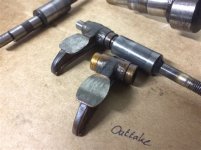
Worn Rockers.jpg

I didn’t have a photo of my exact worn parts but did find this from another never-to-be-mentioned site. Photo attribution is marked and I have purloined it accordingly. Anyway, it’s a common problem, you may have personal experience!

All worn part arrows point to a root cause failure due to high wear. This is either too high contact pressures or more likely, lack of oil lubrication in those critical areas. Specifically, the exhaust cam bearings, followers, lobes, literally every moving part in the top front of the engine.
 
Last edited:
Part 2, Me

The way my brain works is in pictures. My wife has a word brain, mine is a picture brain. Using picture brain to find words to describe pictures is always a challenge for me. Some of you know I’m a mechanical engineer, I work in the aerospace field for a fortune 50 company - manage tech development for jet engine controls – along with 2000ish of my closest friends who are all of my ilk. I daily work in Jet A, JP4, Lube Oil, Scavenge systems, controls, root cause analysis, among other things.

To make things interesting, early in my career I was a test rider for Honda R&D in Torrance CA in the early 1980’s. Raced too, home tracks were Saddleback Park for dirt and Willow Springs for pavement. And if it was Wednesday night, it was watching the flattrack boys and girls at Ascot. I like motorcycles.

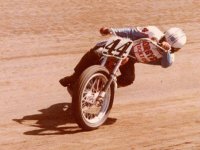
Alex “Jorgy” Jorgensen on a Woods Norton, I “think” this was Ascot?
Jorgy.jpg

There was a brief stint in Newport Beach where I worked at Ricky Racer (the late Lance Weil, an American who was a British road race champion in the 60’s) located next to Ron Woods shop, loved the Woods Norton’s!!!!!!! The craftsmanship that was Ron Wood creations was/is amazing, the gold standard of coolness.

In the learning and thinking cube of Concrete v Abstract and Sequential v Random….I am so far on the Random/Abstract side of how I process (16 patents earned) that there is almost no relating in my brain to the Concrete/Sequential thought process. One of my old supervisors told me “I live in chaos” and he was right from his perspective (0 patents earned) he was the exact opposite, he was so far Concrete/Sequential in his thinking that he couldn’t follow my ideas. On the other hand, he is the most solid engineer I know and I would frequently bounce my ideas through his filter as a sanity check and he’d lay out a path to prove/disprove those ideas. Good stuff.

I can relate:
Real Voices.jpg
 
Part 3, Ideation

To fix the lubrication problem, I looked at making a bigger piston as the simplest solution, but the more I studied, the less I liked. Still, retaining the space, or location envelope felt right. Then, I took a deep breath and started looking at how the oil is scavenged, filtered and distributed.

I came up with this schematic:
Oiling Schematic.jpg

So what? Well, every orifice in the schematic (the little opposing parentheses with the line in between, schematically represents an orifice) is an outlet point for the available oil. Each contributes to diminishing the overall supply performance of pressure and flow from the pump. If the distribution network were all on a flat plane or level playing field, then arguably, all points would receive their fair share of oil. At that point, the orifice size would be adjusted to allow more or less at that location, and so on, for each location and according to priority need. But, since our engine distributes top end oil up around the two right side stud bolts, not a level playing field, then those two studs require a higher pressure to push oil up to the top end then distribute to the cam bearings and lobes/rockers. Since these are all plain bearing surfaces (not rolling bearings like are in the bottom end), they rely on an oil film to deny metal on metal contact and thus reduce wear in those areas.

Oil is simply not there when needed.

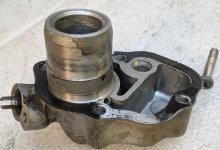
The piston pump on my ’70 CL450:
Piston Pump.jpg

This is a little out of order from actual events but I instrumented an exhaust side cam bearing with a pressure gauge. What I found is interesting in that the pressure was so low, I had to keep finding more and more sensitive pressure scales to measure what is actually there, or not. I’m staying in English units and ended up with inches of water column (“wc), not the typical pounds per square inch (psi) that most of you are familiar with. For you SI (Standard International, or metric) folks, I could not find a gauge calibrated in pascals, or as commonly used mega pascals (MPa) here in the US, so “wc it is.

Initially, I started my test horse, a ‘70 CL450 with approximately 13K miles on it and a really good oil pump – I put a seal ring on the piston so I knew it was good - but, measured while it was on the side stand. After a good 3 minutes, I was still not showing any pressure. Zero. I got worried and unhooked the gauge and didn’t have any oil coming out of an open hose so stopped the process there and decided to redesign the whole pumping system.

Useless information here, the ring on the piston pump – never going to work long term:
piston with ring.jpg

I found out later there was a flaw in my measurement process, but it made no difference to the outcome or decisions made at that time, whew! More on that later.

BTW, a stock piston pump of known quality, puts out about 5”wc (edit: 0.18psi) at idle but I’m ahead of my story. No, I haven’t measured the output on the modified pump with piston ring.
 
Part 4, Rules of Engagement

“Don’t fire before you see the whites of their eyes” is a famous revolutionary war ROE quote for the Minutemen’s unique deficit of too little gunpowder, need for accuracy in smoothbore muskets and simply living to fight another day, ref General Putnam and Battle of Bunker Hill.

For me, it was “using today’s technology and standard work, design an oil pump that outperforms by a significant margin, fits into the original cavity mounts and requires no secondary machining”. This was a tall task that I had to revisit and scratch my head to justify. In the end, I thought that someone in the far reaches of the globe, without access to specialized services/machining, could still improve the oiling for our beloved 450/500’s. We need to keep these machines running!

When you see the end result, it looks so simple that you’ll wonder why it was so hard. Anyway, it was a tall order, even for picture brain. At the time I set the goals, I was pretty ignorant of the challenges I’d have to overcome to arrive at that simplicity.

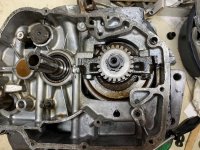
The available space on a 4 speed bottom end:
4 spd bottom.jpg

Of note is the help of both Steve (66Sprint) and Tom (AncientDad) for asking the hard questions and forcing me to justify my decisions, choices and direction the project would take. Thank you both, especially a big shout out to Tom for keeping me grounded with your “Dude, use smaller words, we’re not all engineers!” Au contraire, with your erudite discourse, you sure as hell fooled me…not an engineer, my aching @$$!

Again heartfelt thanks to you both, it was a comfort to know you had my back.
 
Part 5, Tailored Engineering

My process was to measure the available space, plus, the mounting method and everything must fit cleanly. I drew from my aerospace pump experience, what other history units used for a pump, how they were driven - the list is long. I asked Mr. Google too. It took me about 6 months of research before I was satisfied I had a workable solution.

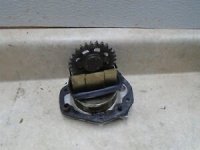
Noteworthy are the CA/CB/CL72/77 engines (250 & 305 sloper motors) which utilized a gear pump in production, before the 450 was designed, well I’m guessing on the timeline. Likely it was just a different design team at Honda with no cross pollination of the worker bees to produce better, more tasty, honey.

CA77 Oil Pump for grins:
CA77 Gear Pump.jpg

Once hard engineering started, it took a couple of weeks of iterating gear sizes, speeds, outputs, etc, to set the performance v. envelope fit. On paper, my perfectly performing gear pump delivers twice the pressure/flow of a perfectly performing piston pump. Reality is there are losses that I would measure once I had hardware, assumed to be in the 5-10% area. That is, empirical numbers are better than theoretical numbers every day of the week! But I had to start somewhere.

What became obvious was the piston pump design not only running at 30% crank speed but that 30% was further cut in half for the retract stroke so the oil delivery time was at 15% of the crankshaft rotating time. Could I speed up that pump somehow? Add a 2[SUP]nd[/SUP] or 3[SUP]rd[/SUP] piston? No, not practically possible. How about using the cam itself with some kind of “swash plate” design on the tach drive to bias oil supply to itself? Again, no, not practical, perhaps doable, but, would ruin the lines of that cover so no on this one.

How about a trochoidal design? (brand name Gerotor, Eaton makes these available as a module) Another parts manufacturer in Europe uses this design but the secondary machining needed to install this pump is easily twice the cost of the pump. Further, I couldn’t find, or design a size that would meet the flow and envelope requirements. There were certainly some pressure and flow benefits but failed for envelope and bolt-in. Further, this design uses needle roller bearings in lieu of journals – with a cascade effect of starving the lobes. Again, no!

I came back full circle to the 72/77 gear design and designed a pair of gears that would give a constant pressure/flow at all turns and positions of the crankshaft. Check. Then, my issue was how to drive the whole thing, with the associated need for correct gear rotation. There wasn’t enough space to drive from the crankshaft so decided to drive from the clutch gear, the packaging and drive then became elegant. Rotation direction was correct. Double Check.

At this point, I had a workable design that met or exceeded all of my design parameters.

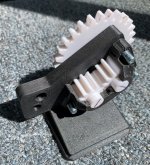
Another issue for me was getting affordable prototypes. What I ended up doing was buying a 3d printer and just printed what I thought, and again, ditto, until there was this lovely design shown below. Money well spent! I was able to print, fit, change, massage, visualize and develop, all from my living room.

A Lovely design, cut away to show the internals:
3D Printed Pump.jpg

Tools, drawing and first article inspection:
Tools and Drawings.jpg

What we've all been waiting for, the new gear pump functional prototype installed for engine test:

R2bpfTF.png
 
Last edited by a moderator:
Part 6, Proof of Concept

Remember that flaw in measurement I mentioned earlier? Turns out the sump pickup is in the side opposite of side-stand lean, the high side. So I measured with the bike idling on its side stand with oil draining away from the pickup, when it should have been on its center stand or leaning right.

Lessons learned: Start and warm your bike when it’s upright, no exceptions! If no center stand, hold the bike upright yourself or risk starving the engine for oil.

Once I figured this out, the piston pump produced around 5”wc (edit: add conversion 0.18 psi) and the new gear pump produced 20”wc. The pic below notes around 15”wc, but, oil level was low at that time. With the correct level, pressure was reliably at 20”wc hot.
The piston pump took around 30ish seconds to register 5”wc cold and didn’t go higher.

The gear pump took 10ish secs to register 20”wc (add conversion: .72 psi) when hot. When cold, pressure went to 45”wc (add conversion: 1.62 psi).

The net gain is a 4x improvement in pressure……and all that lovely oil is going to your cam properly and at all times. It’s then an easy logic statement that if lack of oil is root cause for high wear, then wear will be significantly reduced when oil is present.

An at-idle gear pump performance picture, the very first startup:
Pressure reading CL450 gear pump.jpg
 
Part 7, Mission Accomplished

With oil pressure now showing a surplus directly at the exhaust cam feed, wear will be reduced as well, thus increasing the overhaul interval to the level commensurate with the Honda name. For the well being of your motorcycle, this is highly recommended!

Current cost is 425 USD as of 5/3/2022.

Installation instructions will have pictures AND words!

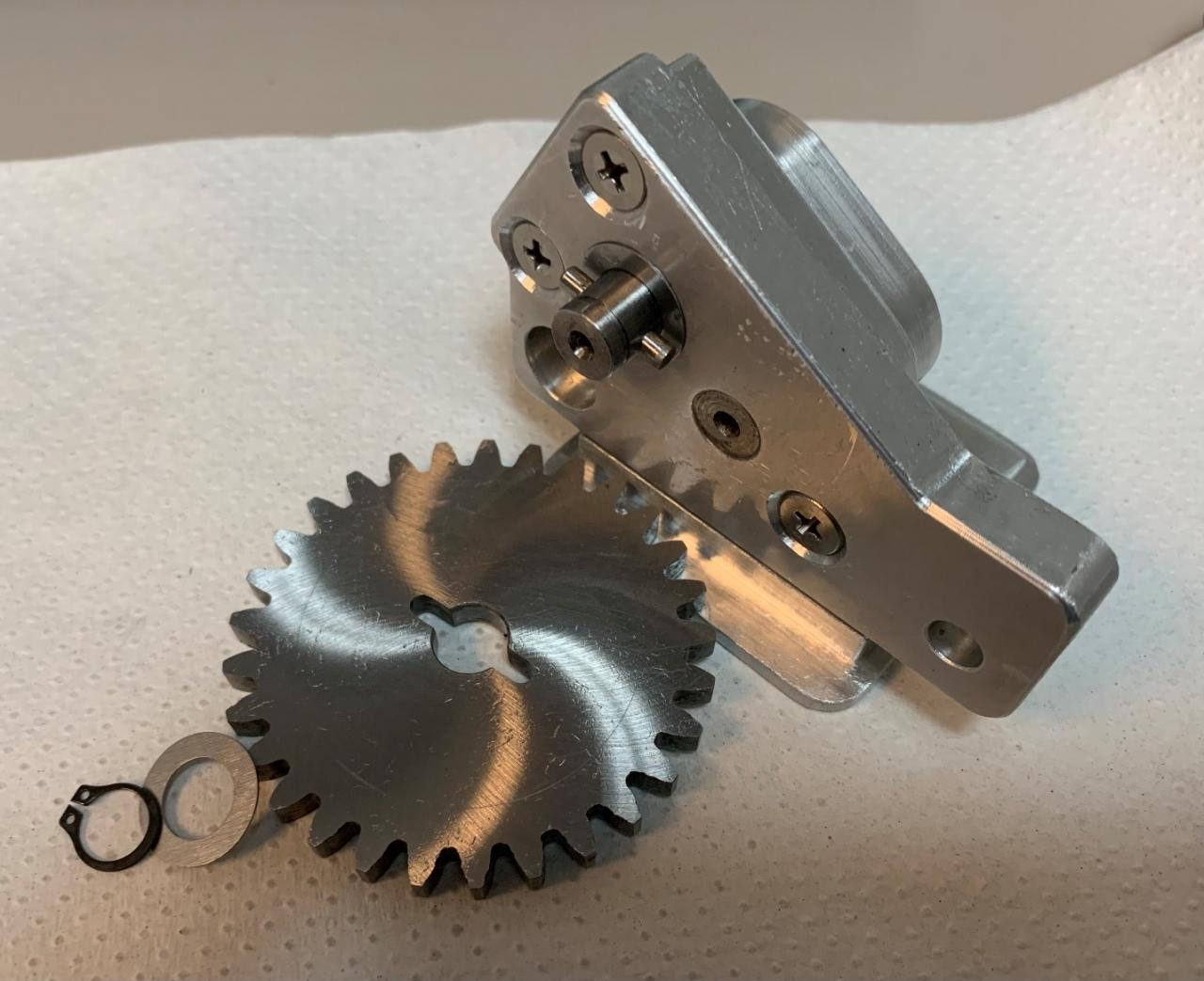
The gear pump kit. Not shown are dowel o-ring and mounting screws:

SUd4vta.png
 
Last edited:
Part 2, Me

The way my brain works is in pictures. My wife has a word brain, mine is a picture brain. Using picture brain to find words to describe pictures is always a challenge for me.
Initial thought? I don’t own a DOHC 450/500 nor am I an engineer, and this is probably way over my head. I started reading since I do own a 450… then I couldn’t put it down. One of the easiest “technical” documents I’ve attempted to decipher lately; and it’s a great story!
I am easily, and often, amazed by those like yourself who are capable of producing a functioning replica of their mind pictures. I’m tempted to buy one to have a first edition, and then I’d have no reason not to get a DOHC 450. Very well done.

Me, too. Cheers!


Tom - 1982 CM450E
 
Very nice work. I've passed it along to a few folks I know who are deep into the 450's.

One mod for a 350 to increase oil pumping is to use a 450 clutch basket so I'm curious how easily adaptable this new pump would be to a 350 engine.

I live with a concrete sequential which is probably a good thing as my approach is closer to the random abstract .... she usually knows where to find the things I've lost.
 
Very nice work. I've passed it along to a few folks I know who are deep into the 450's.

One mod for a 350 to increase oil pumping is to use a 450 clutch basket so I'm curious how easily adaptable this new pump would be to a 350 engine.

I did not know a 450 clutch basket would fit and work with a 350 trans shaft and primary drive, much less make for better oil pump output. Interesting... I would never have thought to try it. As far as I'm aware, Jay will be working on a pump for the 350 next.
 
Thanks Boomer!
The 350 is a different animal to fit, the main housing is inordinately complex. As soon as I can get the 450 settled (almost there) will free up bandwidth for the 350. Initial thoughts are to make a casting. A wild thought was to make a lost wax/investment casting tool from my 3D printer … which isn’t working … I broke it, got the repair/upgraded parts and still can’t make it work!

anyone have Creality Ender 3 Pro experience?
 
@ tomeben Thank you for your kind words and I’m glad you enjoyed my offbeat humor!

Do you need a oil pump for your 450?
 
Great design, and results. Those measurements are astonishingly low. For those who haven't bothered to look it up, 20"WC is equal to 0.72psi. It sure explains why oiling is such an issue for the cams.
 
I did not know a 450 clutch basket would fit and work with a 350 trans shaft and primary drive, much less make for better oil pump output. Interesting... I would never have thought to try it. As far as I'm aware, Jay will be working on a pump for the 350 next.


I never had the parts to try it myself. The gains are modest. Will dig out my old laptop to see if I still have the link. It was on ADV Rider a few years ago.
 
Great design, and results. Those measurements are astonishingly low. For those who haven't bothered to look it up, 20"WC is equal to 0.72psi. It sure explains why oiling is such an issue for the cams.

Astonishing is a good description for it, I was amazed at Jay's results. And when I think back to my improperly assembled oil filter bypass valve, it really drives home how much effect the smallest mistake has on keeping the parts lubed enough.
 
@ tomeben Thank you for your kind words and I’m glad you enjoyed my offbeat humor!

Do you need a oil pump for your 450?

As Tom replied, I have a SOHC 450. Purchasing one of your pumps would, however, compel me to GET a DOHC model, but I’m not there yet. Thank you, though.


Tom - 1982 CM450E
 
some more info about the engine spec
i am using a cb450 outer clutch basket ,primary drive and driven gear(the one attached to outer basket)
this is a proven mod that also takes advantage of the cb450 pump drive eccentric which has a larger journal hence more durable
the primary ratio is now 10% lower numerically which spins everything 10% faster in the clutch/gearbox
this puts the gear ratios a bit closer together which may be good with the cam i'm using the hottest cam honda had besides the un-streetable cyb cam which i sold to a dedicated cyb project in sweden
yes 1rst gear will be a bit tall but for my riding it will be fine
10% more pump speed at any given rpm is a good thing
spinning the clutch and gearbox faster reduces the loads on them

Thread is

https://advrider.com/f/threads/the-african-twin-honda-never-built.1181059/page-2

Get the popcorn .... It is quite a read ... he was not impressed with the KA Slipper and made his own tenioner setup ....
 
Thanks very interesting! A question on oil pressure..... Is oil pressure and oil flow directly proportional? I seems to me that you can pour a bucket of oil over a cam with very little oil pressure so should we talk about volume instead? Not questioning your work but trying to understand lubrication.
I think it was Jensen who fitted an electric booster oil pump, would love to hear what he has to say on this matter?
Please keep us posted as you progress.
 
Re oil pressure. Edited so no double post.

This pump is capable of over 100psi but would consume 1-2 hp to get there. But, draws almost no power with the low pressures in this engine.

I’ll post a pictures of the various flow curves tomorrow.
 
450roo, in a positive displacement pump, flow follows rpm. Conversely, pressure is achieved by consuming horsepower (edit, and the fluid is incompressible). Because pressure is low, power consumption in almost nil.

Here is a curious condition I’m still pondering.
@ 5500rpm, pressure is 45”wc (1.62 psi)
@ 6000rpm, pressure is 45”wc
@ 8000rpm, pressure is 50”wc

i believe the relief valve has opened @ 5500rpm stopping any further pressure rise. I’ll shim mine and see where pressure goes this weekend.
 
20”wc is a 4x improvement from the 5”wc output of the piston pump.

You're correct though, it explains why the exhaust side wears quickly.
 
What are you using for the conversion? I found 1psi is equal to ~27.68"WC, making 45"WC equivalent to about 1.63psi. Still, a big improvement over the stock pump.
 
Thanks very interesting! A question on oil pressure..... Is oil pressure and oil flow directly proportional? I seems to me that you can pour a bucket of oil over a cam with very little oil pressure so should we talk about volume instead? Not questioning your work but trying to understand lubrication.
I think it was Jensen who fitted an electric booster oil pump, would love to hear what he has to say on this matter?
Please keep us posted as you progress.

I have several thoughts about pressure/volume/lubrication I'd like to add for your consideration.....
Since it will take some time and effort, I'll be posting them both to this thread and adding them as a topic in my "classroom" in a few days.....
Stay tuned!.....
 
@wintersol - you are correct my friend, my conversion isn't 17, it's 27 as you stated. or 1psi=27.708"wc. i'll be correcting my posted conversions.
Thank you for catching that!
 
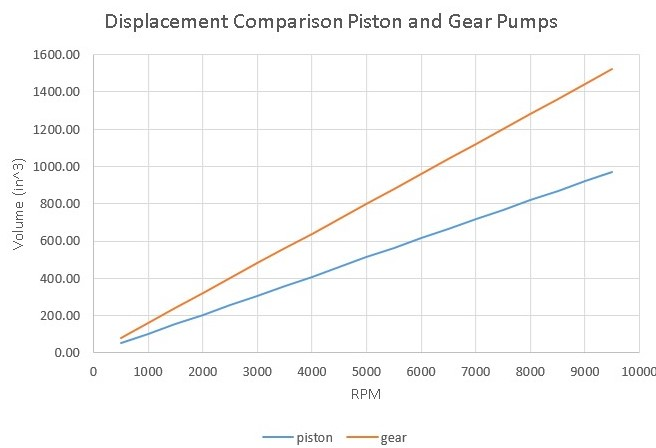
As promised, here is my pump displacement graphic.

Hiksvkk.png
 
Last edited by a moderator:
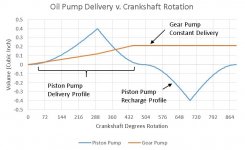
One more thing to wrap your head around. This graph is normalized around one piston stroke, it shows the relative rotational degrees needed to reach full capacity for both pumps and what their delivery curves look like.
Delivery Comparison.jpg
It's important to note that while I've shown the two pumps as starting at the same point, the reality of the OEM piston pump is that the piston rests at a random position relating to crankshaft position at startup. What that means is when you first crank your engine, that piston may be just starting its retract stroke so critical oil delivery doesn't occur until later, or exactly as shown, or another position of infinite variation. Conversely, the gear pump is delivering oil the instant the crank starts to turn and would continue to slope upwards, not flatten as shown.

Again, it's a normalized graph showing shape or character of delivery. Its purpose was to help me understand what was going on relating to oil delivery.
 
I am a few days late to this party but I must say this is one of the most informative and entertaining threads that I have read in quite awhile! It speaks to the root and nature of why I believe the founders created the VHT forum, which is our love and continued dedication to improve and keep these old Honda twins on the road.
Excellent ideas, discovery, and dedication to the task Jay! As much as I have already invested in the DOHC 450 in general I would be honored to accept one of your initial offers for a pump and install it for use on one of my bikes (most likely at this point a ‘69 K2 450). Sign me up! PM me with necessary details please.
 
PM sent.

I promised some high rpm piston pump pressure numbers, this is from my 68 CL450.
At idle, cold = 20”wc
At idle, hot = 5”wc
At 30-60 mph, 3-5Krpm, hot = 15-20”wc
At full throttle, 8Krpm, hot = 25”wc

i took it apart to ensure quality of the pump is good, affirmed.

Replaced with a gear pump for a 2nd set of data points. Refilled with 15W40 HD diesel oil, to the top of the dipstick groove
At drained system, took 25sec to fill and show pressure on the gauge, timed to 5”wc as my timing comparison.
At idle, cold = 20”wc
At hot, but I think the oil still cool, 3Krpm starting to ride = 40”wc
At 80mph/6500 rpm, 100”wc
At 80 mph oil hot, 40”wc
At idle, hot = 20”wc
At 3Krpm hot = 20”wc coming off the interstate, but, same ride on the road home on city streets = 40”wc. Motor wasn’t turned off, but it seems the oil delivery is allowed to catch up with itself.
 
Some Observations

1st, quality of your oil is critical, change it early and often.

2nd, it appears this engine “hides” oil, that is, once is in circulation it doesn’t flow back to the pickup cavity quickly, I think the pump supply is starved on high speed runs. It does get oil, just not in plentiful supply. Certainly this pump is superior but the Honda design leaves a bit to be desired in scavenging.

3rd, with the higher pressure number of 100”wc, it’s clear the relief is not limiting pressure, still working on this one however. I have thoughts, lol.

Bracing for Henri just now, ugh.
 
While the 3Krpm results look confusing, the numbers are correct.

When I first came off of the interstate, pressure initially stabilized at 20”wc. Then, on my several miles ride home at the same rpm, pressure stabilized at 40”wc. This tells me that without the high speed churn, oil can flow via gravity to the desired sumping area.
 
Hi Jim,
There is a level difference of about an inch between the main sump and where the pump picks up. For racing, I’ll have to “reach” around a case bolt boss, through a window in the web behind the clutch and into the transmission cavity and down, just aft of the drain plug. Part 4, the pic showing the 4 speed shows that window but doesn’t show the level difference. One can see the level diff in the last pic in Part 5.

Whew, dizzy just thinking about it! It’s fine for street use as is to be sure. But, reporting my findings helps us all.
 
My K0 project has a K4 engine in it, which I'm hoping to keep until I get the whole bike together to see what else it needs. I have another K0 4 speed engine block, minus a head and all the parts that go with a head, and I'm toying with the idea of rebuilding that engine someday. Is it true that your gear drive pump would fit both engines?

About Henri - I grew up in Connecticut in the 50's and remember the series of hurricanes that blasted the state again and again. Carol, Edna, Diane and Donna and Waterbury, Naugatuck, Torrington and Winsted all lost big chunks down the river. I hope that doesn't happen again. It was terrible.
 
Is it true that your gear drive pump would fit both engines?

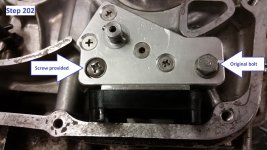
I can tell you it absolutely will. The mounting points are exactly the same, the only difference between the two engines is the 4 speed used two 6mm studs in the same location to mount the pump to the lower crankcase while the 5 speed uses two 6mm bolts in the same holes. On the 4 speed you'd simply remove the studs and use one 6mm bolt along with the 6mm screw supplied with Jay's pump. Fully explained in the written installation instructions Jay will provide with the pump along with a link to many annotated pictures illustrating the installation steps.

M.jpg
 
Yes!

As ancientdad notes, the oil pump mounting is the same for all 450 K0 through to the 500T, inclusive. I tried them all, just to make sure!

What was interesting is the 5speed bottoms had slightly less space available which set the design limits. The 4 speed/K0-K1 bottoms have the most space.
 
A brief comparison and discussion of the two types of pumps.

They are both positive displacement but the similarity ends there. The piston pump uses a pair of check valves, both oriented in the same direction and in series. With increasing and decreasing (reciprocating) volume between the valves, fluid is moved.

Conversely, when gear teeth go into and out of mesh, fluid is moved.

The pumped fluid, oil, is used in both cases to form a perfect seal around any/all clearances, it increases efficiency.

Its been mentioned in discussions elsewhere that the gear pump doesn’t have a check valve to prevent oil back flow of oil from the top end back into the sump. Well, neither does the piston pump as a primary function. There is a check valve present but drain back is a secondary function as the pump won’t work without it.

I further submit that at 50ish years old, will likely leak anyway thus diminishing any functional use. What the gear pump does have is a gear cavity lower than any flow port where there is oil always present. The seal critically needed for the pump to be most efficient is always there. It will self prime even when dry, it’s just more efficient. The piston pump will do this too, but it is way more dependent on the check valve integrity.

Carry on.
 
Hi,

Nice pump! certainly worth to try. I keep the oil level (cold) 8 mm above the highest oil level sign on the oil dipstick (CB450 K0). This way the crank JUST touches the oil level when cold, but as soon as oil is pumped into the crank, cams and transmission / clutch, the crank doesn't touch the oil any more. This way there 's always enough oil available for the pump.

Jensen
 
I should note where I’m taking the oil pressure from. I wanted to get as close to the exhaust cam as I could, and on the oil inlet side.

90FC1FC4-CE3A-4499-BB19-75430866F9F8.jpg

This is the first cavity in the cam bearing/tach drive before it feeds the exhaust camshaft, right side. I assume the camshaft internal pressure is somewhat less but unknown exactly how much.
 
A big thanks to Brandon_in_CO, WentWest and 12ozPBR (Pabst Blue Ribbon, really? LOLOL) who have bought pumps. I've not asked them if this is okay but I suspect we'll be hearing from them once they're up and running.

Thanks again!
Jay
 
Question for the Forum

What is the hole for?

Yes, the larger hole is supply. But what purpose is the smaller one?
Exhaust Cam Bearing, Right Side - CB450/500T cam bearing, tach drive

I won't have a head to fit this in until the weekend but it appears that hole limits the oil pressure/flow to the exhaust cam.

The larger, supply hole is approx 4mm diameter and feeds the end of the cam and tach drive. The smaller hole of approx 1.5mm is my question. Where does it go? What does it do?
 
Has the initial offering of four pumps accounted for? If not, I would be interested in purchasing one, although I would likely wait until spring to install. If they are all spoken for, do you have an idea when the next batch would become available?

This is impressive work. Thank you for your efforts!
 
so....there's a cast cutout in the head where the hole in question is arguably aimed at throwing lube at that right front exhaust torsion bar tube. Thoughts on this postulation?
 
so....there's a cast cutout in the head where the hole in question is arguably aimed at throwing lube at that right front exhaust torsion bar tube. Thoughts on this postulation?

Interesting, not something I ever noticed - wonder if all of the cam bearings have one then? For cooling purposes? (since the twisting action would generate some heat I'd suppose)
 
From what I can see, that hole is only on the one bearing.

Ive never seen a fail, or mention for that matter, of any of the torsion tubes so my focus is now cause and effect. Plugging that hole will provide more oil to the cam and associated surfaces, but at the expense of oil to what it sprays. Of course I’ll try this on my own engine first.
 
Back
Top Bottom