1965 CB160 Restoration Project

Hi There!

Here is my third update...

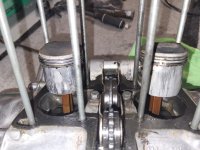
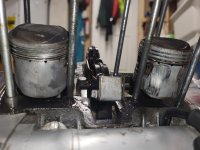
Got the head off and it appears the pistons and bores are standard size. I say this because I have only a good vernier caliper at my disposal. Taking all possible bore measurements (8 numbers, top and bottom, criss cross), I am consistently reading about 50.0 mm. My piston measurements (even less reliable with a vernier caliper) is coming up about 49.9 mm.

There is no scoring of the bores, they look good. The pistons look horrid.

Big-ends have no noticeable radial play. Axial float is less than 1mm.

Please have a look at these piston photos, and chime in. I am inclined to not bother having this all measured up properly but rather just proceed to a 1st overbore. Let me know what you think!

Backs of pistons

Backs.jpg


Fronts of pistons

Fronts.jpg
 
That left piston appears to show evidence of a partial seizure, on the skirt, it's a paperweight now. I would clean up the barrel and test fit a pair of new, unworn standard pistons in the bore to see what the actual piston/cylinder wall clearance is.
 
I agree Mike, with your assessment. What is surprising to me is the PO told me the right cylinder had issues and was fouling plugs. Looking at these pistons the left one appears far worse.
 
L/R could be a matter of perspective but I’m surprised there was no mention of the racket that would have been causing.

I’d echo your sentiment - find a good set of overbore pistons/rings (I ended up going .75 because I found a good deal) and just get a clean slate.
 
Yes I have noticed that standard pistons and rings seem harder to find than the larger ones. I did not manage to hear this engine run before I tore it down. It allegedly runs but the spark was non-existent on one side and very weak on the other. Possibly the 5h trailer ride home and resultant vibrations caused something to give up the ghost.
 
A couple questions on the oil filter...

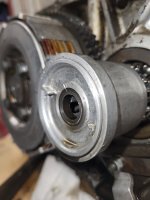
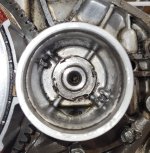
Any suggestions on how to get this oil spinner off? Apparently in the past someone was wailing on the tabs and one broke. Is this bad enough to throw things out of balance?
1000020323.jpg
 
Last edited:
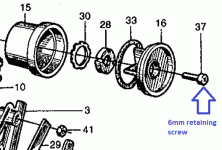
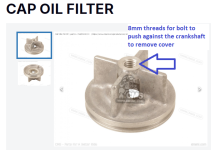
Take the M6 machine screw out and put an M8 in its place. As you screw in the M8, the cover come off on its own. Someone wrecked the one on my SL175 too!

p1110070-jpg.51746
 
Last edited:
Apparently in the past someone was wailing on the tabs and one broke.
Not likely wailing on it, but before taking time to read the FSM many just try to grab the little tang to pull the cover off, often even before they realize there's a screw into the end of the crankshaft holding the cover on the cup.
Is this bad enough to throw things out of balance?
You'll never notice a difference, probably half of them out there are like yours.
 
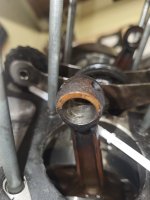
Ugh. Right piston wrist pin was very tight. Once removed the small end and pin appear to have suffered trauma.

More evidence of a previous seizure?

Bottom end service and new rods are now on the docket.

1000020357.jpg

1000020358.jpg
 
Lack of oil from plugged crank oil passages eats wrist pins and piston skirts. Fix/clean crank passages from center bearings out, then fit new pins to see if possible to run those rods. A real good machine shop may be able to re-bush those small ends. Ultimate fix is to find a shop with a press and all the goodies to disassemble the crank.
 
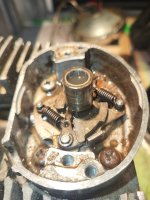
Area beneath the points cover was pretty rusty, advance mechanism totally stuck.

I have penetrating oil soaking on there for an attempt this evening.

I read a thread on here about successful removal through heating, tapping, soaking, prying, repeat. All seem like the right approach.

Any suggestions or tricks to this removal?

1000020361.jpg
 
Some have used a couple of small Allen wrenches to get behind the advancer for leverage on each side.
 
Full disclosure I have no experience on the CB160 but I had a similar problem with the advancer on a CB450. It took a lot of time and patience. What finally worked was applying pressure under the plate while using a small aluminum washer(to avoid damage) and a small socket as a drift that just fit on the on the points end of the cam shaft and gave it a few taps with a hammer. The other side of the cam needs to be loose so it can move freely. Having another person to help apply the pressure while you tap will really help or just grow a third arm.

Here is the link to my thread starting post 115.

 
Making progress, got the advance unit off. Heat, tapping on the center nut, penetrating oil, and prying got it out.

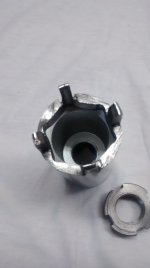
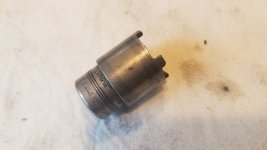
Now onto crank removal and I need tools, namely the 16mm lockout tool for the oil Spinner rotor. I many of these available online. Do any of the easy to find one (i.e Amazon) fit? Any recommendations?
 
Looks like the Motion Pro 08-00015 fits your model. You can find several vendors online selling this product at varying prices. You will also need a tool to remove the rotor. Sometimes the axle is the same size and pitch and can be used - I'm not sure about the CB160.
 
Looks like the Motion Pro 08-00015 fits your model. You can find several vendors online selling this product at varying prices. You will also need a tool to remove the rotor. Sometimes the axle is the same size and pitch and can be used - I'm not sure about the CB160.
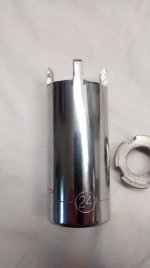
Rear axle for the bike pulls the rotor on this one. Even has a nice flat dish to smack with a hammer to pop it off.
 
Thanks guys! This is golden. Ordering the tool now.

But take a look... Some others that came before had a better idea than getting the tool. My guess is they gave up and the crank never got serviced, hence the carnage.

I think the correct Promotion tool has a 50-50 chance of success.

I can also enviseage a nuclear option involving an angle grinder and a new rotor spinner (no doubt unobtanium)... Fingers crossed I don't end up there.
1000020372.jpg
 
Looks like they did get it off with a screwdriver or chisel. There are marks indicating they put it back on and tightened it the same way. The nut won't be as tight as if it was done with the proper tool, so I'm thinking the tool will definitely remove the nut.
 
He can always make one from a deep socket too, more than a few here have done it. When my father and I first got into Hondas in '68 we used a chisel before finding the proper tool, but it helps to use a blunt chisel that is more like a drift. It works but is cave-man at best.
 
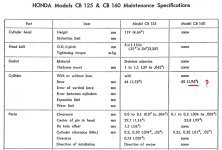
Back to the bore issue. I am replacing the pistons no matter what, the only question is standard or first oversize? At least, until I read page 129 of the FSM.

The manual says two things - bore size 50 mm and also 1.95 in. (in parentheses). Problem is, 50 mm is actually 1.9685 in. The ambiguity is actually more than 18 thou. The allowable clearance ranges from 0.004 to 0.008 in. My bores look pretty good and measured in with very little observable taper, at 1.972 in. or only 0.003 in. over the real value of 50 mm (1.9685 in.).

Just a bit of conundrum...
P129 reference.JPG
 
Back to the bore issue. I am replacing the pistons no matter what, the only question is standard or first oversize? At least, until I read page 129 of the FSM.

The manual says two things - bore size 50 mm and also 1.95 in. (in parentheses). Problem is, 50 mm is actually 1.9685 in. The ambiguity is actually more than 18 thou. The allowable clearance ranges from 0.004 to 0.008 in. My bores look pretty good and measured in with very little observable taper, at 1.972 in. or only 0.003 in. over the real value of 50 mm (1.9685 in.).

Just a bit of conundrum...

View attachment 55650
Hmmmm. That's .07MM. 1st OS is .25 Definitely borderline, IMO. However, since you're replacing pistons anyway, I'd do the 1st over at a minimum (or whatever set of pistons/rings are the easiest to come by), and just have a blank slate
 
Back to the bore issue. I am replacing the pistons no matter what, the only question is standard or first oversize? At least, until I read page 129 of the FSM.

The manual says two things - bore size 50 mm and also 1.95 in. (in parentheses). Problem is, 50 mm is actually 1.9685 in. The ambiguity is actually more than 18 thou. The allowable clearance ranges from 0.004 to 0.008 in. My bores look pretty good and measured in with very little observable taper, at 1.972 in. or only 0.003 in. over the real value of 50 mm (1.9685 in.).

Just a bit of conundrum...
A machinist familiar with motorcycle engines would have no problem telling you what oversize you would need based on bore and wear limit specs from the FSM. Typically when pistons look galled like that, it usually requires an overbore.
 
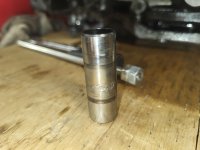
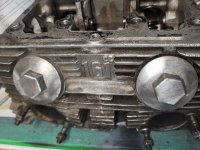
These valve tappet caps that I wish I had loosened when the engine was in the frame...

Is there any trick to removing them? They seem very tight.

1000020513.jpg
 
I would try some PB Blaster or other penetrating oil and let it soak overnight. Tapping the head with a plastic hammer can sometimes break the seal, but don't hit it too hard, just want to shock it. If you have the original 6 sided wrench from the tool kit use that or a 6 sided socket. Use a piece of pipe for more leverage. You can also get two 8" or 10" long structural screws at Home Depot to screw the head to the workbench through the stud holes.
 
Just took those off a really ugly head this morning. PB Blaster, let it soak, get it hot around the edges - then it’s a 21mm 6-sided socket and a weak battery impact works the best. Or breaker bar that you’re tapping on with pressure.
 
I was running low on WD40 in the middle of removing the rusted advance mechanism and decided to try PB Blaster.

I am pretty sure it made a big difference. I could see the rust dissolving immediately. Glad to have a can handy.

Thanks Tom - I like the idea of bolting it my bench.
 
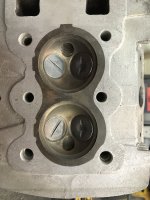
Running into a snag with the reconditioning of the cylinder head.

I got everything disassembled nicely. The local machine shops however are not interested in measuring the small guide bores for clearance (likely don't have the tools). They are more inclined to replace the guides if they can 'feel play'. I cannot feel any play but at the small clearances published in the FSM, I doubt anyone could.

The speedometer indicates North of 13,200 miles. Should I just assume the guides need replacement and attempt to acquire them? Or is there any validity to the wiggle test for play?

Thanks in advance for suggestions...
 
Running into a snag with the reconditioning of the cylinder head.

I got everything disassembled nicely. The local machine shops however are not interested in measuring the small guide bores for clearance (likely don't have the tools). They are more inclined to replace the guides if they can 'feel play'. I cannot feel any play but at the small clearances published in the FSM, I doubt anyone could.

The speedometer indicates North of 13,200 miles. Should I just assume the guides need replacement and attempt to acquire them? Or is there any validity to the wiggle test for play?

Thanks in advance for suggestions...
I'd send the head to Schumann Motor Works, he does excellent work on these vintage heads.

 
Running into a snag with the reconditioning of the cylinder head.

I got everything disassembled nicely. The local machine shops however are not interested in measuring the small guide bores for clearance (likely don't have the tools). They are more inclined to replace the guides if they can 'feel play'. I cannot feel any play but at the small clearances published in the FSM, I doubt anyone could.

The speedometer indicates North of 13,200 miles. Should I just assume the guides need replacement and attempt to acquire them? Or is there any validity to the wiggle test for play?

Thanks in advance for suggestions...
I've always felt it's better to not disturb the valve guides unless they really need changed. Changing the valve guide, more often than not, destroys the concentricity of the valve stem to the existing seat and the seats need re-cut to re-establish a proper valve seal. Taking metal off with a seat cutter sinks the valve farther into the head, go deep enough and you start to effect the flow characteristics of the head. Sinking the valve seat deeper also affects the installed height of the valve spring, affecting the closed and open spring pressure. Engines,such as the CB350/450 also run out of adjustment range when the valves are sunk deeper into the head. Also, if the person doing the guide change doesn't bother to clean the carbon build up off the lower end of the guide and drives the guide out with the head at room temperature it's possible to oversize the hole, losing the interference fit of the guide, in the head. Try a new, unworn valve in the guide,how does it fit? Any grooves on the sealing surface of the valves? If so they need to be tossed anyway.
 

Attachments

  • IMG_3058.JPG
    IMG_3058.JPG
    1.7 MB · Views: 1
  • IMG_4117.JPG
    IMG_4117.JPG
    1.9 MB · Views: 1
Thank you. So many great suggestions. I'll dig into this and see what makes most sense. Sending my head across the border for re-work is a non-starter, unfortunately.

https://ebay.us/m/u30gOU

Considering getting the guides listed above and proceeding locally.

I replaced the guides and seals on my Ducati 250 single. It was a no brainer for my machinist and worked out flawlessly.
 
Hello!

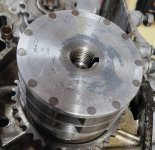
Finally getting around to splitting the cases (crank service on the menu). Had my M14 x 1.5 bolt at the ready.

Turn out the rotor is not from a CB160. the orphan in my engine is marked CB93L, and 5D00055. The threaded hole looks like M15 x 1.5, which I am quite sure is unobtanium.

Is this a common occurrence? Any suggestions how pull this puppy? I am considering using an M8 rotor bolt and stack of washers...

1000020812.jpg
 
That is the correct part for the 160 alternator. Lots of parts used on the CB/CL 160s originated on the earlier 125cc CB93 and are carried over to the later machine. Have you tried the rear axle, as a possible source for a puller bolt? To preserve the magnetism, in the rotor, do not hammer on it or knock it around. While things are apart, it's best to store it in the stator assembly to preserve the magnetism.
 
Good to know Mike, thank you.

Tried both axles, not even close. Very fine pitch too. I think that axle - rotor synergy might be a CB/CL 175 thing.
 
Last edited:
Good to know Mike, thank you.

Tried both axles, not even close. Very fine pitch too
You don’t actually need to remove it. That crank is pressed together so the only way to clean the passages is long soaks of kerosene, brake cleaner, WD 40 and air. You can leave the rotor on there while doing all of that.
 
I wonder if the CA95 axle would do the trick to remove your flywheel. If so, you could order a crappy CA95 axle off of eBay just for this purpose.
 

Attachments

  • ca95 rear axle1.jpg
    ca95 rear axle1.jpg
    1.3 MB · Views: 0
  • CA95 rear axle.jpg
    CA95 rear axle.jpg
    1.3 MB · Views: 0
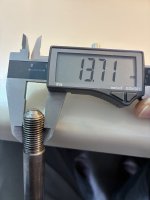
I have two in my collection from my days in the shops, the black one is 15.9 mm and the silver one is 13.85mm. The thread pitch of 1.5 on both. I use the black one for my CB450 and C78. Maybe the silver is for the smaller engines.

20260321_165152.jpg
 
Hello!

Finally getting around to splitting the cases (crank service on the menu). Had my M14 x 1.5 bolt at the ready.

Turn out the rotor is not from a CB160. the orphan in my engine is marked CB93L, and 5D00055. The threaded hole looks like M15 x 1.5, which I am quite sure is unobtanium.

Is this a common occurrence? Any suggestions how pull this puppy? I am considering using an M8 rotor bolt and stack of washers...

View attachment 56161
On mine an M16 bolt with air wrench will quickly remove the rotor. Sorry don’t remember the thread pitch. Pretty sure I picked it up at the local hardware store!
IMG_3401.jpegIMG_3402.jpeg
 
Ok - so I was barking up the wrong tree. I gather the real thread is M16 x 1.5.

Once I discovered M15 bolts are near impossible to find, I used my 2-jaw puller. the claws actually grab the steel starter sprocket, not the vulnerable rotor.

It was on tight, but the puller popped it cleanly. No damage to the sprocket.

Thanks guys!
 
Hello!

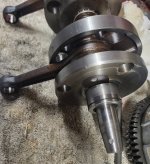
Almost ready to bring my crankshaft in for servicing (new rods and left outer main bearing). I am puzzled by the outer right roller main bearing and hope some folks hear can clear this up for me.

Left outer main bearing feels terrible. Inner two bearings (roller type) feel smooth as glass. Right outer bearing (also roller type) feels good, not as smooth as the inner ones. Hoping to re-use the right outer as is. See picture below of right outer, after the ring, cage, and rollers were removed. You can see the inner race on the right hand end of the crank.

By 'feel' I mean how smoothly these roll.

According to the parts manual, the cage, rollers, and outer ring are all identified parts (and I have managed to source them). Also below is a snip from the manual showing ring 1A (the outer ring). The inner race is not even listed.

Am I to understand that the rollers, cage, and outer ring can be replaced but the inner race cannot? I always understood rollers and races had to be renewed together, with no mixing of old and new.

What gives?

1000021012.jpg


1000021010.jpg

Any help, as usual, much appreciated.
 
The "inner race" is also the left side shaft of the crankshaft itself, and these cranks have to be pressed apart with a 20 ton rig. Honda probably never dreamed these economically-built smaller bikes for the masses would still be around 60+ years on and need the left main bearing inner race replaced.
 
Last edited:
Back
Top Bottom