Kbongos 1972 CB450 K5 engine disassembly

That's a great photo in post #34 — if I were younger I would probably be able to devise a wicked meme from it, but, sadly, that is not the case.

It will be interesting to see what becomes of this motor. Are you keeping an eye out for a 450 or 500T on the cheap, preferably with a title and not running? If so, you may as well modify the side cover for Jay's oil pump!
 
You may have identified this already and I missed seeing it in the thread but in post 15 you posted a pic with a small broken piece of case. In post 50 you posted this image and I copied it and marked where the broken bit probably comes from. My upper case is broken in the same area. I am planning on using the upper case from my donor engine but will lose the engine serial number that came with the bike which bites. I will have a CBL450 though.

20240430_170345.jpg
 
You may have identified this already and I missed seeing it in the thread but in post 15 you posted a pic with a small broken piece of case. In post 50 you posted this image and I copied it and marked where the broken bit probably comes from. My upper case is broken in the same area. I am planning on using the upper case from my donor engine but will lose the engine serial number that came with the bike which bites. I will have a CBL450 though.

View attachment 32144
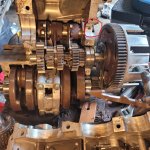
Good eye. I hadn't noticed that. I did spot what something in another pic that looks like it might be the piece:
20240430_170035.jpg
In the middle there, I didn't notice until looking over the pic. I'll have to see if I can find that small part i posted in #15 and see if it fits. That would make me feel better as I don't believe I broke that off, whereas I have been a little rough with it since.

That's a great photo in post #34 — if I were younger I would probably be able to devise a wicked meme from it, but, sadly, that is not the case.

It will be interesting to see what becomes of this motor. Are you keeping an eye out for a 450 or 500T on the cheap, preferably with a title and not running? If so, you may as well modify the side cover for Jay's oil pump!

I got it just to tear apart and learn about these engines. So all is good, maybe I can sell or give away some parts. Maybe I'll get a 450 some day, and learning something about them will be useful. They do seem very unique.

I was set to get a 72 CL350 from a guy I shot pool with that passed away. Unfortunately his wife just passed as well I was told so the ownership and title will be tied up and it doesn't sound like I can get that anytime soon. That's fine, I should give my older CM400 bike some love and attention.

Headed to the garage to see if I can find those pieces!
 
You may have identified this already and I missed seeing it in the thread but in post 15 you posted a pic with a small broken piece of case. In post 50 you posted this image and I copied it and marked where the broken bit probably comes from. My upper case is broken in the same area. I am planning on using the upper case from my donor engine but will lose the engine serial number that came with the bike which bites. I will have a CBL450 though.
RobMan, your original upper case is probably ok to use. that is not a critical area. The bronze trans shaft bushing will still be well supported and the knock pin is intact which is important. Even kbongo's is probably ok too.
 
To be period correct:

I will use that on my next album cover ;) Back in Y2016 I put some music on a site called jamendo that allows you to call something an album and give it a cover pic. Here's a link: https://www.jamendo.com/artist/487256/kbongos

Couldn't find that piece yet that I probably broke off. It's on a gear shaft end, got a long rod and on the end is a large pivot cylinder that is anchored with a metal dowl to where it broke the lip. Knocking that could account for the mishap.
 
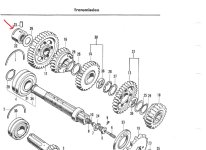
It looks to me that where the case is broken it is a machined opening to act as reservoir to collect splashed oil for the counter shaft bearing #22. There is a groove cut in the bearing cap that sits directly under the opening in the case and my concern would be the bearing would not get adequate oiling with the lip broken off. There may be enough splash in that area that this wouldn't be a concern but I am not familiar enough with the machine to say for sure.
Transmission.jpg
 
I think Rob is correct, the broken piece is machined with the groove to serve as a reservoir for drip lubrication of the bearing. While not ideal I think there'd be no problem using the upper case.
However if you find the broken piece you might consider getting it welded back in place. Won't require a lot of penetration in the weld since it's a non-structural piece. Even JB Weld might work.
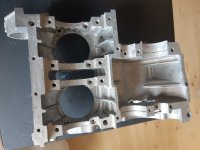
This picture shows daylight thru the slot
cb450 upper case4.jpg
 
I am thinking of having mine welded although so far I have been unable to find the broken bit. It may have broken during a previous rebuild and been tossed. It would take a bit to fabricate a piece and then have it welded and then finished to fit the bearing properly. Once I get both engines torn down I will start picking out the best parts and decide then. :sneaky:
 
I am thinking of having mine welded although so far I have been unable to find the broken bit. It may have broken during a previous rebuild and been tossed. It would take a bit to fabricate a piece and then have it welded and then finished to fit the bearing properly. Once I get both engines torn down I will start picking out the best parts and decide then. :sneaky:
A piece of @1/2" aluminum plate, hole saw, hone, micrometer to get the right bearing fit. Then it's cut and grind to shape the piece. Good part is you'll have enough of the circle to make at least 2 of them so if one gets messed up before welding you have a do over piece.
 
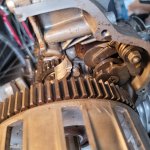
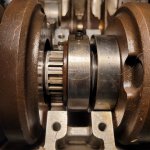
I'm loosing my marbles, or my roller bearings ;) Just kidding around, I'm sure they are all there. One of middle crank bearings slid over and released it's rollers. Not a big deal, I'll get over it, in time. Here is a better shot of the lip that got busted. Have not found the piece yet. Lot's of little pieces, would probably help to start with a very clean garage floor.
20240502_185217.jpg20240502_180156.jpg20240502_180143.jpg
Not sure if penetrating oil is really squirting into the skirt around that piston from the bottom, hard to see down there. I did try the heat gun around the cylinder, but that didn't seem to do a whole lot. Lot of mass for that cheap HF hot air gun, and I already wrecked my first one of those working on the fridge. I'm not ready to cut or melt the piston out yet, but getting there. Maybe I'll try some judicious use of the propane torch on the cylinder metal sleeve. Or maybe try the heat gun first on the sleeve instead of the outside cylinder cooling fins. Or maybe....
 
That groove in the counter weight/flywheel next to the roller cage is where the crank sludge monster lives.

Time for another barbeque?
 
I'm loosing my marbles, or my roller bearings ;) Just kidding around, I'm sure they are all there. One of middle crank bearings slid over and released it's rollers. Not a big deal, I'll get over it, in time. Here is a better shot of the lip that got busted. Have not found the piece yet. Lot's of little pieces, would probably help to start with a very clean garage floor.
View attachment 32206View attachment 32207View attachment 32208
Not sure if penetrating oil is really squirting into the skirt around that piston from the bottom, hard to see down there. I did try the heat gun around the cylinder, but that didn't seem to do a whole lot. Lot of mass for that cheap HF hot air gun, and I already wrecked my first one of those working on the fridge. I'm not ready to cut or melt the piston out yet, but getting there. Maybe I'll try some judicious use of the propane torch on the cylinder metal sleeve. Or maybe try the heat gun first on the sleeve instead of the outside cylinder cooling fins. Or maybe....
Decisions decisions decisions! I have to say I admire your dedication to an engine you say you don't plan to use but I think you know you will just because of the elegant engineering in these animals. Of course I am keeping a close eye out for parts I might need if you decide to part it out later. :)
 
The upper case is supposed to have a pocket that will catch splashed oil and deliver it through the bearing cup slot. Looks like it got broken off, good eye indeed!

Intuitively I think there is enough splashing oil so that bearing is still lubricated enough - but still better to have it in position. That pin also positions the cup to control end play on that first inboard gear. I further think the squeeze of the two case halves will keep it in place but that pin is oh-so-convenient!

All in all, better to replace that set of cases.
 
I did try the heat gun around the cylinder, but that didn't seem to do a whole lot. Lot of mass for that cheap HF hot air gun, and I already wrecked my first one of those working on the fridge. I'm not ready to cut or melt the piston out yet, but getting there. Maybe I'll try some judicious use of the propane torch on the cylinder metal sleeve. Or maybe try the heat gun first on the sleeve instead of the outside cylinder cooling fins.

I like the idea to keep at it with spurts of heat. Maybe things will gradually break free after many cycles of heat and cooling, combined with pb blaster or equivalent, and some gentle tapping every now and again.
 
be sure to dig out the accumulated debris in the crankshaft oiling channels and run a wire through the crank pins and slightly bent to the oiling channels to the rod big end. I think Jensen has some pretty good thoughts on how he does it, etc. But the cranks are always dirty in those areas and need cleaning.

You can do it, the force is strong in you!
 
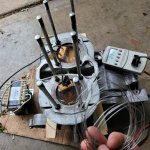
To continue the saga of trying to unstick the pistons:

If you got one loose with just PB blaster, what did the other one do? They're essentially tied together at the crank so if one side goes down, the other should come up and vice versa.

Well I'm pretty sure it moved, but a little uncertain if it really did or how much. Now I am learning about the mechanics of it now that I have the back cover off and can see how the crank ties it all together. One mistake I did was I tried removing the back casing at first but it didn't come off then decided I'd wait on that, my mistake was I didn't tighten all those bolts back up. Since they are the backing plate for the outside crank bearings, this could be a problem pressing on the pistons. Possibly bending on the crank as the two inner bearings are still bolted with a separate holder.

I should have studied the internals first like looking at lower parts pics on CMSNL. So I did get the lower case off and gears out now. This is maybe a good thing, maybe not. With the crank bearings loose I could press on one piston and all the force would not just get exerted to the other piston trying to go the other way, it should be able to move somewhat without the other. Two of the bearings moved and let out a bunch of roller bears, not great. I suppose I could put them back in and bolt the case all back together, but that seems like it's a step backward and a bit of work so I'm probably not going to do that.

I have tried various penetrants sitting on top of the cylinder heads, penetrating oil, mixes of ATM and acetone, kerosene, gas, brake fluid, letting it sit for a day with pressure from the jig. Tried lighting it on fire. Let it sit a few days with the bottom side filled up with water, dish soap and a splash of vinegar hoping that would seep in from the back side.

Maybe I can put it in the oven for a while or on the gas grill. I have googled and read a lot of suggestions, some say to just cut or melt out the piston, you can replace them. Trying to heat with hot air or propane torch seems slow and not very effective.

I am using the acorn nuts and I should find some good regular ones to avoid the basic problem of not being able to see how much travel I have left to tighten. I basically tighten the large center threaded rod as much as possible then get a little more pressure by cranking down on the 4 cylinder bolts.

I'll get some proper nuts for the press and try that side that I think may have moved some next.

I do have cylinder jugs loose now by about 1/8 inch. I've tried some wedges there, but that seems weak compared to the press jig. With the press jig it's pressing the cylinder jugs back against the upper case.

I have studied the crank and bearing now. Interesting there are slightly different sized bearing rollers between inner and outer bearings. I've learned(from CMSNL pics) the lower connecting rods have roller bears(not the top which is just a pin). These seem to have too much wiggle in them compared say to the main bearing fitment that seems perfect. Maybe those wear more or maybe I damaged them with the press arrangement.

A few suggested Kroil penetrating as being extra good, it seems overly expensive, like $30 that I don't want to spend, so I'll probably stick to stuff like the acetone and ATM.

Wanted to get the back off to make sure it wasn't stuck some other way(like broke or stuck gears), but that was not the case and I have come to the conclusion the problem is likely that the rings rust and fuse together with the jug sleeve. Eventually I will be able to verify that when I eventually get the stupid pistons out, if that comes to cutting them out then so be it. But I'd like to leave that as last resort just to entertain my stubborn side that wants to see them slide out.

I'll take measurements and see if it will fit in the oven or gas grill. Maybe see how easy the cylinder bolts come out as they add significant to the size in regard to putting it in an oven or bucket bath.
 
So a few other interesting methods I've read about includes making a heavy cover plate that bolts to cylinder top with a grease fitting added and using grease gun to apply pressure to push, like a big brake cylinder. Another is to use a wide solid spacer with press jig to press more on outside edge of piston to better spread the load over to the outside edge of the piston. Or boil it in a big tank of water.
 
What about muriatic acid to dissolve the rust from the rings?
There was a thread here of someone using it for this purpose. I think it would be somewhat destructive and eat away at the sleeve so I'm a little hesitant. I'm also a lousy chemist. I do have that sitting on the shelf. It is strong nasty stuff, I used it on some toilet cleaning, nasty fumes. I hear it's used for concrete cleaning. And I'm reading it might eat the aluminum piston tops. But it might be something to try if I get in a certain don't care mood.
 
In your case, if you’ve got everything out of the case and it’s basically the pistons hanging up in the cylinders, find a stable way to support the edges of the case with the crank hanging free, then press both pistons down to slide the whole apparatus out. You want linear force in these situations when you’re also fighting rotational axis you’ve multiplied the force needed as you have to not only force one piston down, but the other up at the same time, along with some major deflection between the press sliding off center and the angle created by the distance from crank center line to the center of the piston rod pivot point.

A sawed off M110 or C243 wooden baseball bat makes a good punch for those of you want to try impact - you’ll just have to really make sure you’ve got the case supported evenly and braced.

Alternatively, see if you can get a 2 ton bottle jack in between that wooden plank and the piston head and make your own hydraulic press.

Battery tender a sacrificial anode and a Tupperware tote and you can make a DIY electrolysis tank. Might get the rust that way.
 
A sawed off M110 or C243 wooden baseball bat makes a good punch for those of you want to try impact - you’ll just have to really make sure you’ve got the case supported evenly and braced.

Alternatively, see if you can get a 2 ton bottle jack in between that wooden plank and the piston head and make your own hydraulic press.

Battery tender a sacrificial anode and a Tupperware tote and you can make a DIY electrolysis tank. Might get the rust that way.
I have tried giving a few good punches with a piece of an oak tree. The bottle jack I have doesn't quite fit in the spot as a press, but I did try it for size. Shock it with electricity submersed in a tank, hmm, that's a new idea!
 
The muriatic acid will attack the aluminum, not the liner.
I’ve soaked rags with the muriatic and cleared seized aluminum from a bore quite nicely on past race failures.

So…you “could” allow a bead of acid around the piston and simply let it percolate through to dissolve the piston.

Lots of ventilation. Need an hour + for effectivity. Water hose handy.
 
Battery tender a sacrificial anode and a Tupperware tote and you can make a DIY electrolysis tank. Might get the rust that way.
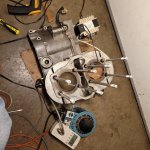
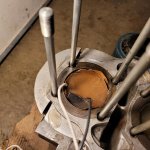
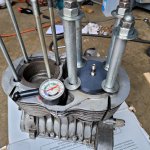
I have read that electrolysis has been used to de-rust metal. So that is a possibility. I took my electric tea water heater out and tried filling it with hot water. That cools very quickly. Looking into heating the water with electricity. Put together a quick try as proof of concept. It worked pretty good, but I need to refine it. Using a 120v to 12v(10A) transformer here with a submerged piece of wire as heating element. Using the autotransformer to adjust power along with a watt-o-meter to tell me the watts. The water heats up here to 75C in about 10 minutes, the jugs start to heat up as well. This is turned up on autotransformer to about 50V, seeing about 3-4V out the secondary to heating element, about 160W on watt-o-meter.

I need to arrange a longer heating element is probably the biggest thing, so the power goes more to heating the water and not the transformer. And preferably heat both cylinders at once. The spacer is card board submerge in the water, that could use some improvement as well.

So for a initial proof of concept I'm happy with results, looks promising. Here's some pics.
20240523_225518.jpg20240523_225709.jpg20240523_231008.jpg

I do believe it was a mistake to take the case apart. I was thinking I could just put it back together if it was a mistake, but that is not as easy as it appears once you actually get it apart(and bearings start falling out), and then all the parts are more subject to damage with it apart. The whole press arrangement or hammering at pistons seems somewhat questionable, destructive if you want to avoid damage. We will see if this hot water bath can have better luck at seeping in and loosening those pistons.

I did manage to remove one of the long cylinder bolts just to see if I could do it. I used a vice grips. It came out grudgingly. They might be useful to pull out if I wanted to put the whole thing in the oven say, or submerge in a big pail of hot water. I'll leave them in now and see how this crock pot idea works.
 
If you choose to remove more of the studs, I would suggest getting a pair of appropriately sized nuts (not the cap nuts). Lock them together on the threads with a pair of wrenches and then you should be able to turn the stud out using a wrench.

Hopefully the rust gives up soon. If not, I'd still be inclined to try Coca Cola®.
 
If you choose to remove more of the studs, I would suggest getting a pair of appropriately sized nuts (not the cap nuts). Lock them together on the threads with a pair of wrenches and then you should be able to turn the stud out using a wrench.

Hopefully the rust gives up soon. If not, I'd still be inclined to try Coca Cola®.
Yes, apparently I don't have the nuts of the appropriate size. My collection of metric hardware is limited. Weather is getting nice and I think another trip to the pull ur own parts junk yard might be enjoyable where last summer I was wondering around shirtless picking up random nuts and bolts. I'm guessing they are not cheap if I just go to the hardware store.

I like the idea of Coca Cola®., you would hope it is not too caustic, people actually consume that stuff. Wife drinks the Diet Pepsi, maybe that would work.

I did get the spanner tool for the oil filter inside nut and that came off easy enough.
spanner_20mm_24mm_ebay.png
 
If that submerged wire is copper, you’re actually creating more corrosion in the aluminum, particularly if there’s any chlorine in the water or other minerals.

Your best bet is to toss a little bicarbonate in that water, hook the negative to the aluminum block and the positive to a zinc anode and submerge both.

The chemical reaction will pull corrosion from the aluminum and into the zinc, eventually degrading the zinc.
 
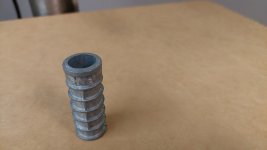
If you need a cheap source for zinc, you can get cement anchors at any hardware store. They are almost 100% zinc.
View attachment 33104
Good call! I've always used crab and lobster pot zincs because they have a wire end that makes it easy to loop and connect to -- those would be just as easy for about 1/4 the price (not to mention the fact that I end up dropping an extra $50 in offshore tackle every time I go to the landing for them).
 
I took apart 20+ 450 engines, most of them with one or two stuck pistons. Those piston rings and sleeves didn't get stuck within a few days, neither the will unstuck within a few days. The lesson I've learned that patience is your friend, and violence isn't.

You learned already that it is not wise to use a hammer in the neighborhood of fins, and splitting the cases while the pistons are still stuck. The reason that the piston rings are stuck is that the pistons rings and sleeve are connected via rust, this connection is strong, but porous. The pores have a capillary function, and to attack the rust from within these pores takes time, lots of time.

I use phosphoric acid (H3PO4) and let time and pressure do the rest. Refresh the phosphoric acid when it stops producing gas bubbles (in most cases within 24 hours). For applying, pressure, I use a steel tube with an OD 0.5 mm smaller than the cylinder ID to apply an even force onto the piston while it soaked in phosphoric acid. To apply pressure on the tube, I use a jack screw between a beam of the ceiling while the engine is leveled on wooden blocks at the bench. The pressure is applied all day, 24 hours, as long as it is free. Before I had a jack screw I use a wooden pole and a wedge.

The longest time to free a piston was 7 weeks, most give up within 2 to 3 weeks.
 
Thanks everyone for the tips and suggestions. So the phosphoric acid is a medium strength acid a little more friendly, I do like the idea of the wider metal cylinder as a press element, my threaded rod does not center well. I will try and learn some patience.

I did rig up a better heater, used a longer piece of galvanized wire(this was just excess galvanized wire) with a tight wind. Two jugs at once, about 200W total for both cylinders, heat up nicely the water and the jugs, up to around 80C. I was hoping for some quick fix here, thinking the heat would allow the fluid to seep in. I let it go for a few hours. Now I can't let it go to long without attendance, it doesn't have a lid so the water does evaporate, and if I were to forgot it I may have a fire hazard at some point. An automatic shutoff timer would be nice.

After this crock pot treatment I did give it a some whacks with the rubber mallot and stout oak(I know, I know, stop with the violence!). Still stuck. So I will leave it sit with the press arranged on one cylinder and I just filled up with some cleaning vinegar as I don't have the phosphoric acid, and I don't have a can of Coca Cola(which has some phosphoric acid in it). Maybe I'll pick some up to try, as this cleaning vinegar seems rather weak.

So there's this method where they build a sealed cap and pressurize with grease. I don't like that idea, it sounds like a ton of work and mess, and grease is rather thick and I can't imagine it seeping in to get to the rust. But it's made me wonder about building a sealed cap and applying air pressure along with some fluid of choice to attach the rust, and if that would work to force the fluid down into the piston rings. It would be interesting to see if it is tight as a drum and holds air pressure, or do you get some leak down. You've got three sets of spaced piston rings to get to, and just hoping it will seep down with gravity and capillary action is maybe wishful thinking.

I'm not doing electrolysis with my crock pot idea here, using AC and heating element. Electrolysis/electroplating does sound interesting and fun, but I am a little skeptical about how that is going to target the rust trapped in that tight space of those piston rings. It might be fun to try on something smaller and rusty.

20240524_183417.jpg
 
I have done some light to medium whacks with a heavy steel ball peen and steel drift or pipe to send shocks through to aid penetration of PBblaster/WD40/whatever. Rubber or wood absorbs those shock too much.

I like Jensens idea of acid to eat the aluminum away.
 
Exactly, I think violence may be to strong a word, metal needs a little firm love once in while. Pressure over time can be less than tender love. Now, how does acid clean out the rust, or is it really eating away at the metal just loosening it? Is the aluminum piston expendable? As Neil Young said, rust never sleeps. I'm not sure what that means, but I do like rock and roll music.
 
Exactly, I think violence may be to strong a word, metal needs a little firm love once in while.

Please don't feel offended, that might be a translation/ language barrier thing (Dutch - English), maybe (brute) force is a better word, but that doesn't translate the other way around (English - Dutch).
The Dutch word "geweld" is a correct word to use in this case, and is literary translated in "violence", but a literary translation is not a figurative translation.

I like Jensens idea of acid to eat the aluminum away.

Phosphoric acid (H3PO4) converts rust into water and iron (III) phosphate, but at the same time it will convert aluminum in aluminum phosphate (ALPO4). Both conversions will destroy the intimate embrace between the rings and sleeve, and giving room by dissolving the aluminum at the same time. Heating up the cylinder and pistons will "speed" up the process.

In general, applying force to one piston, the piston will go down, but since the crank is a 180 degree crank, the other piston will be pushed up at the same time. The force on one piston will translate through the crank to the other piston, and that's not what you want. Splitting the crankcase will avoid this, but it's better to keep the crankcases closed, and push only one piston down. The force is again translated though the crank, and will push the other piston up, but it will lift the cylinder up if you give it the possibility to do so. And this is what you want, working on one piston only, without having the problem to do two pistons at once.

This is the reason why I use a jack screw or a wooden pole to apply force to the piston only, so the other stuck piston can go up, taking the cylinder with it.
 
Last edited:
Exactly, I think violence may be to strong a word, metal needs a little firm love once in while. Pressure over time can be less than tender love. Now, how does acid clean out the rust, or is it really eating away at the metal just loosening it? Is the aluminum piston expendable? As Neil Young said, rust never sleeps. I'm not sure what that means, but I do like rock and roll music.
Sure, pistons are cheap in the grand scheme of things. Probably spend the same or more on the rebore of the cylinder.

Heck of a metaphor there, Neil.
 
Jensen you do really well with English, and I would never take offense to anything you say. Thanks for all your pics, posts and effort on VHT here. I am lucky the rest of the world has English as a 2nd language, I have not learned a 2nd language. Unless you want to call math or programming a language. Sometimes the wife looks at my computer screen and sees only foreign gibberish. I did take a short business trip into Germany in younger years, with a weekend stop in England where I met up with our business co-workers there. I tried learning a little german language before hand with not much luck. Often thought if I ever went back to school, a foreign language would be a nice new thing to study compared to math and science.

I just googled this, and apparently Dutch and German is not the same language but perhaps related, but different enough to not translate easily. We have our slight differences even in this homogenous country of the USA. A southern accent for example. On that trip and the weekend stay in UK I was surprised at the various accents I heard. I understand there is quite a lot of variation in Chinese language to the point that they don't understand each other from place to place. The Chinese written symbols are certainly different. We have unicode to try and adapt for computers. UTF8 accent has apparently won that language battle. Here at VHT we like pictures ;) I'm a caveman and wish we had just a single language everyone would use. Preferably with 7-bits between 0x20 and 0x8F. My dad sailed the seas and had an interest in Esperanto. He also had an interest in Henry George economics theory. He had a very strange humor that most people thought was odd, I do believe I've inherited this to the detriment of all who surround me.

So any fluid, say the phosphoric acid, has to work it's way down between the piston and sleeve, into those grooves to work on the rust. I'm thinking the 3 sets of rings, the slim space between piston and sleeve are all a challenge for this to happen. It all just sits there pooled up and does not appear to get pulled into the fine space between piston and sleeve. Perhaps I need more patience.

I'm starting to come over to that barbarous ballbarians point of view that aluminum piston tops are cheap and easily replaced so melt it or cut it out. Maybe that's what it will come to, we will see. It's not like I'm trying to save this engine(save the whales!). Cutting it out might be interesting as it would allow visually seeing what the contact surface between the two look like. I could take pics ;)
 
I think putting acid around the periphery of the piston will dissolve the aluminum and not harm the liner. Cast iron is surprisingly resistant to acid.

Indeed, phosphoric acid is harmless for iron and will attack the rust and aluminum. If the rust didn't much harm to the liners in terms of depth, I think a 0.5 mm overbore will do after freeing the pistons.
 
I am lucky the rest of the world has English as a 2nd language,
When I was in the Air Force I was very fortunate to spend 10 years overseas and enjoy a number other cultures. The old joke was "What do you call someone who can only speak one language?" The answer of course is American. I did very little to disprove that other then learning enough to order beer in a number of languages. :)
 
So on the recommendation of Jensen I have been shopping for phosphoric acid. It's generally not sold outright at the local hardware stores, but I found something called Rust-Oleum Rust Dissolver, $10 for a quart at a local auto-zone store. It shows a 'Safety Data Sheet' as mostly phosphoric acid. I want to pick this up and try it.

Some of the other rust removers are funny, they offer a 'Safety Data Sheet', and ihave pages of useless documentation, but does not say what is in it., Harbor Freight Vapo-Rust is an example. I did find just a 'phosphoric acid' on Amazon, but it was like $20 a quart.

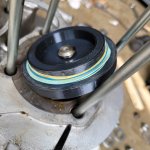
I am trying to make a air pressure fitting with 3D plastic. First attempt I did make something that held 15-30lb or so for a short time, but it's rather sketchy, wish I had some heavy metal milling capability, but no.

20240526_110407.jpg
I did print some M10 fine nuts so I can stop abusing my acorn nuts here.
20240526_110622.jpg
The inside diameter was a little small, rubber bands worked briefly, but then not so much. They tend to squeeze or blow out. Try printing something tighter tonight, with a tapper, hopefully work like a test-tube cork. Having a proper round gasket with a groove probably would help, but my skills at 3D CAD are woefully limited.

I had water in for this short test. Thinking I will try it dry to see if it will pass air. But the main idea is to try and force the fluid down to get to the rust.

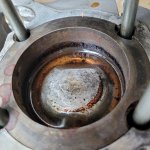
The cleaning vinegar does produce some crude, but I'm not exactly sure what that means. Want to pick up some rust phosphoric stuff and try that.
20240526_102449.jpg
 
Yes, the rust-oleum will do, all these rust removers are based on Phosphoric acid, with some different additives per brand. I like the pressed air route used for pressing the acid through the rust layer, but be careful keeping the pressure relative low and use a pair of safety glasses. Pressure per square inch can be very high, fragmenting the plastic in small pieces when exploding. To avoid this, people use grease, the effect is the same, but safer. Ever pushed out a brake cylinder with pressed air ? There is still a hole in my wooden ceiling (18 mm thick plywood).
 
So on the recommendation of Jensen I have been shopping for phosphoric acid. It's generally not sold outright at the local hardware stores, but I found something called Rust-Oleum Rust Dissolver, $10 for a quart at a local auto-zone store.
The one I've used is Klean Strip Concrete and Metal Prep from Home Depot. The Q&A page claims it is 10–30% phosphoric acid with about 2% alcohols, including 1% isopropyl. They don't specify, but presumably the rest is water. It's $17 for one gallon. (I really have used Coca Cola® for rust removal as well and it does a decent job.)
 
Cheap toilet bowl cleaner works good on gas tanks, but ICR what's in it.
I know some toilet bowl cleaners (e.g., The Works) use HCl (hydrochloric/muriatic acid). I've used muriatic on tanks as well and it's very effective. The upside to phosphoric acid is that it is much safer to handle and much easier on paint or other things that the acid could be working near.
 
Back
Top Bottom